Catalog Optimization
SKU-Level Catalog Enrichment for AI Search: The Ultimate Guide
How to structure product specs, schema, and metadata so AI shopping assistants cite, compare, and convert your SKUs - with platform-specific tactics for ChatGPT, Perplexity, Gemini, and Amazon Rufus.

Gaurav Rawat





Key Takeaways
SKU-level catalog optimization means enriching each product record with complete structured attributes, schema markup, and contextual metadata so AI shopping assistants can accurately parse, compare, and recommend that specific SKU.
80% of sources cited in Google AI Overviews do not rank organically for the query, and even a top-3 organic position offers only an 8% chance of being cited (Onely analysis of 25,000 ecommerce queries), meaning traditional SEO rank does not predict AI visibility - structured product data does.
27% of SKUs fail AI citation eligibility on completeness alone, and 66% of shoppers have abandoned a purchase because product information was missing or inaccurate.
AI referrals converted 31% more than other traffic sources during the 2025 holiday season (Adobe Analytics), making catalog quality a direct revenue lever, not just a discoverability tactic.
Product data improvements show measurable results in AI search citations within 2-4 weeks, while building external authority takes 3-6 months.
SKU-level catalog optimization for AI search is the practice of enriching each individual product record with complete structured attributes, schema markup, and contextual metadata so AI shopping assistants can accurately parse, compare, and recommend that specific SKU. Catalog enrichment at the SKU level is the fastest lever ecommerce teams have today for AI-driven revenue, with measurable citation lift in 2-4 weeks versus 3-6 months for external authority work.
Why AI Shopping Assistants Are Now the Primary Product Discovery Channel
AI platforms now function as the shelf itself, not as a supplementary traffic source. Adobe Analytics data shows AI-driven traffic to US retail sites grew 393% year-over-year in Q1 2026, with December 2025 peaking at 1,151% YoY growth. ChatGPT alone now handles over 84 million shopping-related questions per week in the US across 900 million weekly active users, and 37% of consumers now begin product searches on AI tools rather than traditional search engines.
The scale of this shift demands a different kind of product visibility strategy. McKinsey projects agentic commerce could redirect $3-5 trillion in global retail spend by 2030, and eMarketer projects AI platforms will account for $20.9 billion in retail spending in 2026 alone. Brands that treat AI assistants as a primary shelf - not a niche channel - are positioned to capture a disproportionate share of that spend as it migrates.
The financial stakes are real. AI-referred shoppers convert at up to 14.2% versus Google organic's 2.8%, and AI-driven revenue per visit grew 84% from January to July 2025. Brands without AI-ready catalogs are not just losing visibility - they are losing their highest-converting traffic source to competitors who structured their product data first.
What Is SKU-Level Catalog Optimization and How It Differs from Traditional PDP SEO
Traditional PDP SEO targets keyword rankings. SKU-level catalog optimization targets AI parsability - the ability of an AI engine to read, trust, and cite your product record in a generated answer.
GEO (Generative Engine Optimization) is the broader discipline of making content and product data more likely to be selected and cited by AI-powered search engines, prioritizing structured, trustworthy, and easily interpretable information. SKU-level catalog optimization is GEO applied at the individual product record level - not just the category page, not just the homepage, but each SKU.
The proof that rank and AI visibility are decoupled: 80% of sources cited in Google AI Overviews do not rank organically for the query, and even a top-3 organic position yields only an 8% AI Overview inclusion rate (Onely analysis of 25,000 ecommerce queries). A product page that never appears on the first SERP page can still be the AI's top recommendation - if its data is complete, schema-valid, and contextually rich. For catalog teams that means rank reports stop being a useful proxy for AI visibility; SKU-level data completeness has to be tracked as its own KPI.
The Four Pillars of AI-Ready Product Data
AI citation eligibility is determined by four pillars. Failing any one of them reduces the probability that an AI assistant will recommend your SKU, regardless of how strong the others are.
Pillar 1: Attribute Completeness
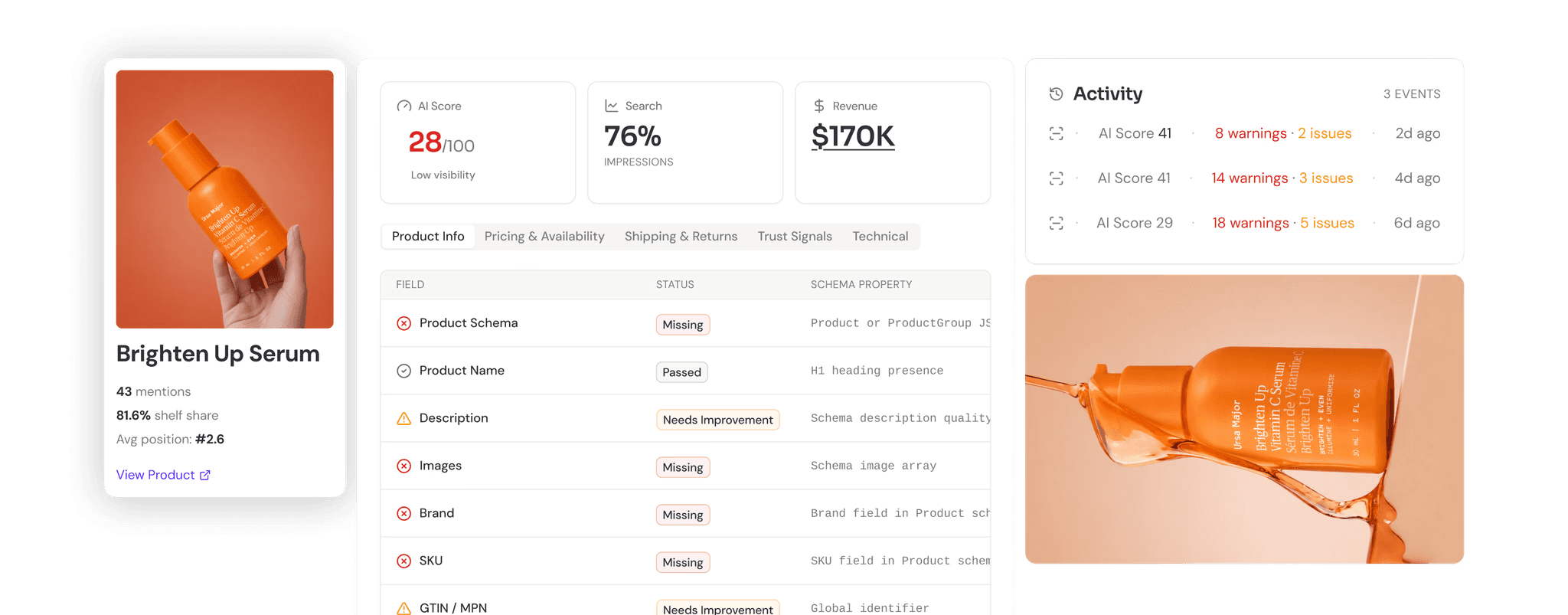
27% of SKUs fail AI citation eligibility on completeness alone, and 23% fail on accuracy. Required fields include dimensions, materials, compatibility, weight, GTIN, MPN, category, price, and availability - all at the individual SKU level. Missing or machine-unreadable fields cause AI shopping agents to skip the product entirely. Treat the minimum viable attribute set as a launch-day requirement, not a backlog item.
Pillar 2: Structured Schema Markup
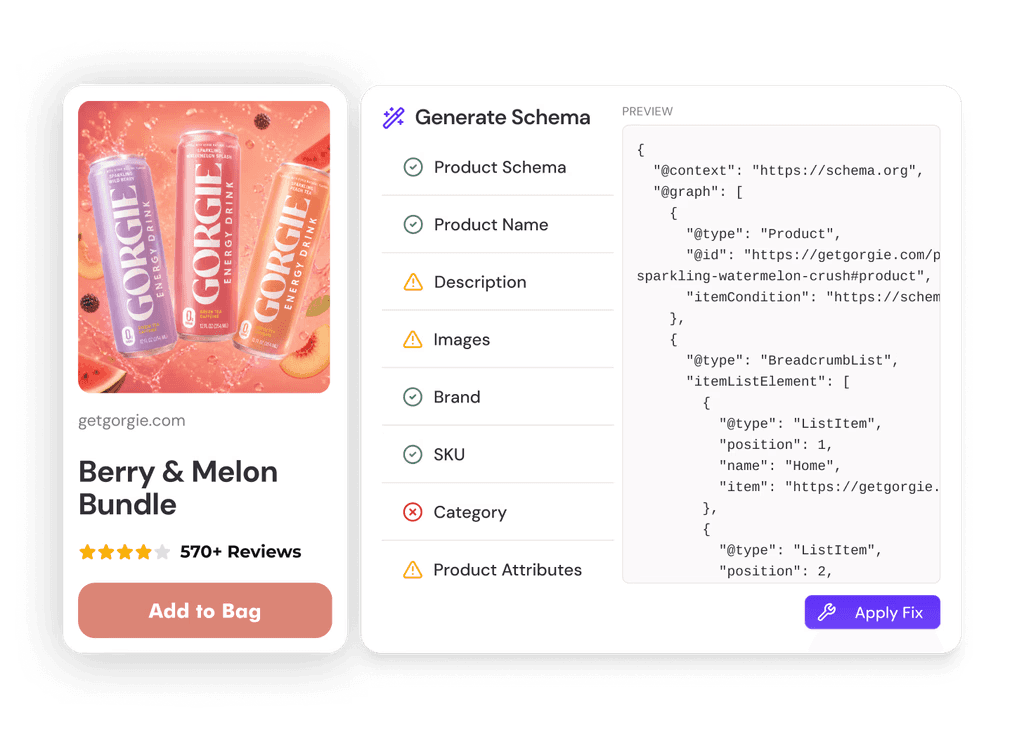
Structured data markup provides a 2.5x citation lift in AI-generated answers, and 71% of pages cited by ChatGPT and 65% cited by Google AI Mode include structured data. At minimum, every PDP needs Product schema, Offer schema, AggregateRating/Review schema, and FAQPage schema. Each must be implemented at the SKU level, server-side rendered as JSON-LD, and validated against the visible page content.
Pillar 3: Conversational Metadata
AI assistants answer conversational queries, not keyword queries. The average ChatGPT prompt is 23 words versus 3.37 words for a traditional Google query, which means product descriptions need to read like answers to natural-language questions. Use-case tags ("best for outdoor use"), activity suitability, and subjective qualifiers ("sturdy," "lightweight," "true to size") all matter as much as objective specs. AI systems pull this contextual language verbatim into their answers.
Pillar 4: Social Proof Signals
Review volume and recency both matter to AI summarization engines, and brand operators consistently report that review depth materially affects whether AI agents recommend their products. The practical implication: prioritize getting new SKUs to five or more reviews within the launch window. Brands that treat review velocity as a catalog health metric - not just a CX metric - gain a measurable AI citation advantage.
The table below shows how each pillar maps to the major AI shopping platforms.
Pillar | ChatGPT / Operator | Perplexity | Google Gemini | Amazon Rufus |
|---|---|---|---|---|
Attribute Completeness | Critical - feeds agentic checkout data | High - used for source verification | Critical - Shopping Graph eligibility | Critical - listing indexing |
Structured Schema | Product + Offer schema required for Operator transactions | Moderate - aids source selection | High - Product schema + Merchant Center feed | N/A - proprietary feed system |
Conversational Metadata | High - FAQ blocks cited in chat answers | Very high - semantically complete pages favored | High - supports AI Mode answers | Very high - subjective/event/activity language weighted |
Social Proof | Moderate | Moderate - cited sources add trust | High - AggregateRating schema weighted | Very high - review volume and recency are primary signals |
Platform-by-Platform Optimization Requirements
Each AI shopping platform has a distinct data model. Optimizing for one does not automatically optimize for another. The table below summarizes the key differences, followed by platform-specific notes.
Platform | Primary Data Source | Schema Requirements | Key Ranking Signals | Top Tactical Priority |
|---|---|---|---|---|
ChatGPT / Operator | Structured product feeds, web crawl | Product, Offer schema; checkout-ready data | Data completeness, feed freshness | Structured product feeds with real-time pricing and availability |
Perplexity | Web crawl with cited sources | Schema aids selection; not required | Semantic completeness, source credibility | Semantically rich PDPs with cited, verifiable claims |
Google Gemini | Shopping Graph (50B listings), Merchant Center | Product + Offer + Review schema critical | Merchant Center feed quality, schema validity | Google Merchant Center feed accuracy and Product schema |
Amazon Rufus | Amazon listing data | Proprietary - no external schema | Subjective attributes, review volume/recency, event suitability | Explicit 'best for' language, event/activity tags, subjective descriptors |
ChatGPT / Operator: ChatGPT Instant Checkout has been live since September 2025 with over 1 million Shopify merchants enrolled. For Operator transactions, structured product feeds with real-time pricing, availability, and complete Product + Offer schema are non-negotiable - agents skip any SKU where checkout-ready data is missing or stale.
Perplexity: With 45 million active users and 780 million+ monthly queries, Perplexity favors pages that are semantically complete and citable. Unlike Google, it surfaces sources directly to users, so the credibility of your product content - ingredient lists, technical specs, use-case context - directly influences whether your page is chosen as a source.
Google Gemini: Gemini pulls from a Shopping Graph of 50 billion listings, which means Google Merchant Center feed quality and Product schema accuracy are the primary levers. Feeds must update in near real-time, and missing AggregateRating data is one of the most common reasons SKUs are excluded from Gemini's Shopping Graph eligibility.
Amazon Rufus: Rufus now surpasses 250 million users and generated $12 billion in incremental sales in 2025. Shoppers who engage it are 60% more likely to buy. Optimizing for Rufus is fundamentally different from optimizing for external AI platforms: it weighs subjective language, event suitability ("best for camping"), and review volume more heavily than schema. Listing copy needs explicit best-for framing and activity tags - not just technical specs.
Step-by-Step Catalog Enrichment Workflow for Enterprise Teams
The following six-step workflow is designed for catalog and commerce ops teams managing large SKU volumes. Each step maps to a specific Nudge capability so every action is operationalizable, not just aspirational.
Audit SKU completeness and accuracy. Run every SKU against a minimum viable attribute checklist. Flag the 27% that fail completeness and the 23% that fail accuracy. Use Nudge Catalog Enrichment to automate this audit across your full catalog and export a prioritized gap report.
Prioritize by revenue and query volume. Do not try to fix everything at once. Identify your highest-revenue SKUs and those appearing in high-volume AI query clusters first. This is where Nudge AI Search Visibility scoring surfaces which products are already being queried - and which are being passed over.
Enrich attribute fields with both objective and subjective descriptors. Populate every required spec field (dimensions, materials, compatibility). Then layer in contextual language: use-case tags, activity suitability, and subjective qualifiers like sturdy or best for beginners. Both types are required for AI parsability.
Implement Product, Offer, Review, and FAQPage schema at the SKU level. Schema must live on the individual product page, not just the category template. Nudge Catalog Enrichment ships governed JSON-LD at scale, eliminating the need for manual developer deployments per SKU.
Add a 5-8 question FAQ block to each PDP. Questions should mirror conversational queries AI users ask: Is this suitable for outdoor use? What size should I order? How does this compare to similar products? Answers must be concise enough for AI engines to quote directly. Nudge Shoppable Funnels aligns FAQ content to the prompt patterns your SKUs are being discovered through.
Accelerate review velocity for new SKUs. Target five or more reviews within the launch window. Volume and recency both matter to AI summarization engines. Treat this as a launch-day catalog requirement, not an afterthought.
The timeline for results is faster than most teams expect. Product data improvements show measurable results in real-time AI searches within 2-4 weeks, while building external authority signals takes 3-6 months. Schema and attribute fixes are the highest-leverage early actions because they directly affect how AI engines parse and verify your records.
How to Measure AI Catalog Performance and Attribute Revenue Impact
The core challenge for enterprise teams is not knowing which catalog changes drove which revenue outcomes. Measuring AI catalog performance requires three distinct layers, each answering a different question.
Layer 1: AI Citation Rate by SKU
Track which products appear in AI-generated answers across ChatGPT, Perplexity, and Google AI Mode. This is the upstream metric - it tells you whether your enrichment work is translating into actual AI recommendations. Nudge's AI Search Visibility platform tracks SKU-level citations across the major AI engines so commerce teams can see which products are winning AI shelf space and which are being skipped.
Layer 2: AI-Referred Traffic Quality
AI-referred visitors are a qualitatively different audience. They arrive further along in their decision process: they are 33% less likely to bounce and convert 31% more than shoppers from other sources. AI-driven revenue-per-visit grew 84% from January to July 2025. Segmenting AI referral traffic in your analytics stack and tracking conversion rate, revenue-per-visit, and return rate separately gives you the clearest signal of catalog quality's downstream impact.
Layer 3: Catalog Health Scoring
Ongoing completeness, accuracy, and schema validity scores per SKU are the operational foundation. Without this layer, enrichment efforts degrade over time as new products are added and existing records drift. Nudge's Catalog Enrichment runs continuous catalog health scoring so teams can catch attribute decay before it suppresses AI visibility.
The cost of not measuring is compounding. Incomplete or inconsistent product data causes 8-12% of revenue to evaporate because customers cannot locate products that actually exist - and that figure does not include the AI visibility penalty that compounds the loss across every channel where AI engines mediate discovery.
Ready to enrich your catalog for AI Shopping? Book a demo!
Frequently asked questions
Which product attributes matter most for AI shopping assistant citations?
Completeness of structured attributes (dimensions, materials, compatibility), subjective descriptors (sturdy, spacious, best for X), schema markup (Product, Offer, Review, FAQPage), and review volume and recency are the highest-signal attributes across ChatGPT, Perplexity, Gemini, and Amazon Rufus.
Does traditional SEO rank predict whether my SKUs appear in AI search results?
No. 80% of sources cited in Google AI Overviews do not rank organically for the query, and even a top-3 organic position yields only an 8% AI Overview inclusion rate (Onely analysis of 25,000 ecommerce queries). AI visibility is driven by data completeness, schema quality, and semantic relevance - not keyword ranking position. A product page that never appears on page one of traditional search results can still be the top AI recommendation if its catalog data is structured correctly.
What schema markup types are required for AI product citations?
At minimum: Product schema (name, description, SKU, brand, image), Offer schema (price, availability, currency), AggregateRating/Review schema, and FAQPage schema for the conversational Q&A block. Each should be implemented at the individual SKU level, not just the category page. Nudge's Catalog Enrichment capability ships governed JSON-LD at scale.
How many product FAQs should each PDP include for AI optimization?
5-8 FAQs per product page is the recommended range. Questions should mirror conversational queries AI users ask - for example, Is this suitable for outdoor use? or What size should I order? Answers must be concise enough for AI engines to quote directly. This content serves dual purpose: it captures long-tail queries and provides structured Q&A that AI can cite verbatim.
Does catalog optimization apply differently to Amazon Rufus vs. Google Gemini?
Yes. Amazon Rufus prioritizes subjective attributes, event and activity suitability, and best-for language in listing copy. Google Gemini pulls from a Shopping Graph of 50 billion listings and weights Google Merchant Center feed quality and Product schema. Both require completeness, but the attribute vocabulary and feed channels differ significantly. The platform table in this guide summarizes the key tactical priorities for each.