Catalog Optimization
Optimizing PDPs for AI Search: A SKU-Level Guide
How to structure every PDP with machine-readable attributes, complete schema markup, and modular copy so AI engines extract, verify, and cite your products in generated recommendations.

Sakshi Gupta





Key Takeaways
AI-referred shoppers convert 4.4x better than organic search visitors (Semrush, 2025), making PDP optimization for AI discovery a direct revenue lever, not a future-proofing exercise.
Pages with structured data are cited 3.1x more often in AI Overviews; deploying Product schema in JSON-LD format is the single highest-ROI fix for most PDPs.
Around 34% of individual product pages cannot be properly accessed by AI (Adobe), meaning catalog-wide attribute gaps are silently costing brands citations and conversions today.
SKU-level AI visibility, tracking which specific products get recommended across ChatGPT, Gemini, and Perplexity, reveals revenue gaps that brand-level AEO metrics completely miss.
Brands should achieve 95%+ attribute completion on their top 50 SKUs by revenue before scaling optimization across the full catalog.
Optimizing product detail pages for AI search means structuring every SKU with machine-readable attributes, complete schema markup, and modular copy so AI engines can extract, verify, and cite your products in generated recommendations. Brands that do this now are already capturing AI-referred traffic that converts at multiples of traditional organic search.
Why AI Search Has Made PDP Optimization Non-Negotiable in 2026
AI-generated results now appear for over 91% of ecommerce queries, yet only 0.3% of AI Overviews include ecommerce sources. That gap between ubiquity and inclusion defines the PDP optimization opportunity right now.
The scale of the shift is hard to overstate. Shopping queries on AI platforms grew 4,700% between 2024 and 2025. Traffic to retail sites from generative AI tools increased 693.4% during the 2025 holiday season, and in the first three months of 2026, AI-sourced traffic to U.S. retail sites grew 393% year over year. Meanwhile, 58% of consumers now use generative AI tools like ChatGPT instead of search engines for product recommendations.
Quality of AI traffic has also improved sharply. Adobe found that AI traffic converted 42% better than non-AI customers in March 2026, a complete reversal from March 2025 when AI traffic converted 38% worse. AI-referred shoppers also spend 45% more time on-site and view 13% more pages per visit. The conclusion is straightforward:
AI discovery is now a primary revenue channel, and traditional PDP copy built for keyword ranking does not clear the bar AI engines require for citation.
How AI Engines Actually Decide Which Products to Recommend
AI recommendation works in three sequential stages: Recognition, Verification, and Selection. A product that fails any stage is excluded from the AI response, regardless of how well it ranks in organic search.
Recognition: Can the model identify the product from structured signals? This depends on GTIN, brand, model name, and schema markup being present and parseable.
Verification: Do the attributes on the page confirm what the schema declares? Mismatches between structured data and visible content reduce citation confidence.
Selection: Does the offer beat alternatives on availability, price, reviews, and policy clarity? AI engines actively compare competing products before selecting which to cite.
Query format matters significantly for triggering AI summaries. Single-word queries trigger AI summaries only around 15% of the time, while 10-word conversational queries trigger them roughly 68% of the time. This means PDPs need to cover conversational attribute patterns, not just head keywords. Notably, 80% of products appearing in Google AI Overviews do not rank in the top 10 organic results, confirming that AI visibility and SEO rank are separate outcomes requiring separate tactics.
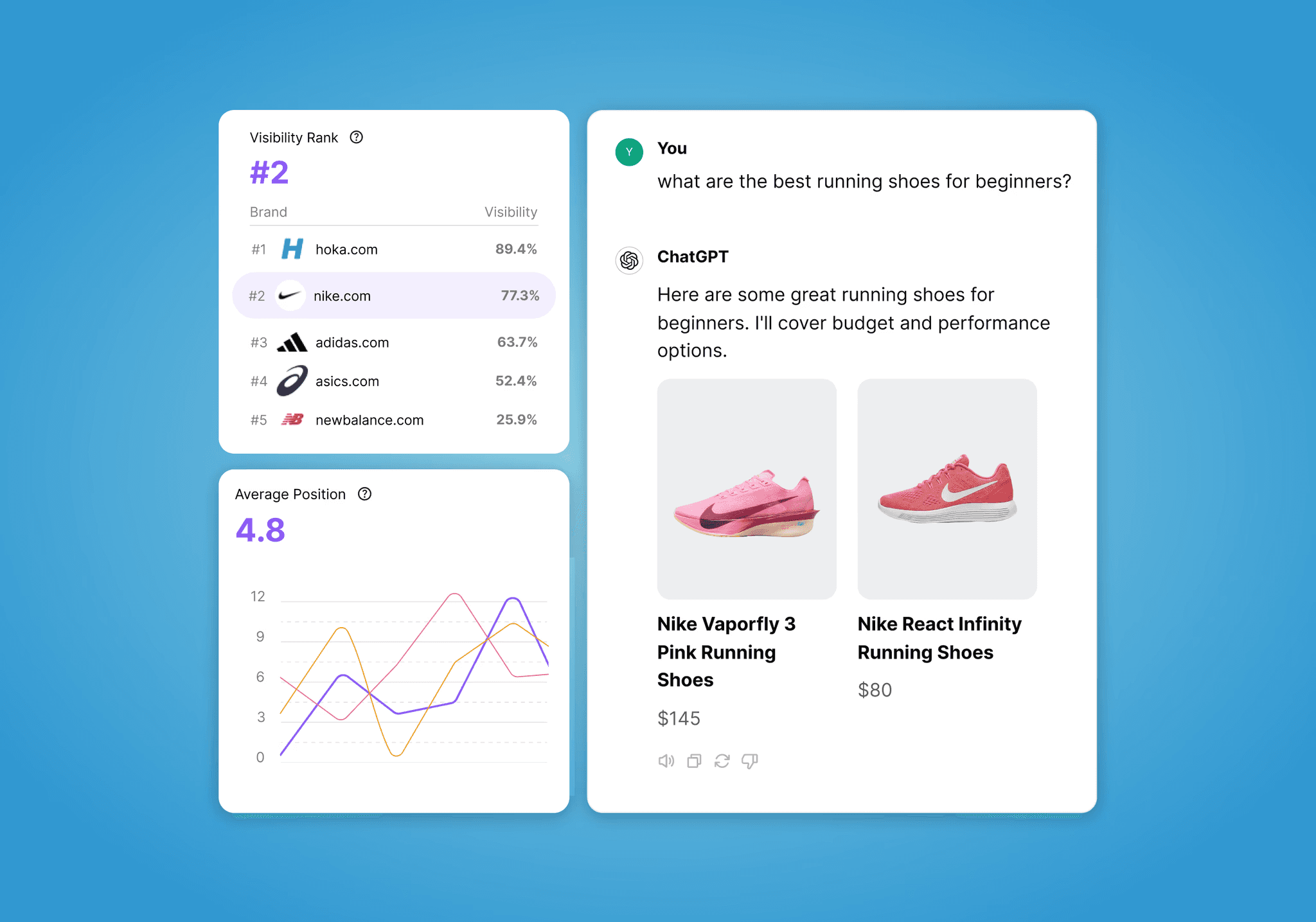
This is also why brand-level AEO, which only confirms whether a brand name appeared in an AI response, is insufficient. SKU-level AI visibility tracks every individual product across ChatGPT, Gemini, and Perplexity with revenue attribution, revealing exactly which products are winning or losing AI shelf space. Nudge's AI search visibility platform is built specifically for this granularity.
The SKU-Level Attribute Stack: What AI Engines Actually Extract
AI engines extract four distinct attribute layers from every product page. Missing any one layer reduces citation eligibility, and around 34% of individual product pages cannot be properly accessed by AI, typically because one or more layers are incomplete.
Attribute Layer | Key Data Points | Schema Property | Highest-Weight Platforms |
|---|---|---|---|
Core Identifiers | GTIN, MPN, brand, model name | Product: gtin, mpn, brand, name | Google AI Overviews, Perplexity |
Functional Specs | Materials, dimensions, compatibility, variants | Product: description, additionalProperty | ChatGPT, Gemini, Perplexity |
Commercial Signals | Price, availability, shipping time, return policy | Offer: price, availability, hasMerchantReturnPolicy | Google AI Mode, Perplexity Shopping |
Social Proof | Review count, average rating, UGC | AggregateRating: ratingValue, reviewCount | All major AI platforms |
Social proof deserves particular attention as a commercial priority. Data shows a 161% higher conversion rate for shoppers who see UGC, and even 10 reviews drive a 53% uplift in sales. AggregateRating schema makes this data machine-readable and citation-eligible, turning your review count into a direct AI ranking signal. Review schema is not an SEO nicety, it is a revenue driver at the SKU level.
Schema Markup and Structured Data: The Technical Foundation for AI Citations
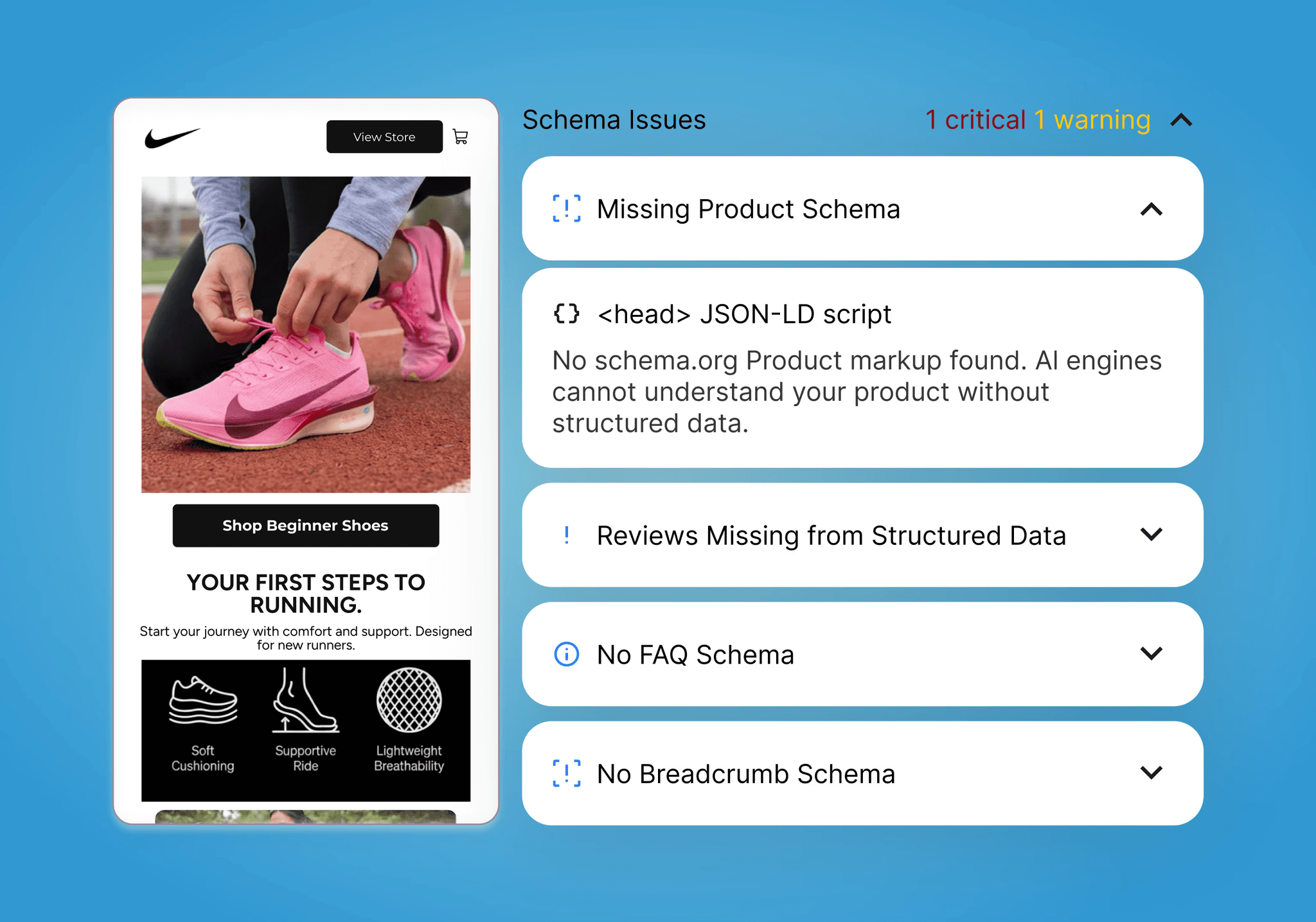
Pages with structured data are cited 3.1x more often in AI Overviews, and both Google and Microsoft confirmed in 2025 that they use schema markup for their generative AI features. Deploying Product schema in JSON-LD is the single highest-ROI technical fix available to most catalog teams today.
JSON-LD is the correct implementation format. It holds 89.4% market share among structured data formats because it aligns with how AI crawlers process information, sitting in the document head rather than embedded in HTML markup. The minimum viable Product schema block for AI citation includes:
Product: name, description, image, brand, sku, gtin
Offer: price, priceCurrency, availability, url
AggregateRating: ratingValue, reviewCount
One frequently overlooked technical decision is crawler access control. Brands can block GPTBot, which collects training data, while separately allowing OAI-SearchBot, which drives search referrals. Sites that allow key AI search crawlers see approximately 5,000 AI search visits and $15,000 in AI-attributed revenue monthly. Blocking both crawlers indiscriminately sacrifices that revenue without any benefit. Review your robots.txt configuration against this distinction before any other technical work. For a deeper look at common schema errors that suppress SKU visibility, see Nudge's guide on product schema mistakes affecting AI visibility.
Content Structure and Copy: Writing PDPs That AI Engines Can Extract and Quote
AI engines pull discrete, self-contained content blocks rather than reading pages linearly. PDPs structured as long narrative paragraphs are systematically disadvantaged compared to modular, labeled content. GPT-4 improves its performance from 16% to 54% with structured content, and a Princeton University study found GEO can boost content visibility in AI responses by up to 40%.
Apply these five structural rules to every PDP template:
Lead with a 40-word direct-answer description that names the product, its primary use case, and its key differentiator. This is the block AI engines are most likely to quote directly.
Use labeled bullet-format feature lists with explicit attribute labels (e.g., Material: 100% organic cotton, Weight: 320g) rather than prose paragraphs. Labels map cleanly to schema additionalProperty fields.
Embed a FAQ section on every PDP targeting 8-10 word conversational queries such as "What size should I order if I am between sizes?" These match the query formats that trigger AI summaries 68% of the time.
Use descriptive, stable image file names and factual alt text that matches schema image declarations. Mismatches between alt text and schema reduce AI confidence in the page.
Ensure the H1 contains the product name plus one primary use-case keyword. This is the first signal AI crawlers use to classify the page type and product category.
Catalog-Scale Implementation: Prioritization, Governance, and Measurement
Page-by-page optimization breaks down at thousands of SKUs. Enterprise catalog teams need a governed, phased rollout that delivers measurable AI citation lift without requiring manual effort per product. The revenue stakes justify the infrastructure: AI-driven revenue per visit was up 254% during the 2025 holiday season, and Amazon Rufus surpassed 300 million users and generated nearly $12 billion in incremental annualized sales during 2025.
Execute catalog optimization in three phases:
Phase 1 - Revenue-first audit: Identify your top 50 SKUs by revenue. Achieve 95%+ attribute completion across all four attribute layers before touching the rest of the catalog. This concentration delivers disproportionate AI citation lift where it matters most financially.
Phase 2 - Template governance at category scale: Enforce PDP template standards across category clusters using a governed data model integrated with your PIM. Attribute completeness rules, schema validation, and copy structure should be enforced at the template level, not managed SKU by SKU.
Phase 3 - SKU-level AI visibility tracking: Deploy measurement infrastructure that tracks citation share, AI-referred traffic, and revenue attribution at the individual product level. This is the feedback loop that tells you which optimizations are working and where gaps remain.
Metric | What It Measures | Why It Matters |
|---|---|---|
AI citation rate per SKU | How often a specific product appears in AI-generated responses | Reveals which products have AI shelf space and which are invisible |
AI-referred conversion rate | Purchase rate of visitors arriving from AI platforms | Validates that AI traffic quality justifies optimization investment |
Revenue per AI visit | Average revenue generated per AI-referred session | Enables ROI calculation for catalog optimization spend |
Attribute completion score | Percentage of required attributes populated per SKU | Leading indicator of citation eligibility before traffic data arrives |
Nudge unifies all three phases in a single governed suite. The catalog optimizer enforces attribute completeness and schema standards at scale, while the AI search visibility platform tracks SKU-level citations and revenue attribution across ChatGPT, Gemini, and Perplexity. Commerce teams get a single view from attribute gap to AI-attributed revenue, rather than stitching together separate tools for each phase.
Agentic Commerce: Preparing PDPs for the Next Phase of AI Shopping
McKinsey projects agentic commerce could drive $3-5 trillion globally by 2030, with AI agents potentially capturing 10-20% of ecommerce revenue. Brands that complete attribute and schema work now are automatically better positioned for agent-led transactions, because agents make purchase decisions on declared structured data.
Three requirements make a PDP agentic-ready:
In-chat checkout compatibility: The primary AI shopping surfaces are already transactional. Perplexity processes purchases via PayPal, Google AI Mode supports Shopify checkout, and ChatGPT surfaces Shopify Catalog products directing buyers to the merchant store. Brands not connected to these surfaces are invisible to agents regardless of PDP quality.
Real-time inventory and pricing accuracy in schema: Agents act on declared data. A product with stale availability or incorrect pricing in its Offer schema will be deprioritized or skipped entirely. Schema freshness is now an operational requirement, not a nice-to-have.
Policy completeness as a selection signal: Returns, shipping timelines, and warranty terms are active signals agents use to rank competing offers. Incomplete policy data is a competitive disadvantage at the moment of agent-led purchase decision.
The SKU-level catalog work described throughout this guide is the foundation for agentic readiness. There is no separate agentic optimization track - it is the same attribute completeness, schema accuracy, and policy clarity work, now with purchase consequences attached. Nudge's shoppable funnels are designed to bridge the gap between AI citation and in-chat conversion as these surfaces mature.
Ready to optimize your PDPs for AI Search? Book a demo!
Frequently asked questions
What is the most important PDP change for AI search visibility?
Implementing complete Product schema in JSON-LD with all core attributes (GTIN, price, availability, aggregateRating) is the single highest-impact change. Pages with structured data are cited 3.1x more often in AI Overviews, according to data confirmed by both Google and Microsoft in 2025. Start with your top revenue SKUs and validate schema completeness before any copy changes.
Which product attributes matter most for AI shopping recommendations?
The four layers AI engines extract are: core identifiers (GTIN, brand, model), functional specs (materials, dimensions, compatibility), commercial signals (price, availability, return policy), and social proof (review count, rating). Missing any layer reduces citation eligibility. Around 34% of individual product pages cannot be properly accessed by AI, typically because one or more of these layers is incomplete or unparseable.
How should enterprise teams prioritize catalog optimization at scale?
Start with the top 50 SKUs by revenue and achieve 95%+ attribute completion before scaling. Then enforce PDP template standards across category clusters using PIM-integrated governance. Finally, deploy SKU-level AI visibility tracking to measure citation share and revenue attribution per product. This phased approach delivers disproportionate revenue impact early while building the infrastructure for full-catalog coverage.
Does blocking AI crawlers hurt product visibility in AI search results?
Blocking GPTBot, which collects training data, does not hurt AI search visibility. Brands should allow OAI-SearchBot, which drives search referrals, separately. Sites that allow key AI search crawlers see approximately 5,000 AI search visits and $15,000 in AI-attributed revenue monthly. Review your robots.txt to ensure you are not inadvertently blocking search referral crawlers alongside training crawlers.
How do reviews and UGC affect AI product recommendations?
Review count and average rating are active selection signals for AI engines. Data shows a 161% higher conversion rate for shoppers who see UGC, and even 10 reviews can drive a 53% uplift in sales. AggregateRating schema makes this data machine-readable and citation-eligible, turning your review volume into a direct AI ranking signal rather than just a social proof element for human visitors.