Catalog Optimization
7 Schema Markup Types That Get Products Cited by AI
A data-backed guide for ecommerce teams on the structured data signals that drive citations on ChatGPT, Perplexity, Google AI Overviews, and Gemini in 2026.

Sakshi Gupta





Key Takeaways
71% of pages cited by ChatGPT include structured data, yet only 18% of ecommerce product pages have complete schema markup, making implementation a clear competitive gap.
Product schema combined with AggregateRating schema makes products 3x more likely to appear in AI-generated recommendations than basic markup alone.
FAQPage markup makes pages 3.2x more likely to appear in Google AI Overviews, and sites adding FAQ blocks saw a 44% increase in AI search citations (BrightEdge).
Schema markup must be server-side rendered in JSON-LD format. AI crawlers do not execute JavaScript, and hidden schema with no visible on-page counterpart is ignored by all tested AI systems.
Traditional SEO rank is a poor proxy for AI citation: 54% of brands that rank well on Google are never cited by AI, and 80% of products in AI Overviews do not rank in the top 10.
Schema markup is now the core infrastructure separating brands that get cited by AI from those that are invisible to it. The seven schema types covered in this guide, deployed in the correct order and format, give AI systems the machine-readable signals they need to surface, verify, and recommend your products.
Why Schema Markup Is Now Core Infrastructure for AI Discovery
AI-referred sessions jumped 527% between January and May 2025, and online shopping traffic from generative AI grew 4,700% year over year in July 2025. ChatGPT Shopping now processes 50 million queries daily. The channel shift is not coming. It is already here.
The core tension for ecommerce teams: 54% of brands that rank well on Google are never cited by AI, and 80% of products in AI Overviews do not rank in the top 10. Traditional SEO rank is a poor proxy for AI citation. Schema markup is the new competitive moat because it gives AI systems the structured, machine-readable signals they need to verify and recommend your products with confidence.
The Foundation Rule: Server-Side JSON-LD or It Does Not Count
Before implementing any schema type, one technical prerequisite is non-negotiable: your schema must be server-side rendered in JSON-LD format. JSON-LD holds 89.4% market share among structured data formats because it aligns with how AI crawlers process information. AI parsing success is 94% for static HTML with schema, dropping to 23% for JavaScript-rendered content.
Two rules govern every schema type below. First, AI systems do not wait for JavaScript execution, so if your JSON-LD loads dynamically through client-side JavaScript, AI crawlers will never parse it. Second, and critically: hidden JSON-LD with no visible on-page counterpart is ignored by all tested AI systems. Every schema field must mirror content a user can actually see on the page. Microdata and RDFa are not recommended for AI optimization.
#1 Product Schema: The Non-Negotiable Starting Point
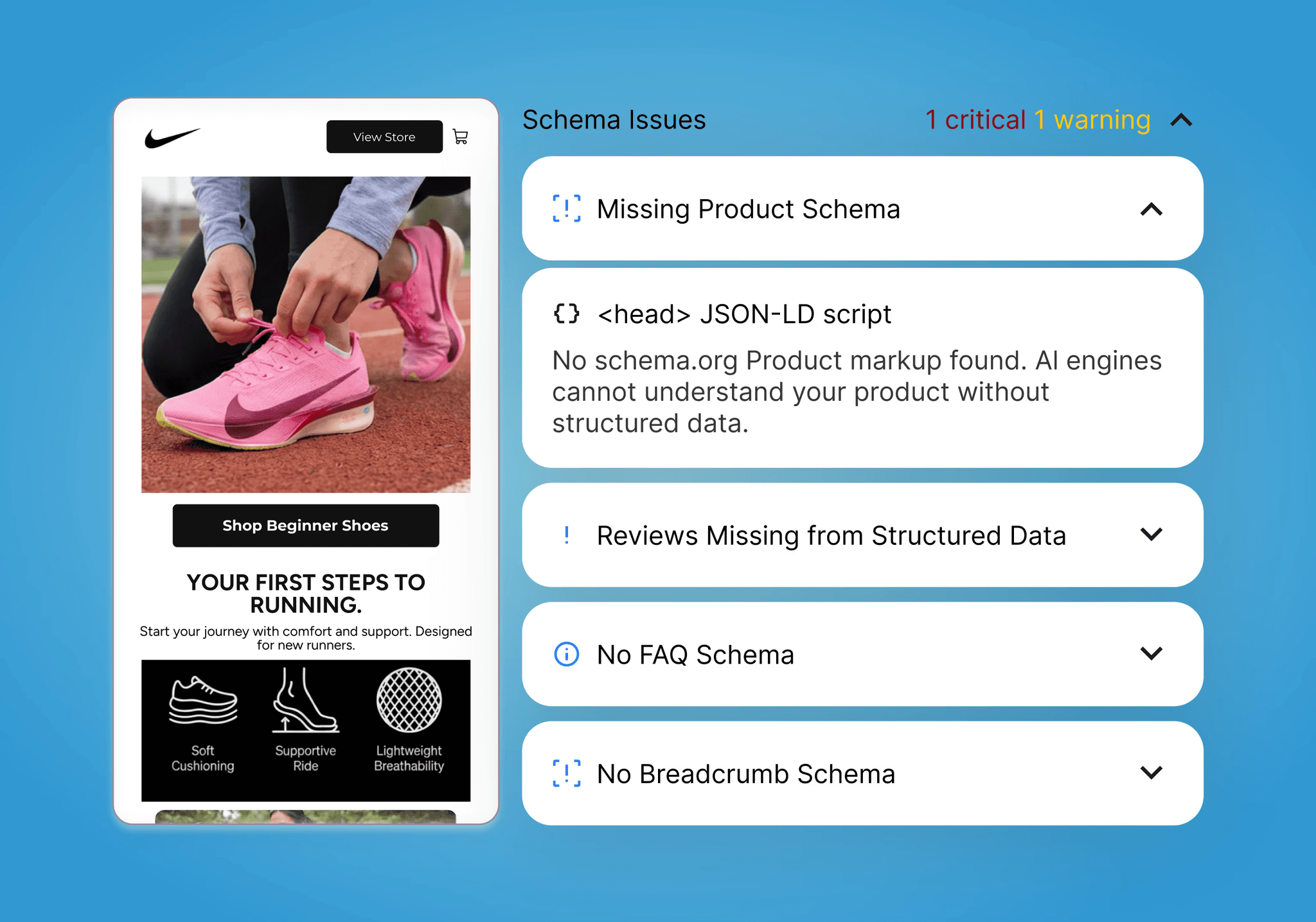
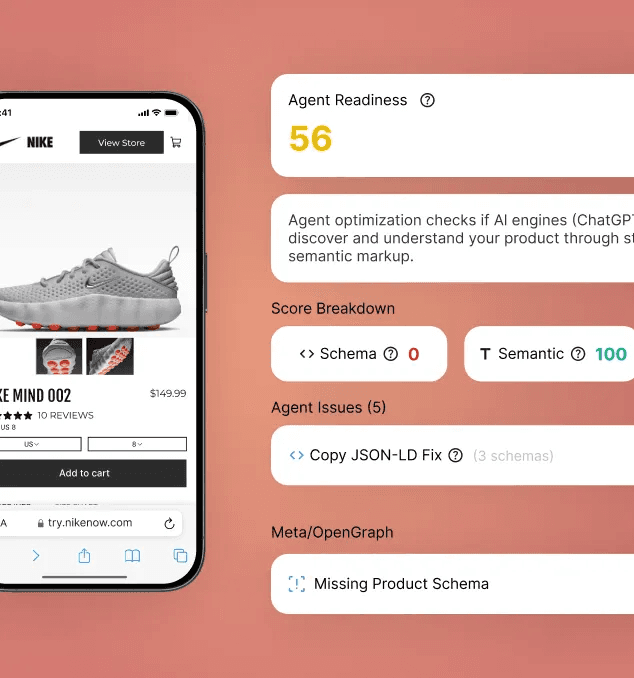
Product schema is the single highest-priority type for ecommerce AI citations. Only 18% of ecommerce product pages have complete schema markup, and 61.7% of ecommerce searches now trigger AI Mode shopping features. That gap is your opportunity.
The critical fields AI systems extract from Product schema are: name, description, brand, GTIN/MPN, price, priceCurrency, availability, and url. Missing even one of these fields reduces citation eligibility. ChatGPT confirmed in November 2025 that it uses structured data to determine which products appear in its Shopping results.
For enterprise catalogs with thousands of SKUs, implementing and maintaining complete Product schema manually is not viable. Nudge's SKU-level catalog optimizer automates complete Product schema deployment at scale, ensuring every field is populated, server-side rendered, and mapped to visible on-page content across your entire catalog.
#2 AggregateRating Schema: The Trust Signal AI Systems Prioritize
Product schema paired with AggregateRating makes products 3x more likely to appear in AI-generated recommendations than basic markup alone. AI systems use review signals as a credibility proxy. Without AggregateRating, even a perfectly implemented Product schema underperforms.
Required fields are: ratingValue, reviewCount, and bestRating. All three must reflect values visible on the product page. The revenue case for getting this right is direct: traffic to ecommerce sites from ChatGPT converts at 11.4% versus 5.3% from organic search. AI-referred visitors arrive with higher intent, and trust signals are what earn the citation in the first place.
#3 FAQPage Schema: Highest Citation Rate Per Implementation Effort
FAQPage markup makes pages 3.2x more likely to appear in Google AI Overviews, and a BrightEdge study found a 44% increase in AI search citations for sites implementing FAQ blocks. This is the highest citation rate per implementation effort of any schema type.
An important clarification: since August 2023, Google restricted FAQ rich results to government and health sites only. However, AI systems extract FAQ content independently of rich result eligibility. The dual-layer mechanism still works fully for AI Overviews, ChatGPT, and Perplexity.
Correct implementation requires three practices: Q&A pairs must mirror visible on-page content, questions should match natural language query patterns used on ChatGPT and Perplexity, and each answer should be self-contained and under 50 words for direct AI extraction. Answers that require reading surrounding context are less likely to be cited verbatim.
#4 Organization and BreadcrumbList Schema: Entity Authority Signals
Organization schema establishes brand entity identity that AI systems use for citation confidence scoring. Without it, AI systems cannot reliably resolve who is behind the content, reducing citation probability regardless of how good your Product schema is.
Key Organization fields: name, url, logo, contactPoint, and critically, sameAs links pointing to your LinkedIn, Wikidata, and Crunchbase profiles. The sameAs field is how AI systems cross-reference your entity across sources to verify legitimacy. Fabrice Canel, principal product manager at Microsoft Bing, confirmed in March 2025 that schema markup helps Microsoft's LLMs understand content for Copilot, and Microsoft's NLWeb initiative is built entirely on structured data for conversational AI interfaces. Entity resolution is platform-agnostic.
BreadcrumbList schema helps AI systems understand site hierarchy and content relationships, improving context verification when an AI system is deciding whether your page is the authoritative source for a query. Together, Organization and BreadcrumbList form the entity layer that makes all other schema types more credible.
#5 Article and Person Schema: Freshness and Expertise Signals
Article and Person schema signal freshness and expertise, two of the strongest predictors of AI citation. 85% of AI Overview citations were published in the last two years, 44% from 2025, and 50% of Perplexity citations are content published in 2025 alone. If your content does not signal recency through schema, AI systems default to newer sources.
Article schema fields that matter for AI citations: datePublished, dateModified, author, headline, and publisher. Pair with Person schema fields: name, jobTitle, worksFor, sameAs (linking to LinkedIn and other professional profiles), alumniOf, and hasCredential. GPT-5's accuracy improves from 16% to 54% when content relies on structured data. Authorship and freshness signals are part of that structure, not an afterthought.
#6 HowTo Schema: Procedural Query Capture
HowTo schema captures instructional and comparison queries, a fast-growing query type on Perplexity and ChatGPT. When users ask how to choose, compare, or use a product category, HowTo-marked pages have a structured advantage because AI systems can extract step-level answers directly.
Required fields: name, step (with name and text for each individual step), totalTime, and supply or tool where relevant. Each step should be self-contained and match visible on-page content. Like FAQPage, HowTo rich results are restricted by Google for most sites, but AI extraction still functions fully when schema mirrors visible content. HowTo schema increases the surface area for citation by giving AI systems discrete, extractable answer units rather than requiring them to parse unstructured prose.
#7 Offer and ItemList Schema: Catalog-Level AI Visibility
Offer schema, nested within Product, adds the pricing context AI shopping surfaces require: price, priceCurrency, availability, priceValidUntil, and seller identity. ChatGPT Shopping and Perplexity Shopping explicitly surface these fields in product cards. Without Offer schema, your product may be cited in text but excluded from shoppable AI product carousels.
ItemList schema enables AI systems to understand product collections, category pages, and curated sets as structured entities rather than unrelated pages. This is how category-level queries get matched to your catalog at scale. Only about 12.4% of websites use any structured data at all, making complete Offer and ItemList implementation a significant differentiator for brands willing to do the work.
Managing Offer and ItemList schema across thousands of SKUs requires automation. Nudge's catalog optimizer handles Offer and ItemList schema deployment at enterprise scale, with SKU-level monitoring to catch schema drift as prices, availability, and catalog structure change. For teams evaluating options, the key criteria are server-side rendering, field-level completeness, and integration with your existing commerce platform.
Implementation Priority Matrix: Which Schema to Deploy First
Deploy schema in tiers based on AI citation impact and implementation complexity. The table below gives ecommerce teams a clear sequencing framework.
Tier | Schema Types | Timeline | Primary AI Signal |
|---|---|---|---|
Tier 1 | Product + AggregateRating + Offer | Deploy immediately | Product citation eligibility and shoppable surface inclusion |
Tier 2 | FAQPage + Organization + BreadcrumbList | Deploy within 30 days | Citation rate lift and entity authority verification |
Tier 3 | Article + Person + HowTo + ItemList | Deploy within 90 days | Freshness, expertise, and procedural query capture |
Validation Steps After Each Deployment
Run Google Rich Results Test to validate syntax and field completeness for each schema type.
Confirm JSON-LD is server-side rendered by checking page source (not browser-rendered DOM) for your schema blocks.
Verify every schema field has a visible on-page counterpart. Any field with no visible content equivalent will be ignored by AI systems.
Monitor for schema drift at the SKU level as prices, availability, and catalog structure change. Stale schema is worse than no schema for Offer fields.
For ongoing citation tracking and SKU-level schema monitoring at enterprise scale, Nudge's Agentic Commerce provides the observability layer that most schema tools lack. Knowing your schema is valid is different from knowing whether it is driving AI citations. Both matter.

Frequently asked questions
Does schema markup directly cause AI systems to cite my products?
Schema is a strong signal but not a guarantee. Research shows 71% of ChatGPT-cited pages use structured data, yet a December 2024 study from Search/Atlas found no direct correlation at scale between schema coverage and citation rates. Schema improves citation probability by making content machine-readable and verifiable, but it must be paired with authoritative, visible on-page content. Schema without quality content is insufficient.
Which single schema type has the biggest impact on AI citations?
Product schema combined with AggregateRating is the highest-impact combination for ecommerce. Products with both are 3x more likely to appear in AI recommendations. For informational content, FAQPage schema delivers the highest citation rate per implementation effort, with pages using it being 3.2x more likely to appear in Google AI Overviews.
What format should I use for schema markup: JSON-LD, Microdata, or RDFa?
JSON-LD is the correct choice. It holds 89.4% market share among structured data formats, aligns with how AI crawlers process information, and must be server-side rendered. Microdata and RDFa are not recommended for AI optimization. If your JSON-LD loads through client-side JavaScript, AI crawlers will not reliably parse it.
Can I block AI training crawlers while still getting AI search citations?
Yes. Block GPTBot, which collects training data, while allowing OAI-SearchBot, which handles search referrals, in your robots.txt. These are separate crawlers with separate functions. Sites that correctly configure crawler access to allow AI search bots see meaningful AI search traffic and revenue attribution monthly without contributing to training data collection.
How do I know if my schema is being read by AI crawlers?
Use Google Rich Results Test to validate syntax, confirm JSON-LD is server-side rendered by checking page source rather than the browser-rendered DOM, and verify every schema field has a visible on-page counterpart. Hidden schema with no visible content equivalent is ignored by all tested AI systems. For ongoing monitoring, Nudge provides SKU-level schema validation and AI citation tracking through its AI Search Visibility platform.