AEO & GEO
Generative Engine Optimization for Ecommerce Companies: The Ultimate Guide
How enterprise commerce brands with thousands of SKUs can earn AI citations on ChatGPT, Perplexity, and Google AI Overviews - and convert that visibility into revenue.

Kanishka Thakur





Key Takeaways
GEO (Generative Engine Optimization) is the practice of structuring content and product data so AI engines like ChatGPT, Perplexity, and Google AI Overviews cite your brand in their responses - and specific tactics can boost AI visibility by up to 40% (GEO-Bench, KDD 2024).
AI-referred traffic to U.S. retail sites grew 1,300% YoY in Q4 2024, and shoppers arriving from AI sources are 38% more likely to buy than those from traditional channels (Adobe; eMarketer 2025).
For large catalogs, GEO requires SKU-level structured data, schema markup, and prompt-aligned product descriptions - not just site-wide SEO - because LLMs cite only 2-7 domains per response.
85% of brand mentions in AI answers come from third-party pages, so enterprise GEO strategy must combine on-catalog optimization with earned media and authoritative external citations.
Agentic commerce protocols (OpenAI ACP, Google UCP) mean catalog data quality and structured feeds will determine whether AI agents can complete purchases on your behalf by 2026.
Generative Engine Optimization (GEO) is the discipline of making your content and product data citable by AI engines - not just rankable by traditional search. For enterprise brands managing thousands of SKUs, this is no longer optional: AI-referred traffic to U.S. retail sites surged 1,300% year-over-year in Q4 2024, and the brands earning those citations are pulling ahead fast.
What Is Generative Engine Optimization - and Why Does It Hit Differently for Large Catalogs?
GEO is the practice of optimizing content and structured product data to appear as citations in AI-generated responses from platforms like ChatGPT, Perplexity, Google AI Overviews, and Claude. Unlike traditional SEO - which targets keyword rankings in a list of ten blue links - GEO targets a far more concentrated environment: LLMs cite only 2-7 domains per response. That compression changes everything for large catalog brands.
Their GEO-Bench framework tested optimization tactics across 10,000 queries and found that targeted strategies could boost AI visibility by up to 40%. For a brand with 10,000 or 50,000 SKUs, that uplift potential is enormous - but only if optimization is applied systematically at the product level, not just at the homepage or category level.
The catalog-specific challenge is operational scale. A boutique brand can manually rewrite 200 product descriptions. A retailer with 50,000 SKUs cannot. GEO for large catalogs requires systematic tooling, schema templates, and prompt-aligned content workflows - not one-off edits. Nudge's catalog optimizer is built specifically for this challenge, giving commerce teams a single system of record for AI-driven discovery across every SKU.
How Big Is the AI Shopping Shift - and What Is at Stake If You Ignore It?
The consumer shift to AI-driven discovery is already material and accelerating. 58% of consumers have replaced traditional search engines with Gen AI tools for product recommendations (Capgemini 2025), and according to Salesforce's Connected Shoppers Report, 39% of all consumers - and over half of Gen Z - already use AI for product discovery. These are not early adopters anymore. They are mainstream shoppers.
The revenue quality of AI-referred traffic is equally compelling. Adobe data shows these shoppers have 32% longer visits, 27% lower bounce rates, and AI-driven revenue-per-visit grew 84% from January to July 2025. Shoppers arriving from AI services are 38% more likely to buy than those from traditional channels (eMarketer 2025). High intent, low friction, strong conversion - this is the traffic profile every commerce team wants.
Looking further ahead, McKinsey projects agentic commerce could redirect $3-5 trillion in global retail spend by 2030, with nearly $1 trillion from the U.S. alone. OpenAI's Agentic Commerce Protocol (ACP) - launched alongside the 'Buy it in ChatGPT' feature co-developed with Stripe - and Google's Universal Commerce Protocol (UCP) are the infrastructure signals that catalog data quality will determine who participates in autonomous transactions. Brands that ignore GEO now will not just lose citations; they will be structurally excluded from agentic commerce.
GEO vs. SEO: What Changes When You Have 10,000+ SKUs?
SEO rank does not equal AI visibility. Only 17-38% of AI Overview citations come from top-10 Google organic results, according to Ahrefs and BrightEdge research. That means a brand can dominate traditional search and still be invisible in AI-generated answers - and vice versa. The table below maps the five most critical differences.
Dimension | Traditional SEO | GEO for Large Catalogs |
|---|---|---|
Optimization unit | Page | SKU / entity |
Ranking signal | Backlinks and keywords | Structured data, trust signals, fact density |
Content format | Keyword-optimized copy | Answer-first, stat-dense, schema-backed descriptions |
Measurement | Rank position, organic traffic | Citation share, prompt coverage, AI-referred revenue |
Scale challenge | Manageable for most sites | Exponential without systematic tooling |
The scale challenge is the defining issue. At 10,000+ SKUs, manual GEO is impossible. Teams need systematic workflows: schema templates applied at the product-type level, automated prompt-testing to surface citation gaps, and content rules that enforce answer-first structure across every new product listing. This is precisely the operational gap that purpose-built platforms like Nudge address - explore the catalog optimization for AI platforms guide for a deeper implementation walkthrough.
The 6-Step GEO Framework for Enterprise Catalog Teams
The following six steps form a sequential implementation framework. Work through them in order: early steps create the foundation that makes later steps effective.
Step 1: Audit AI citation gaps. Run systematic prompt tests across ChatGPT, Perplexity, and Google AI Overviews for your highest-revenue categories and SKUs. Identify which products appear in AI responses, which competitors are cited instead, and which query types return no brand mention at all. This audit defines your GEO gap and sets the baseline for measuring progress. Nudge's AI search visibility platform automates this monitoring at catalog scale.
Step 2: Enrich product data with answer-first descriptions. Rewrite product descriptions so the primary benefit appears in the first 40-60 words - the window AI engines extract for citations. Include factual claims, specifications, and use-case language every 150-200 words to maintain the fact density that LLMs reward. Avoid keyword stuffing; write for a question-answering model, not a keyword index.
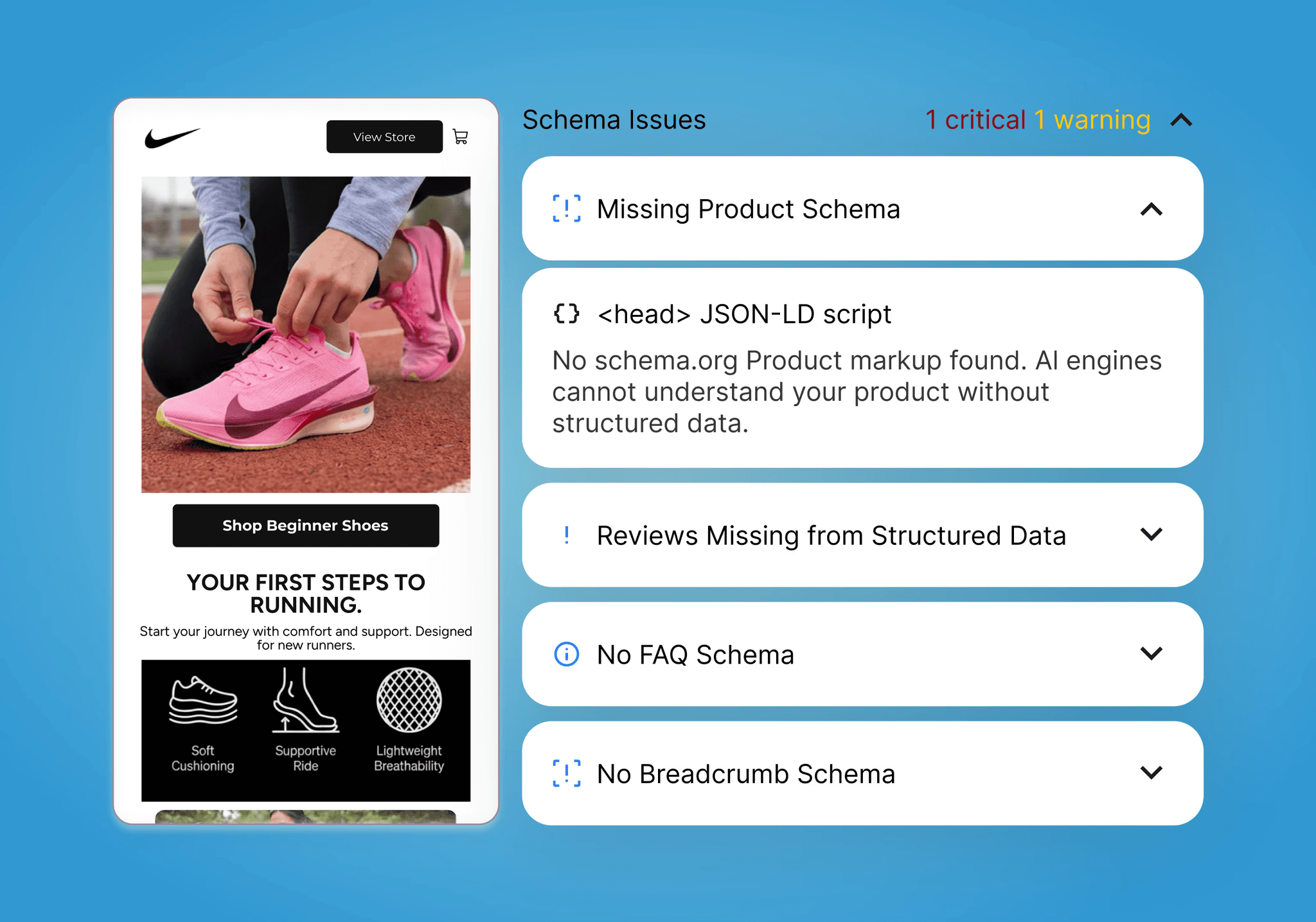
Step 3: Implement structured data at SKU level. SE Ranking found that 71% of ChatGPT-cited pages and 65% of Google AI Mode-cited pages include structured data. Deploy Product, Offer, Review, and BreadcrumbList schema as the minimum stack for every SKU. Apply schema at the template level so new products inherit it automatically - do not treat schema as a manual per-page task at catalog scale.
Step 4: Build topical authority through category content clusters. AI engines build entity graphs of your catalog. Support that graph with category-level content - buying guides, comparison articles, and use-case explainers - that positions your brand as the authoritative source for each product segment. This topical depth gives AI engines a coherent reason to cite you consistently across related queries.
Step 5: Earn third-party citations. Muck Rack analyzed over one million AI-cited links and found 82% of citations come from earned media. AirOps research confirms 85% of brand mentions in AI answers originate from third-party pages. PR placements, review site listings, publisher partnerships, and industry roundups are not optional extras - they are the primary citation channel. On-site optimization is the foundation; earned media is the amplifier.
Step 6: Prepare feeds for agentic commerce. Ensure product feeds meet OpenAI ACP and Google UCP data standards - structured, machine-readable, and updated in near real-time. Catalog data quality is the prerequisite for participating in autonomous AI-agent transactions. Start compliance work now; retrofitting 50,000 SKUs after protocols become mandatory is far more costly than building to standard from the start.
What Does SKU-Level Optimization Actually Look Like in Practice?
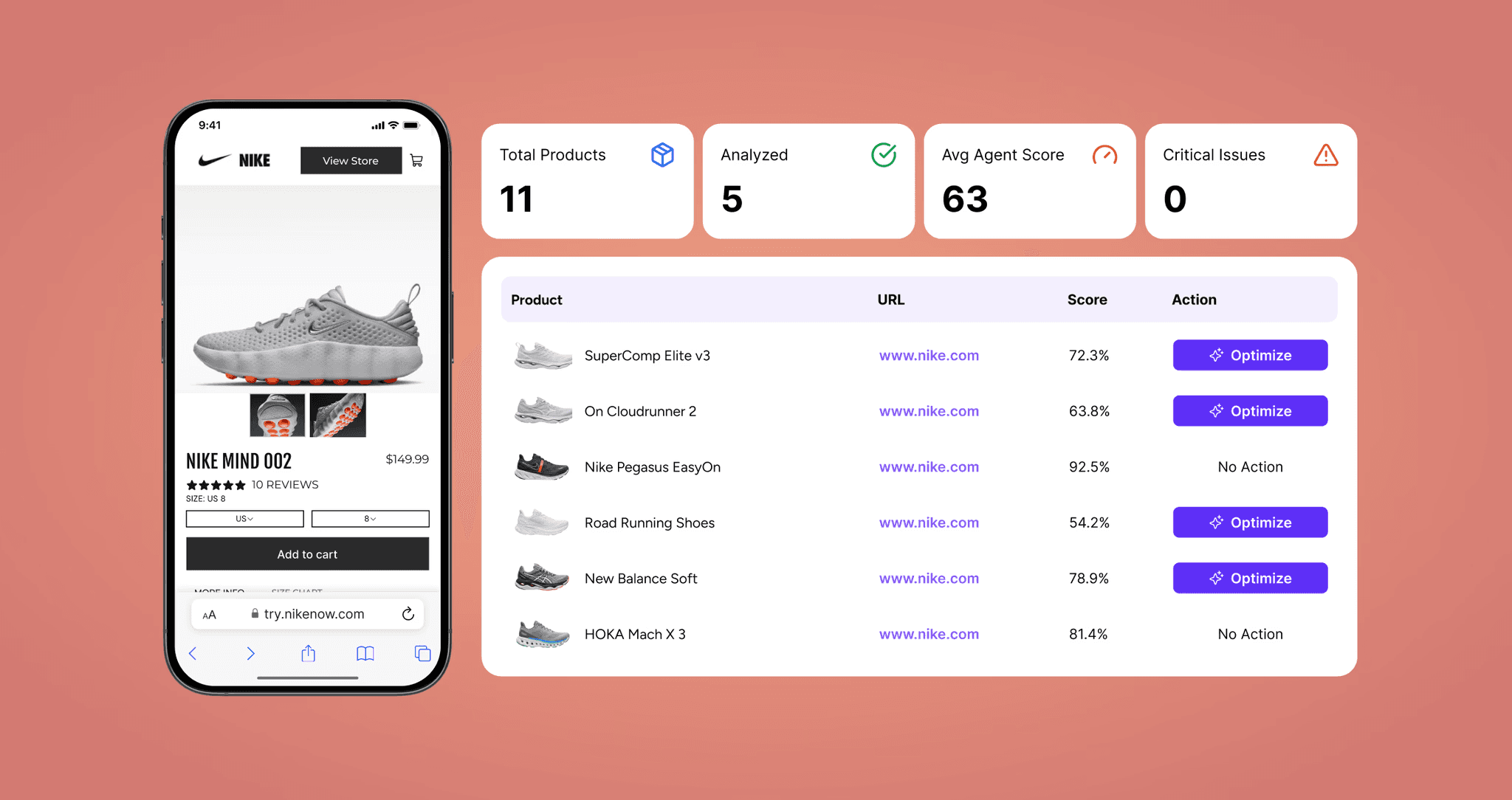
The difference between a GEO-ready product description and a legacy one is structural, not cosmetic. Consider a waterproof hiking boot SKU. A legacy description might read: 'Lightweight hiking boot with waterproof membrane, available in sizes 7-13, multiple colorways.' An answer-first, GEO-optimized version opens with: 'The TrailPro 450 is a waterproof hiking boot rated for 72-hour trail use, weighing 340g per shoe - making it the lightest waterproof boot under $150 in its category.' The second version directly answers the prompt 'best waterproof hiking boot under $150' and gives an AI engine a citable, specific claim.
Three specific tactics drive SKU-level GEO performance. First, entity disambiguation: ensure every SKU has unambiguous product name, brand, category, price, availability, and aggregate rating in both page content and schema markup. Ambiguous or incomplete entity data causes AI engines to skip your product in favor of a better-described competitor. Second, prompt-aligned content: map your highest-value customer intent queries to specific SKUs, then write descriptions that directly answer those queries. Third, schema markup completeness: Product, Offer, Review, and BreadcrumbList schema are the minimum stack. Pages that added proper structured citations saw a 115.1% AI visibility increase even when ranked fifth in traditional search. For a full breakdown of common schema errors, see Nudge's guide on product schema mistakes affecting SKU AI visibility.
How Do You Measure GEO Performance Across a Large Catalog?
Most SEO tools do not track AI citation performance - which means most catalog teams are flying blind on GEO impact. The measurement framework needs to cover four distinct metrics that traditional analytics miss entirely.
AI citation share: How often your brand or specific SKUs appear in AI responses for a defined set of target prompts, expressed as a percentage. Track this at both brand and category level, and benchmark against key competitors.
Prompt coverage: What percentage of your high-intent prompt universe returns at least one of your products. A large catalog may have thousands of relevant prompts - systematic coverage mapping identifies the biggest gaps.
AI-referred traffic quality: Bounce rate, pages per visit, and revenue per visit for sessions originating from AI platforms. These sessions already outperform traditional channels on quality metrics, so a decline signals a content-citation mismatch.
Competitor share of voice in AI answers: For each priority prompt cluster, track which domains are cited most frequently. This surfaces competitive threats earlier than traditional rank tracking and informs where to invest in earned media.
The scale of AI platforms makes systematic monitoring non-negotiable. Google AI Overviews now appear in 25.11% of searches (Conductor 2026 benchmarks, based on 21.9 million searches analyzed), and ChatGPT processes 2.5 billion prompts per day. Manual spot-checking cannot cover that surface area. For tooling guidance on setting up catalog-scale AI visibility tracking, see Nudge's AI visibility tracking guide for retail teams.
From AI Citation to AI Conversion: Closing the Loop with Shoppable Funnels
Earning an AI citation is only half the job. When a shopper clicks through from a ChatGPT or Perplexity response, they arrive with a specific query context - and landing them on a generic product listing page that ignores that context wastes the intent signal that made them valuable in the first place.
Prompt-aligned shoppable funnels match the AI query to a curated product experience - surfacing the specific SKUs referenced in the AI response, presenting relevant social proof, and removing the navigation friction that causes drop-off. The data supports this approach: AI-referred shoppers already show 32% longer visits and 27% lower bounce rates compared to other traffic sources, meaning they reward relevance when they find it. The conversion opportunity is not in acquiring these shoppers - it is in not losing them after the citation does its job.
Nudge's shoppable funnels platform is designed specifically for this conversion layer - connecting AI citations to prompt-matched landing experiences at SKU level. For implementation detail, the shoppable AI funnels conversion guide covers funnel architecture, SKU mapping, and A/B testing frameworks for AI-referred traffic.

Frequently asked questions
How is GEO different from SEO for an ecommerce brand?
SEO optimizes pages to rank in traditional search results via keywords and backlinks. GEO optimizes content and structured product data to be cited in AI-generated answers. Only 17-38% of AI Overview citations overlap with top-10 Google organic results (Ahrefs and BrightEdge, February 2026), so a separate GEO strategy is required - strong SEO rank does not guarantee AI visibility.
How long does it take to see results from GEO?
Early citation gains from structured data and answer-first content rewrites can appear within 4-8 weeks. Earned media and topical authority build over 3-6 months. Agentic commerce readiness - feed compliance with OpenAI ACP and Google UCP - is a longer-term infrastructure investment that should begin now given the pace of protocol adoption.