AI Search Visibility
AI Visibility Tracking for Retail Teams: The Complete Guide
Generative AI traffic to US retail sites grew 4,700% year-over-year. Learn how to track, measure, and improve your brand's citation share across ChatGPT, Perplexity, Gemini, and Google AI Overviews before competitors do.

Kanishka Thakur





Key Takeaways
Generative AI traffic to US retail sites grew 4,700% year-over-year as of July 2025, yet 54% of brands that rank well on Google are not cited by AI systems at all, making AI visibility tracking a distinct discipline from traditional SEO.
AI search engines like ChatGPT, Perplexity, and Google AI Overviews cite only 2-7 domains per response, so retail teams must track citation share, prompt-level mentions, and SKU-level coverage, not just keyword rankings.
Shoppers arriving from AI referrals convert 38% more often than non-AI traffic and interact with AI assistants at a 4x higher conversion rate (12.3% vs. 3.1%), making AI citation share a direct revenue metric.
The same brand can see citation volumes differ by 615x between platforms like Grok and Claude, proving that multi-platform tracking across ChatGPT, Perplexity, Gemini, and Google AI Overviews is non-negotiable for retail teams.
Properly structured content with schema markup shows 73% higher AI selection rates, and pages with well-organized headings are 2.8x more likely to earn AI citations, making structural optimization the fastest lever retail teams control.
AI visibility tracking is the practice of measuring how often, where, and how accurately your brand and products are cited inside AI-generated answers across platforms like ChatGPT, Perplexity, Gemini, and Google AI Overviews. For retail teams in 2026, it is not a future-state initiative: it is an active revenue channel that demands its own metrics, workflows, and optimization strategy.
Why AI Visibility Is Now a Revenue Metric for Retail Teams
AI-driven traffic is no longer a rounding error. Adobe Digital Insights reports that generative AI traffic to US retail sites grew 4,700% year-over-year as of July 2025, with AI-driven revenue-per-visit growing 84% in the same period. Shoppers from AI referrals are 38% more likely to convert than shoppers from non-AI sources, and those who interact with AI assistants convert at 12.3% versus 3.1% for non-AI shoppers, a 4x difference.
The revenue case is sharpened by what is happening to traditional search. AI Overviews now appear in over 25% of Google searches, and their presence correlates with a 58% lower average click-through rate for the top-ranking organic page. Brands that rely solely on keyword rankings are watching traffic erode while a new discovery layer grows above them.
The core problem: 54% of brands that rank well on Google are not cited by AI systems at all. LLMs cite only 2-7 domains per response. Retail teams that do not actively manage AI citation share are invisible to the fastest-growing shopper acquisition channel in commerce.
What AI Visibility Actually Means for Retail Teams
AI visibility is defined by citation share, prompt-level mention frequency, and SKU-level coverage across AI platforms. It is structurally different from Google rankings. Around 80% of AI-cited URLs do not rank in Google's top 100 for the same query, and 47% of AI Overview citations come from pages below position five in traditional search. Rank tracking tells you almost nothing about citation share.
Platform variance compounds the challenge. The same brand can see citation volumes differ by 615x between Grok and Claude, according to Superlines data from March 2026. Single-platform monitoring creates a blind spot that can hide both opportunity and competitive threat.
The key metrics retail teams must track are: citation frequency per platform, share of voice in AI responses versus named competitors, prompt coverage by category and SKU, and sentiment accuracy of AI-generated product descriptions.
How to Set Up AI Visibility Tracking: A Step-by-Step Framework
A practical AI visibility tracking setup follows four steps. Execute them in sequence to build a measurement foundation before optimizing.
Build a prompt library: Map prompts to your product categories and buyer intent stages. Include navigational queries ("where to buy [brand]"), comparison queries ("[brand] vs [competitor]"), and recommendation queries ("best [product type] for [use case] under $X").
Run systematic queries across platforms: Test ChatGPT, Perplexity, Google AI Overviews, Gemini, and Claude. Log citation frequency, source URLs, and whether your SKUs appear in shopping cards or recommendation lists.
Benchmark against competitors by category and SKU: Track share of voice, not just your own mentions. Identify which competitors are being cited instead of you and in what prompt contexts.
Track changes weekly: Detect how content updates, schema changes, or new reviews shift citation behavior. Run targeted audits within 48-72 hours after any major content or schema deployment.
The table below shows what to track per platform to make this operational:
Platform | Primary Tracking Signals | Retail-Specific Focus |
|---|---|---|
ChatGPT | Mention frequency, recommended product names, source URLs | Shopping query coverage, brand name accuracy, SKU-level recommendations |
Perplexity | Source citations, shopping card appearances, follow-up prompt behavior | Product card inclusion, in-app checkout eligibility (PayPal integration) |
Google AI Overviews | Citation URL, featured snippet text, position relative to organic results | Category-level coverage, local product availability signals |
Gemini | Mention frequency, Shopping tab integration, product attribute accuracy | Google Merchant Center data alignment, image-based product recognition |
Claude | Brand mention context, citation source type, sentiment of product descriptions | Accuracy of product specs, comparison framing versus competitors |
Enterprise retail teams managing large catalogs can automate this process with Nudge's AI Search Visibility platform, which unifies prompt-level citation tracking across all major AI platforms in a single dashboard.
7 Strategies That Improve Brand Visibility in AI Search Engines
These seven tactics are the highest-leverage actions retail teams can take to increase AI citation share. Each addresses a distinct signal that AI systems use when selecting sources.
1. Structured Content Formatting
Pages with well-organized headings are 2.8x more likely to earn AI citations according to AirOps research. Use a clear H2/H3 hierarchy, short paragraphs under 80 words, and bullet points for feature lists and comparisons. AI systems parse structure before prose.
2. Schema Markup Implementation
Properly structured content shows 73% higher AI selection rates compared to unmarked content. Yet 89% of ecommerce sites implement SKU schema incorrectly. Prioritize Product, Offer, Review, and BreadcrumbList schema. Validate with Google's Rich Results Test before publishing.
3. Content Authority Signals
Princeton GEO research found that citing sources, adding statistics, and including quotations improves AI visibility by 30-40% compared to unoptimized content. Add data points, link to authoritative external sources, and include expert perspectives in product category content.
4. Topic Cluster and Content Ecosystem Strategy
AI systems favor brands with connected content that covers a topic from multiple angles: buying guides, comparison pages, use-case articles, and FAQs that interlink. Recency also matters: the majority of ChatGPT citations pull from content published between 2023 and 2025. Publish consistently and update older pages with current data.
5. Online Reputation and Data Accuracy
Brands recommended by ChatGPT average 4.3-star ratings across review platforms. Consistent NAP (name, address, phone) data, accurate Google Business Profile information, and high review volume across third-party sites all influence AI citation behavior. Audit your data accuracy across marketplaces and review platforms quarterly.
6. Multimodal Content Integration
Pages combining text, images, video, and structured data see 156% higher AI selection rates, with full multimodal and schema integration delivering up to 317% more citations. For retail, this means product pages need alt-text-rich images, embedded video demonstrations, and structured data, not just text descriptions.
7. Domain Authority and Traffic Building
Domain authority is the strongest single predictor of AI citations. SE Ranking's study of 2.3 million pages found that high-traffic sites earn 3x more AI citations than low-traffic ones, with domain traffic as the strongest factor (SHAP value: 0.63). Invest in link acquisition, PR, and traffic-driving content alongside technical AI optimization.
SKU-Level Catalog Optimization: The Retail-Specific AI Visibility Layer
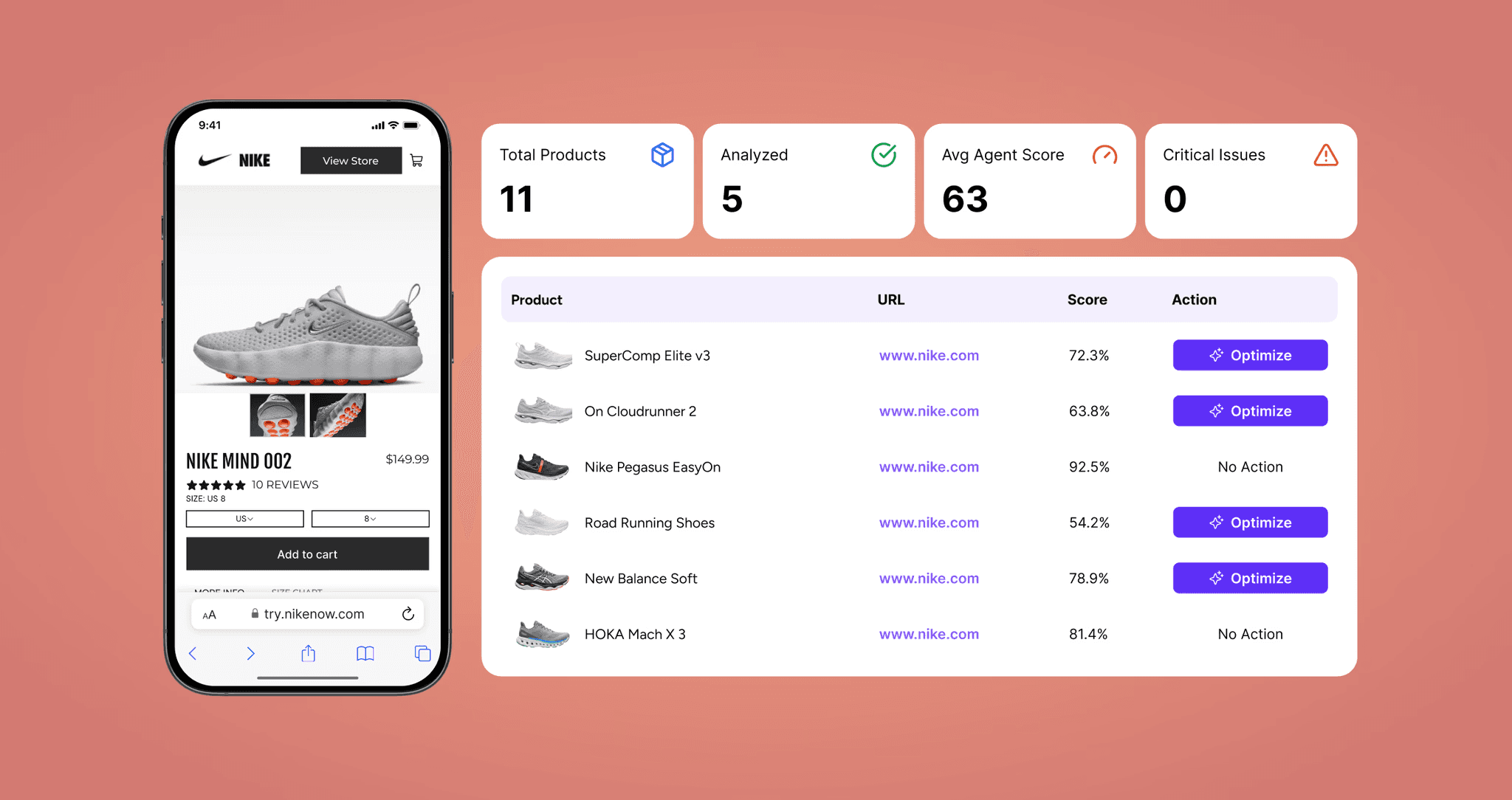
Generic AEO guides focus on brand-level visibility. Retail teams face a harder problem: AI must understand and recommend individual products across thousands of SKUs. This requires a dedicated catalog optimization layer that most enterprise teams have not yet built.
The stakes are concrete. A McKinsey report drawing on insights from over 3,000 ecommerce companies found that product data errors cost up to 23% in clicks and 14% in conversions. Incomplete or inaccurate product attributes mean AI assistants either skip your SKUs or describe them incorrectly, both outcomes damage conversion.
The scale of AI shopping infrastructure makes this urgent. Amazon Rufus is on track to drive more than $10 billion in incremental annualized sales, and ChatGPT handles over 84 million shopping-related questions per week in the US. These systems surface SKU-level recommendations based on attribute completeness, review accuracy, and structured data quality.
Only 25% of AI shopping citations are brand-owned. Third-party review sites and marketplaces dominate the remaining 75%. Catalog enrichment, ensuring every SKU has complete attributes, accurate pricing, and clean structured data, is how brands reclaim that share. Nudge's catalog optimizer and product data enrichment tools are built specifically for enterprise catalog teams managing this at scale.
Measuring What Matters: AI Visibility KPIs for Commerce Teams
Retail teams need a KPI framework that connects AI citation activity to business outcomes, not just platform metrics. The five KPIs below are reportable to leadership and directly tied to revenue.
KPI | Definition | How to Measure |
|---|---|---|
AI Citation Share | Percentage of target prompts where your brand appears across tracked platforms | Systematic prompt testing across ChatGPT, Perplexity, Gemini, Google AI Overviews, Claude |
Share of Voice vs. Competitors | How often you appear versus named competitors in category queries | Competitive prompt benchmarking by category, tracked weekly |
SKU Coverage Rate | Percentage of catalog SKUs appearing in AI responses for relevant prompts | Product-specific prompt library matched to catalog; log SKU appearances |
AI-Referred Traffic and Conversion Rate | Sessions and conversions attributed to AI platform referrals | GA4 referral source segmentation and UTM parameters; benchmark vs. 38% conversion lift baseline |
Sentiment Score | Accuracy and tone of AI-generated product descriptions | Manual review of AI responses; flag inaccurate attributes or negative framing |
The market context makes this a board-level priority. The NRF estimates that AI-influenced commerce will grow from approximately $31 billion in 2025 to $194 billion by 2030. Teams that build AI citation tracking infrastructure now will have a compounding advantage as this channel scales.
Nudge's unified dashboard connects citation tracking to revenue attribution in a single view, giving enterprise commerce teams the reporting layer they need to demonstrate AI visibility ROI.
Ready to Improve AI Visibility for your brand? Book a demo!
Nudge is the only enterprise platform that unifies prompt-level AI citation tracking, SKU-level catalog optimization, and shoppable AI funnels in a single suite. Retail teams use Nudge to move from guessing about AI visibility to measuring it, optimizing it, and attributing revenue to it.
Frequently asked questions
How is AI visibility tracking different from traditional SEO tracking?
Traditional SEO tracks keyword rankings and click-through rates. AI visibility tracking measures citation frequency, prompt-level mention share, and SKU coverage across LLM platforms. Around 80% of AI-cited URLs do not rank in Google's top 100, so rank tracking tells you almost nothing about AI citation share. The two disciplines require separate prompt libraries, separate metrics, and separate optimization workflows.
Which AI platforms should retail teams track for brand visibility?
Retail teams should track ChatGPT, Perplexity, Google AI Overviews, Gemini, and Claude at minimum. Citation volumes can differ by 615x between platforms for the same brand, according to Superlines data from March 2026, so single-platform tracking creates a significant blind spot. Prioritize platforms where your target shoppers are most active, and expand coverage as AI shopping behavior evolves.
How often should retail teams run AI visibility audits?
Weekly tracking is recommended for high-priority product categories and competitor benchmarking. Monthly full-catalog audits help detect structural shifts in citation behavior. After any major content or schema update, run a targeted audit within 48-72 hours to measure the impact. Consistent cadence is more valuable than occasional deep dives.
What is the fastest way to improve AI citation rates for a retail brand?
The fastest levers are structural. Adding organized H2/H3 headings delivers a 2.8x citation lift, implementing correct schema markup produces 73% higher AI selection rates, and adding statistics and source citations to content improves visibility by 30-40%. These changes can be deployed without a full content overhaul and show measurable impact within weeks.
How do I track AI visibility at the SKU level, not just the brand level?
Build a prompt library that includes product-specific queries such as 'best [product type] under $X for [use case]' and run them systematically across AI platforms. Log which SKUs appear, in what context, and with what attributes. Enterprise catalog teams use platforms like Nudge's catalog optimizer to automate this at scale across thousands of SKUs, connecting SKU-level citation data to conversion outcomes.