AI Search Visibility
Best AI Commerce Platforms for Enterprise Brands (2026)
Discover which platforms help large retail brands get discovered and bought via ChatGPT, Perplexity, Gemini, and Google AI Overviews in 2026. Compare the 7 best AI commerce platforms on features, pricing, and enterprise readiness.

Gaurav Rawat






Key Takeaways
AI-driven referrals to e-commerce sites grew 4,700% year-over-year, yet only 7.4% of Fortune 500 companies have implemented AI search optimization, making platform choice a critical competitive advantage in 2026.
The best AI commerce platforms for enterprise brands combine SKU-level catalog optimization, prompt-aligned shoppable funnels, and multi-engine visibility tracking across ChatGPT, Perplexity, Gemini, and Claude.
54% of brands that rank well on Google are not cited by AI systems at all, meaning traditional SEO tools are insufficient and enterprises need purpose-built AI commerce infrastructure.
ChatGPT converts at 15.9% versus Google organic at 1.76%, making AI channel optimization one of the highest-ROI investments available to enterprise commerce teams today.
Enterprise-grade AI commerce platforms must include SOC 2 compliance, SSO, PIM/OMS integrations, and SKU-level citation tracking to meet the governance and scale requirements of large retail operations.
AI is no longer a future channel for enterprise retail. It is the primary discovery layer your customers are using right now. The brands that invest in purpose-built AI commerce infrastructure in 2026 will own the citation, the recommendation, and the conversion. The brands that do not will be invisible, regardless of how well they rank on Google.
Why Enterprise Brands Cannot Ignore AI Commerce Platforms in 2026
The AI commerce shift is not incremental. It is structural. Adobe Analytics data shows that traffic from generative AI sources to U.S. retail sites grew 4,700% year-over-year. During the 2025 holiday season alone, generative AI traffic to retail sites jumped 693.4% compared to the prior year. These are not edge-case numbers; they represent a fundamental shift in how shoppers find and evaluate products.
The conversion case is equally compelling. ChatGPT converts at 15.9% compared to Google organic at 1.76%, a nearly 9x gap, per Nudge's analysis of Seer Interactive data. AI referrals also converted 31% more than other traffic sources during the 2025 holiday season, with revenue per visit up 254%. Shoppers arriving from AI assistants are 33% less likely to bounce, spending 45% more time on-site and viewing 13% more pages per visit.
The problem is that most enterprises are not ready. Only 7.4% of Fortune 500 companies have implemented AI search optimization, and 54% of brands that rank well on Google are not cited by AI systems at all. Traditional SEO tools do not address the structured data, prompt alignment, and catalog hygiene that AI engines require. Purpose-built AI commerce platforms are now a strategic necessity.
What to Look for in an Enterprise AI Commerce Platform
Enterprise buyers should evaluate AI commerce platforms across six core criteria. Skipping any one of them creates a gap that competitors will exploit.
Multi-engine AI visibility tracking: At minimum, the platform must track ChatGPT, Perplexity, Google AI Overviews, Gemini, and Claude. Enterprise teams should also cover Amazon Rufus and Microsoft Copilot for full channel coverage.
SKU-level catalog optimization: Product data enrichment at the individual SKU level is required for AI citation eligibility. Generic feed optimization is not sufficient for large catalogs.
Prompt-aligned shoppable funnels: The platform should map product content to the specific prompts shoppers use in AI assistants, creating direct paths from AI recommendation to purchase.
Enterprise security and compliance: SOC 2 compliance and SSO are non-negotiable for brands managing thousands of SKUs across complex tech stacks.
PIM/OMS/CDP integrations: Seamless data flow between the AI commerce platform and existing commerce infrastructure prevents catalog drift and ensures consistent product data across channels.
Citation and conversion analytics: Brands need SKU-level attribution showing which products are being cited, by which AI engines, and at what conversion rate.
The 7 Best AI Commerce Platforms for Enterprise Brands
The platforms below represent the current best options for enterprise retail brands investing in AI commerce infrastructure. Each is evaluated on the six criteria above.
1. Nudge - Best Overall AI Commerce Suite for Enterprise
Nudge is the only platform that unifies AI search visibility, prompt-aligned shoppable funnels, and SKU-level catalog optimization in a single SOC 2-compliant enterprise suite. It is built for brands that need to control how AI assistants cite, compare, and convert their products at scale.
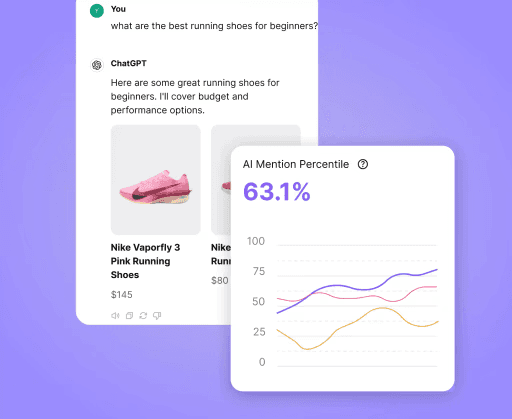
AI Search Visibility Suite: Tracks brand and SKU citations across ChatGPT, Perplexity, Gemini, Claude, and Google AI Overviews with prompt-level granularity.
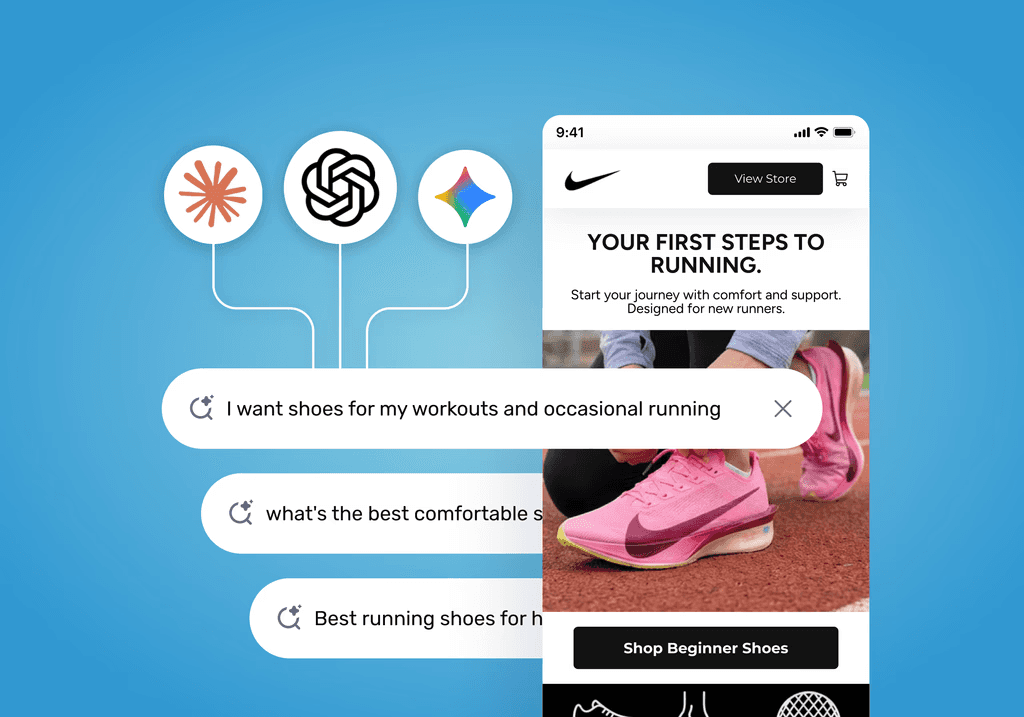
Shoppable Funnels: Maps product content to the specific prompts shoppers use, creating direct AI-to-purchase conversion paths aligned to buyer intent.
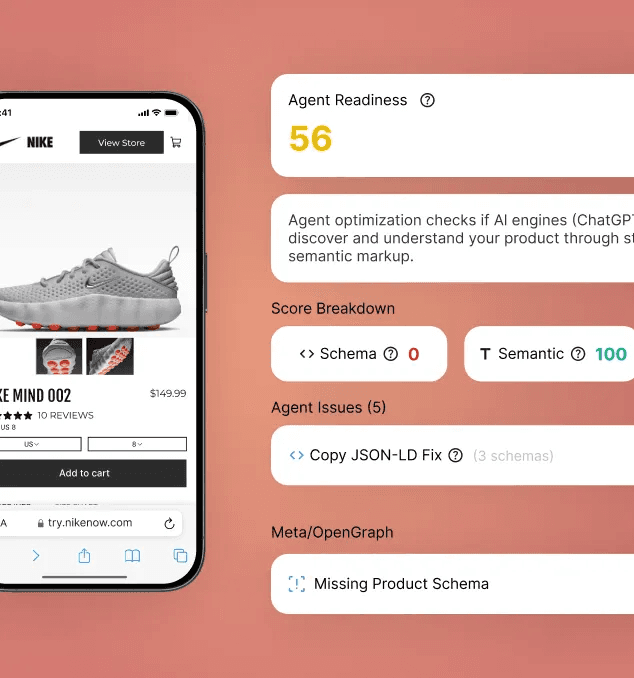
SKU-Level Catalog Optimizer: Enriches product data at the individual SKU level to meet AI engine structured data requirements and maximize citation eligibility.
Enterprise Security: SOC 2 compliant with SSO support, designed for large retail organizations with strict governance requirements.
Commerce Integrations: Native PIM, OMS, and CDP integrations ensure catalog data stays consistent across the full tech stack.
Citation and Conversion Analytics: SKU-level attribution dashboards showing which products are cited, by which engines, and at what conversion rate.
Best For: Enterprise retail brands that need a single platform to manage AI visibility, catalog optimization, and shoppable funnel conversion simultaneously. Learn more about Nudge's AI search visibility suite, shoppable funnels, and catalog optimizer.
2. Yext - Best for Structured Data Publishing Across AI Engines
Publishes structured brand and product data to ChatGPT, Gemini, and Perplexity via direct integrations.
Strong knowledge graph infrastructure helps brands maintain consistent entity data across AI engines.
Better suited to brand-level visibility than SKU-level catalog optimization.
Best For: Multi-location retail brands prioritizing brand-level AI entity management and structured data distribution.
3. Constructor - Best for AI-Powered Product Discovery and Search
Named a Leader in the Forrester Wave for Commerce Search and Product Discovery (Q3 2025) and in the Gartner Magic Quadrant for Search and Product Discovery (2025).
Specializes in AI-powered on-site search, recommendations, and product discovery optimization for large catalogs.
Strong merchandising controls and A/B testing capabilities for catalog teams.
Best For: Enterprise brands focused on on-site AI product discovery and search, with large catalogs requiring advanced merchandising controls.
4. Brand Armor AI - Best for AI Citation Monitoring and Brand Protection
Monitors how brands are represented and cited across AI assistants, with alerts for inaccurate or missing citations.
Focused on brand reputation and citation accuracy rather than catalog-level optimization.
Best For: Brands that need to monitor and protect how their brand is represented in AI-generated responses, particularly those with brand accuracy or compliance concerns.
5. Siftly - Best for AI Brand Mention Tracking
Tracks brand mentions and citation frequency across AI search platforms, providing share-of-voice analytics.
Lightweight monitoring tool suited to teams starting their AI visibility measurement journey.
Best For: Marketing teams that need AI mention monitoring and share-of-voice reporting without full catalog optimization requirements.
6. Profound - Best for Multi-Engine Citation Analytics
Tracks citations across ten answer engines and processes over 5 million daily citations, making it one of the broadest coverage tools available.
Strong analytics layer for brand and agency teams measuring AI presence across multiple LLM platforms.
Less focused on catalog optimization or shoppable funnel conversion.
Best For: Enterprise brands and agencies that need deep, multi-engine citation analytics and breadth of LLM coverage for AI visibility reporting.
7. Shopify Plus with Hydrogen - Best for AI-Native Commerce Storefront Architecture
Shopify was a launch partner for ChatGPT Instant Checkout (September 2025), enabling direct purchase flows from ChatGPT for Shopify merchants.
Hydrogen headless framework enables structured, feed-ready product data architecture optimized for AI engine ingestion.
Best For: Enterprise brands building or rebuilding their commerce storefront who want native AI commerce readiness at the infrastructure level.
Platform Comparison Table: Enterprise AI Commerce Features at a Glance
Use this table to benchmark platforms against the six enterprise evaluation criteria. Nudge is the only platform that covers all six comprehensively.
Platform | AI Engines Tracked | SKU-Level Optimization | Shoppable Funnels | SOC 2 / SSO | PIM/OMS Integrations | Pricing Tier |
|---|---|---|---|---|---|---|
Nudge | ChatGPT, Perplexity, Gemini, Claude, Google AI Overviews, Amazon Rufus, Copilot | Yes - full SKU-level | Yes - prompt-aligned | Yes / Yes | Yes - native | Enterprise |
Yext | ChatGPT, Gemini, Perplexity | Limited - brand entity level | No | Yes / Yes | Partial | Enterprise |
Constructor | On-site AI only | Yes - catalog level | No | Yes / Yes | Yes | Enterprise |
Brand Armor AI | Multiple engines | No | No | Not disclosed | No | Mid-market |
Siftly | Multiple engines | No | No | Not disclosed | No | SMB to mid-market |
Profound | 10 answer engines | No | No | Not disclosed | No | Mid-market to enterprise |
Shopify Plus / Hydrogen | ChatGPT (via Instant Checkout) | Feed-level via Hydrogen | Partial - via ChatGPT integration | Yes / Yes | Yes - extensive | Enterprise |
How These Platforms Help Brands Show Up in ChatGPT and Perplexity
AI product recommendation eligibility depends on four technical requirements that traditional SEO tools do not address. The platforms above each tackle one or more of these requirements.
Structured Product Data
A Data World study shows GPT-4 accuracy jumps from 16% to 54% when content uses structured data, a 3x improvement. Platforms like Nudge and Constructor address this at the catalog level, while Shopify Hydrogen provides the structured feed architecture that makes product data AI-readable by default. Brands relying on unstructured PDPs are leaving the majority of their catalog invisible to AI engines.
Prompt-Aligned Content
AI assistants respond to natural language queries, not keyword-stuffed product titles. Nudge's shoppable funnels are specifically designed to align product content with the prompts shoppers actually use in ChatGPT and Perplexity, increasing the probability that a brand's products appear in AI-generated responses for high-intent shopping queries.
Commerce Protocol Readiness
The AI commerce infrastructure is maturing rapidly. ChatGPT launched Instant Checkout in September 2025 with Shopify and Etsy as partners. Walmart and Target both launched ChatGPT integrations in late 2025. Stripe's Agentic Commerce Protocol (ACP) is now live, enabling programmatic commerce flows between AI agents and businesses, with brands including URBN, Etsy, Ashley Furniture, Coach, Kate Spade, and Revolve already onboarding. Enterprise brands need platforms that are compatible with these emerging standards.
Citation Source Diversity and Feed Hygiene
AI engines draw from multiple sources when generating product recommendations. Yext and Profound address citation source diversity through structured data publishing and multi-engine tracking. Nudge combines both with feed-level catalog hygiene to ensure product data is accurate, enriched, and consistently indexed across engines. McKinsey data shows product data errors cost up to 23% in clicks and 14% in conversions, making catalog hygiene a revenue issue, not just a data quality issue.
How to Choose the Right Platform for Your Enterprise Stack
The right platform depends on your primary AI channel goal, catalog complexity, and existing tech stack. Use the framework below to identify your best starting point.
Primary Goal | Recommended Platform(s) | Key Reason |
|---|---|---|
AI citation visibility across all major engines | Nudge or Profound | Multi-engine tracking with citation analytics |
On-site AI product discovery optimization | Constructor or Yext | Catalog-level and entity-level optimization |
Prompt-aligned shoppable AI funnels | Nudge | Only platform with native shoppable funnel capability |
AI mention and brand reputation monitoring | Siftly or Brand Armor AI | Lightweight monitoring without full catalog requirements |
AI-native storefront infrastructure | Shopify Plus with Hydrogen | Structured feed architecture and ChatGPT commerce integration |
Full-stack AI commerce (visibility + optimization + conversion) | Nudge | Only platform covering all six enterprise criteria in one suite |
For most enterprise brands, the question is not whether to invest in AI commerce infrastructure but how quickly. 88% of enterprises plan to modernize their commerce infrastructure within the next 12 months, and 97% of decision-makers agree that AI will reshape commerce. Brands that act now will establish citation authority and conversion infrastructure before competitors close the gap. The best starting point is a platform audit: map your current catalog data quality, identify which AI engines you are missing, and benchmark your citation rate against category competitors. Nudge's AI ecommerce visibility tools comparison is a useful reference for that audit.
Ready to Improve AI Search Visibility? Book a demo!
Frequently asked questions
Which AI platforms should enterprise brands prioritize for product visibility?
At minimum, brands should track and optimize for ChatGPT, Perplexity, Google AI Overviews, Gemini, and Claude. For full AI channel coverage, also include Amazon Rufus and Microsoft Copilot. Each engine has different citation criteria, so multi-engine visibility tracking is essential. Nudge covers all of these in a single platform.
Why are brands that rank on Google still invisible in AI recommendations?
54% of top Google-ranking brands are not cited by AI systems because AI engines prioritize structured, enriched product data over traditional SEO signals like backlinks and keyword density. Google ranking confirms that your content is indexed and relevant to keyword queries. AI citation requires that your product data is structured, prompt-aligned, and feed-ready in a format that AI language models can accurately parse and recommend. These are fundamentally different technical requirements.
What is the ROI of optimizing for AI commerce channels?
The ROI case is strong. ChatGPT converts at 15.9% versus Google organic at 1.76%, nearly 9x higher. During the 2025 holiday season, AI referrals converted 31% more than other traffic sources, with revenue per visit up 254%. AI conversions were 54% higher than non-AI on Thanksgiving 2025. These figures come from Adobe Analytics data and Seer Interactive analysis.
What enterprise security features should an AI commerce platform have?
SOC 2 compliance and SSO are non-negotiable for enterprise brands managing thousands of SKUs across complex tech stacks. PIM, OMS, and CDP integrations are also required to maintain catalog data consistency and prevent product data drift across channels. Platforms that lack these features create security and governance gaps that are unacceptable for large retail organizations.
How does structured product data affect AI recommendation eligibility?
The impact is significant. A Data World study shows GPT-4 accuracy jumps from 16% to 54% when content uses structured data, a 3x improvement. Brands with enriched, feed-ready catalogs are significantly more likely to be cited and recommended by AI assistants. Conversely, McKinsey data shows product data errors cost up to 23% in clicks and 14% in conversions. Structured data is the single highest-leverage catalog investment for AI commerce readiness.