AEO & GEO
AEO for Ecommerce: The Ultimate Guide for DTC Teams
A practical guide for DTC teams implementing Answer Engine Optimization. Covers why SEO alone fails in AI search, the 4-pillar implementation framework, and the metrics that actually indicate AI visibility.

Sakshi Gupta





Key Takeaways
AEO (Answer Engine Optimization) structures content so AI assistants cite your brand directly in responses - not just rank you in a list of links, making it the primary discovery channel for the 39% of consumers already using AI for product research.
AI-referred shoppers convert at 4.4x the rate of organic search visitors (Semrush, 2025) and are 68% less likely to return purchases, making AI visibility a direct revenue lever, not a vanity metric.
Only 12% of URLs cited by ChatGPT, Perplexity, and Copilot rank in Google top 10, meaning traditional SEO rankings no longer predict AI citation - ecommerce teams need a separate AEO strategy.
SKU-level structured data is the highest-leverage technical fix: 89% of ecommerce sites implement product schema incorrectly, and fixing it can unlock a 73% lift in AI selection rates.
Only 16% of brands systematically track AI search performance today, creating a first-mover window for DTC teams that instrument AI citation monitoring before competitors do.
AEO for ecommerce means structuring your product content, schema, and third-party presence so that AI assistants like ChatGPT, Perplexity, and Google AI cite your brand directly in generated answers - not as a ranked link, but as the recommended answer. For DTC teams, this is no longer optional: over 91% of ecommerce queries now trigger AI-generated results, and the brands winning those citations are converting at rates traditional SEO cannot match.
What Is AEO and Why Does It Matter More Than SEO for Ecommerce Right Now?
Answer Engine Optimization (AEO) is the practice of structuring content so that AI assistants can directly provide answers to user queries rather than returning a list of links. For ecommerce, this means your products, categories, and brand attributes must be machine-readable enough for an AI to confidently recommend them in a generated response. The urgency is real: Gartner projects a 25% drop in traditional search volume by 2026, and McKinsey projects $750 billion in US revenue will flow through AI-powered search by 2028. Critically, 80% of LLM citations do not rank in Google top 100 for the same query - meaning your current SEO investment provides almost no protection in AI search.
Dimension | Traditional SEO | AEO |
|---|---|---|
Primary ranking signal | Backlinks, page authority, keyword density | Structured data accuracy, E-E-A-T, citation frequency |
Content format | Long-form keyword-optimized pages | Conversational Q&A, FAQ schema, SKU-level attributes |
Query length | Average 3.37 words | Average 23 words (ChatGPT prompts) |
Conversion outcome | Baseline organic traffic conversion | 4.4x higher conversion rate vs. organic search |
Measurement unit | Keyword rankings, organic sessions | Citation share, prompt-level visibility, AI-referred revenue |
Overlap with Google top 10 | Direct correlation | Only 12% of AI citations rank in Google top 10 |
How Big Is the AI Shopping Opportunity - and How Fast Is It Moving?
The growth numbers are not projections - they are already in the data. AI-referred ecommerce traffic is compounding at a rate that demands immediate action from DTC teams.
693% traffic growth: Adobe Analytics recorded a 693.4% increase in traffic to retail sites from generative AI tools during the 2025 holiday season year-over-year.
752% AI referral spike: BrightEdge recorded a 752% year-over-year spike in AI referrals from ChatGPT and Perplexity to ecommerce brands during the same period.
3,100% YTD growth: Generative AI traffic to ecommerce sites was up 3,100% in April 2025 compared to July 2024, according to Adobe.
4.4x conversion advantage: Semrush data confirms AI-referred visitors convert at 4.4x the rate of organic search visitors.
68% lower return rate: Consumers who use AI for shopping are 68% less likely to return their purchase - reducing reverse logistics costs alongside increasing revenue.
$20.9B retail spend: eMarketer projects AI platforms will account for $20.9 billion in retail spending in 2026, nearly quadrupling 2025 figures.
39% consumer adoption: Salesforce reports 39% of consumers - and over half of Gen Z - already use AI for product discovery.
Only 16% tracking it: McKinsey found just 16% of brands systematically track AI search performance, leaving a significant first-mover window open.
Holiday season data sharpens the picture further: AI conversions were 54% higher than non-AI on Thanksgiving and 38% higher on Black Friday, with AI referrals converting 31% more than other traffic sources overall. Against a record $257.8 billion spent online during the 2025 holiday season, the brands capturing AI citations captured a disproportionate share of that spend.
Why Traditional SEO Tactics Fail in AI Search - and What Changes
SEO playbooks were designed for 3-word queries and ranked link results. AI search operates on fundamentally different mechanics - and applying old tactics to new platforms produces poor results.
The query format alone signals the shift: the average US search query is 3.37 words, while the average ChatGPT prompt is 23 words. These are not the same optimization problem. A page optimized for 'best running shoes' will not automatically surface for 'what are the best lightweight running shoes for someone with wide feet who runs on trails and needs waterproofing under $150.' Prompt-level data replaces keyword-level data as the core measurement unit.
Three structural realities make a separate AEO strategy non-negotiable:
Commercial intent triggers web search 53.5% of the time in ChatGPT versus 18.7% for informational queries - meaning your product pages must be indexable and citable, not just ranked.
48% of AI citations come from Reddit, YouTube, and review platforms while brand-owned sites account for only 5-10% of sources AI references - SEO-only strategies optimize the wrong assets.
Citation volatility is severe: only 30% of brands stay visible from one AI answer to the next, making one-time optimization insufficient. Continuous monitoring is required.
For a detailed comparison of AEO tools built for ecommerce teams, see the AI ecommerce visibility tools comparison on Nudge.
The AEO Implementation Framework: 4 Pillars Every DTC Team Must Execute
AEO implementation for ecommerce breaks into four distinct pillars. Each addresses a different layer of how AI assistants discover, evaluate, and cite products. Execute all four - partial implementation leaves citation gaps that competitors will fill.
Pillar 1: SKU-Level Structured Data
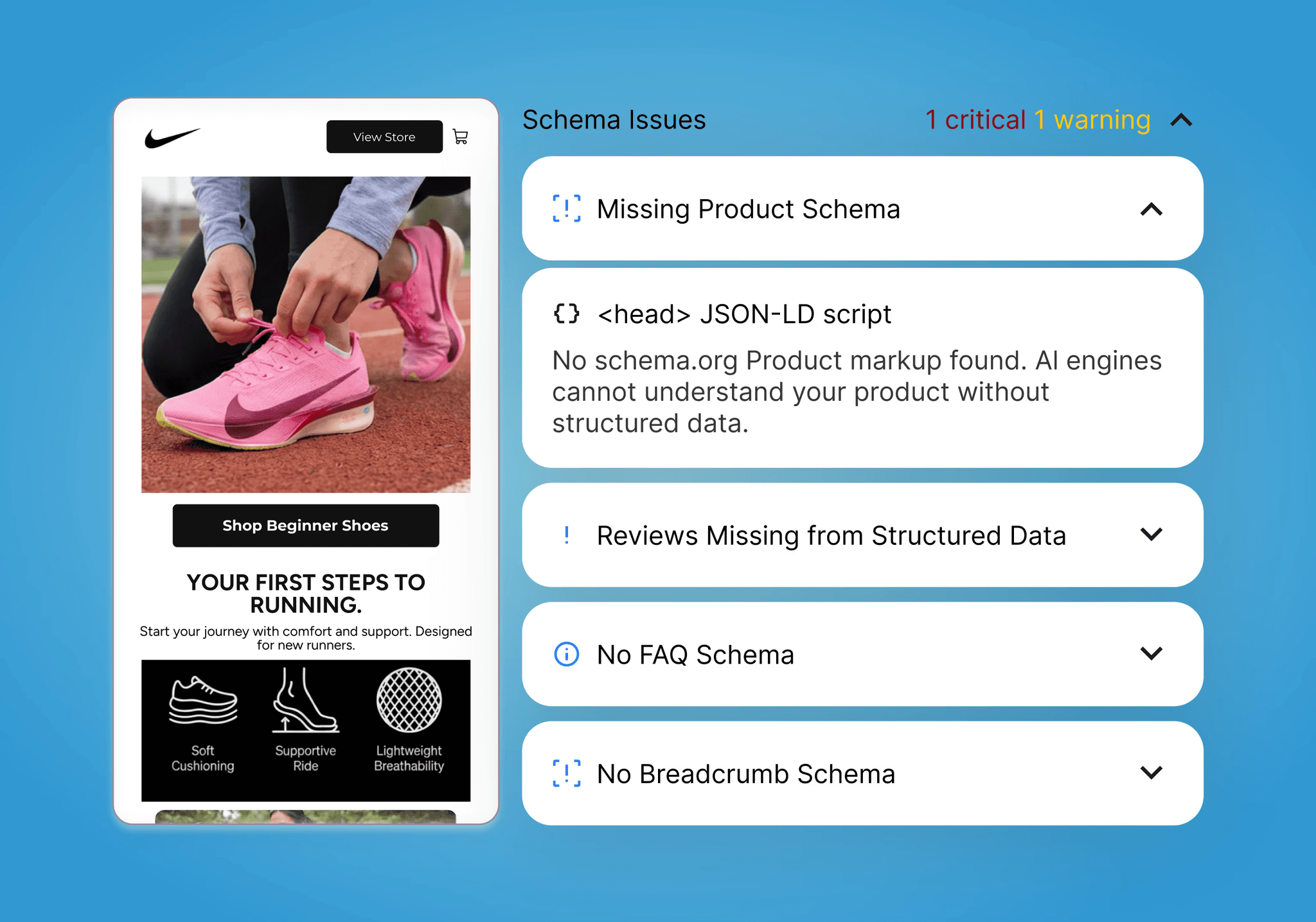
Basic Product and Offer schema is insufficient. LLMs treat structured data as a source of truth and require material composition, certifications, compatibility matrices, and use-case specs - all enriched at the SKU level, not the page level. The scale of the problem is significant: 89% of ecommerce sites implement product schema incorrectly, and fixing this single issue can unlock a 73% lift in AI selection rates. Structured data also gives GPT-4 a 3x accuracy jump - from 16% to 54% correct product responses - directly improving how AI engines represent your catalog. For a detailed implementation guide, see Nudge's SKU-level catalog optimization resource.
Pillar 2: Conversational Content Architecture
Replace generic adjectives like 'premium' or 'professional' with specific, machine-readable attributes: waterproof, USB-C, sulfate-free, 10,000 mAh. AI assistants pull attribute data to populate filters and comparison tables, so precision directly affects citation rates. Structure content to answer 23-word prompts, not 3-word keywords - this means dedicated FAQ sections, comparison content, and use-case pages that mirror how real buyers ask questions. Pages with FAQ schema receive 2.7x more AI citations, making it one of the highest-ROI structural changes available without a full site rebuild.
Pillar 3: Third-Party Citation Strategy
Since 48% of AI citations come from Reddit, YouTube, and review platforms - and brand-owned sites account for only 5-10% of AI references - DTC teams must treat third-party content as a core distribution channel, not a secondary concern. This means seeding authoritative product content on review platforms, building YouTube presence with attribute-rich descriptions, and ensuring community discussions on Reddit reflect accurate product information. E-E-A-T signals must extend across your entire web footprint, not just your own domain.
Pillar 4: Agentic Commerce Readiness
Agentic commerce - AI assistants completing purchases autonomously on behalf of users - is live, not theoretical. ChatGPT Instant Checkout lets users buy products directly within ChatGPT conversations, processing payment via Stripe without redirecting to the merchant site. Two protocols now govern how brands integrate into these flows: ACP (Agentic Commerce Protocol), OpenAI and Stripe's protocol live since September 2025, and UCP (Universal Commerce Protocol), Google's coalition-backed protocol announced January 2026 for Google Search AI Mode and Gemini. Brands not integrated with these protocols will be invisible in transactional AI interactions - the segment eMarketer projects at $20.9 billion in retail spending in 2026. The Nudge catalog optimizer is built to support both protocol integrations at scale.
How to Measure AEO Performance: Metrics, Tools, and Tracking Cadence
Most DTC teams are flying blind: only 16% of brands systematically track AI search performance, according to McKinsey. Before defining what to measure, acknowledge the measurement gap - the tools and dashboards built for SEO do not capture citation share, prompt-level visibility, or AI-referred revenue by default.
The five core AEO metrics every DTC team should track:
Citation share by platform: what percentage of relevant AI responses across ChatGPT, Perplexity, Google AI Overviews, and Gemini include your brand or products.
Prompt-level visibility: which specific commercial prompts surface your products, and which do not - this replaces keyword ranking as the core diagnostic.
Citation volatility score: how consistently your brand appears across repeated AI queries over time. Only 30% of brands maintain consistent visibility, making volatility a key health indicator.
AI-referred conversion rate: the conversion rate of sessions arriving via AI platforms, segmented by platform and prompt type.
Revenue per AI visit: total AI-attributed revenue divided by AI-referred sessions, enabling direct ROI comparison with other channels.
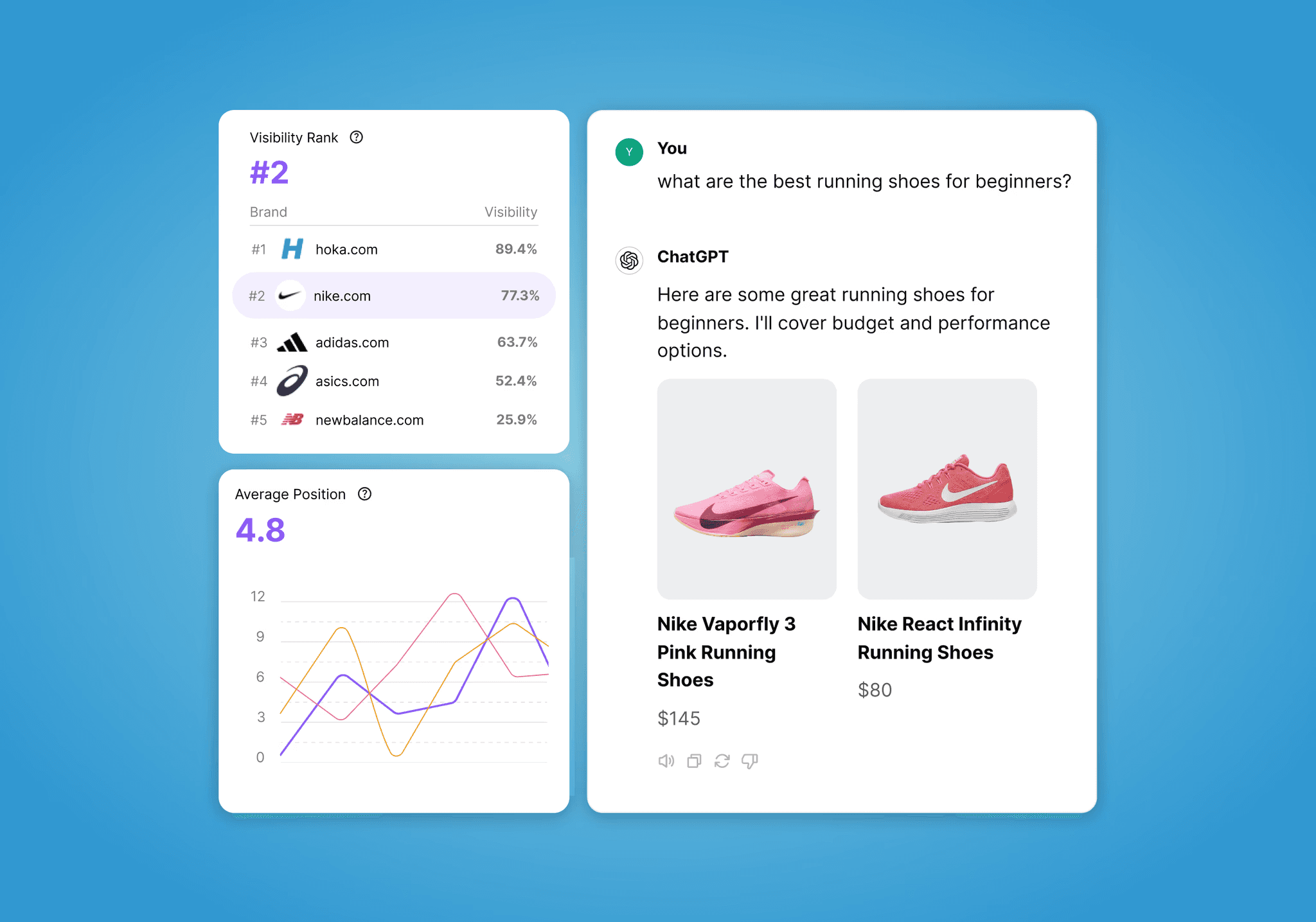
A critical warning for teams building measurement infrastructure: citation volumes can vary by 615x between platforms for the same brand. A tool that only tracks one or two AI engines will systematically underreport your true visibility gaps. Set a weekly monitoring cadence - citation volatility means monthly snapshots miss significant swings. The $77 million invested in AI visibility tooling during May-August 2025 alone validates this as a category enterprises are treating as infrastructure, not a nice-to-have. For implementation guidance, see AI visibility tracking for retail teams.
How Nudge Operationalizes AEO for Enterprise DTC Teams
Nudge is the only enterprise platform that unifies all four AEO pillars in a single suite - AI citation tracking, SKU-level catalog optimization, and shoppable prompt-aligned funnels - so DTC teams can control how AI assistants discover, compare, and convert their products end-to-end.
The fragmentation problem is real for enterprise teams: point tools for schema, separate dashboards for citation tracking, and no connection between AI visibility data and conversion outcomes. Nudge addresses each layer:
AI citation tracking: prompt-level, multi-platform monitoring across ChatGPT, Perplexity, Google AI Overviews, and Gemini - with the cross-platform coverage needed to avoid the 615x citation volume variance blind spot. See the AI search visibility platform.
SKU-level catalog optimization: automated detection and remediation of the schema errors affecting 89% of ecommerce sites, at scale for catalogs managing thousands to millions of SKUs.
Shoppable prompt-aligned funnels: landing experiences designed to convert AI-referred traffic at the destination - matching the specific prompt that drove the visit to the most relevant product content. See shoppable funnels.
Enterprise-grade infrastructure: SOC 2 compliance, SSO, and native integrations with PIM, OMS, and CDP systems - governance built for teams that cannot afford data leakage or manual workarounds at scale.
As Amos Ductan, SVP of Search at Razorfish, stated: 'AI search visibility is a leading indicator, because understanding where a brand is strong in AI search and where there are gaps helps predict performance everywhere else.' That framing captures why unified platform infrastructure matters: AI citation data is not just a marketing metric - it is an early warning system for overall commerce performance. For ROI analysis on AI visibility platforms, see AI visibility platform ROI for DTC brands, and for a platform comparison, see best AEO platforms for DTC brands.
Ready to Measure Your AI Citation Share? Book a demo!
Most DTC teams do not know which AI prompts are driving traffic to competitors right now. Nudge gives enterprise commerce teams prompt-level visibility across ChatGPT, Perplexity, Google AI Overviews, and Gemini - with SKU-level optimization and shoppable funnels to convert what you capture.
Frequently asked questions
What is the difference between AEO and SEO for ecommerce?
SEO optimizes for ranked link results in traditional search engines; AEO structures content so AI assistants cite it directly in generated answers. The two require different content formats, different measurement metrics (citation share vs. rankings), and different technical implementations (SKU-level schema vs. page-level optimization). Only 12% of URLs cited by AI engines rank in Google top 10, confirming they are separate disciplines that require separate strategies.
How do I get my products cited by ChatGPT and Perplexity?
Implement SKU-level structured data with specific machine-readable attributes - not generic adjectives like premium or professional, but precise specs like waterproof, USB-C, or sulfate-free. Add FAQ schema to product and category pages (pages with FAQ schema receive 2.7x more AI citations). Create content that directly answers conversational 20+ word prompts. Build a third-party citation footprint on Reddit, YouTube, and review platforms, since 48% of AI citations come from those channels rather than brand-owned sites.
Does AEO replace SEO, or do both strategies run in parallel?
Both run in parallel but serve different discovery moments. Traditional SEO still drives traffic from the 31% of users who prefer it as their primary source of insight; AEO captures the 44% of AI-powered search users who now prefer AI as their primary source. The technical foundations overlap - crawlability and E-E-A-T matter for both - but content structure, schema depth, and measurement differ significantly enough to require dedicated resourcing for each.
How do I measure whether my AEO efforts are working?
Track citation share by AI platform (ChatGPT, Perplexity, Google AI Overviews, Gemini), prompt-level visibility for your top commercial queries, AI-referred conversion rate, and revenue per AI visit. Avoid single-platform tracking: citation volumes vary by 615x between platforms for the same brand, meaning tools that only cover one or two engines will systematically underreport your true visibility gaps. Set a weekly monitoring cadence since only 30% of brands maintain consistent AI visibility over time.