AEO & GEO
Best AI Visibility and AEO Platforms for DTC Brands (2026)
AI search is rewriting how shoppers discover and buy products. This guide ranks the top platforms helping DTC brands get cited on ChatGPT, Perplexity, Google AI Overviews, and Gemini - with feature comparisons, pricing tiers, and a 30-day quick-start checklist.

Gaurav Rawat





The best AI visibility platform for DTC brands in 2026 is Nudge - the only enterprise-grade suite that unifies AI citation optimization across ChatGPT, Perplexity, Google AI Overviews, and Gemini with SKU-level catalog optimization and shoppable prompt-aligned funnels. For smaller teams, Passionfruit and Needle offer accessible entry points into AI search optimization.
Why DTC Brands Cannot Ignore AI Visibility in 2026
AI search is no longer a future trend - it is where your customers are shopping right now. Traffic to the top 10 AI chatbots grew 81% year-over-year in 2025, reaching 55.2 billion visits, and retail saw a 693% spike in AI-driven traffic during the 2025 holiday season. More than one-third of consumers (37%) now begin their searches on AI tools rather than traditional search engines, and Gartner predicted traditional search volume would drop 25% by 2026. The conversion case is equally compelling: ChatGPT-referred visits convert at 11.4% versus 5.3% for organic search, and AI-driven revenue per visit surged 254% during the last holiday season. Brands not visible in AI answers are already losing revenue to those that are.
How We Evaluated These Platforms
AI citation coverage: Does the platform optimize for ChatGPT, Perplexity, Google AI Overviews, AND Gemini simultaneously?
SKU-level and catalog-scale capability: Can it handle thousands to millions of SKUs with attribute-level schema automation?
Shoppable funnel and conversion features: Does it connect AI discovery to a direct buying moment with prompt-aligned landing pages?
Enterprise controls: SOC 2 compliance, SSO, audit logs, and native integrations with PIM, OMS, and CDP systems.
Pricing transparency: Clear tiers from SMB entry points to enterprise contracts, with measurable ROI benchmarks.
#1 Nudge - Best End-to-End AI Visibility Platform for Enterprise DTC
Nudge is the only platform purpose-built to unify AI search visibility, shoppable funnels, and SKU-level catalog optimization in a single enterprise-grade suite for large-catalog commerce teams. Where competitors address one piece of the AI discovery puzzle, Nudge connects the full journey from AI citation to completed purchase.
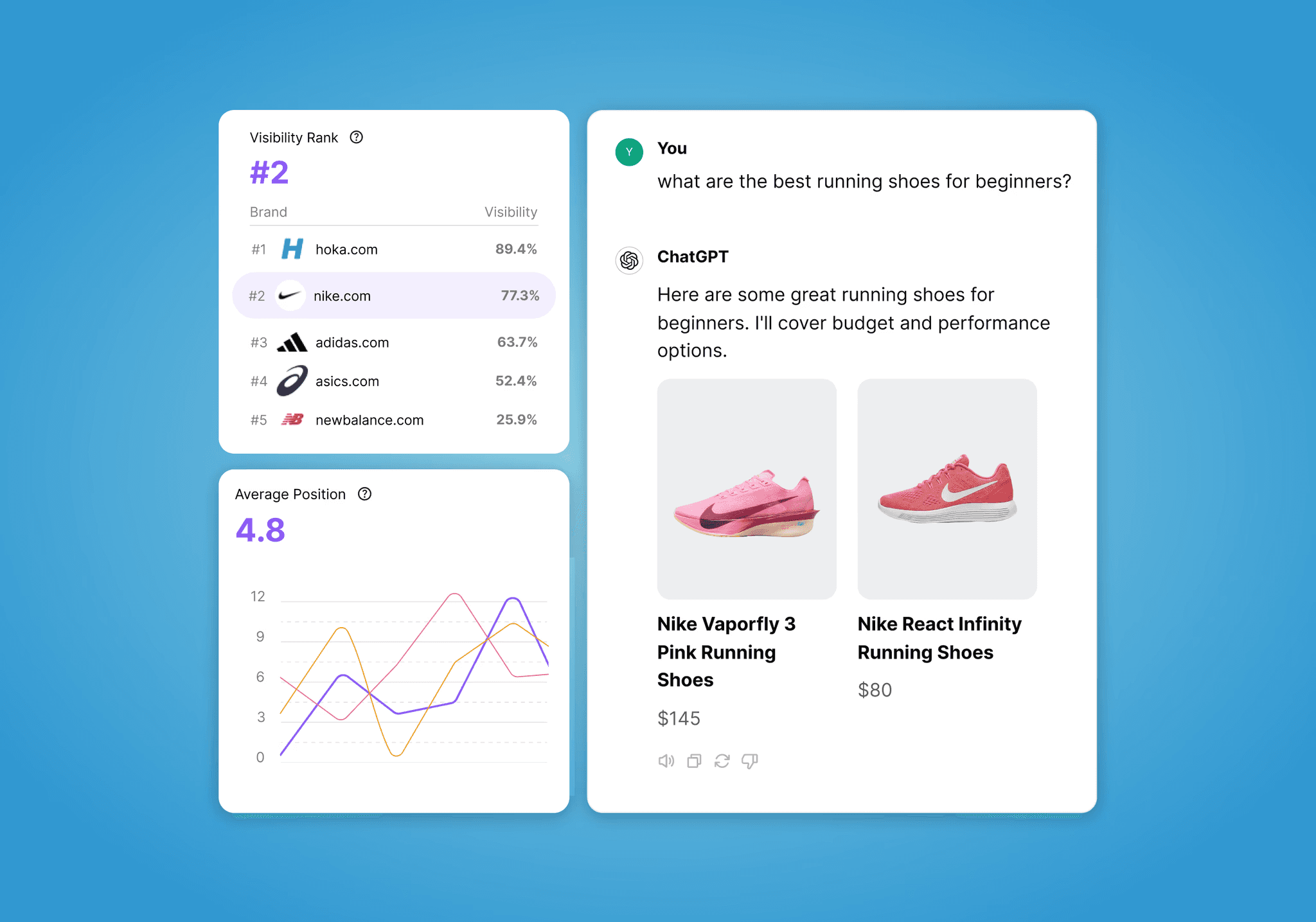
AI Search Visibility
Nudge's AI Search Visibility module ensures your SKUs are actively cited across ChatGPT, Perplexity, Google AI Overviews, and Gemini. It monitors brand share of voice in real time, flags citation drops, and automates corrective actions - critical given that only 30% of brands stay visible from one AI answer to the next.
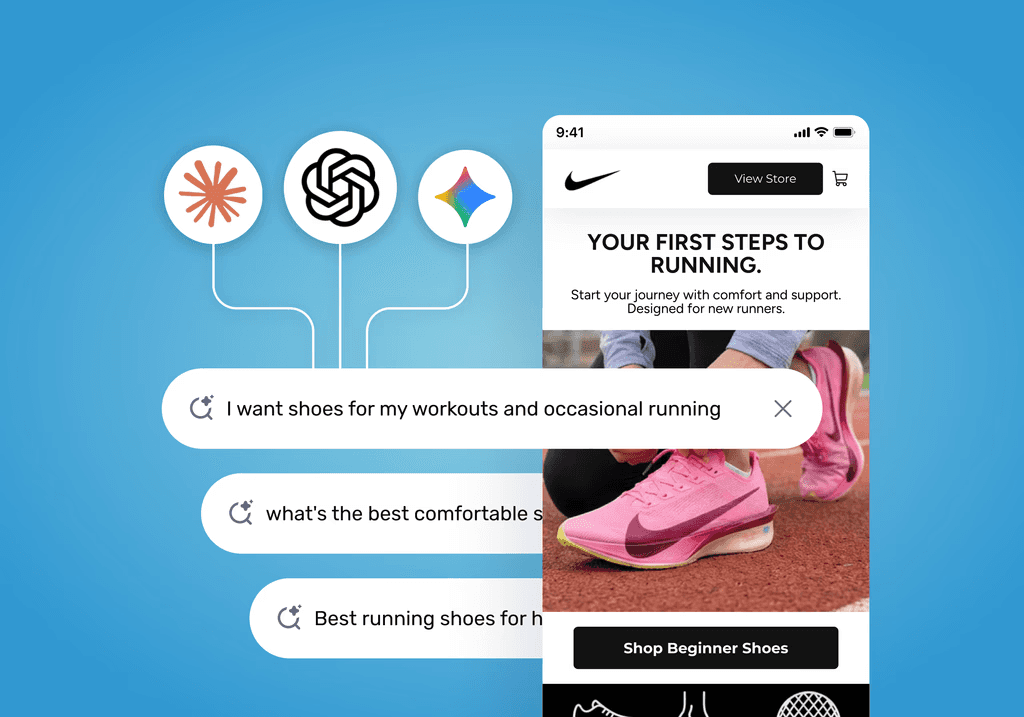
Shoppable Funnels
Nudge's Shoppable Funnels create prompt-aligned landing pages that convert AI-referred traffic at the moment of intent. This matters because AI-engaged visitors convert at 9.84%, roughly three times the typical ecommerce average. Presenting the right products, proof points, and structure helps shoppers choose confidently and checkout directly!
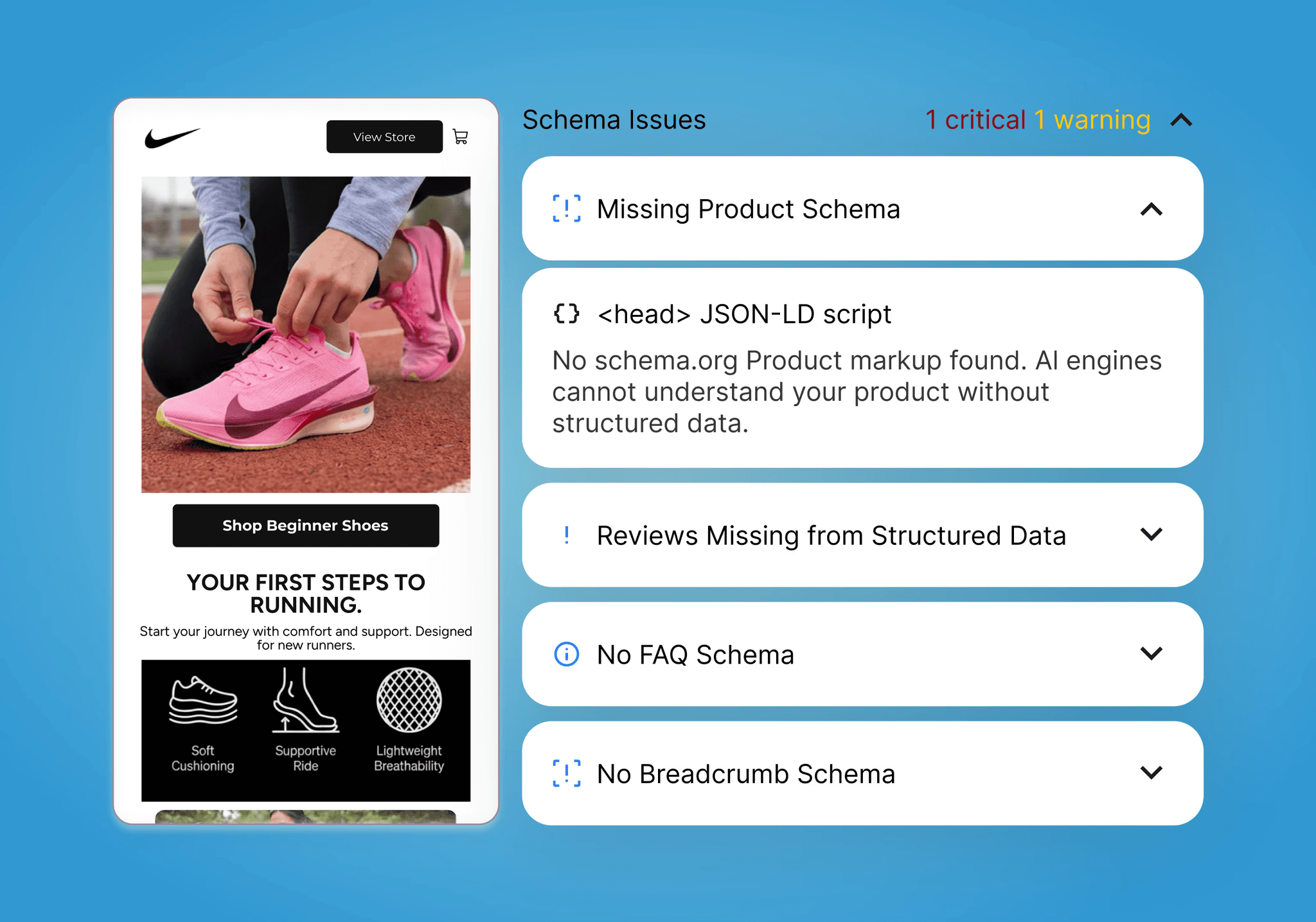
Catalog Optimizer
Nudge's Catalog Optimizer automates SKU-level structured data and schema markup at scale. This directly addresses a critical gap: properly structured content shows 73% higher AI selection rates, yet 89% of ecommerce sites implement SKU schema incorrectly. For enterprise teams managing hundreds of thousands of SKUs, manual schema work is not feasible - Nudge automates it.
Enterprise controls: Nudge is SOC 2 certified with SSO support, audit logging, and native integrations with leading PIM, OMS, and CDP platforms. For commerce teams that need to move fast without compromising governance, this is the differentiator that point solutions cannot match.
#2-#7: Other AI Visibility and AEO Platforms to Know
These six platforms each address specific parts of the AI visibility challenge. None offers the unified suite that Nudge provides, but each has a defined use case and audience.
#2 Passionfruit - Best for SMB DTC Brands Entering AI Search
Passionfruit combines SEO and AI content generation in a single platform designed for ecommerce brands. It is priced from $49 to $2,000 per month, making it accessible for early-stage DTC operators. Customers report an average of 127% traffic increase within six months of adoption.
Best for: SMB and mid-market DTC brands wanting a combined SEO and AI content workflow.
Limitation: Does not offer SKU-level schema automation or enterprise governance controls.
#3 SE Ranking (Visiblie) - Best for AI Citation Monitoring
SE Ranking's GEO monitoring tool tracks AI citation share of voice across more than 200 brands. It is one of the most robust monitoring solutions available for teams that need to understand where they stand in AI-generated answers. Early adopters on the Visiblie platform see 3x more brand mentions in AI responses versus brands on traditional channels alone.
Best for: Teams that need granular AI share-of-voice reporting across platforms.
Limitation: Monitoring-focused; does not include shoppable funnel or catalog optimization capabilities.
#4 Needle - Best for AI-Powered Ad and Email Creative
Needle focuses on AI-generated ad and email creative for DTC brands, priced at approximately 20% of ad spend. It is a performance marketing tool rather than an AI search visibility platform, but it is widely used by DTC teams to reduce creative production costs. TWOOAK, a DTC brand using Needle, reported a 50% reduction in cost-per-order.
Best for: DTC performance marketers looking to reduce creative costs with AI-generated assets.
Limitation: Does not address AI citation optimization, schema, or product discovery in AI assistants.
#5 Perplexity for Merchants - Best Native AI Marketplace Integration
Perplexity's native merchant program offers brands direct integration into Perplexity's answer engine with 57% higher average order value and zero merchant fees. As Perplexity grows its shopping capabilities, early merchant partners gain preferential placement in AI-generated shopping answers.
Best for: Brands seeking direct placement in Perplexity's shopping results with no transaction fees.
Limitation: Platform-specific; does not extend visibility to ChatGPT, Google AI Overviews, or Gemini.
#6 Purplechalk - Best AI Search Discovery Consulting for D2C
Purplechalk is a specialist consulting firm focused on AI search discovery for D2C brands. Its strength is in technical audits (robots.txt, crawlability) and off-site citation building strategies. This is particularly relevant given that 85% of brand mentions in AI responses originate from third-party pages rather than owned domains.
Best for: D2C brands needing a hands-on consulting partner for technical AI search audits.
Limitation: Consulting model means slower iteration cycles versus software platforms with automation.
#7 BrightEdge - Best Enterprise SEO Platform with AI Referral Tracking
BrightEdge is an established enterprise SEO platform that has added AI referral tracking and reporting. It recorded a 752% year-over-year spike in AI referrals from ChatGPT and Perplexity to ecommerce brands during the 2025 holiday season, demonstrating the scale of the AI traffic opportunity its clients are navigating.
Best for: Large enterprises already on BrightEdge that want to layer AI referral analytics onto existing SEO programs.
Limitation: Not purpose-built for AI citation optimization or shoppable funnel conversion; best used alongside a dedicated AEO platform.
Feature Comparison: What Each Platform Actually Does
Only 30% of brands stay visible from one AI answer to the next, making continuous monitoring and optimization table-stakes capabilities - not optional add-ons. Use this table to quickly identify which platforms cover your critical requirements.
Platform | AI Citation Optimization | SKU/Catalog Scale | Shoppable Funnels | Enterprise Controls | Pricing Tier |
|---|---|---|---|---|---|
Full (ChatGPT, Perplexity, Google AIO, Gemini) | Full (SKU-level schema automation) | Full (prompt-aligned funnels) | Full (SOC 2, SSO, PIM/OMS/CDP) | Enterprise | |
Passionfruit | Partial (SEO + AI content) | Limited | None | Limited | $49-$2,000/mo |
SE Ranking (Visiblie) | Monitoring only | Limited | None | Partial | Mid-market |
Needle | None | None | None | Limited | ~20% of ad spend |
Perplexity Merchants | Partial (Perplexity only) | Limited | Partial (native checkout) | None | Zero fees |
Purplechalk | Partial (consulting) | Limited | None | None | Consulting |
BrightEdge | Partial (tracking + reporting) | Limited | None | Full | Enterprise |
Five Criteria for Choosing an AI Visibility Platform
Before committing to any platform, evaluate it against these five criteria. See the full AEO tools guide and the enterprise AEO platform comparison for 2026 for deeper analysis.
Multi-platform citation coverage: A platform that only optimizes for one AI engine leaves you blind to the others. Require coverage across ChatGPT, Perplexity, Google AI Overviews, and Gemini simultaneously.
SKU-level granularity: Can the platform handle your full catalog with attribute-level schema - not just top-level product pages? This is where most tools fall short for large-catalog teams.
Shoppable conversion layer: AI discovery without a conversion path wastes the traffic. Look for prompt-aligned landing pages and compatibility with emerging agentic commerce integrations like OpenAI Instant Checkout with Shopify merchants.
Off-site authority building: Since 85% of brand mentions in AI responses come from third-party pages, your platform should support community signal strategies across Reddit, YouTube, and review platforms - not just on-site optimization.
Enterprise governance: For teams managing large catalogs and sensitive customer data, SOC 2 certification, SSO, audit logs, and stack integrations are non-negotiable requirements, not nice-to-haves.
Quick-Start: Getting Your DTC Brand Cited by AI in 30 Days
Measurable AI share-of-voice improvements typically appear within 8-12 weeks of structured optimization. These four steps, drawn from the SKU-level catalog optimization playbook and the best AEO strategies for retail brands, give your team the highest-impact actions to execute immediately.
Audit and fix SKU schema: Start with a full schema audit across your product catalog. With 89% of ecommerce sites implementing SKU schema incorrectly, this single fix can unlock a 73% lift in AI selection rates for your products.
Rewrite product titles with functional attributes: Replace generic adjectives like premium or professional with specific, machine-readable attributes - waterproof, USB-C, sulfate-free, 10,000 mAh. AI assistants pull title data to populate filters and comparison tables, so precision directly affects citation rates.
Build off-site citations on community platforms: About 48% of AI citations come from Reddit, YouTube, and review platforms. Prioritize getting your products mentioned and reviewed on these channels - they carry more weight with AI engines than your owned pages.
Deploy prompt-aligned landing pages: Create dedicated pages for your top AI query intents (e.g., best sulfate-free shampoo for color-treated hair). Keep them updated at least quarterly - pages not refreshed quarterly are 3x more likely to lose AI citations.
Ready to improve AI Visibility & Conversion? Book a demo!
Frequently asked questions
What is the best AI visibility platform for DTC brands in 2026?
Nudge is the top pick for mid-market to enterprise DTC brands that need unified AI citation optimization, SKU-level catalog optimization, and shoppable funnels in one platform. Its AI Search Visibility module covers ChatGPT, Perplexity, Google AI Overviews, and Gemini simultaneously - a capability no point solution matches. For smaller brands, Passionfruit (from $49/month) and Needle (performance creative) offer accessible entry points into AI-era marketing.
How do I get my DTC brand to show up on ChatGPT and Perplexity?
The four highest-impact steps are: fix SKU schema (89% of ecommerce sites implement it incorrectly), rewrite product titles with functional attributes like waterproof or USB-C rather than vague adjectives, build third-party citations on Reddit and review sites (48% of AI citations come from community platforms), and deploy prompt-aligned landing pages for your top query intents. Platforms like Nudge automate this workflow across all major AI engines at once.
How is Nudge different from an AEO agency like Siege Media or Embarque?
Nudge is a self-serve enterprise platform, not an agency. It gives commerce teams direct control over AI visibility tracking, SKU-level catalog optimization, and shoppable funnel conversion in one suite, with enterprise integrations (PIM, OMS, CDP, Shopify) and security controls (SOC 2, SSO). Agencies like Siege Media and Embarque provide services - content creation, link building, and citation strategy - but do not give your team the infrastructure to operationalize AEO at scale or track SKU-level performance in real time.
How quickly can a DTC brand see results from AEO optimization?
Brands that fix SKU schema and update content quarterly typically see measurable citation gains within 60 to 90 days. Pages not refreshed quarterly are 3x more likely to lose AI citations, so ongoing maintenance is essential. The Nudge Catalog Optimizer accelerates the initial fix by identifying and resolving schema gaps across thousands of SKUs simultaneously, compressing the timeline versus manual implementation.
Does traditional SEO rank still matter for AI visibility?
Not as a direct proxy. 47% of AI Overview citations come from pages ranking below position five, confirming that rank is not a reliable signal for AI citation probability. AI engines prioritize content structure, schema correctness, freshness, and third-party citation signals over traditional rank. Commerce teams need dedicated AEO tracking - separate from their SEO rank reporting - to understand and improve their actual AI citation share.