AI Search Visibility
5 Essential Strategies to Increase AI Search Visibility
This article is the only guide you need to understand key strategies to enhance your brand’s visibility in AI search results and convert that intent better.

Sakshi Gupta





AI assistants are becoming the default starting point for product research and shopping questions. Traditional search volume is projected to drop as users move toward conversational interfaces, with Gartner predicting a 25 percent decline in search engine volume by 2026 due to AI chatbots and virtual agents. If you run ecommerce growth, this shift changes how you measure and increase visibility in AI search across ChatGPT, Perplexity, Claude, and Gemini.
This article outlines five essential strategies for AI search visibility enhancement, and how you can operationalize them with Nudge to turn AI-driven intent into shoppable, prompt-aligned funnels.
Working definition: AI search visibility means being mentioned in the answer, cited as a source, recommended as the product or brand, and chosen as the next-step action the model suggests, as described by Pew Research Center’s analysis of AI summaries.
1. Understanding AI Search Dynamics:
From Blue Links To Shortlists
Traditional SEO optimized for ranking in a list of links. AI search engines compress that list into a synthesized answer. Pew’s research on Google AI summaries shows that AI systems summarize and reduce clicks, which directly affects how often users reach your site.
At the same time, Google’s AI Overviews now reach more than 1.5 billion people every month, according to coverage from The Verge. This is not a niche channel. It is a massive discovery surface where your brand either appears in the shortlist or disappears from the journey.
Why Visibility In AI Answers Is Different
AI answers collapse discovery, evaluation, and purchase into a single step. When a user asks “best moisturizer for sensitive skin,” the assistant:
Interprets the intent behind the prompt.
Pulls from multiple sources, often third-party content.
Generates a narrative and a shortlist of products.
Suggests next steps, such as visiting a specific site.
Even if you hold the number one organic result, you can lose clicks when an AI summary sits above it. Ahrefs’ analysis of AI Overviews found that even top organic results see reduced click-through when AI content appears first. Search Engine Land also reports that AI Overviews can drive a 61 percent drop in organic CTR and a 68 percent drop in paid traffic.
How Nudge Maps AI Search Dynamics
You cannot manage what you cannot see. Nudge’s AI Search Visibility capabilities focus on three questions:
Where do AI models already mention and cite your brand?
How do they describe your products and use cases?
Which prompts create high-intent, commerce-ready traffic?
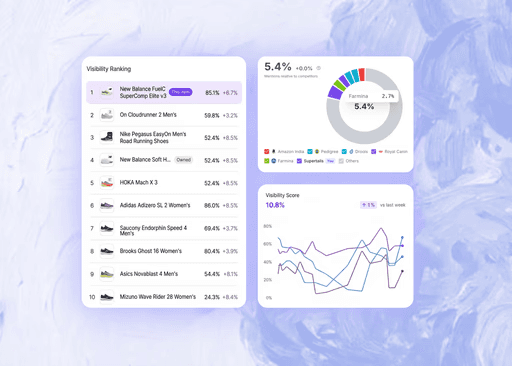
By tracking how different assistants respond to category prompts, Nudge helps you understand your current AI search presence and identify the visibility gap: the places where you should appear but do not.
2. Optimizing Content For AI Discovery:
Design Content For Prompts, Not Keywords
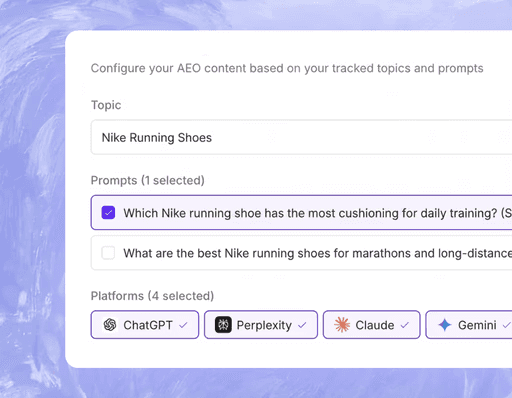
AI assistants respond to natural-language prompts like “best running shoes for flat feet under $150,” not isolated keywords. To optimize AI search presence, you need intent-aligned content that matches real questions buyers ask.
Key principles:
Write in question-and-answer formats that map to common prompts.
Cover use cases, skin types, fit profiles, or scenarios, not only product features.
Clarify who the product is for, when to use it, and why it is different.
Google’s AI Overviews documentation emphasizes high-quality, helpful content and clear structure, which also benefits AI assistants that rely on web content for grounding.
Use Structured Data & Clear Product Attributes
AI models rely on structured signals to interpret your catalog. While each assistant uses its own retrieval stack, consistent patterns help:
Use structured data for products, reviews, and FAQs.
Standardize attributes such as size, material, skin type, and use-case tags.
Ensure pricing, availability, and key specs are machine-readable.
This structure makes it easier for AI systems to match your SKUs to specific prompts like “lightweight waterproof hiking boots for wide feet.”
How Nudge Operationalizes AI-Ready Content
Nudge is built around AI search visibility enhancement. It helps you:
Identify high-value prompts across ChatGPT, Perplexity, Claude, and Gemini.
Design shoppable, intent-aligned landing experiences for those prompts.
Align product attributes and on-site copy with AI language patterns.
To go deeper, you can review Nudge’s guides on AI search visibility tactics, AI search visibility tools & tracking, and best AEO tools for 2026. These resources focus on how to create content that AI models prefer and how to measure the impact.

3. Tracking AI-Driven Traffic In GA4:
Why You Need An AI Traffic Lens
Right now, AI referrals are a small slice of traffic. Passionfruit’s analysis of GA4 setups suggests that AI referrals currently sit around a fraction of a percent of total traffic, but could grow significantly over the next few years. If that share increases, you need a way to attribute revenue to AI search and justify investment.
Without a dedicated view, AI-driven visitors blend into “direct” or “referral” traffic, and you cannot tell which prompts or assistants are driving high-intent sessions.
Step-By-Step: GA4 Setup For AI Referrals
Use this workflow to measure and increase visibility in AI search with clean analytics:
Standardize UTM parameters for AI sources. Use source to capture the assistant, such as chatgpt, perplexity, claude, or gemini. Use medium to flag AI referrals, such as ai_referral. Passionfruit’s GA4 guide recommends patterns like source=perplexity and medium=ai_referral to ensure clean reporting.
Use source to capture the assistant, such as chatgpt, perplexity, claude, or gemini.
Use medium to flag AI referrals, such as ai_referral.
Tag AI-specific landing experiences. Add unique campaign values for major prompts, such as best-moisturizer-sensitive-skin. Use consistent naming so you can compare performance across assistants.
Add unique campaign values for major prompts, such as best-moisturizer-sensitive-skin.
Use consistent naming so you can compare performance across assistants.
Create a dedicated AI Traffic channel in GA4. Best-practice recommendations suggest building a custom channel grouping for AI traffic, so you can isolate sessions where medium=ai_referral and analyze behavior separately.
Monitor engagement and conversion by assistant. Compare bounce rate, time on site, and conversion for ChatGPT, Perplexity, Claude, and Gemini. Identify which assistants send the highest-intent visitors for each category.
Compare bounce rate, time on site, and conversion for ChatGPT, Perplexity, Claude, and Gemini.
Identify which assistants send the highest-intent visitors for each category.
How Nudge Connects AI Visibility To Revenue
Nudge helps you go beyond raw traffic. With its focus on AI search visibility and product performance, Nudge lets you:
Map which prompts and assistants are driving AI referrals.
Align those referrals to shoppable funnels and product experiences.
Measure conversion, AOV, and product-level performance from AI-driven sessions.
Combined with GA4, this gives you a full loop: from AI answer visibility to on-site behavior to revenue, so you can prioritize the prompts where improved visibility will have the largest commercial impact.
4. Leveraging AI Search Funnels:
What AI Search Funnels Look Like
An AI search funnel starts inside the answer, not on your homepage. When someone asks “best vitamin C serum for dark spots,” the assistant might:
List three to five recommended products.
Describe pros, cons, and ideal use cases.
Provide one or two links for next steps.

If you win that link, the landing experience must mirror the AI narrative. Generic PLPs or homepages create a conversion gap. Shoppers expect to see a curated, prompt-aligned view of your products, not a broad category grid.
Design Shoppable, Prompt-Aligned Funnels
To increase visibility in AI search and capture value, you should:
Create landing pages that mirror specific prompts and use cases.
Curate a small, high-relevance set of SKUs instead of full catalogs.
Re-state the shopper’s problem and show how each product solves it.
Include comparison blocks, routines, or bundles aligned with the prompt.
These shoppable funnels function as the “answer layer” on your own site, giving AI assistants a strong, structured target to recommend and link to.
How Nudge Builds AI Search Funnels
Nudge treats shoppable AI search funnels as a core content format, not a side project. With Nudge Shoppable Funnels, you can:
Turn high-intent prompts into dedicated, conversion-optimized funnels.
Dynamically pull in the best-fit SKUs based on attributes and performance.
Test different layouts, copy, and product mixes for each prompt.
Because Nudge connects AI visibility, funnel design, and product performance, you can see which funnels drive the most revenue from AI referrals and iterate quickly.
5. Improving Product Recommendations In AI Searches:
Why Product Data Drives AI Recommendations
AI systems choose products based on how well they map to the user’s intent. If your product data is incomplete, inconsistent, or vague, you lose recommendation share to brands with clearer attributes and claims.
Key levers include:
Attributes that match real-world use cases, such as “sensitive skin,” “wide feet,” or “carry-on compatible.”
Clear, concise descriptions that explain benefits and trade-offs.
Evidence-backed claims, where applicable, and honest positioning.
Most AI shopping answers still pull heavily from third-party sources. If those sources describe your products poorly, AI will follow. You need to own the way AI describes your catalog.
Optimize Product Attributes For AI Matching
To improve AI recommendations, focus on:
Attribute coverage. Ensure every SKU has complete data for material, fit, use case, and key differentiators.
Attribute language. Use the same phrases customers use in prompts, such as “non-comedogenic,” “pet-friendly,” or “machine-washable.”
On-site explanation. Translate attributes into clear copy on PDPs, FAQs, and comparison tables so AI assistants can quote and summarize accurately.
How Nudge Tunes Product Data For AI Search
Nudge’s AI shoppable funnel capabilities help you connect product data quality to AI visibility. Nudge lets you:
See how often each product appears in AI shopping answers for target prompts.
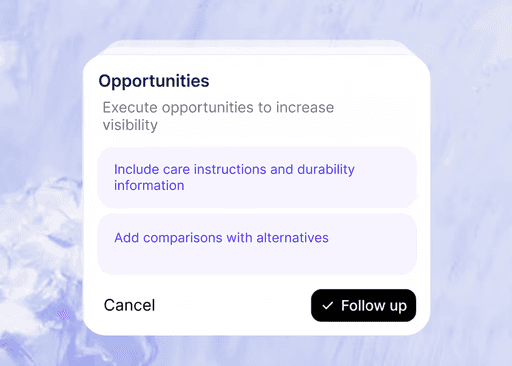
Identify attribute gaps that reduce your chance of being recommended.
Test alternative positioning and messaging to improve match quality.
Because Nudge links product performance with AI search visibility, you can prioritize attribute and copy updates where they will move recommendation share the most.
Comparison: Nudge vs Generic AEO Tools:
When you evaluate AEO solutions, focus on how they handle the full AI commerce funnel: discovery, evaluation, and purchase.
Capability | Nudge | Generic AEO Tools |
|---|---|---|
Maps how AI models mention, cite, and recommend your brand across prompts. | Often limited to content scoring or keyword-style recommendations. | |
Builds prompt-aligned, conversion-optimized funnels tied to specific AI queries. | Usually stops at content creation without dedicated funnel experiences. | |
Product Performance | Connects SKU-level attributes and positioning to AI recommendation share. | Focuses on generic SEO metrics, not AI-driven product visibility. |
Analytics & Tracking | Aligns AI visibility data with GA4, UTM frameworks, and revenue outcomes. | Provides limited guidance on AI-specific attribution and tracking. |
If you want a deeper breakdown of the AEO landscape, Nudge’s overview of best AEO tools for 2026 outlines where traditional tools stop and where commerce-focused platforms need to take over.
FAQs:
How Does Nudge Help Increase AI Search Visibility?
Nudge helps you increase AI search visibility by connecting three layers:
It shows where and how AI assistants already mention, cite, and recommend your brand.
It helps you create shoppable, prompt-aligned funnels that AI can confidently link to.
It optimizes product attributes and positioning so your SKUs win more recommendations.
Because Nudge tracks AI-driven traffic and product performance, you can see which visibility gains actually translate into revenue.
What Are AI Search Funnels And Why Are They Important?
AI search funnels are tailored content paths that start with a specific prompt and lead to a curated, shoppable experience. They are important because:
AI assistants compress the funnel into a single answer and a few links.
Shoppers arrive with a clear problem and expect an equally clear solution.
Generic PLPs waste that intent and drive lower conversion.
Nudge lets you design these funnels around real prompts, align them with your product data, and continuously test for higher conversion.
How Can I Track AI Referrals In Google Analytics?
To track AI referrals in GA4, you should:
Use UTM parameters that identify each assistant, such as source=perplexity and medium=ai_referral, as recommended in Passionfruit’s GA4 tracking guide.
Build a dedicated AI Traffic channel in GA4 so you can isolate and analyze AI-driven sessions.
Tag AI-specific landing experiences with campaign names that map back to prompts.
Nudge supports this by aligning your AI visibility insights with your UTM strategy, so you can see which AI answers and prompts are generating revenue.
Why Is Optimizing Product Data Crucial For AI Search?
Optimizing product data is crucial because AI systems select products based on how well they match the user’s intent. If attributes are missing, unclear, or inconsistent, AI assistants are less likely to recommend your SKUs.
Accurate, detailed product data helps AI understand:
Who the product is for.
Which problems it solves.
How it compares to alternatives.
Nudge helps you spot attribute gaps, refine positioning, and connect those improvements to actual changes in AI recommendation share, so product data work translates into measurable visibility gains.
Next Steps:
AI search is quickly becoming a major product discovery channel. BrightEdge data on AI Overviews shows that overall search usage can grow even as AI reduces individual click-through, which means more shoppers will see AI answers before they see your site.
If you want to win in this environment, you need to:
Understand how AI assistants already describe and surface your brand.
Build shoppable, prompt-aligned funnels that convert AI-driven intent.
Optimize product data so your SKUs win more recommendations.
Instrument GA4 and UTMs to track AI referrals and revenue.
Nudge is built specifically for growth-oriented commerce brands that want to own their presence inside AI search and capture the revenue from AI-driven intent.
Ready to rank on AI search engines and convert that intent? Book a demo!