Comparisons
AI Ecommerce Visibility Tools: The Complete 2026 Guide
Discover how AI visibility tools for ecommerce actually differ - from analytics-only monitoring to full-funnel platforms that drive conversions. Compare top platforms, features, and pricing to find the right fit for your catalog.

Kanishka Thakur





Key Takeaways
AI visibility tools split into two distinct categories: analytics-only platforms that track brand mentions across ChatGPT, Perplexity, and Google AI Overviews, and full-funnel platforms that also optimize product feeds, schema, and shoppable funnels to drive conversions.
AI-referred traffic already converts 31% better than other channels and delivers 254% higher revenue per visit (Adobe Analytics, 2025), making conversion capability - not just monitoring - the critical differentiator when choosing a tool.
Citation volumes for the same brand can vary by 615x across AI platforms, so any tool tracking fewer than five engines (ChatGPT, Perplexity, Google AI Overviews, Gemini, Claude) will systematically underreport your true visibility gaps.
SKU-level catalog optimization - including structured data, FAQ schema, and product feed hygiene - is the highest-leverage action ecommerce teams can take; pages with FAQ schema receive 2.7x more AI citations and structured data triples GPT-4 product accuracy.
Enterprise brands need tools that go beyond dashboards: platforms combining AI search visibility, prompt-aligned shoppable funnels, and catalog optimization close the loop from AI discovery to purchase without fragmented tooling.
Most AI visibility tools stop at the dashboard - they tell you where your brand appears in ChatGPT or Perplexity responses, but offer no path from citation to conversion. The tools that actually move revenue go further: they optimize your catalog for AI citation and connect AI-referred traffic to shoppable, prompt-aligned funnels.
Why AI Visibility Is Now a Revenue Channel, Not Just a Metric
AI-driven traffic to retail sites grew 693% year over year according to Adobe Analytics, and that traffic converts at rates traditional channels cannot match. This is no longer a monitoring exercise - it is a primary acquisition channel with measurable revenue impact.
The numbers frame the urgency clearly. AI referrals convert 31% better than other traffic sources and deliver 254% higher revenue per visit (Adobe, 2025 holiday season). ChatGPT-referred visits convert at 11.4% versus 5.3% for organic search.
The competitive structure makes AI visibility a zero-sum shelf-space battle. LLMs cite only 2 to 7 domains per response on average, with the top 5 domains capturing 38% of all AI citations. There is no page two. If your brand is not in that cited set, you are invisible - and a competitor is capturing the conversion.
The Two-Category Taxonomy: Analytics Platforms vs. Full-Funnel Platforms
The AI visibility market divides cleanly into two categories. Understanding which type you are evaluating is the first step in any platform decision.
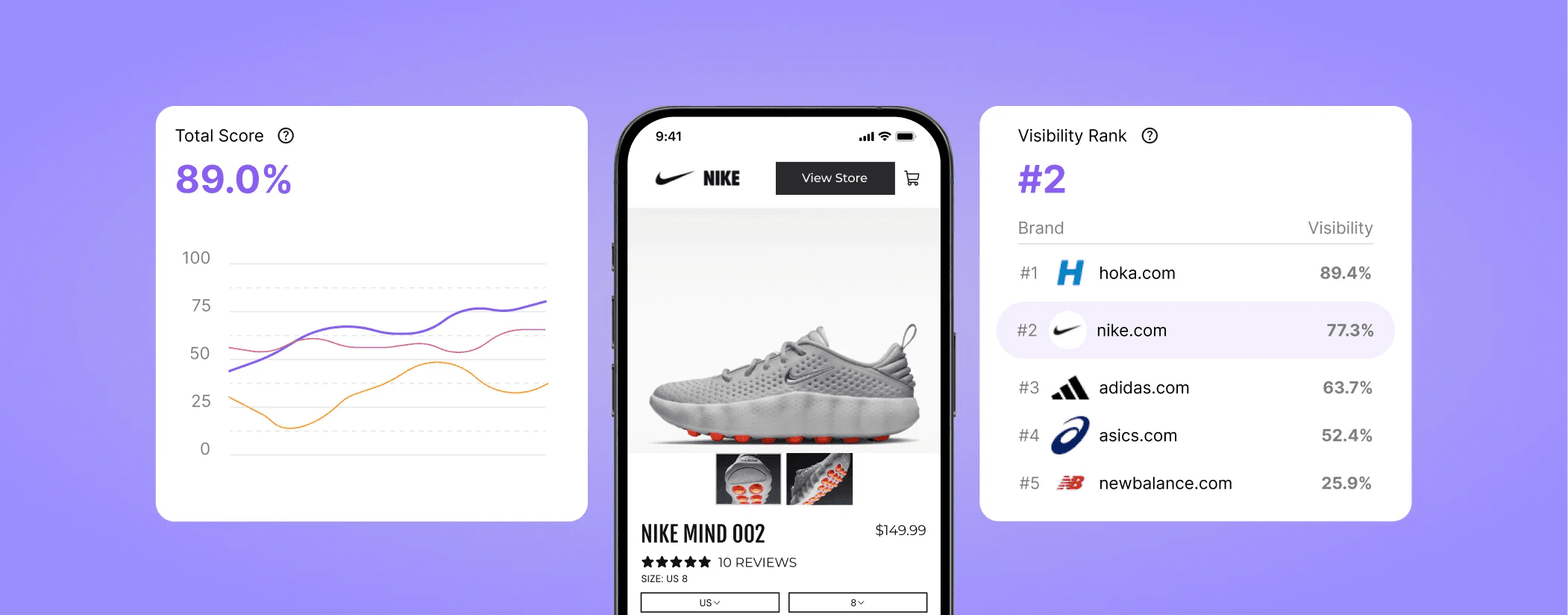
Analytics-only platforms: Track brand mentions, citation share, and sentiment across AI engines. They surface where you appear and how often, but stop at the dashboard. Examples include Profound, SE Ranking AI Visibility, Semrush AI Visibility Toolkit, and Brandi.
Full-funnel platforms: Combine visibility monitoring with catalog optimization, schema remediation, and shoppable conversion surfaces. They answer not just "where do we appear?" but "how do we get cited more, and how do we convert that traffic?" Nudge sits in this category.
Analytics-only tools hit a ceiling quickly. Once you know your citation gaps, they offer limited guidance on closing them. For teams managing large catalogs, this is a critical limitation: 89% of ecommerce sites implement SKU schema incorrectly, meaning the optimization work - not just the reporting - is where most brands need the most help.
Head-to-Head Comparison: 8 Leading AI Visibility Platforms
Citation volumes can vary by 615x across platforms for the same brand, making multi-engine tracking a non-negotiable criterion. The table below evaluates eight platforms against the criteria that matter most for ecommerce teams.
Platform | AI Engines Tracked | SKU/Catalog Optimization | Shoppable Funnels | Schema Auditing | Key Integrations | Pricing Tier | Best For |
|---|---|---|---|---|---|---|---|
Nudge | ChatGPT, Perplexity, Google AI Overviews, Gemini, Claude + more | Yes - SKU-level | Yes - prompt-aligned | Yes | Shopify, PIM, OMS, CDP | Enterprise (custom) | Enterprise retailers needing full-funnel: visibility + optimization + conversion |
Profound | 10+ engines incl. ChatGPT, Claude, Perplexity, Gemini, Copilot, DeepSeek, Grok, Meta AI | No | No | Limited | Enterprise analytics stack | Enterprise (custom) | Enterprise analytics and brand monitoring at scale |
SE Ranking AI Visibility | ChatGPT, Perplexity, Google AI Overviews, Gemini | No | No | No | GA4, Search Console | Agency-tier (per seat) | Agencies needing white-label AI monitoring |
Semrush AI Visibility Toolkit | ChatGPT, Perplexity, Google AI Overviews, Gemini | No | No | No | Semrush suite | $199/mo Starter (5 sites, 50 prompts) | SEO teams extending into AI monitoring |
Brandi | ChatGPT, Perplexity, Gemini, Claude | No | No | No | Limited | Mid-market (subscription) | Brand specialists focused on GEO/AEO tracking |
Alhena AI | ChatGPT, Google AI Overviews | Limited | Via AI shopping assistant | No | Shopify, Klaviyo | Mid-market (subscription) | DTC brands wanting AI shopping assistant + support concierge |
Passionfruit | ChatGPT, Perplexity, Google AI Overviews | No | No | No | GA4, Shopify | SMB/Mid-market | Mid-market DTC brands tracking AEO/GEO with commerce analytics sync |
Brandi (mybrandi.ai) | ChatGPT, Perplexity, Gemini, Claude | No | No | No | Limited | Mid-market | Brand-focused AI visibility and share-of-voice monitoring |
Category verdict - Analytics: Profound leads for enterprise-scale monitoring across the broadest engine set, while SE Ranking AI Visibility and Semrush suit agencies and SEO teams adding AI tracking to existing workflows. Category verdict - Full-funnel: Nudge is the only platform in this comparison that unifies AI search visibility, SKU-level catalog optimization, and prompt-aligned shoppable funnels in a single enterprise suite - closing the gap between AI discovery and purchase that analytics-only tools leave open.
What Actually Drives AI Citations: Four Optimization Levers That Matter
Citation share is not random - it is driven by four concrete, measurable levers. The platforms that help you pull these levers are worth far more than those that only report on the outcome.
1. Structured Data and Schema
This is the highest-leverage technical action available. Structured data gives GPT-4 a 3x accuracy jump - from 16% to 54% correct responses - directly improving how AI engines represent your products. Pages with FAQ schema receive 2.7x more AI citations. Given that 89% of ecommerce sites implement SKU schema incorrectly, schema auditing is the necessary first step on any platform - not an optional add-on.
2. Product Feed Quality
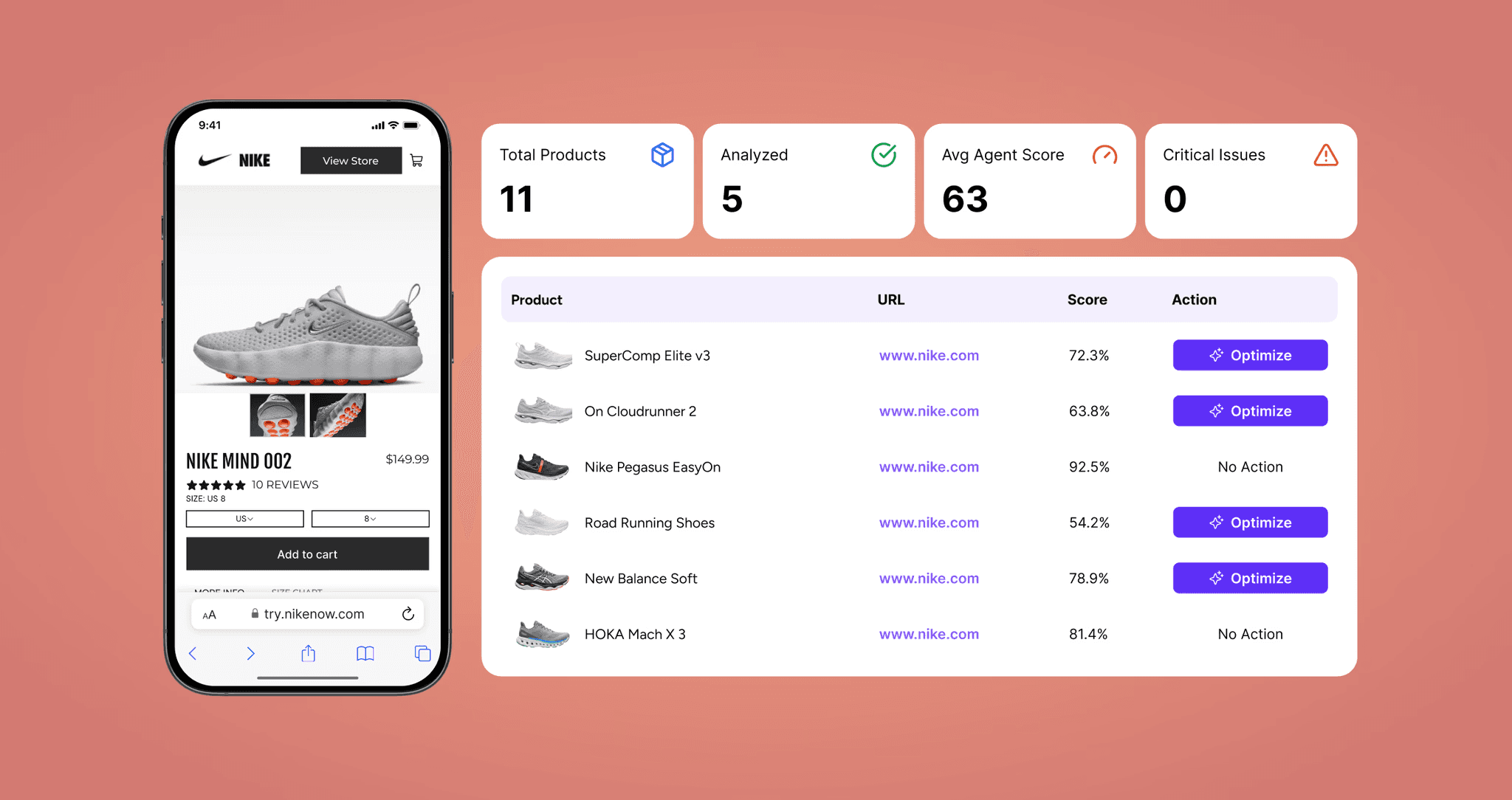
AI shopping assistants - including ChatGPT Shopping, Perplexity Shopping, and Google AI Overviews - prioritize verifiable logistics data when surfacing products. Delivery speed, fulfillment accuracy, return policy transparency, and in-stock status are all signals that influence whether your SKUs appear in AI-generated product recommendations. Feed hygiene is not a backend concern; it is a front-line visibility lever. Learn more about SKU-level catalog optimization for AI.
3. Content Formatting
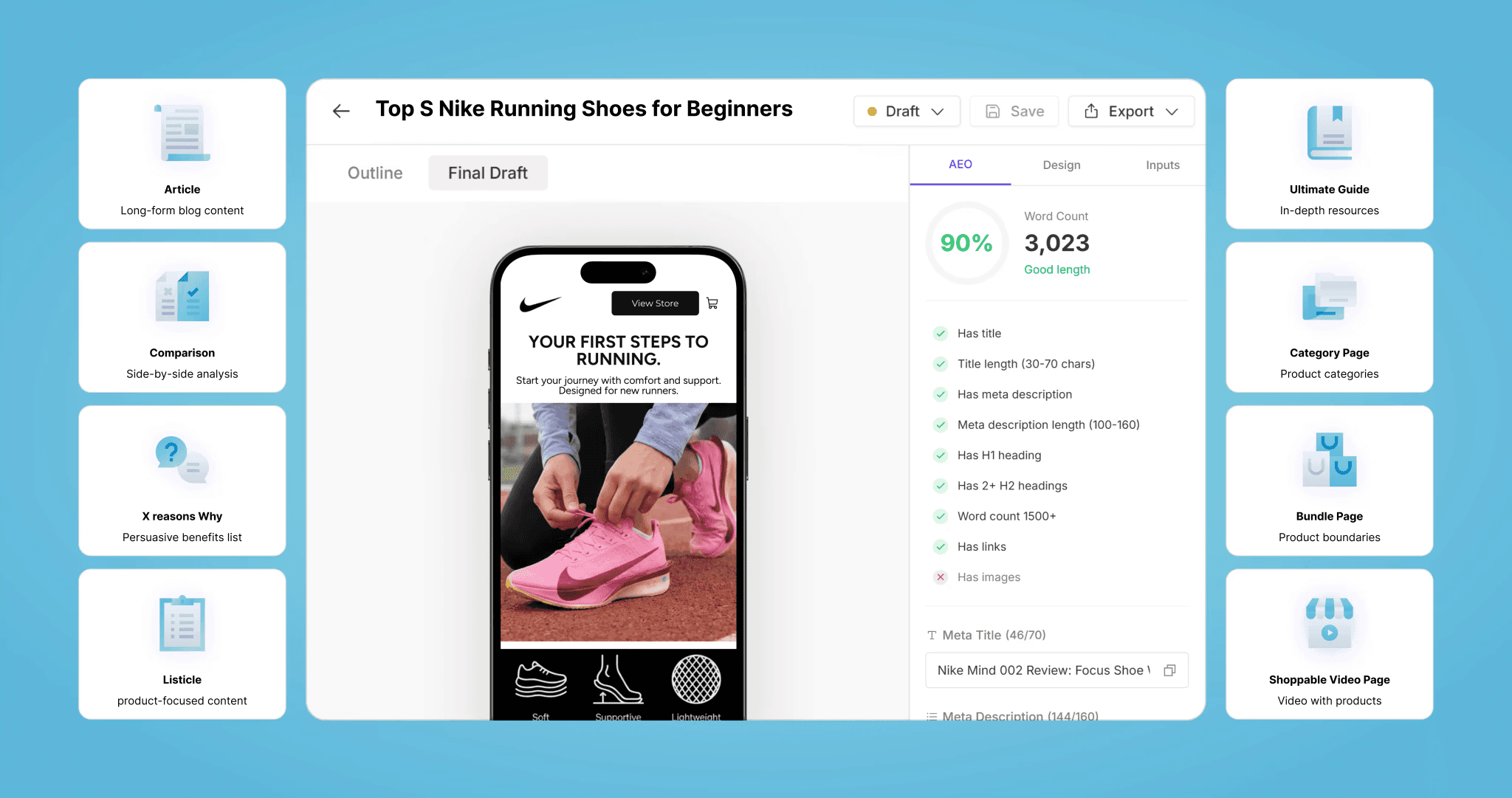
Content with hierarchical headings, bullet points, numbered lists, and tables is 28 to 40% more likely to be cited by LLMs. Format is signal. Pages that look like AI-readable structured content get cited more than dense prose - regardless of keyword density.
4. Prompt-Aligned Landing Pages
Only 30% of brands stay visible from one AI answer to the next, which means even brands that achieve citation are often losing the conversion. Shoppable funnels matched to specific prompts - built around the intent behind queries like 'best running shoes for overpronation under $150' - are required to convert AI-referred traffic consistently. Explore how shoppable AI funnels close this gap.
Platform-Specific Strategies: ChatGPT, Perplexity, Google AI Overviews, and Gemini
Each AI engine sources and cites product data differently. A one-size-fits-all approach will systematically underperform - and a tool that only tracks one or two engines will give you a false picture of your true visibility. Here is what matters on each platform:
Platform | Key Commerce Feature | Optimization Priority | Notable Signal |
|---|---|---|---|
ChatGPT | Instant Checkout live since Sept 2025 for 900M weekly users; ACP with Stripe, Shopify, Instacart | Product feed accuracy, ACP integration, structured data | Cited YouTube less than 1% of the time; prioritizes verifiable product data |
Perplexity | Shopping tab with real-time product results | Citation tracking; strong for product comparison queries | Differentiator for brands in competitive product categories |
Google AI Overviews | Integrated with Google Shopping feed data | Semantic URLs (11.4% more citations), structured data, Google Merchant feed quality | Clicks on traditional results drop from 15% to 8% when AI summary appears |
Gemini | Deep integration with Google Shopping feed | Google Merchant Center feed hygiene, product schema | Feed quality directly influences Gemini product recommendations |
The commercial momentum is clear: ChatGPT's Instant Checkout has been live since September 2025, serving 900 million weekly users, with OpenAI's Agentic Commerce Protocol co-created with Stripe and adopted by Shopify, Instacart, DoorDash, and Etsy. Meanwhile, when Google shows an AI summary, clicks on traditional results drop from 15% to 8% - meaning organic SEO rankings alone no longer protect your traffic. Review the full breakdown of AI search visibility capabilities across these engines.
How to Choose the Right Platform for Your Catalog Size and Team
The right tool depends on your catalog scale, team structure, and whether you need to monitor or optimize. Use this framework to match platform type to buyer profile.
Buyer Profile | Key Requirements | Recommended Platform(s) |
|---|---|---|
Mid-market DTC brand (under 50K SKUs) | Multi-engine tracking, GA4/Shopify integration, affordable prompt volume | Passionfruit, SE Ranking AI Visibility |
Enterprise retailer (50K+ SKUs) | SKU-level tracking, PIM/OMS/CDP integrations, SOC 2, SSO, catalog optimization at scale | Nudge, Profound |
Agency managing multiple brands | White-label reporting, multi-client dashboards, cost-efficient prompt pricing | SE Ranking AI Visibility, Semrush AI Visibility Toolkit |
Six Must-Have Evaluation Criteria for Any AI Visibility Platform
Engines tracked: Minimum five - ChatGPT, Perplexity, Google AI Overviews, Gemini, and Claude. Fewer than five creates systematic blind spots.
Granularity: SKU-level tracking vs. domain-level. Domain-level misses category-specific citation gaps that matter for large catalogs.
Catalog and schema optimization capability: Can the platform identify and fix schema errors, not just report on visibility outcomes?
Shoppable funnel or conversion surface support: Does the platform help convert AI-referred traffic, or does it hand off at the dashboard?
Commerce stack integrations: Shopify, PIM, OMS, CDP, and GA4 connectivity determine whether the tool fits into your existing workflow.
Enterprise security: SOC 2 compliance and SSO are non-negotiable for enterprise procurement. Confirm before shortlisting.
For a deeper breakdown of platform ROI by team type, see the AI visibility platform ROI guide for DTC brands. For a curated list of the best AEO tools for ecommerce, the best AEO tools comparison covers additional options beyond this article.
Ready to Improve AI Search Visibility? Book a demo!
Frequently asked questions
Are AI visibility tools just for tracking mentions, or do they actually help drive sales?
Most tools stop at monitoring - they show where your brand appears in ChatGPT, Perplexity, or Google AI Overviews responses, but offer no path to conversion. Full-funnel platforms like Nudge extend beyond the dashboard to catalog optimization and prompt-aligned shoppable funnels. The revenue stakes are real: according to Adobe Analytics, AI referrals convert 31% better than other traffic sources and deliver 254% higher revenue per visit. A tool that only monitors is leaving that conversion lift on the table.
Which AI engines should an ecommerce visibility tool track at minimum?
At minimum, any platform you evaluate should track ChatGPT, Perplexity, Google AI Overviews, Gemini, and Claude. Citation volumes for the same brand can vary by 615x across platforms, as reported in analysis from Alhena AI. Tracking fewer than five engines creates systematic blind spots - you may believe your brand is invisible on a platform when it is simply untracked.
How is AI visibility different from traditional SEO?
Traditional SEO competes for blue links in a ranked list of ten results. AI visibility - also called AEO (Answer Engine Optimization) - competes to be one of the 2 to 7 domains cited in an AI-generated answer. The top 5 domains capture 38% of all AI citations, making it a far more concentrated competition. Schema, structured data, and prompt-aligned content replace keyword density as the primary optimization levers.
What is SKU-level AI visibility and why does it matter for large catalogs?
Domain-level tools treat your entire brand as one entity and report aggregate citation share. SKU-level tracking identifies which individual products are being cited, compared, or filtered out by AI engines. For a retailer with thousands of SKUs, a few hero products may drive the majority of AI-referred revenue - and category-specific gaps are invisible at the domain level. SKU-level granularity is essential for catalog teams that need to prioritize schema fixes and feed updates by product impact, not just brand-wide averages.
How quickly can schema and structured data improvements affect AI citation rates?
Structured data improvements can affect AI citation rates within weeks of re-crawling. Pages with FAQ schema receive 2.7x more AI citations, and structured data triples GPT-4 product accuracy - from 16% to 54% correct responses. However, since 89% of ecommerce sites implement SKU schema incorrectly, a schema audit is the necessary first step before any optimization work begins. The timeline from audit to citation lift depends on crawl frequency and catalog size, but well-implemented schema changes are among the fastest-moving levers available.