Comparisons
Nudge vs Peec vs AthenaHQ: AI Ecommerce Visibility Tools Compared
Peec monitors. AthenaHQ attributes. Nudge executes. See how these three AI visibility tools compare on features, pricing, and enterprise commerce readiness.

Sakshi Gupta





Peec AI monitors AI search citations, AthenaHQ adds revenue attribution and content agents, and Nudge closes the full loop from SKU-level visibility tracking to shoppable prompt-aligned funnels - making it the only end-to-end platform built for enterprise commerce execution at catalog scale.
Why AI Ecommerce Visibility Is Now a Revenue-Critical Channel
AI search is no longer an experiment - it is a primary revenue channel. Adobe reports that AI traffic to retail sites grew 393% year over year in Q1 2026, with AI referrals converting 42% better and generating 37% higher revenue per visit than non-AI traffic. ChatGPT users in the US now submit more than 84 million shopping queries weekly, and 37% of product discovery queries start in AI interfaces.
The stakes are rising fast. McKinsey projects the agentic commerce channel will generate $900 billion to $1 trillion in US retail revenue by 2030, and Salesforce forecasts that over 25% of all Black Friday 2026 orders will involve AI agents completing purchases. For enterprise brands, the core problem is structural: the same brand can see citation volumes differ by 615x between AI platforms for the same SKU, and most teams have no system to detect, diagnose, or fix that gap.
What Do These Three Tools Actually Do - and Where Do They Diverge?
Each tool targets a different layer of the AI visibility stack. Understanding the category each occupies is essential before evaluating features or pricing.
Peec AI is an AI search analytics platform focused on brand visibility monitoring - tracking citation frequency, share of voice, and sentiment across AI platforms. It uses UI scraping technology to simulate real user interactions rather than relying on APIs, capturing authentic responses as real users see them. Peec is analytics-first with no content optimization or commerce execution layer.
AthenaHQ is an AEO/GEO platform with a proprietary Citation Engine (ACE), revenue attribution via Shopify and GA4, and autonomous content optimization agents. Founded by ex-Google Search and DeepMind engineers Andrew Yan and Alan Yao, backed by $2.2M from Y Combinator, it sits at the premium analytics end of the market - strong on attribution and content drafting, but without a commerce execution layer.
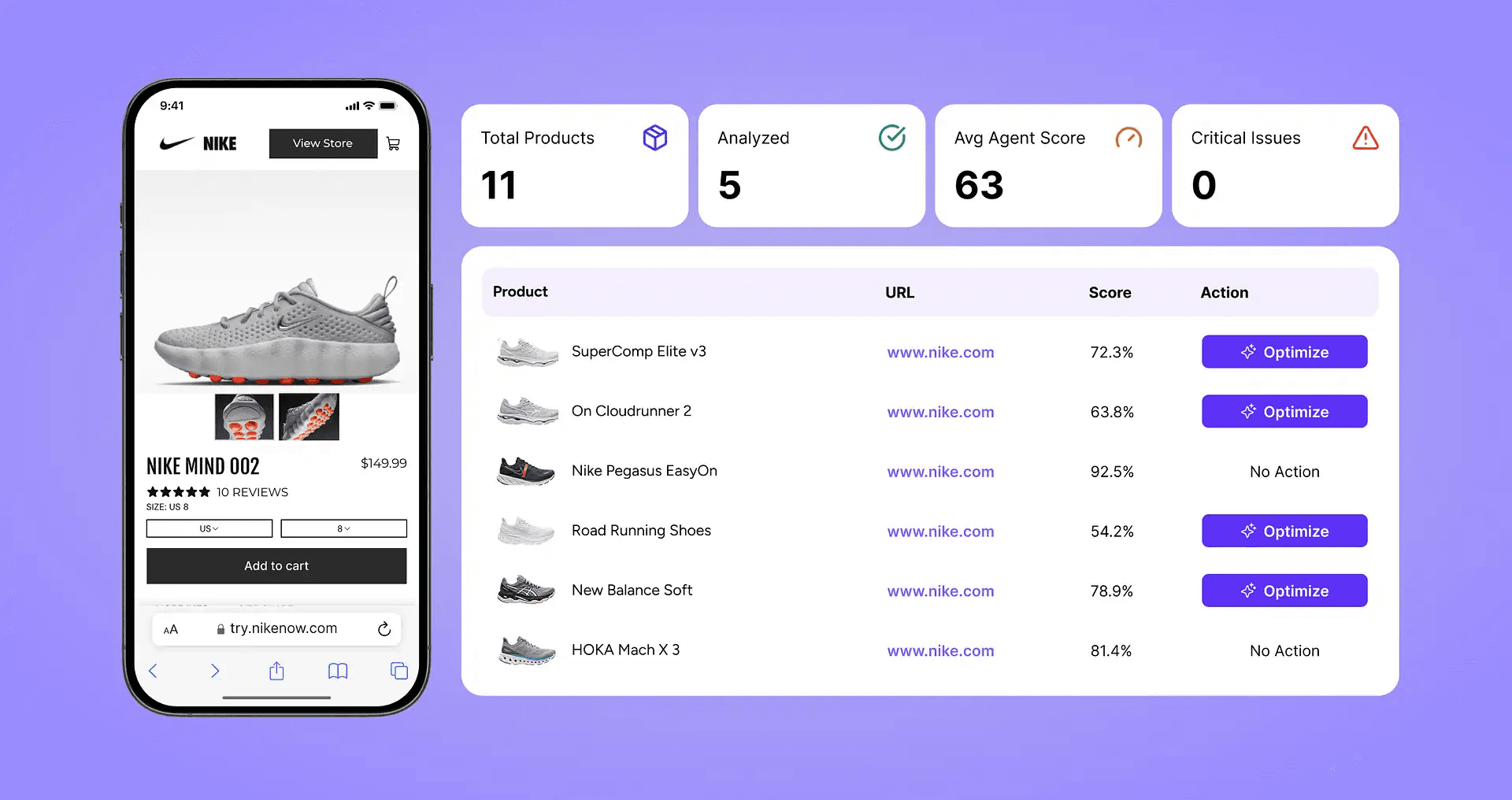
Nudge is an enterprise commerce platform that combines AI search visibility tracking, shoppable prompt-aligned funnels, and SKU-level catalog optimization with deep commerce-stack integrations including PIM, OMS, and CDP. It is the only platform in this comparison purpose-built for end-to-end AI commerce execution at catalog scale.
Feature-by-Feature Comparison: Peec AI vs AthenaHQ vs Nudge
Peec leads on monitoring authenticity, AthenaHQ leads on attribution and content agents, and Nudge is the only tool that covers the full journey from citation tracking to conversion. The table below maps every critical capability.
Capability | Peec AI | AthenaHQ | Nudge |
|---|---|---|---|
AI Platforms Tracked | ChatGPT, Perplexity, Google AI Overviews | ChatGPT, Perplexity, Google AI Overviews, Gemini, Claude | ChatGPT, Perplexity, Google AI Overviews, Gemini, Claude, Rufus |
Prompt-Level Analytics | Yes | Yes | Yes |
SKU / Catalog-Level Tracking | No | Limited | Yes - full SKU-level |
Competitive Share of Voice | Yes | Yes | Yes |
Revenue Attribution (Shopify / GA4) | No | Yes | Yes |
Content Optimization Automation | No | Yes | Yes - catalog schema optimizer |
No | No | Yes | |
No | No | Yes | |
Enterprise Security (SOC 2, SSO) | Not published | SOC 2 Type 1 certified | SOC 2, SSO |
Agency / Multi-Client Tools | Unlimited seats | Pitch Workspaces | Enterprise multi-brand |
UI Scraping for Authentic Responses | Yes | No | Yes |
Commerce Stack Integrations (PIM, OMS, CDP) | No | No | Yes |
Pricing Entry Point | $89/month | $270/month | Enterprise - contact for quote |
Pricing Breakdown: What Do You Actually Get at Each Tier?
Peec is the most accessible entry point, AthenaHQ's credit model introduces cost unpredictability at scale, and Nudge's enterprise model is designed for brands where per-prompt pricing becomes prohibitive across thousands of SKUs.
Tool | Tier | Price | Key Inclusions |
|---|---|---|---|
Peec AI | Starter | $89/month | 25 prompts, 3 countries, unlimited seats, email support |
Peec AI | Pro | $199/month | 100 prompts, 5 countries, unlimited seats |
Peec AI | Enterprise | $499/month | 300+ prompts, 10+ countries, Slack + phone support |
AthenaHQ | Lite | $270/month (annual) | Core citation tracking, content agents |
AthenaHQ | Growth | $545/month (annual) | Revenue attribution, Shopify/GA4 integration |
AthenaHQ | Enterprise | $2,000+/month (annual) | Full platform, additional credits at $100 per 1,250 |
Nudge | Enterprise | Contact for quote | Full SKU-level tracking, catalog optimizer, shoppable funnels, PIM/OMS/CDP integrations, SOC 2 + SSO |
The critical scaling issue: Peec's per-prompt model costs $1.66 per prompt at the Starter tier. For a brand tracking 5,000 SKUs across multiple prompt variants, this compounds quickly. AthenaHQ's credit top-up model at $100 per 1,250 additional credits adds a variable cost layer that makes budget forecasting difficult at enterprise scale. 89% of ecommerce sites implement SKU schema incorrectly - a problem that requires catalog-level tooling, not per-prompt billing, to fix systematically, which is what Nudge follows.
Which Tool Is Right for Your Use Case?
The right tool depends entirely on where your team sits in the AI commerce maturity curve - monitoring, attribution, or full execution.
Agencies and Consultants
If you need multi-client AI visibility dashboards and pitch-ready materials, Nudge, and Peec are strong fits.
B2B Marketing Teams Answering 'Are We Visible in AI Search?'
For teams that need citation frequency benchmarks and competitive share-of-voice reporting without a large budget, Peec AI at $89 to $199 per month is a low-friction starting point. It answers the monitoring question clearly and affordably. AthenaHQ at the Growth tier adds revenue attribution for teams ready to connect AI visibility to pipeline.
Enterprise Commerce Teams with Large Catalogs
For brands managing thousands of SKUs who need to go from AI citation to conversion, Nudge is the only platform purpose-built for this end-to-end workflow. The evidence is clear on what drives results: properly structured SKU content shows 73% higher AI selection rates, and AI referrals convert at 11.4% versus 5.3% for organic search - but only when the landing experience matches the AI-generated prompt intent. Neither Peec nor AthenaHQ can deploy the shoppable funnels or fix the catalog schema required to capture that conversion lift. Commercial intent prompts trigger ChatGPT web search 53.5% of the time versus 18.7% for informational queries, making prompt-level data at the SKU layer non-negotiable for enterprise brands.
Four Actions Enterprise Commerce Teams Should Take Right Now
Regardless of which tool you choose, these four steps represent the highest-leverage actions for improving AI ecommerce visibility - in priority order.
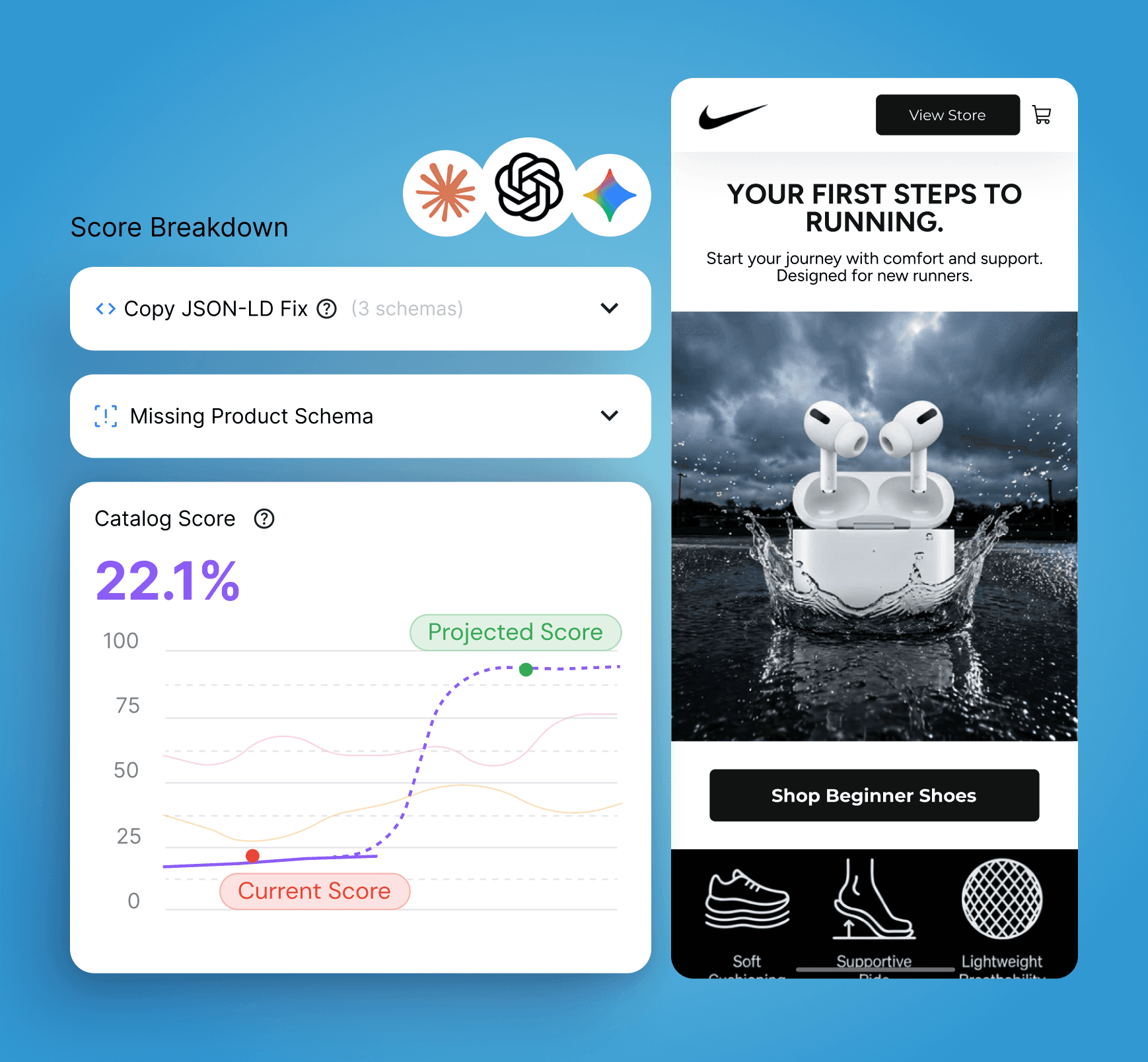
Audit SKU schema first. 89% of ecommerce sites implement it incorrectly. Properly structured content shows 73% higher AI selection rates, and structured data gives GPT-4 a 3x accuracy jump - from 16% to 54% correct responses. This is the highest-ROI starting point for any catalog team. Nudge's catalog optimizer automates this audit and remediation at scale.
Track at the prompt level, not the keyword level. Commercial intent prompts trigger ChatGPT web search 53.5% of the time versus 18.7% for informational queries. Keyword-level SEO data does not capture this distinction. You need prompt-level visibility data mapped to purchase intent categories across every major AI platform.
Build third-party citations on Reddit and review sites. 48% of AI citations come from community platforms like Reddit and review sites. A brand that dominates its own site but neglects community-sourced authority will be systematically underrepresented in AI responses - regardless of how strong its schema is.
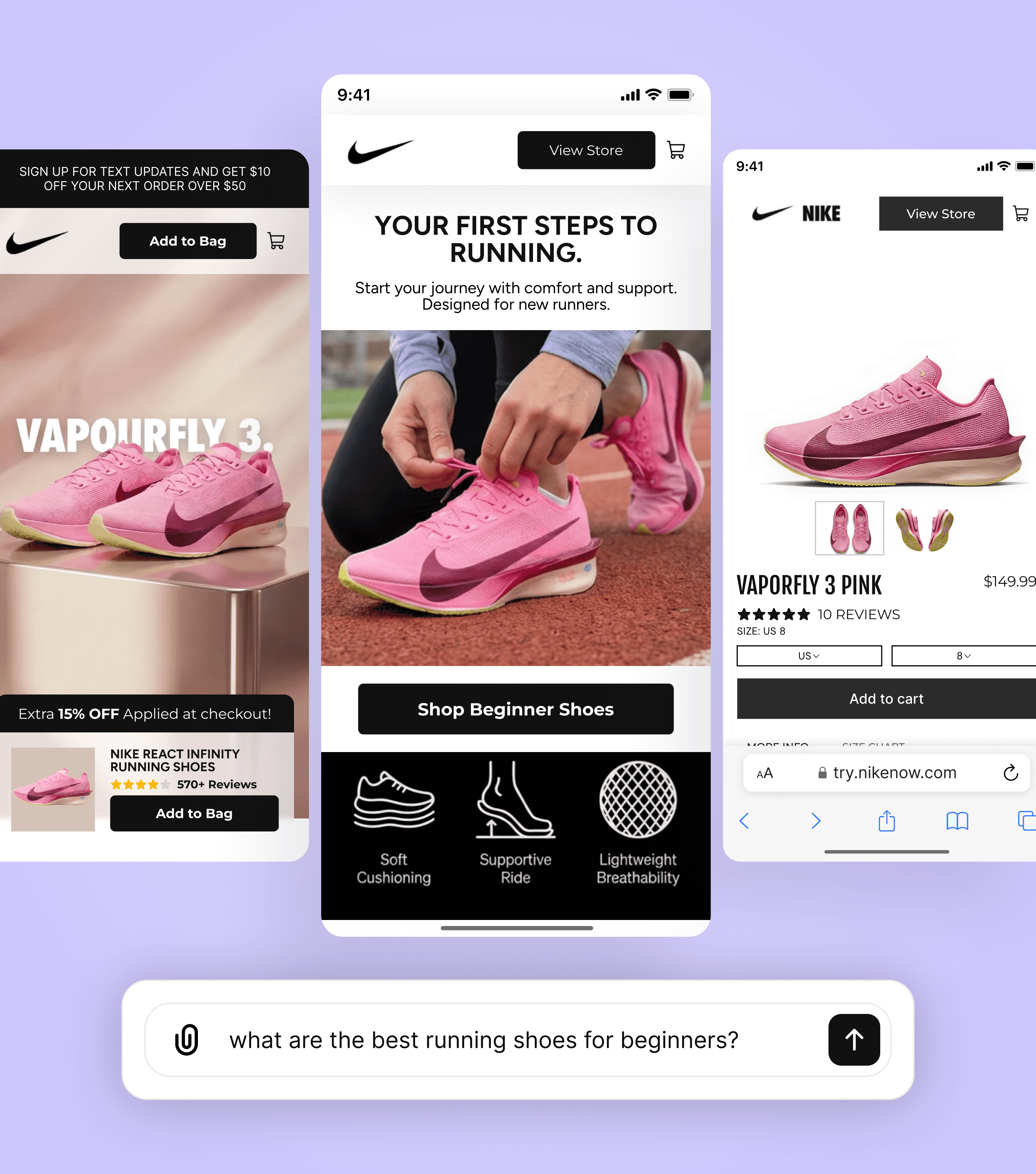
Deploy prompt-aligned landing pages. AI referrals convert at 11.4% versus 5.3% for organic search - but only when the landing experience matches the AI-generated prompt intent. Generic product pages do not capture this lift. Shoppable prompt-aligned funnels are the execution layer that converts AI visibility into measurable revenue.
Nudge: From AI Citation to Conversion in One Platform
Nudge operationalizes all four steps above in a single enterprise suite. The AI Search Visibility module tracks citation frequency, share of voice, and prompt-level performance across ChatGPT, Perplexity, Google AI Overviews, Gemini, and Claude. The Catalog Optimizer audits and remediates SKU schema at scale - fixing the structural issues that cause 89% of ecommerce brands to underperform in AI search. The Shoppable Funnels module deploys prompt-aligned landing experiences that capture the 11.4% conversion rate AI referrals are capable of delivering. All three modules connect to your existing PIM, OMS, and CDP - with SOC 2 and SSO for enterprise security compliance.
Ready to Convert AI-referred Traffic? Book a demo!
Frequently asked questions
What is the main difference between Peec AI, AthenaHQ, and Nudge for ecommerce brands?
Peec AI focuses on AI search monitoring and brand visibility analytics using UI scraping to capture authentic responses. AthenaHQ adds revenue attribution via Shopify and GA4 plus autonomous content agents. Nudge is the only platform that combines visibility tracking with SKU-level catalog optimization and shoppable prompt-aligned funnels - making it the end-to-end solution for enterprise commerce teams.
Which AI visibility tool is best for enterprise ecommerce teams managing large catalogs?
Nudge is purpose-built for enterprise commerce teams with large catalogs, offering SKU-level tracking, catalog schema optimization, and shoppable funnels. Peec and AthenaHQ are strong analytics tools but lack the catalog-level execution layer needed at enterprise scale - particularly for fixing the schema issues that affect 89% of ecommerce sites and deploying the prompt-aligned landing pages that drive 11.4% conversion rates from AI referrals.
How does Peec AI's pricing compare to AthenaHQ for growing teams?
Peec AI starts at $89 per month for 25 prompts across 3 countries, making it accessible for smaller teams or those just beginning AI visibility monitoring. AthenaHQ starts at $270 per month with a credit-based model billed annually. Both scale in cost quickly for large prompt sets - Peec's per-prompt model and AthenaHQ's credit top-up at $100 per 1,250 additional credits both become limiting factors for brands tracking thousands of SKUs.
Does AthenaHQ have enterprise security certifications?
Yes. AthenaHQ achieved AICPA SOC 2 Type 1 certification in October 2025, with the Type 2 observation period underway - making it one of the more security-mature options among AI visibility analytics tools. This is an important consideration for enterprise procurement teams with data governance requirements.
Can Peec AI or AthenaHQ optimize product content for AI discovery, or just track it?
Peec AI is primarily a tracking and monitoring tool with no content optimization features. AthenaHQ offers autonomous content agents that draft optimizations aligned with citation signals. Only Nudge provides full catalog schema optimization and shoppable funnel deployment - moving from diagnosis to execution within a single enterprise platform.