AI Search Visibility
Best AI Visibility Platforms for DTC and Commerce Brands (2026)
AI search is now a revenue channel. Discover which platforms help commerce brands get cited, compared, and bought across ChatGPT, Perplexity, Google AI Overviews, and beyond.

Kanishka Thakur





The best AI visibility platforms for DTC and commerce brands in 2026 are purpose-built tools that track citation frequency across ChatGPT, Perplexity, Google AI Overviews, Gemini, and Claude - not just search rankings. Leading options include Profound, Otterly.AI, Evertune, SE Ranking Visible, and Nudge, which is the only platform combining AI visibility tracking, shoppable funnels, and SKU-level catalog optimization in a single commerce-native suite.
Why AI Visibility Is Now a Revenue-Critical Channel for Commerce Brands
AI search is not a future trend - it is already driving measurable revenue for commerce brands. Data shows retail AI-driven traffic surged 693% year over year during the 2025 holiday season, while ChatGPT-referred visits convert at 11.4% versus 5.3% for organic search - more than double the rate. AI-driven revenue per visit surged 254% in the same period.
The scale is equally striking. Around 50 million shopping queries hit ChatGPT every day, and more than one-third of consumers now begin their searches on AI tools rather than traditional search engines. Meanwhile, Gartner predicts traditional search volume will drop 25% by 2026, and 60% of searches already end without a click due to AI summaries. For commerce brands, AI visibility is not a marketing experiment - it is a new revenue channel that demands dedicated tooling.
What Is an AI Visibility Platform - and How Is It Different from SEO Tools?
An AI visibility platform tracks how often and how accurately your brand is cited in AI-generated answers across engines like ChatGPT, Perplexity, Google AI Overviews, Claude, and Gemini. Success is measured by citation frequency, share of voice, and hallucination accuracy - not rankings or CTR.
Traditional SEO tools are structurally blind to this channel. Only 12% of URLs cited by ChatGPT, Perplexity, and Copilot rank in Google's top 10, and 80% of LLM citations do not rank in Google's top 100 for the same query.
Two related disciplines underpin this space. AEO (Answer Engine Optimization) focuses on optimizing content for citation frequency in AI-powered answer engines - ChatGPT, Perplexity, Claude - where success is measured by how often your brand is recommended. GEO (Generative Engine Optimization) focuses on the technical and content strategies that help LLMs understand, trust, and accurately represent your catalog. Commerce brands need both: AEO to earn citations, GEO to ensure those citations are accurate and conversion-ready.
What Should a Best-in-Class AI Visibility Platform Actually Do?
A best-in-class platform does more than count mentions - it connects AI citations to catalog data, content quality, and conversion outcomes. Use these six criteria to evaluate any platform:
LLM coverage: At minimum, the platform must track ChatGPT, Perplexity, Google AI Overviews, Gemini, and Claude. Enterprise teams should also cover Amazon Rufus and Microsoft Copilot.
SKU- and prompt-level granularity: Domain-level tracking misses the detail that matters. You need to know which products are cited for which prompts - not just whether your brand appeared.
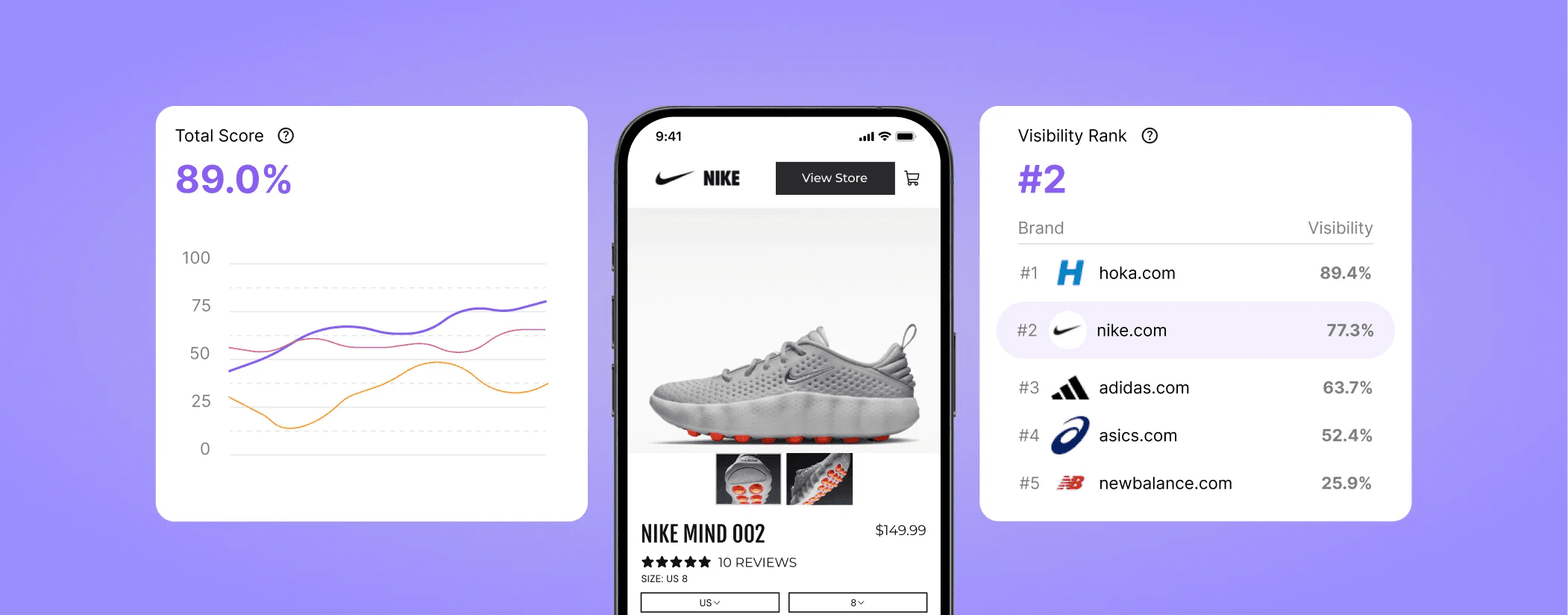
Hallucination detection and brand accuracy monitoring: AI engines sometimes report wrong pricing, outdated specs, or competitor confusion. Platforms must flag these errors before they damage conversion.
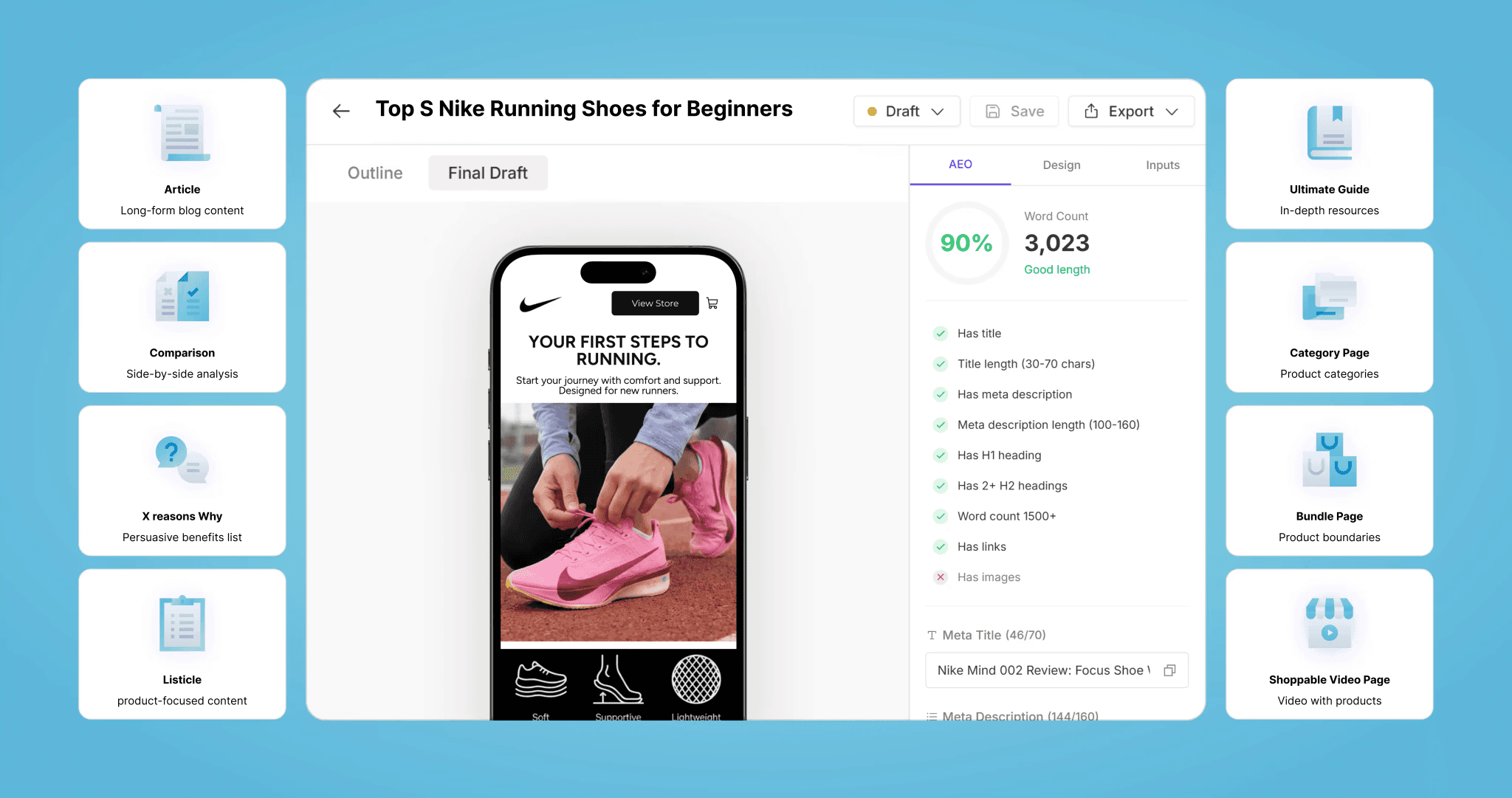
Content optimization recommendations tied to catalog data: A Data World study shows GPT-4 goes from 16% to 54% correct responses when content uses structured data - a 3x accuracy jump. Platforms should surface schema gaps and content improvement actions directly linked to your SKUs.
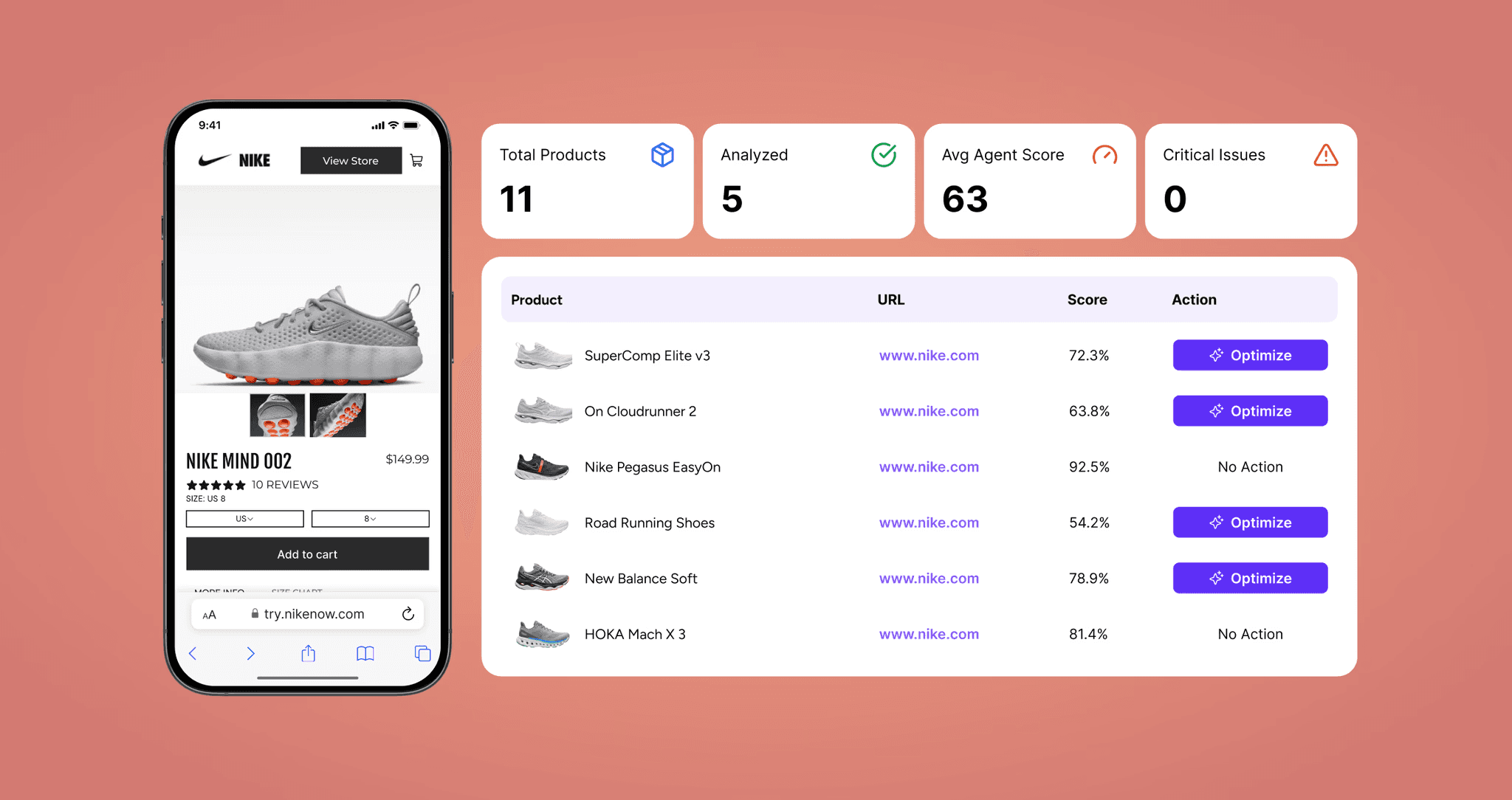
Shoppable funnel or conversion integration: Citation without conversion is incomplete. The best platforms connect AI visibility to prompt-aligned landing pages and purchase paths.
Enterprise controls: SOC 2 compliance, SSO, and PIM/OMS integrations are non-negotiable for brands managing thousands of SKUs across complex tech stacks.
One critical data point for enterprise teams: 89% of ecommerce sites implement SKU schema incorrectly, making schema auditing a high-priority first step when onboarding any AI visibility platform.
Top AI Visibility Platforms for Commerce Brands: Head-to-Head Comparison
The table below compares leading AI visibility platforms across the criteria that matter most to DTC and enterprise commerce teams. Use it to shortlist options by your team size, catalog complexity, and conversion requirements.
Platform | LLM Coverage | SKU-Level Tracking | Hallucination Alerts | Content Optimization | Commerce Integrations | Pricing Tier | Best Fit |
|---|---|---|---|---|---|---|---|
Nudge | ChatGPT, Perplexity, Google AI Overviews, Gemini, Claude, Rufus | Yes - prompt + SKU level | Yes | Yes - catalog-linked | PIM, OMS, Shopify, SSO, SOC 2 | Enterprise | Enterprise DTC and retail with large catalogs |
Profound | 10 answer engines, 5M+ daily citations | Partial | Yes - citation drift monitoring | Yes | Limited | Mid-market to Enterprise | Brand and agency teams tracking share of voice |
Evertune | ChatGPT, Perplexity, Gemini, Claude | Partial | Yes | Yes | Limited | Mid-market | DTC brands prioritizing brand accuracy |
SE Ranking Visible | Google AI Overviews, Perplexity, ChatGPT | No | No | Yes - content recommendations | Limited | SMB to Mid-market | Lean teams and agencies |
Otterly.AI | ChatGPT, Perplexity, Gemini | No | Partial | Limited | None | SMB | Small DTC brands and solo marketers |
Peec AI | ChatGPT, Perplexity, Claude | No | No | Limited | None | SMB | Early-stage brands exploring AEO |
Conductor | Google AI Overviews, limited LLM coverage | No | No | Yes - SEO-adjacent | CMS integrations | Enterprise | Enterprise content and SEO teams |
Similarweb | Limited - AI traffic estimation only | No | No | No | Analytics integrations | Mid-market to Enterprise | Competitive intelligence teams |
Platform Callouts: Top Picks for Commerce Teams
Nudge is the only platform that unifies AI visibility tracking, shoppable prompt-aligned funnels, and SKU-level catalog optimization in a single enterprise suite. For brands managing thousands of SKUs, Nudge connects citation data directly to catalog enrichment and conversion paths - so visibility actually drives revenue. Explore the AI Search Visibility platform and the Catalog Optimizer for a full picture of the suite.
Profound is a strong choice for brand and agency teams that need breadth of LLM coverage. Its Answer Engine Insights tracks citations across ten answer engines and processes over 5 million daily citations, making it well-suited for monitoring share-of-voice and citation drift at scale.
Evertune focuses on brand accuracy and hallucination detection across major LLMs, making it a practical option for mid-market DTC brands that need to monitor and correct AI-generated brand descriptions without a full enterprise stack.
SE Ranking Visible offers accessible AEO tracking and content recommendations at an SMB-friendly price point. It is a solid starting point for lean teams that want structured content guidance alongside basic AI citation monitoring.
How Do Leading DTC Brands Actually Win AI Citations?
Winning AI citations requires a systematic approach to content, structure, and authority. Companies that established dedicated AEO strategies in early 2024 report capturing 3.4x more answer engine traffic than competitors who delayed. Here is the implementation framework that delivers those results:
Audit and fix SKU schema first. With 89% of ecommerce sites implementing SKU schema incorrectly, a schema audit is the highest-leverage starting point. Structured data gives GPT-4 a 3x accuracy jump - from 16% to 54% correct responses - so getting this right directly improves how AI engines represent your products.
Add FAQ schema to product and category pages. Pages with FAQ schema receive 2.7x more AI citations. Prioritize pages for your highest-volume prompts and top-revenue categories.
Which Platform Is Right for Your Commerce Team?
Platform selection depends on your team size, catalog complexity, and whether you need visibility alone or visibility plus conversion. Use the decision matrix below to find your fit:
Buyer Profile | Primary Needs | Recommended Platform(s) |
|---|---|---|
Mid-market DTC brand, lean team | Easy setup, broad LLM coverage, actionable content recommendations without a dedicated data team | Nudge, SE Ranking Visible, Evertune, Otterly.AI |
Enterprise retailer, large catalog | SKU-level tracking, PIM/OMS integration, hallucination monitoring, SOC 2 governance, shoppable funnel conversion | Nudge (primary), Profound (supplementary) |
Marketplace or multi-brand platform | Category-level share of voice, competitive intelligence across brands, multi-LLM coverage at scale | Nudge, Profound, Similarweb (for competitive data) |
Agency managing multiple brand clients | Multi-client dashboards, white-label reporting, prompt-level citation tracking across categories | Nudge, Profound, SE Ranking Visible, Otterly.AI |
For enterprise commerce teams managing thousands of SKUs, the core challenge is not just getting cited - it is ensuring those citations are accurate, complete, and connected to a purchase path. Nudge is purpose-built for this: the AI Search Visibility module tracks citations and hallucinations across all major LLMs, the Catalog Optimizer enriches SKU data to improve AI accuracy, and the Shoppable Funnels module converts AI-referred traffic into revenue. No other platform closes this loop in a single suite.
Ready to Measure Your AI Citation Rate? Book a demo!
Most commerce brands are invisible in AI-generated answers right now - and don't know it. Nudge gives enterprise teams a clear picture of where they stand across ChatGPT, Perplexity, Google AI Overviews, Gemini, and Claude, then connects that data to catalog enrichment and conversion. Request a pilot to measure your AI citation lift and see exactly where your brand stands today.
Frequently asked questions
What is an AI visibility platform and why do DTC brands need one?
An AI visibility platform tracks how often and how accurately your brand is cited in AI-generated answers across ChatGPT, Perplexity, Google AI Overviews, and similar engines. DTC brands need one because more than one-third of consumers now begin their searches on AI tools, and traditional analytics miss 80% of AI-driven brand recommendations - meaning most brands are flying blind on a fast-growing revenue channel.