Shoppable Funnels
Shoppable AI Funnels: The Complete Guide to Converting High-Intent AI Shoppers
Build prompt-aligned, structured conversion paths that capture AI-referred shoppers and take them from citation to checkout — with data-backed strategies for enterprise commerce teams.

Sakshi Gupta





A shoppable AI funnel is a conversion path purpose-built for shoppers arriving from AI assistants, starting at the AI citation and ending at checkout, with prompt-aligned landing pages, structured product data, and frictionless purchase options. Brands that build these funnels now are capturing the fastest-growing, highest-converting traffic channel in commerce.
Key Takeaways
AI-referred shoppers convert at 4.4x the rate of organic search visitors (Semrush, 2025), making shoppable AI funnels the highest-ROI conversion investment for commerce brands right now.
LLMs cite only 2-7 domains per response, so brands must build prompt-aligned, structured funnels or lose the citation slot entirely; 54% of top Google-ranking brands are already invisible to AI engines.
Shoppers who interact with an AI assistant during their session convert at 12.3% versus 3.1% for those who do not; a 4x lift that requires landing pages purpose-built for AI-referred intent.
Properly structured product content shows 73% higher AI selection rates, yet 89% of ecommerce sites implement SKU schema incorrectly; catalog optimization is the foundation of every shoppable funnel.
Why AI Shopping Traffic Is the Highest-Converting Channel in 2025
AI-referred shoppers are fundamentally different from any prior traffic source: they arrive pre-qualified, with intent already resolved, and they convert at rates that dwarf every other channel. This is not a future trend — it is a present revenue opportunity with measurable, compounding returns.
Adobe Digital Insights reports that generative AI traffic to U.S. retail sites increased 4,700% year-over-year as of July 2025, with AI-driven referrals to ecommerce sites growing 302% from January to December 2025 — compared to just 23% for all other sources combined. 61% of U.S. adults used AI for shopping in 2025, and ChatGPT alone fields 53 million shopping queries daily.
The conversion data is equally striking. Shoppers who interact with an AI assistant during their session convert at 12.3% — nearly four times the 3.1% rate of those who do not. Microsoft Advertising reports that Copilot-assisted journeys are 33% shorter on average, with high-intent conversion rates 76% higher than traditional search.
What Makes a Funnel 'Shoppable' for AI-Referred Queries?
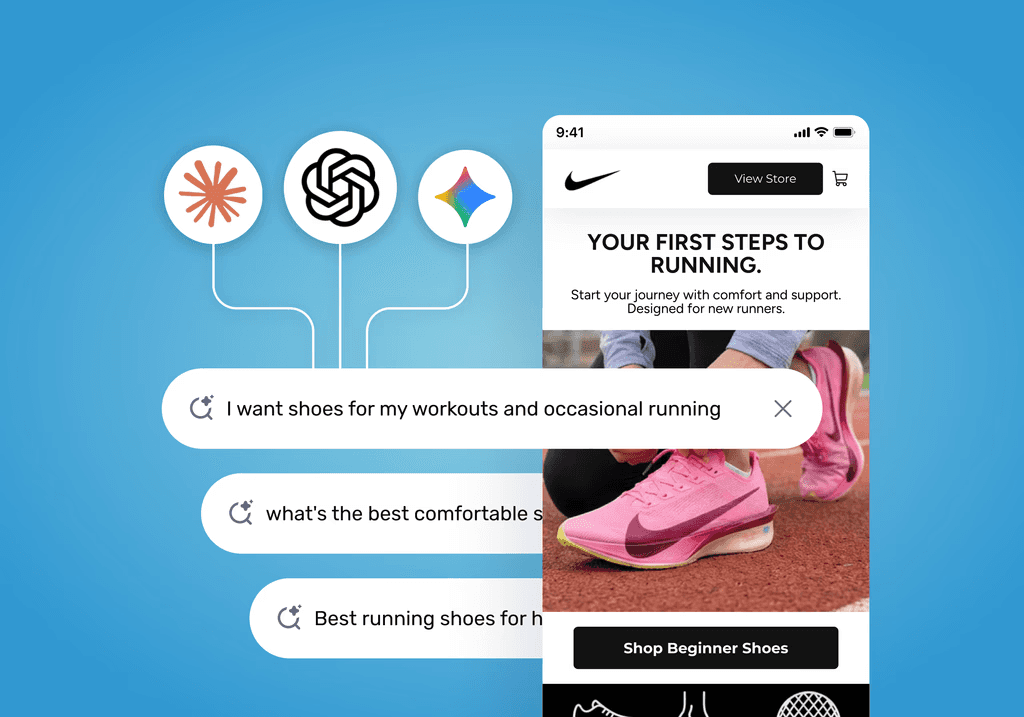
A shoppable AI funnel is a prompt-aligned, structured conversion path that begins at the AI citation and ends at checkout; purpose-built for visitors who arrive with resolved intent, not browsers who need to be persuaded. Traditional funnels move shoppers through awareness, consideration, and decision stages. AI funnels skip directly to confirmation and purchase.
Agentic commerce operates across three distinct modes: agentic shopping (discovery and purchase through conversation), autonomous shopping (agents acting proactively within preapproved parameters), and agent-to-agent commerce (third-party agents transacting directly with brand agents). Each mode demands a different funnel response but all three require the same foundation: structured data, prompt-aligned pages, and frictionless checkout.
The infrastructure signals are unambiguous. ChatGPT launched Instant Checkout in September 2025, powered by the Agentic Commerce Protocol built with Stripe, enabling U.S. users to buy from Etsy sellers and Shopify merchants directly in chat. Google launched its Universal Commerce Protocol (UCP) in January 2026, covering the full shopping journey from discovery through post-purchase support. Brands not integrated with these protocols are missing in-chat conversion opportunities that are live right now.
How to Build a Shoppable AI Funnel: A 5-Stage Framework
Building a shoppable AI funnel requires five sequential stages, each addressing a specific point of failure in the AI-to-checkout journey. Skipping any stage creates a gap that AI-referred shoppers will not tolerate — they will simply return to the AI and pick a competitor.
Stage 1 - Catalog Structuring: Fix SKU schema at the foundation. 89% of ecommerce sites implement it incorrectly, and properly structured content earns 73% higher AI selection rates. This is the prerequisite for every downstream stage.
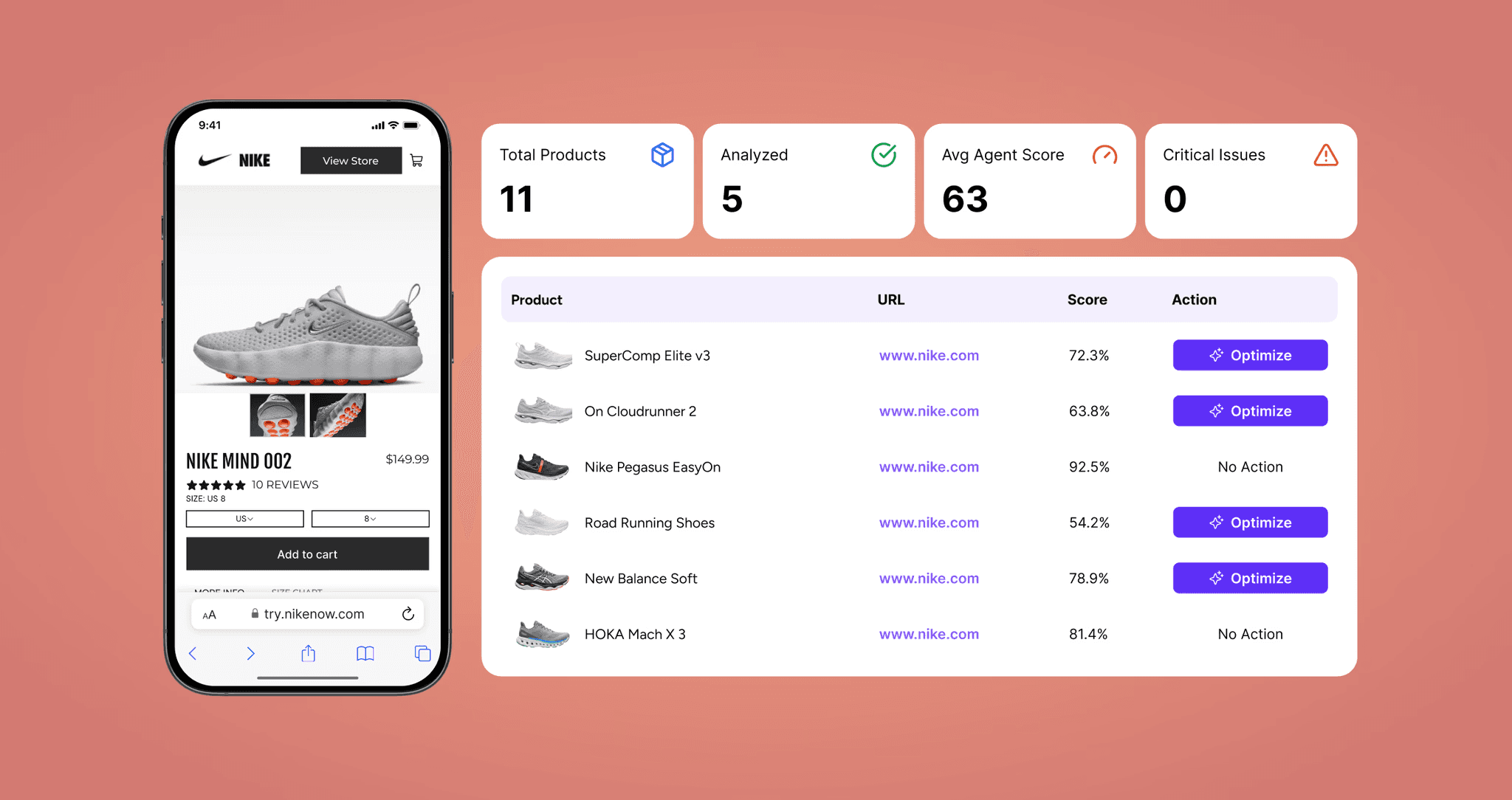
Stage 2 - AI Visibility and Citation Optimization: Ensure your brand appears in the 2-7 domains LLMs cite per response. Apply Generative Engine Optimization (GEO) principles — structured data, authoritative content, and machine-readable signals — to earn and hold citation slots.
Funnel Stage | Traditional Funnel Approach | Shoppable AI Funnel Approach |
|---|---|---|
Catalog | Manual product descriptions, inconsistent attributes | JSON-LD schema, enriched attributes, machine-readable signals |
Visibility | SEO for Google rankings (10 blue links) | GEO for AI citation slots (2-7 domains per response) |
Landing Page | Generic category or campaign page | Prompt-aligned SKU page matching the AI query exactly |
Checkout | Multi-step cart and checkout flow | In-chat Instant Checkout or one-click agentic purchase |
Analytics | Organic/paid channel groupings | AI-attributed session and order tracking as a distinct channel |
Nudge unifies all five stages in a single enterprise suite. The Nudge Shoppable Funnels platform handles prompt-aligned page building and agentic protocol integration, while the Catalog Optimizer addresses SKU schema and attribute enrichment at scale — eliminating the coordination overhead of stitching together point solutions.
What Catalog and Content Optimizations Drive AI Citations?
Google rankings do not guarantee AI citations. Only 17-38% of AI Overview citations come from top-10 Google organic results, and 54% of brands that rank well on Google are not cited by AI systems at all. The selection criteria are different: AI engines prioritize structured, machine-readable product data over raw domain authority.
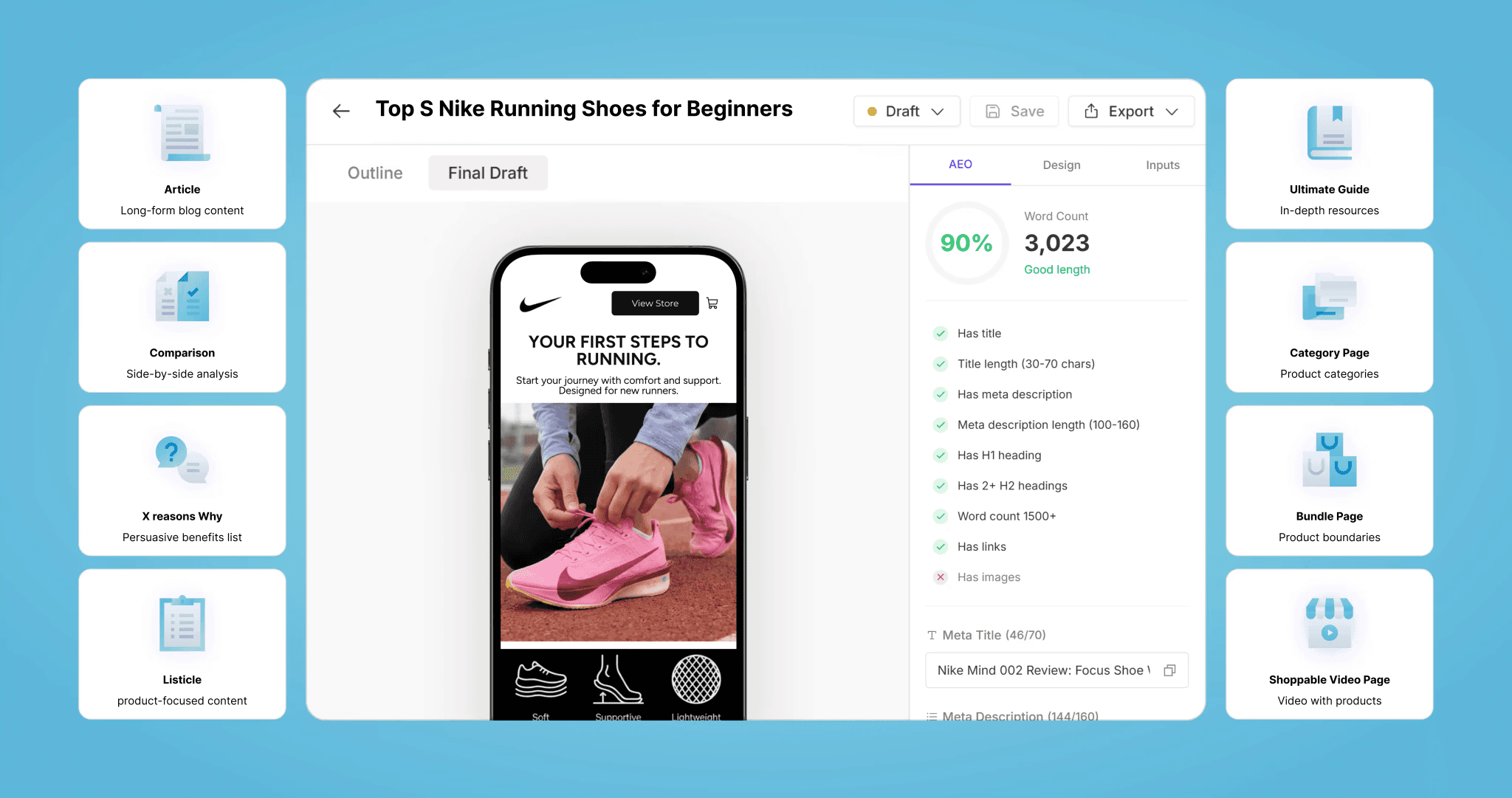
The specific optimizations that move the needle are straightforward but systematically neglected. Implement correct JSON-LD Product schema (the majority of ecommerce sites still do it incorrectly). Enrich product attributes with use-case language, comparison signals, and material/specification detail that mirrors how AI users phrase their queries. Write prompt-mirroring copy that answers the exact questions AI shoppers ask, not generic marketing copy.
The cost of inaction is measurable. A McKinsey analysis of over 3,000 ecommerce companies found that product data errors cost up to 23% in clicks and 14% in conversions. As Jorrit Steinz, CEO of ChannelEngine, put it: 'If product data isn't structured for machines, it won't surface where shopping now begins — and that means lost revenue before a buyer ever reaches your site.' Catalog optimization is not a technical nicety; it is a revenue protection measure. The Nudge SKU-level catalog optimization guide covers the full implementation checklist.
How AI-Referred Shoppers Behave Differently and How Funnels Should Respond
AI-referred shoppers arrive with a specific product already in mind, low tolerance for irrelevant content, and a strong disposition to buy. Funnels designed for browsers will fail them — and the conversion data confirms it.
Adobe's 2025 holiday data shows AI-referred shoppers converted 31% more often, spent 45% more time on site, and were 33% less likely to bounce. Semrush's 2025 analysis found LLM-referred visitors convert at 4.4x the rate of traditional organic search. Critically, in AI Mode, 88% of users took the AI's shortlist without any external check, and the AI's top pick becomes the user's top pick 74% of the time — meaning the citation slot is the sale.
These behavioral patterns translate directly into funnel design principles:
Lead with the exact product or SKU the AI recommended — not a category page, not a homepage. Confirmation of fit is the first job of the landing page.
Show social proof and comparison data above the fold — AI-referred shoppers want validation, not discovery. Reviews, ratings, and brief competitor comparisons reduce friction.
Minimize navigation distractions — browsing options signal to a resolved buyer that they may have landed in the wrong place.
Offer instant checkout — connect to agentic commerce protocols so the gap between intent and purchase is as small as possible.
The Nudge guide to landing page elements that convert AI shoppers covers the specific above-the-fold layout and content hierarchy that drives the highest conversion rates for AI-referred sessions.
Which Tools and Platforms Power Enterprise Shoppable AI Funnels?
Enterprise shoppable AI funnel infrastructure spans four functional categories. The critical decision is whether to assemble point solutions or use a unified platform — a choice with significant implications for speed, governance, and ongoing optimization.
Capability | Point-Solution Approach | Nudge Unified Suite |
|---|---|---|
Catalog Optimization | Separate PIM or schema tool; manual enrichment; no AI citation feedback loop | SKU-level schema fixing, attribute enrichment, and AI selection rate tracking in one platform |
Funnel Alignment | Generic landing page builder with no prompt-intent mapping | Prompt-aligned funnel builder with query-to-page matching and A/B testing |
Agentic Protocol Support | Custom dev work for each protocol (Stripe/ChatGPT, Google UCP) | Pre-built integrations for agentic commerce protocols, maintained as standards evolve |
AI Citation Tracking | No native AI citation analytics; requires stitching multiple tools | Citation share monitoring, AI-attributed session tracking, and revenue attribution |
Enterprise Governance | Varies by tool; SOC 2 and SSO coverage inconsistent | SOC 2 certified, SSO-enabled, enterprise access controls across all modules |
On the commerce integration side, Shopify and Etsy are already live with ChatGPT Instant Checkout, and Google UCP-compatible stacks are expanding rapidly. For analytics, the priority is establishing AI-attributed sessions as a distinct channel — separate from organic and paid — so teams can measure citation share, AI-referred conversion rate, and AI-attributed revenue independently.
For a detailed comparison of the enterprise tooling landscape, including how Nudge compares to AEO point solutions, see the Nudge guide to the best shoppable AI funnel tools for enterprise commerce and the Nudge vs. PEEC vs. AthenaHQ comparison.
Ready to convert AI-referred traffic? Book a demo today!
Frequently asked questions
What is a shoppable AI funnel?
A shoppable AI funnel is a conversion path purpose-built for shoppers arriving from AI assistants — starting at the AI citation and ending at checkout, with prompt-aligned landing pages, structured product data, and frictionless purchase options like in-chat checkout. Unlike traditional funnels designed for browsers, shoppable AI funnels assume intent is already resolved and focus on confirmation and conversion. Learn more at the Nudge shoppable funnels platform page: nudgenow.com/platform/shoppable-funnels.
How much do AI-referred shoppers convert compared to organic search?
Semrush (2025) found LLM-referred visitors convert at 4.4x the rate of traditional organic search. Adobe holiday data shows AI-referred shoppers converted 31% more often and spent 45% more time on site. Search Engine Land analyzed 94 brands and found ChatGPT referral traffic converts at 1.81% versus 1.39% for non-branded organic search — a 31% lift. The conversion advantage is consistent across sources and methodologies.
Why do my Google rankings not translate into AI citations?
Only 17-38% of AI Overview citations come from top-10 Google organic results, according to Ahrefs and BrightEdge research from February 2026. AI engines prioritize structured, machine-readable product data over domain authority — 54% of top-ranking brands are invisible to AI systems because their SKU schema is incorrect or missing. A first-page Google ranking does not get you into AI recommendations. The fix starts with correct JSON-LD Product schema and enriched product attributes.
What is the Agentic Commerce Protocol and do I need to support it?
The Agentic Commerce Protocol (built with Stripe) powers ChatGPT Instant Checkout, enabling direct purchases inside chat. As of September 2025, U.S. ChatGPT users can buy from Etsy sellers and Shopify merchants without leaving the conversation. Google launched its Universal Commerce Protocol (UCP) in January 2026 to cover the full shopping journey. Brands not integrated with these protocols are missing in-chat conversion opportunities that are live today — not a future consideration.
How do I measure the ROI of a shoppable AI funnel?
Track AI-attributed sessions and orders as a distinct channel in your analytics stack, separate from organic and paid. Key metrics include: AI citation share (how often your brand appears in relevant AI responses), AI-referred conversion rate, AI-attributed revenue, and average order value from AI sessions versus other channels. AI-attributed orders on Shopify grew 11x between January 2025 and March 2026 — brands that establish this measurement infrastructure now will have a compounding data advantage.