Shoppable Funnels
Best Shoppable AI Funnel Tools for Enterprise Commerce (2026)
Compare the top platforms that combine AI search visibility, prompt-aligned shoppable funnels, and SKU-level catalog optimization to convert AI-referred traffic into revenue.

Sakshi Gupta





Shoppable AI funnel tools are platforms that optimize your products for citation by AI engines like ChatGPT, Perplexity, and Gemini, then convert that AI-referred traffic through prompt-aligned landing pages and structured catalog data. Enterprise teams need them now because 58% of consumers have already replaced traditional search with generative AI for product discovery, and traditional SEO tools are not built to address that shift.
Why Enterprise Commerce Teams Need Shoppable AI Funnel Tools Now
AI-driven traffic is no longer a future bet. AI-driven traffic to Shopify sites grew 8x year-over-year in 2025, and AI-driven orders grew 15x. Meanwhile, LLM traffic converts at 2.47% across 329 brands, outperforming Google Ads at 1.82% and Meta Ads at 0.52% - and it arrives at zero cost-per-click. With more than 50 million daily purchase prompts on ChatGPT alone, the question is no longer whether AI drives commerce. It is whether your products are being cited and whether that traffic converts.
The urgency is compounded by a structural gap: only 8% of ChatGPT citations overlap with Google's top 10 organic results for the same query. Ranking in traditional search does not guarantee AI visibility. Enterprise teams need dedicated tooling. Throughout this guide, tools are evaluated on five criteria: AI visibility coverage, shoppable funnel depth, catalog scale and integration, enterprise governance (SOC 2, SSO), and measurable conversion impact.
#1 Nudge - Best End-to-End Shoppable AI Funnel Platform for Enterprise
Nudge is the only enterprise platform that unifies all five evaluation criteria in a single governed suite: AI search visibility, shoppable funnels, SKU-level catalog optimization, on-site AI engagement, and enterprise-grade security. It is purpose-built for commerce teams managing large catalogs who need to win at every stage of the AI-driven purchase path.
Capability Pillar 1: AI Search Visibility
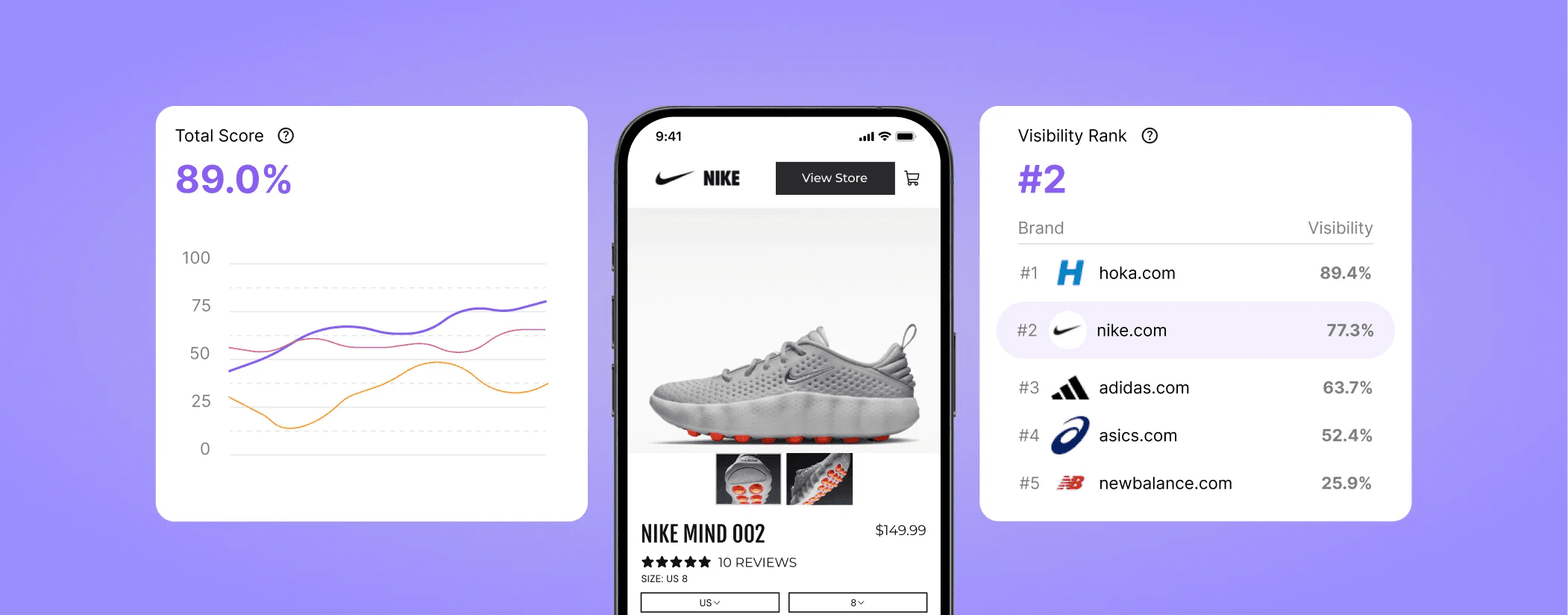
Nudge ensures your products are cited in ChatGPT, Perplexity, Gemini, and Google AI Overviews. The platform tracks citation share across all major AI engines, monitors whether products surface with correct pricing, reviews, and attributes, and provides prompt-level diagnostics so teams know exactly which queries are driving - or missing - product mentions. Learn more on the AI Search Visibility platform page.
Capability Pillar 2: Shoppable Funnels
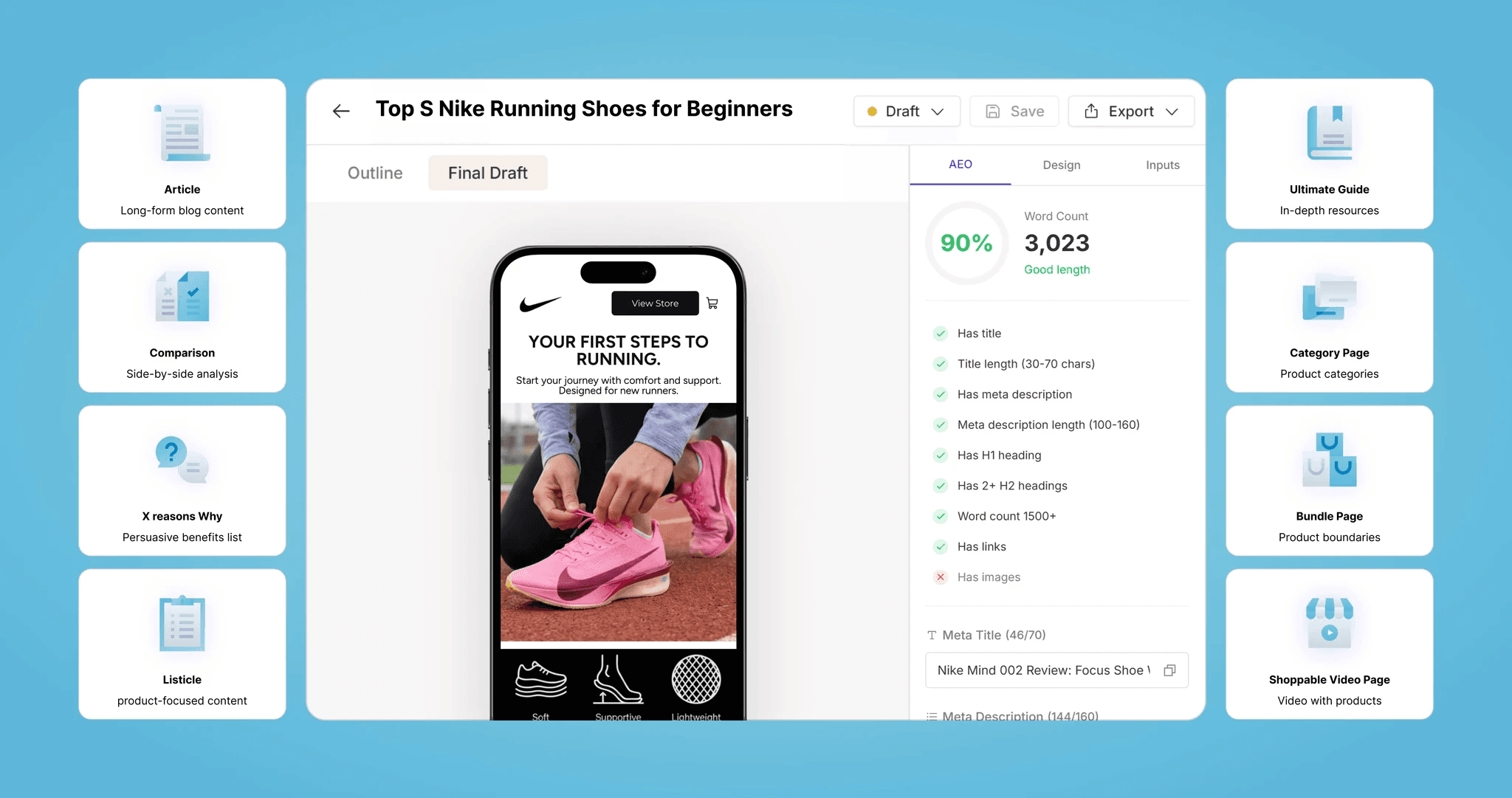
Nudge builds prompt-aligned landing pages and commerce surfaces that convert AI-referred traffic. When a shopper arrives from a ChatGPT recommendation, Nudge serves a landing experience matched to the intent of the prompt that drove the visit - not a generic product page. Adobe's 2026 holiday data shows AI-referred shoppers converted 31% more often and spent 45% more time on site, and Nudge is built to capture that uplift. See how it works on the Shoppable Funnels page and read the deep-dive on AI traffic landing pages.
Capability Pillar 3: SKU-Level Catalog Optimizer
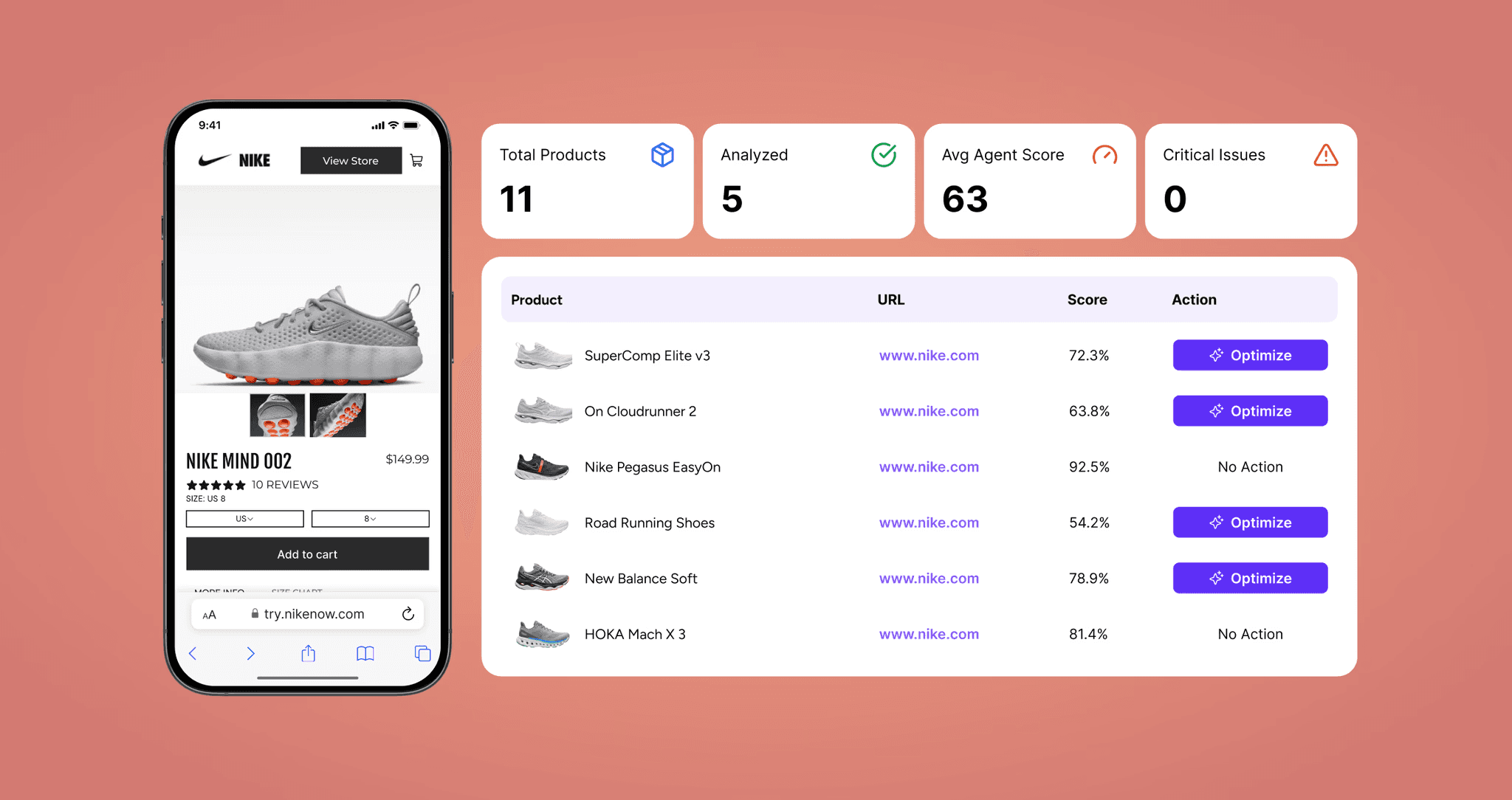
Nudge applies structured data and entity mapping at the SKU level so every product surfaces correctly in AI answers - not just brand-level mentions. This addresses a core gap that most visibility tools miss: if product data is not structured for machines, it will not surface where shopping now begins. Explore the Catalog Optimizer and the technical guide on SKU-level optimization for AI.
Capability Pillar 4: Enterprise Governance
Nudge meets enterprise security and integration requirements: SOC 2 compliance, SSO, and native integrations with PIM, OMS, and CDP systems. For Shopify and Salesforce Commerce environments, Nudge connects directly to existing catalog and order infrastructure. Prompt-level attribution connects AI citations to downstream SKU-level revenue, giving commerce leaders the data they need to justify investment and optimize spend across AI channels.
#2 Alhena - Best for AI-Powered Product Discovery Visibility
Alhena focuses on AI visibility monitoring for ecommerce, tracking whether products are cited in ChatGPT, Gemini, and Perplexity with correct pricing, reviews, and sizing. Its GEO and AEO monitoring capabilities make it a solid auditing layer for brands assessing their current citation footprint. Strengths include catalog citation accuracy tracking and cross-engine monitoring. Limitations: Alhena is primarily a visibility and monitoring tool - it does not offer a native shoppable funnel, SKU-level structured data optimization, or enterprise governance features. Best for: brands that need AI citation auditing as a standalone capability before building out a full funnel stack. See their AEO and GEO framework overview for context.
#3 Birdeye - Best AEO Tool for Multi-Location and Review-Driven Brands
Birdeye's AEO positioning centers on business information accuracy, review management, and citation consistency across AI engines for multi-location brands. Review signals are increasingly material to AI recommendations: Reddit accounts for 40.1% of all generative AI citations per Semrush, which signals that community and review content directly influences what AI engines recommend. Birdeye helps manage those reputation inputs. Limitations: not purpose-built for large SKU catalogs or shoppable funnel conversion infrastructure. Best for: enterprise retailers with multi-location footprints where review consistency and local citation accuracy are the primary AI visibility levers. See Birdeye's AEO tool overview for details.
#4 Rep AI - Best AI Shopping Assistant for On-Site Conversion
Rep AI specializes in proactive on-site AI chat that intercepts shoppers and drives conversion. Proactive AI greetings achieve 45% engagement rates and 35% cart abandonment recovery rates. The Rep AI 2025 Ecommerce Shopper Behavior Report documents a 4x conversion rate increase for AI-assisted sessions, jumping from a 3.1% baseline to 12.3%. These are strong on-site numbers. Limitations: Rep AI operates at the on-site chat layer and does not address AI search visibility, catalog structuring for external LLM citation, or shoppable funnel infrastructure for AI-referred traffic. Best for: Shopify and mid-market brands prioritizing on-site AI chat conversion as a standalone capability.
#5 Ringly.io - Best AI Shopping Assistant for Voice and Multichannel Coverage
Ringly.io differentiates on multichannel AI assistant coverage: voice, social, and website chat, with Shopify integration and real-time catalog and inventory visibility. Its key selling point is broad channel coverage with minimal developer dependency, making deployment fast for lean teams. Limitations: Ringly.io is primarily an AI assistant layer. It lacks enterprise-grade AI search visibility optimization, catalog structuring for LLM citation, or shoppable funnel infrastructure. Best for: SMB to mid-market Shopify brands needing fast multichannel AI assistant deployment without complex engineering lift. See Ringly.io's AI shopping assistant comparison for channel coverage details.
Tool Comparison Table: Shoppable AI Funnel Platforms at a Glance
Platform | AI Search Visibility | Shoppable Funnels | SKU-Level Catalog Optimization | On-Site AI Chat | Enterprise Governance (SOC 2/SSO) | Best For |
|---|---|---|---|---|---|---|
Nudge | Full coverage (ChatGPT, Perplexity, Gemini, Google AIO) | Prompt-aligned landing pages + conversion surfaces | Entity mapping + structured data at SKU level | Included | SOC 2 + SSO + PIM/OMS/CDP | Enterprise teams needing full-funnel AI commerce |
Alhena | Multi-engine monitoring | - | Partial (citation accuracy tracking) | - | Partial | AI citation auditing as standalone layer |
Birdeye | Review-driven citation signals | - | - | - | Partial | Multi-location retail with review-driven AI presence |
Rep AI | - | - | - | Proactive chat + cart recovery | Partial | On-site AI chat conversion for Shopify |
Ringly.io | - | - | - | Voice + multichannel chat | - | Fast multichannel AI assistant for SMB/mid-market |
For enterprise teams that need to win at every stage - from AI citation to final conversion - Nudge is the only platform covering all five dimensions. See the extended platform comparison for a deeper analysis.
How to Evaluate Shoppable AI Funnel Tools: 5 Criteria for Enterprise Teams
Enterprise buyers - Heads of eCommerce, VPs of Product, and Heads of Search - should use these five criteria to assess any shoppable AI funnel platform before committing. LLM traffic grows 40% quarter over quarter at zero CPC, which makes governance and attribution non-negotiable at scale. See the enterprise AEO tool guide for 2026 for additional evaluation context.
AI Channel Coverage: Which LLMs and AI engines does the tool optimize for? Minimum viable coverage includes ChatGPT (which drives 97% of LLM referral traffic), Google AI Overviews, Perplexity, Gemini, and Claude. Tools that cover only one or two engines leave significant citation share on the table.
Catalog Scale: Can the platform handle thousands to millions of SKUs with structured data and entity mapping? Brand-level visibility is insufficient - products must surface with correct pricing, attributes, and availability at the SKU level.
Funnel Depth: Does the tool go beyond visibility to convert AI-referred traffic? Prompt-aligned landing pages and commerce surfaces are what separate full-funnel platforms from monitoring-only tools.
Attribution: Can the platform connect AI citations to downstream revenue at the prompt and SKU level? Without prompt-level attribution, teams cannot optimize spend or demonstrate ROI to leadership.
Enterprise Governance: Require SOC 2 compliance, SSO, and native integrations with PIM, OMS, and CDP systems. For large catalogs and regulated industries, security and data governance are baseline requirements, not differentiators.
The Business Case: AI Funnel Conversion Stats Every Commerce Leader Needs
The ROI case for investing in a unified shoppable AI funnel platform is now data-dense enough to take to a CFO. These are the numbers enterprise decision-makers should have ready.
693.4% growth in AI-driven retail traffic during the 2025 holiday season year-over-year, per Adobe - making AI channels impossible to ignore for seasonal planning.
Revenue per visit from AI channels is up 254% year-over-year, with AI conversions 54% higher than non-AI on Thanksgiving and 38% higher on Black Friday.
LLM traffic converts at 2.47% vs. Google Ads at 1.82% and Meta at 0.52% - and arrives at zero cost-per-click, growing 40% QoQ.
50M+ daily purchase prompts on ChatGPT alone, based on National Bureau of Economic Research data showing more than 2% of ChatGPT prompts are for purchasable products.
Morgan Stanley predicts 25% of online spending will flow through AI agents by 2030, with nearly half of online shoppers using AI shopping agents.
81% of retail executives fear generative AI will weaken brand loyalty by 2027 - making owned AI funnel infrastructure critical to protecting customer relationships.
65% of AI shoppers feel more confident in their purchase and 68% are less likely to return products, meaning AI-driven sales carry lower return rates and higher satisfaction.
The compounding effect is clear: AI channels convert better, generate more revenue per visit, cost nothing in media spend, and grow faster than any paid channel. Fragmented point tools - a visibility monitor here, a chat widget there - cannot capture this opportunity at enterprise scale. A unified platform that connects citation to conversion to attribution is the only architecture that delivers measurable ROI across the full AI purchase path.
Ready to convert AI-referred traffic? Book a demo today!
Frequently asked questions
What is a shoppable AI funnel?
A shoppable AI funnel is a prompt-aligned path from AI-generated product discovery - in ChatGPT, Perplexity, Gemini, and similar engines - through to purchase. It combines AI search visibility, structured catalog data, and conversion-optimized landing pages into a single flow.
How do shoppable AI funnel tools differ from traditional funnel builders?
Traditional funnel builders use static stages and manual setup. AI funnel tools dynamically adapt based on the prompt that drove the visit, the shopper behavior, and real-time catalog data. They also optimize for being cited by AI engines in the first place - which traditional tools do not address.
Which AI platforms do these tools optimize for?
Leading tools optimize for ChatGPT (which drives 97% of LLM referral traffic), Google AI Overviews, Perplexity, Gemini, and Claude. Enterprise platforms like Nudge cover all major AI engines with unified visibility tracking and prompt-level diagnostics.
What integrations should enterprise teams require?
Enterprise teams should require native integrations with PIM, OMS, CDP, and DTC platforms such as Shopify and Salesforce Commerce Cloud. SSO and SOC 2 compliance are baseline security requirements for any platform handling catalog or transaction data at scale.
How do you measure ROI from AI funnel tools?
Measure AI citation share, AI-referred traffic volume, prompt-to-conversion rate, revenue per visit from LLM channels, and SKU-level attribution. LLM traffic arrives at zero CPC and grows 40% quarter over quarter, so ROAS benchmarks differ significantly from paid channels.