Comparisons
Nudge vs. Top AI Commerce Platforms: 2026 Comparison
Which platform actually connects AI search visibility to revenue? Here is how Nudge stacks up against Profound, Stackline, and other leading tools across the three capabilities that matter most for enterprise retail in 2026.

Gaurav Rawat





Nudge is the only enterprise platform that unifies AI search visibility tracking, prompt-aligned shoppable funnels, and SKU-level catalog optimization in a single suite — purpose-built for commerce teams managing large catalogs across ChatGPT, Perplexity, Google AI Overviews, Gemini, and Claude.
Why Your AI Commerce Platform Choice Is a Revenue Decision in 2026
AI discovery is no longer a test channel. Generative AI traffic to retail sites grew 4,700% year-over-year in July 2025, and AI influenced $262 billion in global holiday spend in the same season. Meanwhile, Gartner forecasts traditional search volume will drop 25% by 2026 as shoppers shift to AI chatbots and virtual agents. The platform you choose to manage AI visibility is now a direct input to revenue — not a marketing experiment.
Every platform in this comparison is evaluated across three capability pillars: (1) AI search visibility tracking — which AI engines are monitored and at what granularity; (2) shoppable funnel conversion — whether the platform can turn AI-referred traffic into purchases; and (3) SKU-level catalog optimization — whether the platform can optimize individual product listings for AI discovery at scale.
#1 Nudge — Best End-to-End AI Commerce Platform for Enterprise Retail
Nudge is the only platform covering all three capability pillars — AI visibility, shoppable funnels, and SKU-level optimization — in one enterprise-grade suite. It is purpose-built for commerce teams managing thousands to millions of SKUs.
Pillar 1: AI Search Visibility
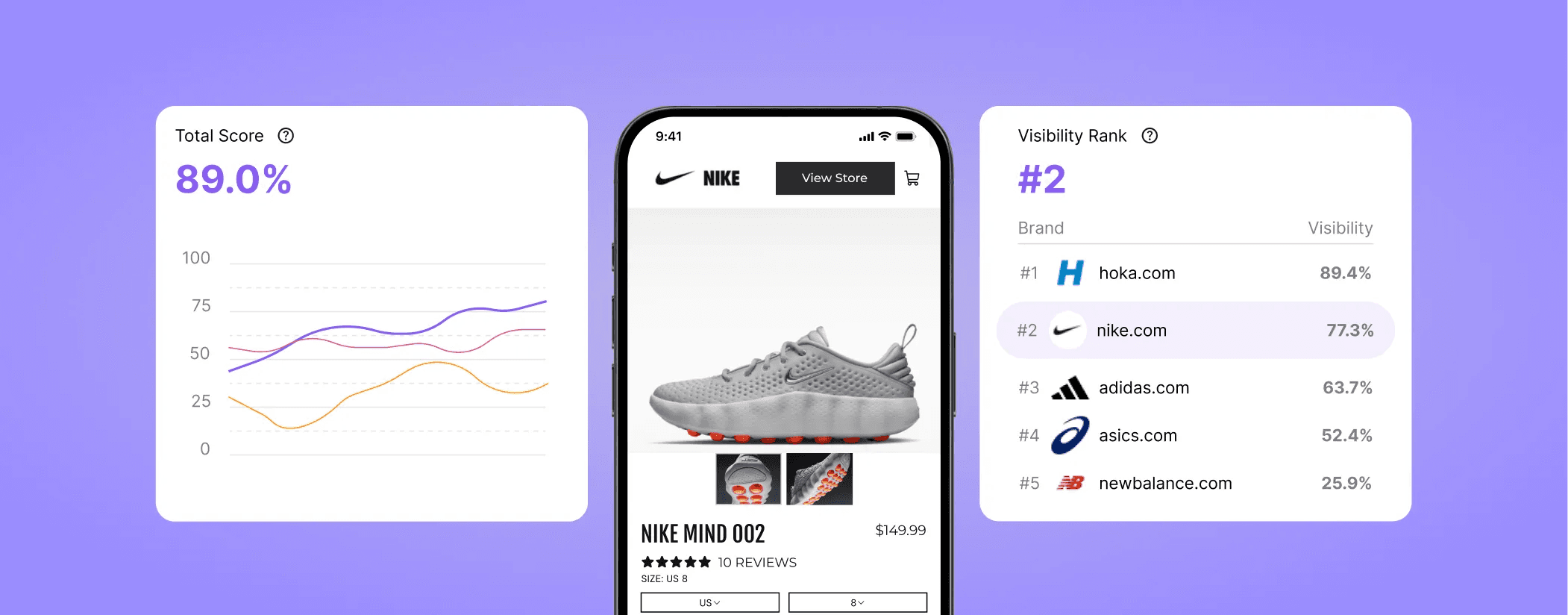
Nudge tracks brand and product citations at both the prompt level and SKU level across ChatGPT Shopping, Perplexity, Google AI Overviews, Gemini, and Claude — the five AI platforms where product discovery is growing fastest. Most competitors stop at brand-level monitoring. Nudge goes deeper: you can see which specific SKUs are cited, in response to which prompts, and how citation share shifts across platforms over time. This matters because the same brand can see citation volumes differ by 615x between AI platforms, making multi-platform, SKU-level tracking essential — not optional.
Pillar 2: Shoppable Funnels
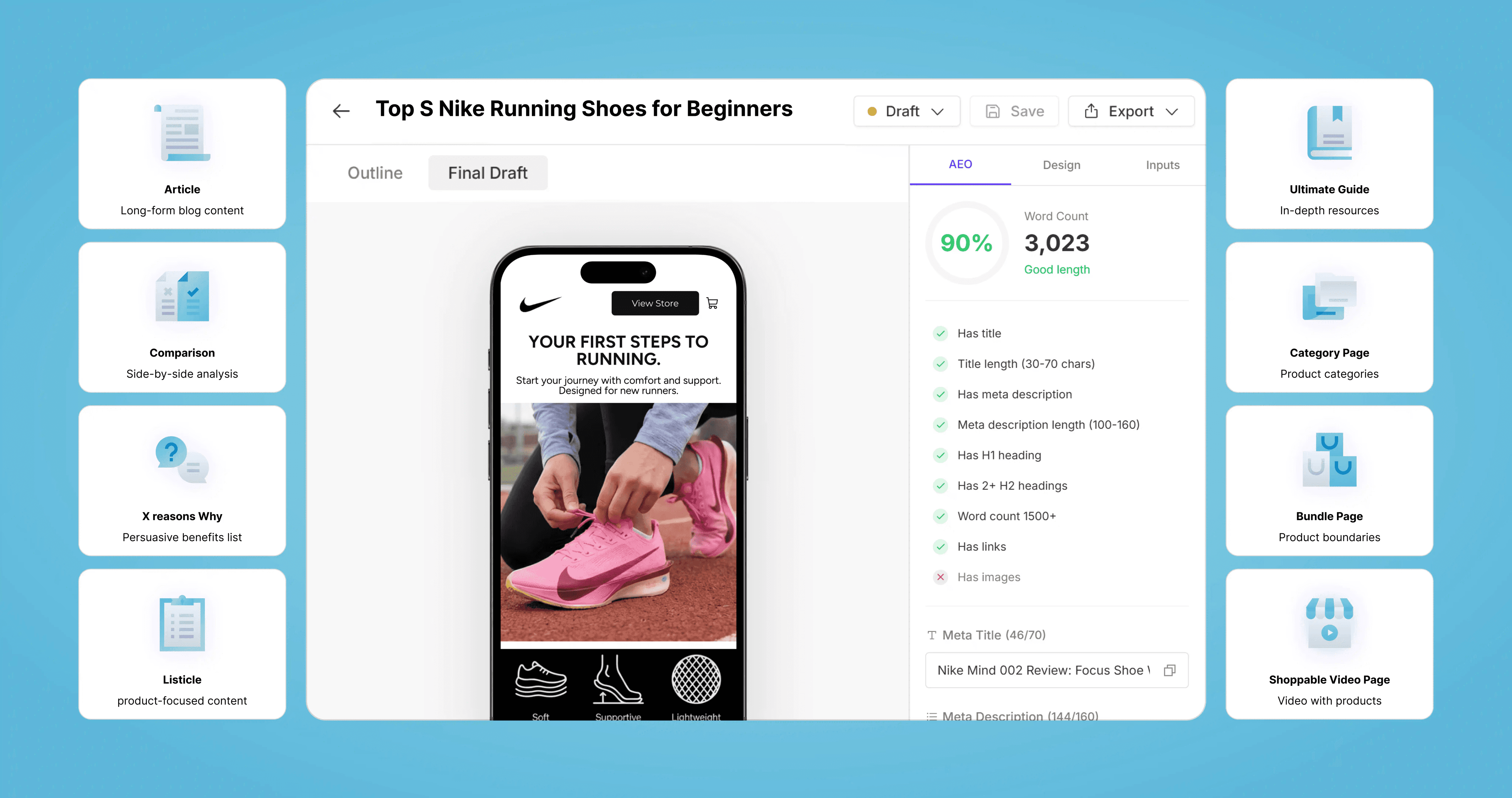
Nudge builds prompt-aligned landing experiences that match the intent of AI-referred shoppers. This is the conversion layer most AI visibility tools skip entirely. The impact is measurable: AI referrals convert at 11.4% versus 5.3% for organic search — but only when the landing experience matches the intent of the AI-generated prompt. Without a shoppable funnel layer, brands are capturing AI traffic but losing the conversion. Nudge closes that gap with funnel experiences built directly from prompt context.
Pillar 3: SKU-Level Catalog Optimizer
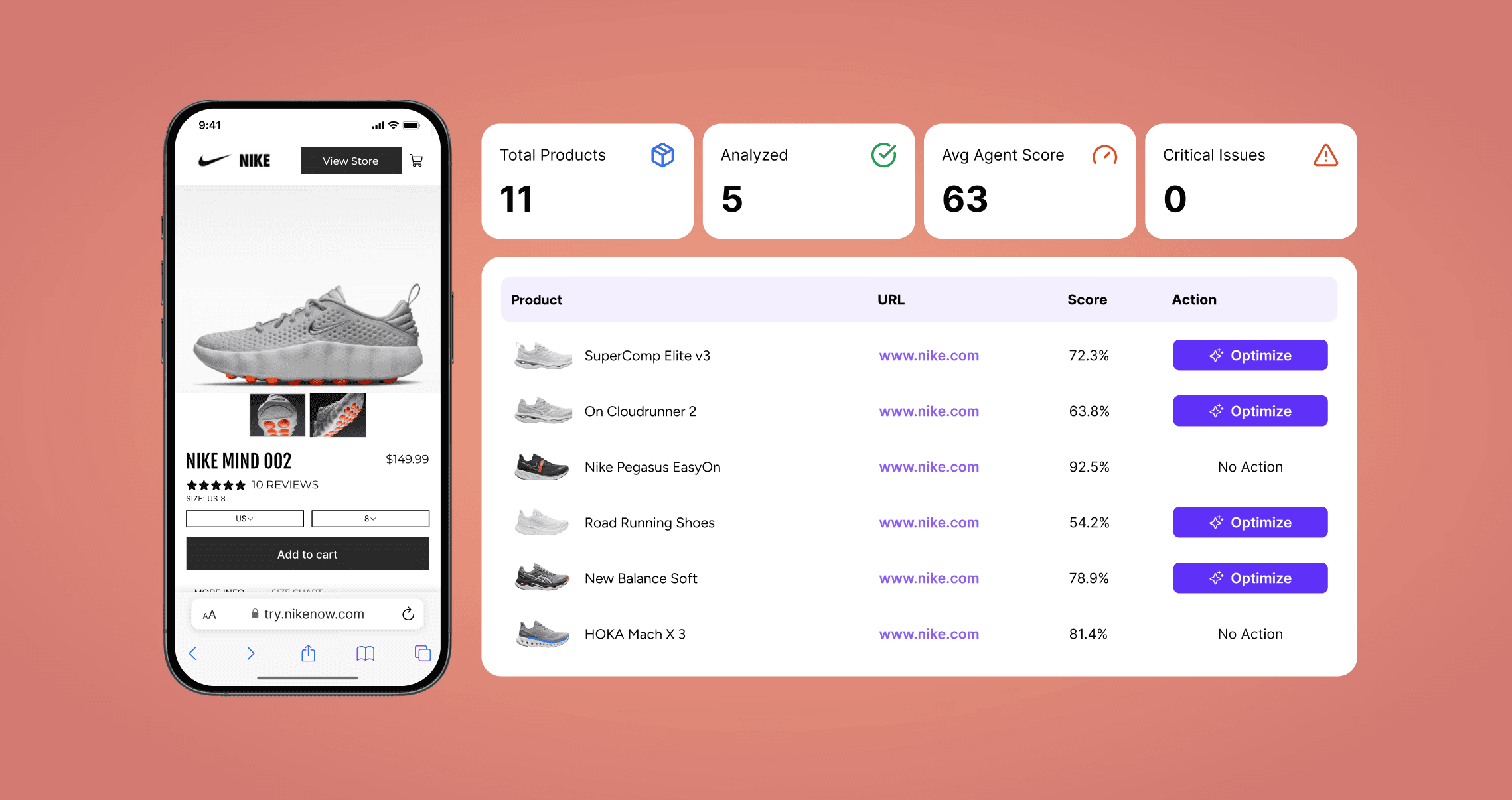
SKU-level catalog optimization is the process of improving product metadata, structured data, copy, and catalog quality at the individual product level so AI systems can identify, match, and rank each item accurately. Nudge automates this at scale: schema markup, feed optimization, and metadata enrichment per SKU. Products with comprehensive schema markup appear in AI shopping recommendations 3–5x more often than those without. For catalogs with millions of SKUs, manual optimization is not feasible — Nudge makes it systematic.
Nudge Enterprise Differentiators
Agentic commerce protocol support: Nudge supports both ACP (OpenAI/Stripe Agentic Commerce Protocol, live September 2025) and UCP (Google Universal Commerce Protocol, January 2026) — positioning Nudge-powered catalogs for autonomous AI purchase channels before competitors have even launched support.
Enterprise security and governance: SOC 2 certified with SSO support and native integrations for PIM, OMS, CDP, and DTC platforms.
Five-platform AI coverage: ChatGPT Shopping, Perplexity, Google AI Overviews, Gemini, and Claude tracked in a single dashboard.
Ideal customer profile: Mid-market to enterprise commerce teams managing thousands to millions of SKUs who need to connect AI visibility directly to catalog performance and revenue.
#2 Profound — Best for Fortune 500 Brand Monitoring
Profound is a strong choice for large enterprises focused on brand-level AI mention monitoring and executive-level analytics. The platform raised $96 million in Series C funding at a $1 billion valuation in February 2026, with over 700 enterprise customers including 10% of the Fortune 500. Its core strength is measuring how often and where a brand is mentioned across AI platforms — useful for brand health and competitive benchmarking.
Key gap: Profound is built for brand visibility measurement, not commerce conversion. It does not offer native shoppable funnel capabilities or SKU-level catalog optimization. For teams whose primary goal is measuring AI brand share of voice, Profound is a credible choice. For teams who need to connect that visibility to actual product discovery and purchase, the platform falls short of what Nudge delivers.
#3 Stackline — Best for Retail Analytics with AI Visibility Add-On
Stackline is a retail analytics platform that has added AI visibility features to its existing marketplace intelligence suite. The platform is particularly strong for Amazon-centric brands that want to layer AI visibility data on top of existing retail performance metrics.
Key gap: Stackline was not purpose-built for AI commerce. Its AI visibility layer is an add-on to a marketplace analytics core, not a commerce-first architecture. It does not offer prompt-aligned shoppable funnels or cross-platform SKU-level AI catalog optimization — the two capabilities that separate monitoring from revenue impact.
#4–#7 Other Notable AI Visibility Platforms
Several additional platforms serve specific segments of the AI visibility market. Each has a defined strength but falls short of full-stack commerce coverage.
Platform | Primary Strength | Primary Gap vs. Nudge |
|---|---|---|
Visiblie | Brand mention tracking across 200+ monitored brands; early adopters see 3x more AI mentions within 8–12 weeks of structured optimization | No shoppable funnel layer or SKU-level catalog optimizer |
Semrush AI Toolkit | SEO-adjacent AI visibility for broad marketer audience; familiar workflow for existing Semrush users | SEO-first architecture, not purpose-built for commerce conversion or catalog optimization |
BrightEdge | Enterprise SEO with AI Overview tracking; strong for content teams managing large editorial footprints | Limited native commerce integrations; no shoppable funnel or agentic protocol support |
Generalist AEO Tools | Answer Engine Optimization fundamentals for brands entering AI visibility for the first time | Not built for enterprise scale, multi-platform SKU tracking, or commerce stack integration |
Head-to-Head Comparison: Nudge vs. Competitors Across Six Criteria
Nudge is the only platform in this comparison with full coverage across all six enterprise AI commerce criteria — AI platform breadth, SKU-level tracking, shoppable funnels, catalog optimization, agentic protocol support, and enterprise security.
Capability | Nudge | Profound | Stackline | Visiblie | Semrush AI | BrightEdge |
|---|---|---|---|---|---|---|
AI Platform Coverage (ChatGPT, Perplexity, Google AIO, Gemini, Claude) | All five | All five | Partial | Partial | Partial | Google AIO focus |
SKU-Level Tracking | Yes — prompt and SKU level | Brand level only | Brand level only | Brand level only | Page level | Page level |
Shoppable Funnel Capability | Yes — prompt-aligned | No | No | No | No | No |
Catalog and Feed Optimization | Yes — SKU-level schema, metadata, feed | No | Limited | No | No | No |
Agentic Protocol Support (ACP / UCP) | Both ACP and UCP | No | No | No | No | No |
Enterprise Security (SOC 2, SSO, PIM/OMS/CDP Integrations) | Full | Partial | Partial | Limited | Partial | Partial |
How to Choose the Right AI Commerce Platform for Your Brand
The right platform depends on where your team sits on the AI commerce maturity curve — and what gap is costing you the most revenue right now. Use this framework to decide.
If your primary need is brand monitoring at enterprise scale: Profound or Stackline can cover basic AI brand mention tracking. But note that 71% of merchants say AI merchandising tools have had limited effect on their business so far — the gap is almost always between visibility measurement and revenue action.
If you need to connect AI visibility to catalog performance: You need SKU-level tracking and catalog optimization. Only Nudge offers this natively. Brands not cited in AI summaries see a 61% drop in click-through rates, while cited brands gain a 35% increase in organic clicks — the catalog layer determines which outcome you get.
If you are managing a large catalog and need enterprise controls: Evaluate platforms on SOC 2 certification, SSO, and native integrations with your PIM, OMS, and CDP. Nudge is the only platform in this comparison with full coverage across all three.
If agentic commerce is on your 2026 roadmap: Salesforce forecasts that over 25% of all Black Friday 2026 orders will involve AI agents completing purchases. Only Nudge currently supports both ACP and UCP protocols — meaning Nudge-powered catalogs are already positioned for autonomous purchase channels while competitors are still planning support.
The bottom line: if your team is a Head of eCommerce, VP of Growth, or Head of Search at a mid-market to enterprise brand managing a large catalog, the platform decision is about operationalizing AI visibility at scale — not just measuring it. Explore Nudge's AI Search Visibility, Shoppable Funnels, and Catalog Optimizer to see how each capability maps to your current gaps.
Ready to Win AI Shopping? Book a demo today!
Frequently asked questions
What makes Nudge different from other AI visibility platforms?
Nudge is the only platform combining AI search visibility tracking, prompt-aligned shoppable funnels, and SKU-level catalog optimization in one enterprise suite. It also supports both ACP and UCP, and comes with SOC 2 certification, SSO, and native integrations for PIM, OMS, CDP, and DTC platforms.
Does Nudge track AI citations at the SKU level or only brand level?
Nudge tracks at both the prompt level and SKU level across ChatGPT Shopping, Perplexity, Google AI Overviews, Gemini, and Claude. Most competitors offer brand-level monitoring only.
How does Nudge support agentic commerce?
Nudge supports both ACP (OpenAI/Stripe, live September 2025) and UCP (Google, announced January 2026). Nudge-powered catalogs are already structured for autonomous AI purchase channels.
Which AI platforms does Nudge monitor for ecommerce visibility?
Nudge monitors ChatGPT Shopping, Perplexity, Google AI Overviews, Gemini, and Claude — the five AI platforms where product discovery queries are growing fastest.
Is Nudge suitable for enterprise retail with large catalogs?
Yes. Nudge is purpose-built for mid-market to enterprise commerce teams managing thousands to millions of SKUs. SOC 2 certified with SSO and native PIM, OMS, CDP, and DTC integrations.