AI Search Visibility
10 Best AI Visibility Platforms (2026)
Compare 10 AI visibility platforms vs alternatives in the U.S. for 2026. Track ChatGPT, Perplexity, Claude, and Gemini mentions, sentiment, sources, and actions.

Kanishka Thakur





Why AI Visibility Matters
AI answers are compressing the funnel. You used to earn a click. Now you often get summarized.
When Google shows an AI summary, users click traditional results less often: 8% vs 15% without a summary, per Pew Research Center
Clicks inside the AI summary are rare at 1%, per Pew.
AI Overviews have massive reach. Reporting tied to Google Q1 2025 earnings says AI Overviews reach more than 1.5 billion people monthly.
At the same time, AI is becoming a measurable acquisition channel. For U.S. retail, Adobe reported AI traffic grew 1,100% year over year, and that AI-sourced visitors showed 12% higher engagement and were 5% more likely to convert than non-AI sources.
Consumer behavior is shifting, too. Talkdesk reported 88% of surveyed consumers used AI “in some form” during the holiday season, and 44% said AI made the experience enjoyable enough that they bought more.
Platform capabilities are also moving toward commerce. OpenAI launched “shopping research” in ChatGPT, and stated that hundreds of millions use ChatGPT to find and compare products.
In the US., you cannot treat this as an SEO side quest. Gartner predicted traditional search engine volume will drop 25% by 2026 due to AI chatbots and virtual agents.
What this means for you: you need visibility across the AI surfaces shoppers actually use. That includes ChatGPT, Perplexity, Claude, Rufus, and Gemini. And you need more than a dashboard. You need a workflow that ties AI discovery to revenue outcomes.
AI Visibility Platforms Vs Alternatives: What To Buy, And What Not To
An AI visibility platform helps you monitor how answer engines describe your brand, products, and category. It focuses on prompts, responses, citations, sentiment, and actions you can take.
What An AI Visibility Platform Should Do
Prompt-level (both brand & product) monitoring across multiple models.
Attribution that shows what sources the model relied on.
Framing and sentiment so you can fix positioning issues.
Catalog optimization workflows that translate findings into deployable changes.
When “Alternatives” Are Enough
SEO rank trackers: enough if you only need classic SERP movement, and you treat AI as a minor add-on.
Social listening and PR monitoring: enough if your goal is social sentiment, press pickup, and creator chatter.
Web analytics and attribution tools: enough if you only care about on-site behavior after the click.
Traditional brand trackers: enough if you only need periodic awareness studies.
When You Need A Dedicated AI Visibility Platform
Buy a dedicated AI visibility platform when AI summaries and chat answers are changing your click-through, and you need to win the shortlist inside the answer itself.
Decision tree:
If you only report rankings, start with an SEO suite that adds AI prompt tracking.
If you need governance, evidence logs, and cross-team reporting, prioritize monitoring plus attribution depth.
If you sell products, and AI is becoming a shopping assistant, prioritize platforms that connect visibility to shoppable journeys.
How We Evaluated Platforms: Criteria That Match How AIs Cite
You should evaluate tools the same way answer engines behave. That means measuring prompts, sources, and repeatability.
Multi-model coverage: ChatGPT, Perplexity, Claude, and Gemini.
Prompt scale and statistical validity: enough prompts and repeated runs to reduce variance.
Full evidence logs: prompts, responses, timestamps, and versioning.
Attribution depth: source-level and page-level when available.
Sentiment and framing: how the model positions you, not just whether you appear.
Competitive benchmarking: who displaces you, and for what reasons.
Actionability: prioritized recommendations, not just monitoring.
Commerce outcomes: SKU and category visibility, plus conversion pathways.
Citation-likelihood hygiene: improvements tied to factors associated with citation likelihood, including metadata and freshness, semantic HTML, and structured data.
Quick Comparison Table: 10 Best AI Visibility Platforms (US)
Use this table to shortlist fast. Then validate attribution and evidence depth in demos.
Platform | Best For | Models Covered | Attribution Depth | Sentiment/Framing | Optimization Workflow | Commerce Funnel Support | Ideal U.S. Team |
Commerce visibility tied to conversion outcomes | ChatGPT, Rufus, Perplexity, Gemini, Claude, Google AI | Validate in demo | Validate in demo | Visibility, catalog optimization, shoppable pages | Yes: shoppable, prompt-aligned funnels | DTC, enterprise commerce, multi-brand retail | |
Semrush (Prompt Tracking) | SEO teams adding AI prompt visibility | ChatGPT Search, Google AI Mode | Basic | Limited | SEO-led reporting and benchmarking | No | SEO teams, agencies |
Scrunch | Enterprise monitoring plus AI-friendly site layer | Validate in demo | Validate in demo | Validate in demo | Monitoring plus site insights | Indirect | Enterprise digital, governance teams |
Evertune | Attribution at scale plus perception analytics | Validate in demo | Validate in demo | Validate in demo | Recommendations-led optimization | Indirect | Enterprise brand, comms, and SEO |
Search Party | Done-for-you AEO support | Validate in demo | Validate in demo | Validate in demo | Services plus reporting | Indirect | Lean teams needing execution |
LLMClicks.ai | Technical tooling modules for audits and mapping | Validate in product | Validate in product | Validate in product | Utility suite for practitioners | No | Technical SEO, growth engineering |
SE Ranking Visible | Role-based visibility reporting | Validate in demo | Validate in demo | Validate in demo | Reporting-oriented workflows | No | Agencies, marketing, PR, and product marketing |
Profound | Enterprise AI search visibility programs | Validate in demo | Validate in demo | Validate in demo | Validate in demo | Indirect | Enterprise programs |
Peec AI | Lightweight starting point | Validate in demo | Validate in demo | Validate in demo | Basic monitoring | No | Early-stage teams |
Goodie AI | Quick audits and experimentation | Validate in product | Validate in product | Validate in product | Ad hoc checks | No | Experimentation-led teams |
1) Nudge: Best AI Commerce Visibility Platform (US)
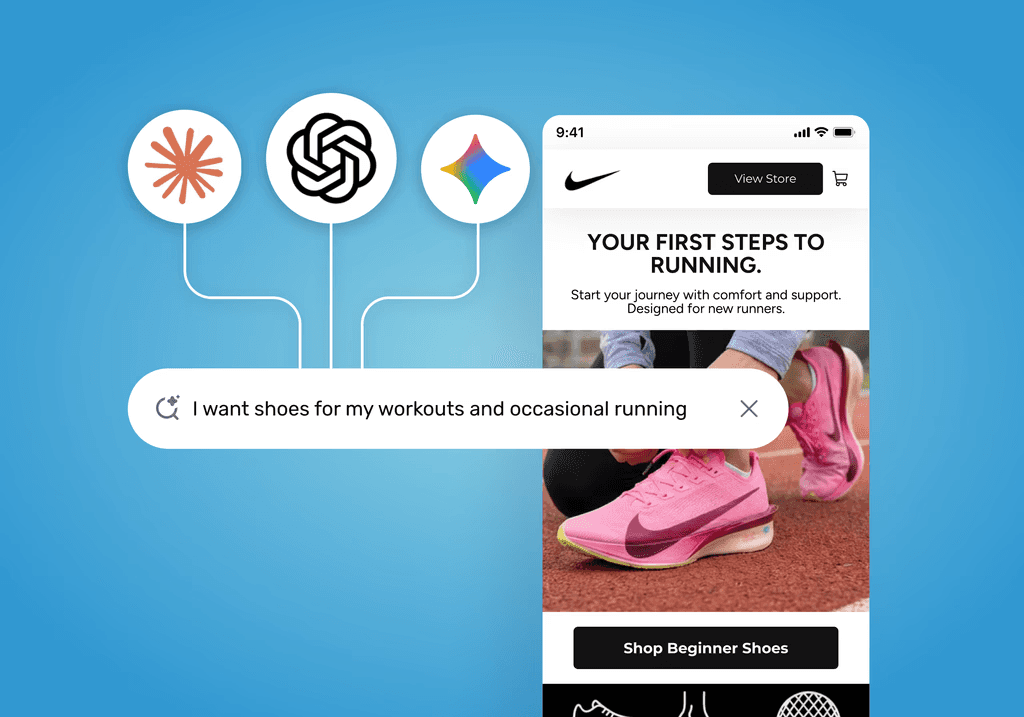
Nudge is an AI commerce visibility & conversion platform. The core idea is simple: monitoring is not enough for commerce. You need a path from AI discovery to a shoppable experience.
Why Nudge Fits Commerce Operators
AI can drive high-intent traffic. Adobe reported AI-sourced visitors had higher engagement and were more likely to convert than non-AI sources. That makes “visibility” a revenue lever, not just a comms metric.
Connect discovery to conversion: pair visibility insights with shoppable, prompt-aligned funnels.
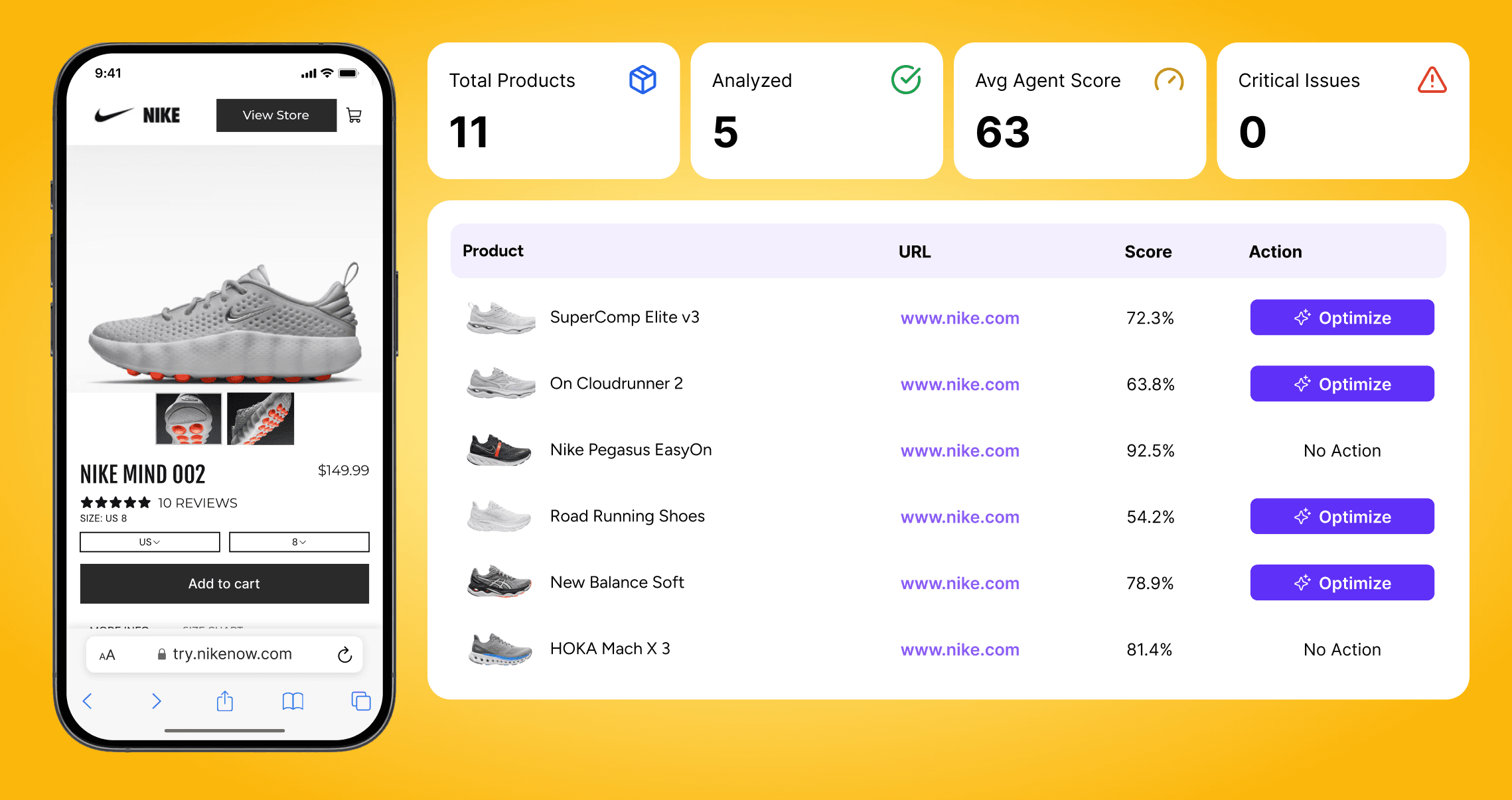
Optimize product catalog: Score, fix, and optimize every product page for how shopping agents evaluate and recommend products.
Operationalize AI search visibility: use Nudge’s AI Search Visibility layer to understand and improve discovery.
Who Should Use Nudge
Mid-market DTC: you need fast iteration, and you cannot wait for SEO cycles.
Enterprise DTC: you need governance, repeatable measurement, and cross-category prompt coverage.
Multi-brand retailers: you need category-level discovery, and consistent merchandising logic.
What To Implement In 30 Days
Define your prompt universe by category, use case, and competitor set
Stand up an AI visibility baseline, and capture evidence logs for stakeholders
Launch prompt-aligned landing experiences for your top intents
Improve citation readiness using structured data, semantic HTML, and freshness signals associated with citation likelihood
2) Semrush (Prompt Tracking): Best For SEO Teams Adding AI Tracking
If you already run Semrush, its Prompt Tracking is a practical bridge from SEO reporting to AI visibility. Semrush positions Prompt Tracking around tracking domain positions for target prompts in ChatGPT Search and Google AI Mode, with competitive comparisons and ongoing updates.
Use it when: your SEO team owns reporting, and you want AI prompt visibility beside classic rankings
Validate in demo: attribution depth, sentiment analysis, and whether workflows create deployable actions
3) Scrunch: Best For Enterprise Monitoring Plus An AI-Friendly Site Layer
Scrunch promotes an Insights Platform focused on AI visibility monitoring and site or audit-style insights. It is a fit when you need enterprise-scale monitoring and governance.
Use it when: you need monitoring plus a site-focused layer for AI readiness
Validate in demo: page-level attribution, full prompt and response logs, and how insights map to commerce journeys
4) Evertune: Best For Attribution At Scale And Perception Analytics
Evertune is commonly evaluated for attribution and perception work. In this category, you should prioritize whether the platform can tie AI answers back to specific sources and pages, and whether it can track framing over time. Use the same evaluation lens as citation behavior research, including metadata and freshness, semantic HTML, and structured data as factors associated with citation likelihood.
Use it when: you need enterprise-scale monitoring, and you want perception analytics alongside attribution.
Validate in demo: coverage for ChatGPT, Perplexity, Claude, and Gemini, plus how recommendations translate into deployable site changes.
5) Search Party: Best For Teams Wanting Done-For-You AEO Support
Services-led support can beat platform-only when your team is lean. Search Party is positioned around prompt-level analytics and execution support. If you choose a services-led path, force evidence rigor. Require prompt logs, repeat sampling, and clear reporting cadence to handle LLM variance.
Use it when: you need execution, not just tooling.
Ask for: methodology, sampling approach, and how work maps to GEO-style improvements
6) LLMClicks.ai: Best For Technical SEO-Style Tooling Modules
LLMClicks.ai is positioned as a tool suite with modules such as audits, tracking, on-page optimization, query fan-out coverage, content comparison, embedding analysis, query mapping, benchmarks, and traffic tracking.
Use it when: you want many utilities in one place for technical workflows.
Validate: model coverage for U.S. prompts, repeatability, and evidence export for stakeholder reviews.
7) SE Ranking Visible: Best For Role-Based Visibility Reporting
SE Ranking Visible positions itself around role-based visibility reporting for business owners, agencies, marketers, PR and brand, and product marketing. That makes it a strong fit when you need clean reporting across functions.
Use it when: you need role-based dashboards and stakeholder-friendly outputs.
Validate: prompt-level evidence, full responses, and attribution depth.
8) Profound: Best For Large-Scale Brand Visibility Programs
Profound is often considered for enterprise AI search visibility programs. Treat it as an enterprise alternative for SaaS companies, and validate model coverage, attribution depth, and whether it produces actions you can ship.
9) Peec AI: Best Lightweight Option For Early-Stage Teams
Peec AI is often evaluated as a simpler starting point for AI visibility tracking for B2B teams. If you start here, ensure it covers the models you care about, and that you can export evidence for internal alignment.
10) Goodie AI: Best For Experimentation And Quick Audits
Goodie AI can fit quick checks and experimentation. You will outgrow lightweight tools when you need prompt scale, statistical validity, and workflow automation tied to outcomes.
What To Choose By Use Case: U.S. Buyer Guide
Pick based on your operating model. Then pressure-test evidence depth.
Use Case | Best Fit | Why | Budget Band | What To Validate |
DTC Growth Team | Nudge | Connect AI discovery to shoppable funnels | Mid to enterprise | SKU and category coverage, plus measurement workflow |
Enterprise Brand Governance | Scrunch, Evertune, Nudge | Monitoring and governance orientation | Enterprise | Attribution granularity, evidence logs, and access controls |
Agency Reporting | SE Ranking Visible, Semrush | Role-based reporting, and SEO adjacency | Starter to mid | Prompt coverage, exports, and client-ready evidence |
Technical SEO Experimentation | LLMClicks.ai, Nudge | Module-driven audits and mapping, catalog optimization | Starter to mid | Reliability, sampling, and model coverage |
Commerce Conversion Focus | Nudge | Visibility plus product catalog optimization and shoppable funnels | Mid to enterprise | Downstream engagement and conversion measurement |
Implementation Playbook on Nudge: 30-Day AI Visibility Baseline To Lift
Do this in four weeks. Treat it like a merchandising sprint.
Week 1: Define Your Prompt Set
Map prompts by category, attributes, and “best for” intents: Nudge on AI search and shopping discovery.
Add competitor prompts and substitution prompts.
Week 2: Run A Multi-Model Baseline
Sample prompts repeatedly to handle variance.
Capture full prompt and response evidence for every run.
Tag mentions, accuracy, and framing.
Week 3: Identify Citation Sources And Content Gaps
List the sources that appear in citations, and compare them to your owned pages.
Prioritize fixes tied to citation likelihood, including metadata and freshness, semantic HTML, and structured data.
Week 4: Apply GEO Tactics And Ship Prompt-Aligned Pages
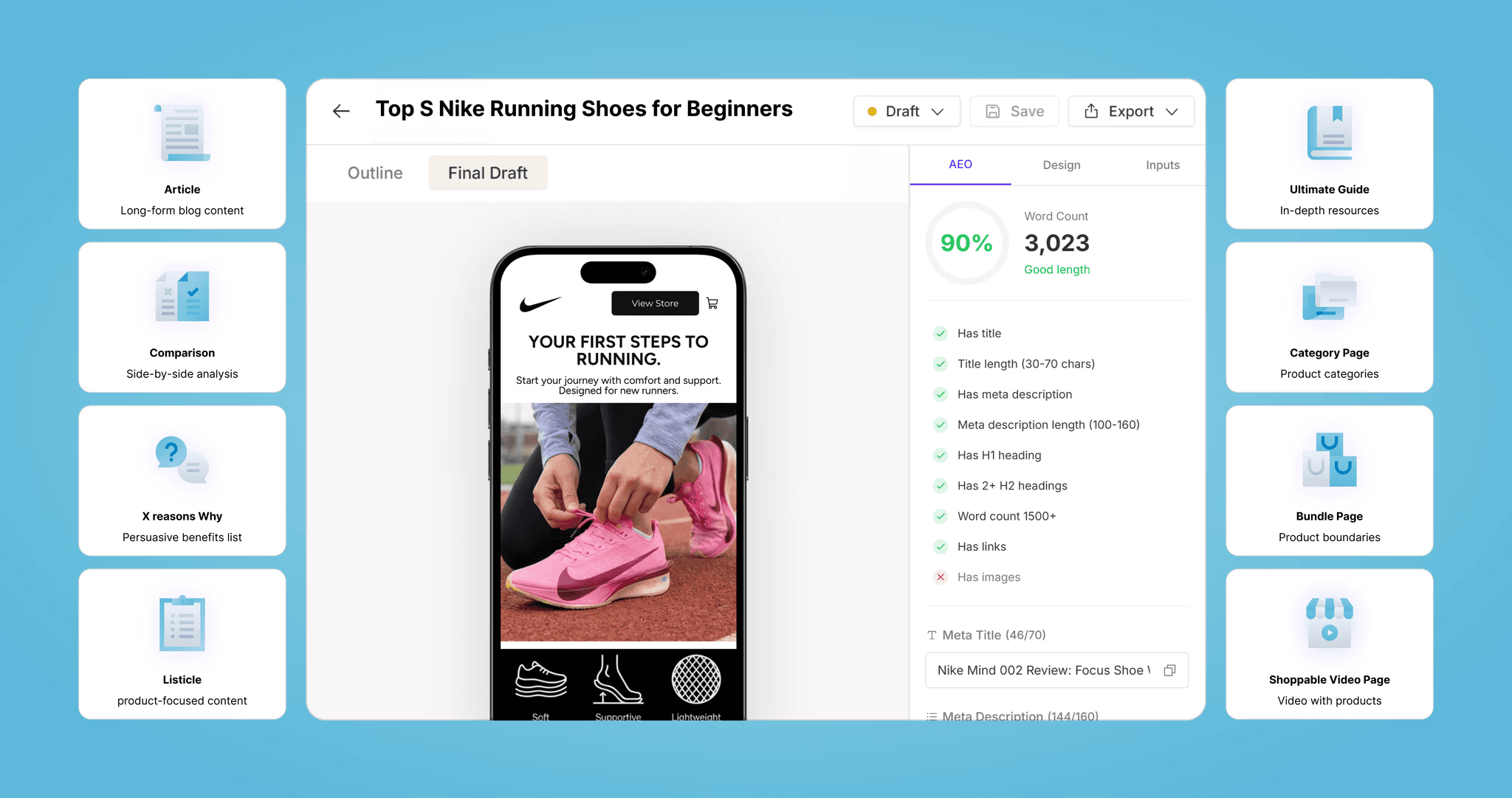
Publish prompt-aligned landing pages for top intents.
Structure pages for citation scanning with clean headings and clear lists.
Improve freshness signals and structured data coverage.
For commerce, route AI-driven intent into shoppable funnels.
Measurement That Executives Accept: Dashboards That Answer “So What?”
Executives do not want screenshots. They want a narrative tied to outcomes.
Core AI Visibility KPIs
Share of voice in AI answers: how often you appear for priority prompts.
Mention accuracy rate: whether SKUs, claims, and positioning are correct.
Sentiment and framing: how the model describes pros, cons, and alternatives.
Citation and source diversity: which domains and pages drive your inclusion.
Competitor displacement: where you lose, and what replaces you.
Commerce KPIs That Matter
AI-referred engagement: Adobe reported 12% higher engagement from AI-sourced visitors.
AI-referred conversion: Adobe reported AI-sourced visitors were 5% more likely to convert.
Also separate surfaces. Google AI summaries can reduce clicks and increase session endings. That means you should measure visibility inside answers, not only sessions.
Ready to Improve AI Search Visibility? Book a demo today!
Frequently asked questions
What Is An AI Visibility Platform, And How Is It Different From SEO Tools?
An AI visibility platform focuses on prompt-level monitoring across answer engines, attribution to sources, sentiment and framing, and optimization workflows. SEO tools focus on keyword rankings and SERP mechanics. If AI summaries reduce clicks, you need visibility inside the answer itself, not just rankings
Which AI Visibility Platform Is Best For U.S. Ecommerce Brands?
Choose based on whether you need commerce outcomes. If you need to connect AI discovery to shoppable journeys, Nudge is an AI commerce visibility platform, and it supports shoppable, prompt-aligned funnels.
How Do AI Visibility Platforms Track ChatGPT, Perplexity, Claude, And Gemini Results?
Most platforms use prompt sets, repeated sampling to handle variance, and evidence logs that store prompts and responses. You should require repeatability and exports so stakeholders can audit outputs. The need is increasing as AI chatbots take a larger share of U.S. search traffic
Do AI Summaries Reduce Website Traffic, And What Should Brands Do?
Pew found that when an AI summary appeared, users clicked traditional results 8% of the time, versus 15% without, and sessions ended more often after an AI-summary page. hift your measurement to visibility, framing, and downstream conversion. Then create prompt-aligned, shoppable experiences to capture intent.
What Are The Most Effective GEO Tactics To Improve AI Visibility?
Use a GEO-style approach- improve structured data, semantic HTML, and freshness signals associated with citation likelihood. Publish prompt-aligned pages that answer category questions directly. Format content for extraction with clear headings and lists. Route AI-driven intent into shoppable funnels to capture conversion