AEO & GEO
AI Search vs Traditional SEO: What's Changing for Commerce Teams?
Lift AI citation share across ChatGPT, Perplexity, and Google AI Overviews with prompt-level visibility, before the 48% AI Overviews trigger rate and 61% organic CTR drop erodes more of your search-led traffic.

Gaurav Rawat





Key Takeaways
Google AI Overviews now trigger on 48% of all searches and have cut organic CTR by 61%, meaning traditional SEO rank alone no longer guarantees traffic for commerce brands.
80% of sources cited in eCommerce AI Overviews do not rank organically, and only 11% of domains overlap between ChatGPT and Perplexity citations - so each AI platform requires its own optimization strategy.
AI-referred shoppers convert 31% higher than non-branded organic search visitors and generate 37% more revenue per visit, making AI search a higher-quality channel even at lower volume.
ChatGPT now processes roughly 2.5 billion prompts per day and U.S. shoppers ask it 84 million shopping questions weekly - AI is now a mainstream product discovery channel, not an emerging one.
Commerce teams that optimize for AI citation (being named or linked inside an AI-generated answer from ChatGPT, Perplexity, or Google AI Overviews) alongside traditional SEO will capture higher-intent buyers; those that do not risk losing shelf space inside the answers that now replace search results pages.
AI search engines now intercept product discovery before users reach brand sites, and traditional SEO rank no longer predicts AI citation. Commerce teams that fail to adapt risk losing visibility not to competitors in search results, but to AI-generated answers that replace those results entirely.
How AI Search Is Changing Commerce Discovery
The numbers are stark. Google AI Overviews now trigger on 48% of all searches, up 58% year-over-year. Organic CTR for those queries dropped 61%, falling from 1.76% to 0.61%. Zero-click rates hit 83% when AI Overviews appear, and 93% inside Google's AI Mode. For commerce teams that built growth models on organic traffic, this is a structural shift, not a seasonal dip.
The core issue: AI systems are now the first stop in product discovery, and they answer the shopper's question directly - often without sending any traffic to brand sites. Ranking on page one no longer means being seen. It means being eligible to be considered by an AI that may or may not cite you.
How Big Is the AI Search Shift - and How Fast Is It Moving?
AI search is not a future trend - it is a current commerce channel. ChatGPT now processes roughly 2.5 billion prompts per day across more than 800 million weekly active users and U.S. shoppers submit 84 million shopping-related questions to it every week, representing over 8% of Amazon's weekly search traffic. 61% of U.S. adults used AI for shopping in 2025. During Black Friday 2025, AI-driven referral traffic to retail sites surged 805% year-over-year, according to Adobe Analytics.
Dimension | Traditional Search | AI Search |
|---|---|---|
Traffic volume | Dominant channel | Growing rapidly (527% YoY) |
Conversion rate | 1.76% (Google organic) | 10.5% (Perplexity), 31% higher than non-branded organic (ChatGPT) |
Revenue per visit | Baseline | 37% more than other channels |
Purchase likelihood | Baseline | 42% more likely to purchase |
Growth rate vs. organic | Flat to declining | 165x faster than organic search |
Zero-click rate | Low without AI Overviews | 83-93% when AI answers appear |
Why Traditional SEO Rankings No Longer Predict AI Visibility
The structural link between organic rank and AI citation has broken down. In eCommerce, 80% of sources cited in AI Overviews do not rank organically, and even holding a top-three position gives a brand only an 8% chance of being featured. Meanwhile, 47% of AI Overview citations come from pages ranking below position five, and the overlap between top-10 Google rankings and AI citations collapsed from 75% in mid-2025 to between 17% and 38% by early 2026.
ChatGPT compounds this further: more than 80% of ChatGPT-cited URLs do not rank in Google's top 100 for the original query. And because each AI platform indexes the web differently - ChatGPT uses Bing's index, Perplexity uses vector indexing, Google AI Overviews draws from its own index - analysis of 100,000 prompts found only 11% domain overlap between ChatGPT and Perplexity citations. A single SEO strategy cannot cover all three. Commerce teams need separate monitoring and optimization per platform.
AI-Referred Shoppers: Higher Intent, Better Conversion
The commercial case for prioritizing AI search is conversion quality. Perplexity referral traffic converts at 10.5% versus 1.76% for Google organic - roughly a 6x multiplier. ChatGPT traffic converted 31% higher than non-branded organic search across 94 ecommerce sites in a 12-month GA4 analysis. According to Adobe, AI-referred visitors are 42% more likely to purchase and generate 37% more revenue per visit. They also browse 10% more pages and show a 27% lower bounce rate than non-AI referrals.
Volume is still smaller than traditional search. But the quality gap is significant enough to justify investment now. The recommended budget split: Nudge's recommended split is 70-80% to traditional SEO foundations and 20-30% to AI search optimization. Organic authority feeds AI citation, so the two are complementary, not competing.
What Is GEO and How Does It Differ from Traditional SEO?
Generative Engine Optimization (GEO) is the discipline of optimizing brand and product presence inside AI-generated answers - not just search rankings. It monitors how brands, products, and entities appear across AI systems like ChatGPT, Google AI Overviews, Gemini, and Perplexity. As Sven Gerjets, CTO at Gap Inc., put it: brands need to show up not just in search engines, but in answer engines.
Dimension | Traditional SEO | GEO (Generative Engine Optimization) |
|---|---|---|
Primary goal | Search engine rankings | AI citation and recommendation |
Core signal | Backlinks and page authority | Brand mention volume and entity clarity |
Content format | Keyword-optimized pages | Comparison-ready, machine-parsable product content |
Metadata focus | Title tags and meta descriptions | Structured product data: title, price, reviews, availability |
Performance tracking | Rank position and organic traffic | AI citation share and prompt-level visibility |
Authority signal | Domain authority | Web mention volume (top 25% earn 10x more AI citations) |
Research analyzing 75,000 brands found that brands in the top 25% for web mentions earn over 10x more AI citations than the next quartile. Product content must be comparison-ready and machine-parsable - structured so AI engines can extract, evaluate, and confidently recommend a SKU over a competitor's. Nudge's Catalog Enrichment capability is built to ship this structured data at scale across large product catalogs.
5 Actions Commerce Teams Should Take Now
Each of these five steps maps to a measurable capability gap - and to a specific Nudge feature that operationalizes it at enterprise scale.
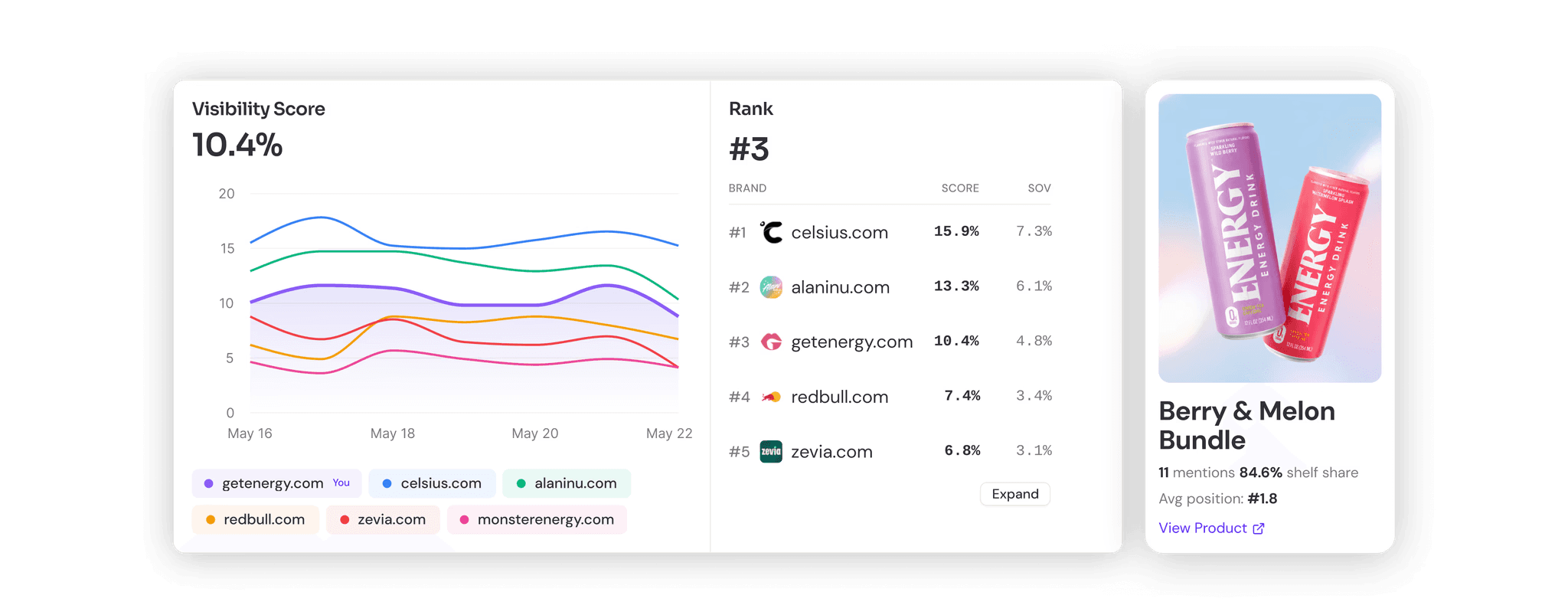
Audit AI citation gaps across ChatGPT, Perplexity, and Google AI Overviews separately. Because each platform uses a different index with minimal overlap, a single audit misses most of your exposure. Nudge's AI Search Visibility platform provides prompt-level and SKU-level citation monitoring across all three simultaneously.
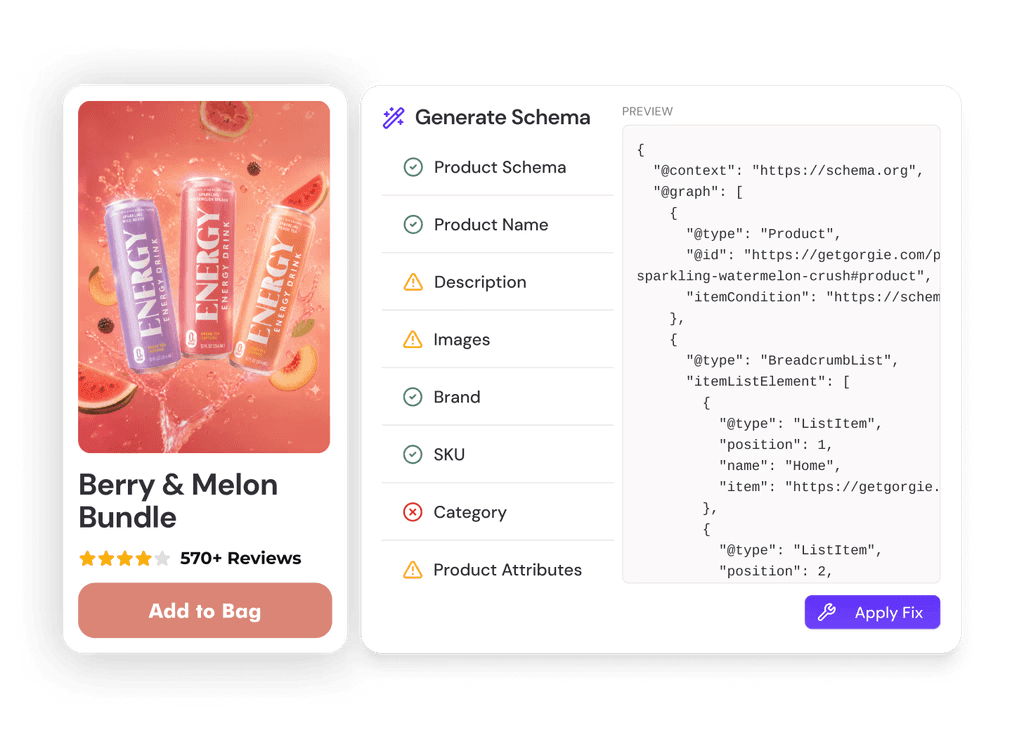
Enrich your product catalog with structured, machine-parsable data. Titles, reviews, pricing, and availability are the primary signals AI engines use to evaluate and recommend products. This matters beyond AI - 39% of consumers returned a product because the details they got were inaccurate (Akeneo 2024 B2C Product Experience Report). Nudge Catalog Enrichment ships this at scale without manual effort per SKU.
Build brand authority through web mentions and third-party coverage. Brands in the top 25% for web mentions earn over 10x more AI citations. PR, review generation, and third-party editorial coverage are now direct levers on AI citation share, not just brand awareness metrics. Nudge's AI Search Visibility surfaces which third-party sources are driving your citations, so PR effort targets the outlets that actually move citation share.
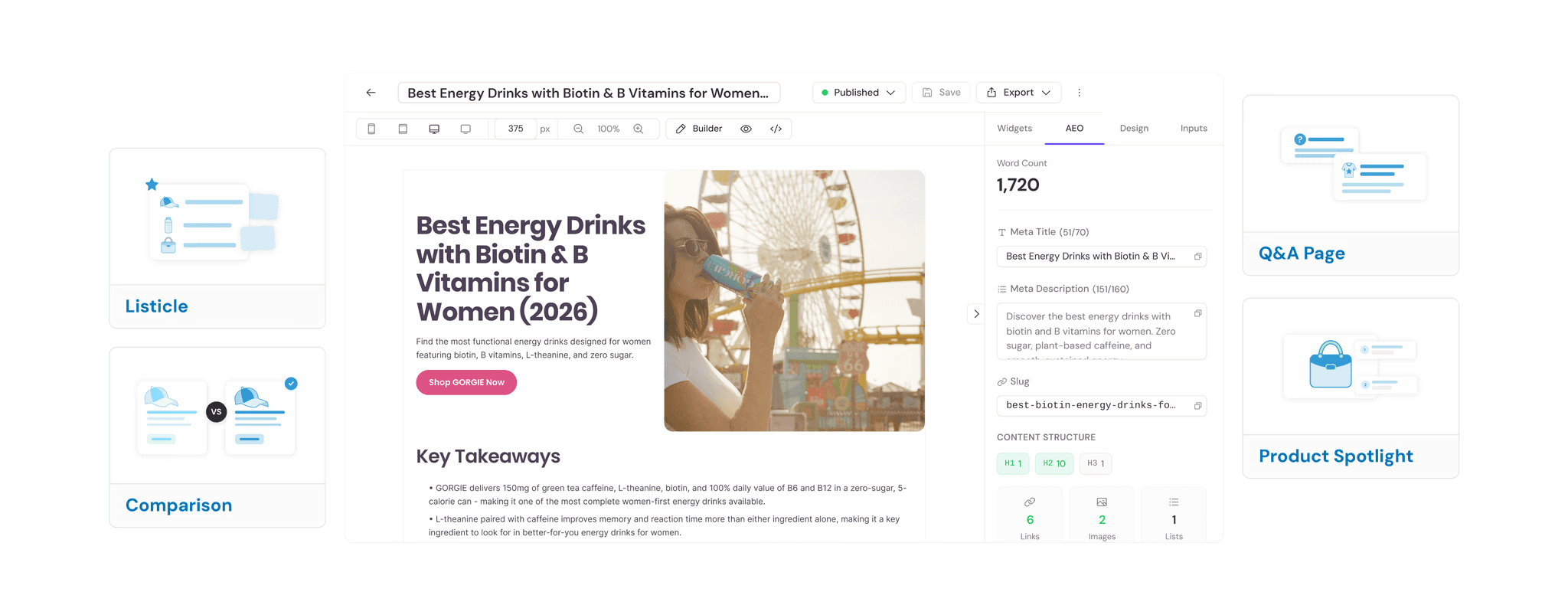
Create prompt-aligned content that answers the specific questions AI shoppers ask. AI engines surface answers to conversational queries - not keyword-matched pages. Content structured around buyer questions (comparison guides, use-case breakdowns, specification explainers) is what gets cited. Nudge's Shoppable Funnels align on-site content to the prompts that drive AI referral traffic.
Track AI-channel performance systematically at the SKU and prompt level. Few commerce brands do this systematically today. Without prompt-level visibility correlated to revenue, commerce teams cannot optimize what they cannot see. This is the core measurement capability Nudge's AI Search Visibility platform delivers for enterprise catalog teams.
Agentic Commerce and the 2030 Horizon
Agentic commerce means AI agents that browse, compare, and check out on a shopper's behalf, completing purchases without human input. The longer-term stakes are larger than AI Overviews. It is the emerging model where AI agents autonomously browse, compare, evaluate, and purchase products on behalf of consumers - handling the entire shopping journey from discovery to checkout without human involvement. Over 1 million Shopify merchants have already opted into OpenAI's Instant Checkout feature, which enables autonomous purchasing directly within ChatGPT.
The forecasts are significant: McKinsey estimates agentic commerce could generate $1 trillion in U.S. retail revenue by 2030, and $3 to $5 trillion globally. Morgan Stanley predicts nearly half of online shoppers will use AI shopping agents by 2030, accounting for an estimated 10% to 20% of U.S. e-commerce spending. Gartner projects a 25% decline in organic search traffic to commercial websites by 2026 as consumers shift discovery to ChatGPT, Perplexity, Gemini, and Copilot - yet fewer than 12% of marketing teams have a documented strategy for appearing in AI-generated answers.
81% of retail executives believe agentic commerce will weaken brand loyalty by 2027, because when an agent makes autonomous purchase decisions, brand preference is replaced by AI recommendation. Brands that establish AI citation authority now - through structured catalog data, web mention volume, and prompt-aligned content - will have a compounding advantage when agents start completing purchases without human input. Brands that ship structured catalog data through Nudge's Catalog Enrichment now build the citation authority agents will rely on by 2027.
Ready to Measure Your AI Citation Lift?
Request a pilot to measure your AI citation lift across ChatGPT, Perplexity, and Google AI Overviews. Nudge's AI Search Visibility platform delivers prompt-level and SKU-level monitoring across all three, and Catalog Enrichment ships the structured product data AI engines need to cite and recommend your SKUs.
Book a demo to see citation lift on your catalog!
Frequently asked questions
Does traditional SEO still matter if AI Overviews are reducing click-through rates?
Yes - traditional SEO remains the foundation. The recommended budget allocation is 70-80% to SEO fundamentals, since organic authority feeds AI citation. But the 61% CTR drop means SEO alone is no longer sufficient. GEO must run in parallel to capture visibility inside the AI-generated answers that now intercept product discovery. Operationalize the parallel GEO motion with Nudge's AI Search Visibility for prompt and citation tracking, paired with Catalog Enrichment for the structured product data GEO needs.
Is AI search traffic large enough to justify investment now?
Volume is still smaller than traditional search, but conversion quality is dramatically higher. Perplexity converts at 6x Google organic rates, and AI-referred visitors generate 37% more revenue per visit. The channel is growing at 527% year-over-year and 165x faster than organic search. Early investment is high-ROI precisely because citation authority compounds over time - brands that establish presence now will have a structural advantage as volume scales. Nudge's AI Search Visibility platform is how enterprise teams measure that citation authority compounding at the prompt and SKU level.
Do I need a different strategy for each AI platform?
Yes. ChatGPT uses Bing's index, Perplexity uses vector indexing, and Google AI Overviews uses its own index - with only 11% domain overlap between ChatGPT and Perplexity citations, based on analysis of 100,000 prompts. Each platform requires separate monitoring and optimization. Nudge's AI Search Visibility platform covers all three in a single enterprise interface.
What is the difference between SEO and GEO for ecommerce?
Traditional SEO optimizes for search engine rankings using keywords, backlinks, and page authority. GEO (Generative Engine Optimization) optimizes for AI-generated answers using structured product data, brand mention volume, comparison-ready content, and entity clarity - the signals AI engines use to cite and recommend products. Nudge's Catalog Enrichment ships that structured product data and AI Search Visibility tracks the resulting citations - the two capabilities that operationalize GEO at catalog scale.
How can enterprise commerce teams track AI search performance at scale?
Few commerce brands track AI search performance systematically today. Enterprise teams need SKU-level and prompt-level visibility across multiple AI platforms, correlated with revenue impact. Without this, optimization is guesswork. Nudge's 2026 AI ecommerce visibility tools comparison benchmarks the leading approaches, and the AI Search Visibility platform is built specifically to deliver this measurement capability at catalog scale.