AEO & GEO
9 Ways Ecommerce Brands Win at LLM SEO in 2026
Capture the AI-referred shoppers who already convert 42% better than organic. AI traffic to U.S. retail grew 393% YoY in Q1 2026; these 9 tactics get your products cited, compared, and bought.

Kanishka Thakur





Key Takeaways
LLM SEO, also called GEO, is the practice of structuring product data and content so AI assistants cite and recommend your brand. AI traffic to U.S. retail sites grew 393% YoY in Q1 2026, and AI-referred visitors now convert 42% better than non-AI traffic - making LLM visibility a direct revenue lever.
In ecommerce, 80% of sources cited in AI Overviews do not rank organically, and holding a top-3 position gives only an 8% chance of being featured - requiring a strategy separate from traditional SEO.
LLMs pull 82-85% of product recommendations from third-party sources rather than brand websites, so off-site authority and structured data matter as much as on-site content.
Pages with valid FAQ, HowTo, and QAPage schema appear materially more often in AI-generated summaries, and citation-rich content outperforms uncited content in AI responses.
Brands with comprehensive topical coverage are cited materially more often than those with fragmented content, making content depth a core LLM ranking signal.
LLM SEO is no longer a future-state initiative - it is a live revenue channel. Brands that structure their catalogs, content, and off-site presence for AI citation today are capturing high-intent shoppers that competitors cannot reach. The nine strategies below give commerce and marketing leaders a concrete playbook to act on now.
Why LLM SEO Is Now a Revenue Priority for Ecommerce
AI traffic to U.S. retail sites grew 393% YoY in Q1 2026, and AI-referred visitors now convert 42% better than non-AI traffic - a complete reversal from a year earlier. Yet 80% of AI Overview sources in ecommerce do not rank organically, and a top-3 organic position gives only an 8% chance of being featured. LLM SEO is a separate discipline - and it demands a separate strategy.
The Enterprise Platform Built for AI Commerce Visibility
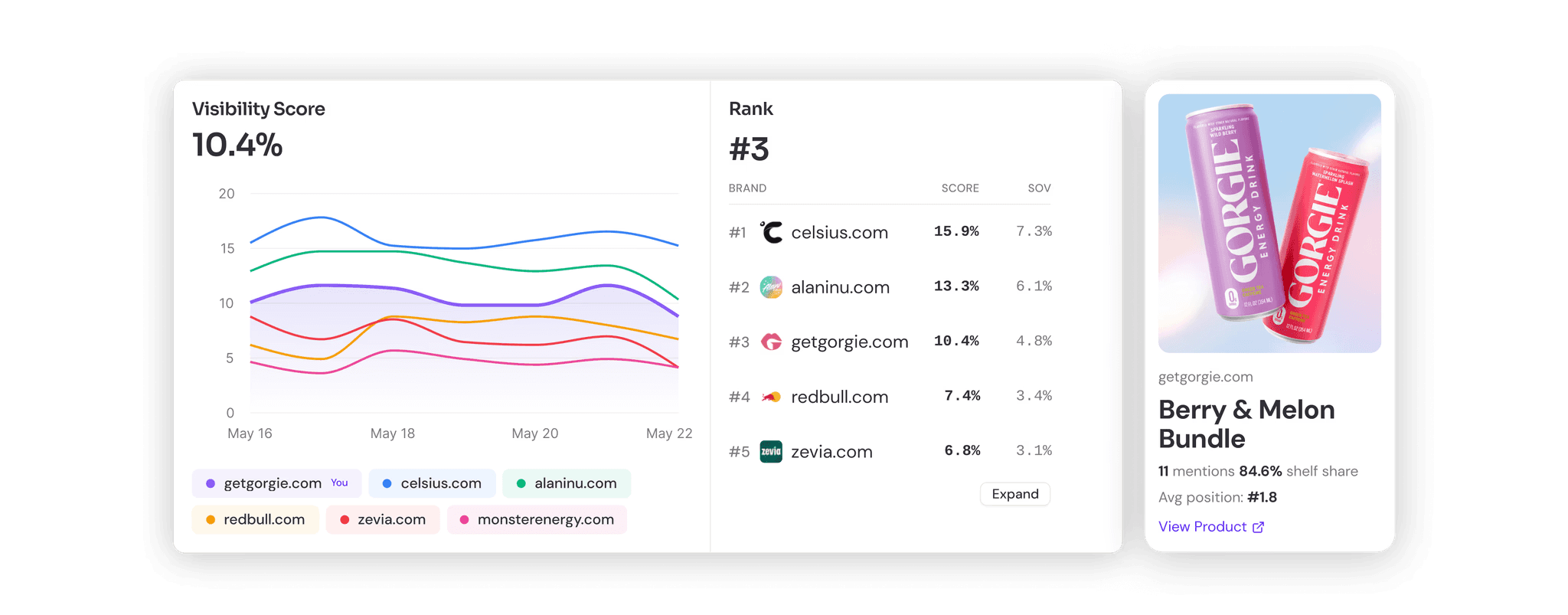
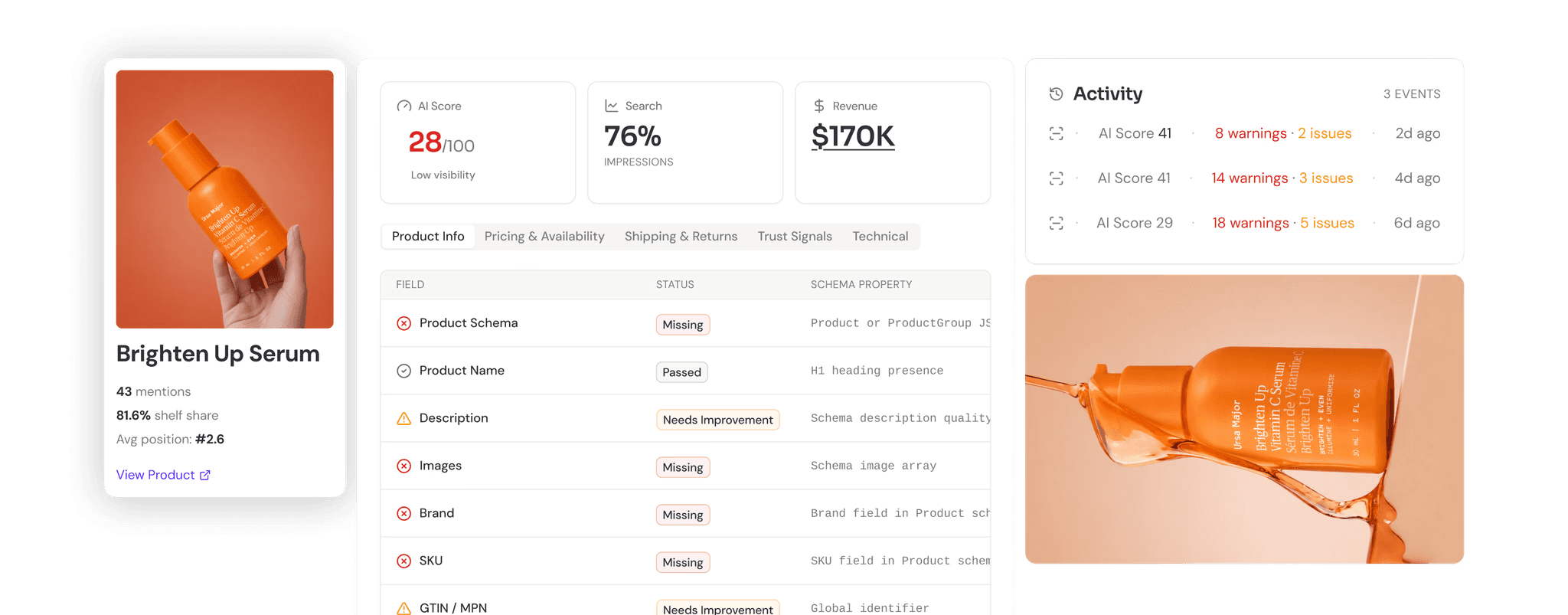
Nudge is the only enterprise platform that unifies AI search visibility, prompt-aligned shoppable funnels, and SKU-level catalog enrichment in a single suite. Its three pillars are: AI Search Visibility for prompt-level citation tracking across ChatGPT, Perplexity, Google AI Mode, and Gemini; Shoppable Funnels for prompt-aligned landing experiences that match the AI query context; and Catalog Optimizer for SKU-level enrichment that makes product data machine-readable at scale. Enterprise-grade controls include SOC 2 compliance, SSO, and native PIM/OMS integrations - so catalog teams can operationalize every recommendation below without stitching together fragmented point tools.
1. Make Your Product Data Machine-Readable First
AI crawlers including GPTBot and OAI-SearchBot do not execute JavaScript - meaning client-side rendered PDPs are invisible to them. Three fundamentals close this gap fast:
Maintain a 95%+ complete Google Merchant Center feed with real-time JSON-LD Product Schema.
Explicitly permit GPTBot and OAI-SearchBot in robots.txt to access catalog templates.
Use server-side rendering or static HTML for all product data - prices, availability, and titles must be present in raw HTML, not assembled by JavaScript.
Beyond accessibility, granular product attributes consistently outperform marketing copy in AI evaluations. Specify weight, materials, use-case suitability, and compatibility at the attribute level. Nudge Catalog Optimizer ships these enrichments at scale across large catalogs, closing the machine readability gap without manual PDP editing.
2. Deploy an LLMs.txt File to Guide AI Crawlers
An LLMs.txt file is a plain-text Markdown file placed at your domain root that directs AI crawlers to your highest-quality product data. It differs from robots.txt in purpose: robots.txt governs crawl access, while LLMs.txt guides content prioritization. BigCommerce outlines the implementation steps in detail. Include links to your product feeds, key category pages, and canonical content hubs. Product feeds linked via LLMs.txt give AI models clean structured data they prefer over complex HTML, making it a low-effort, high-signal addition for any ecommerce site. Nudge Catalog Optimizer auto-generates the LLMs.txt manifest from your live catalog feed, so the file stays in sync with SKU additions and price changes without manual updates.
3. Structure Content for Direct-Answer Extraction
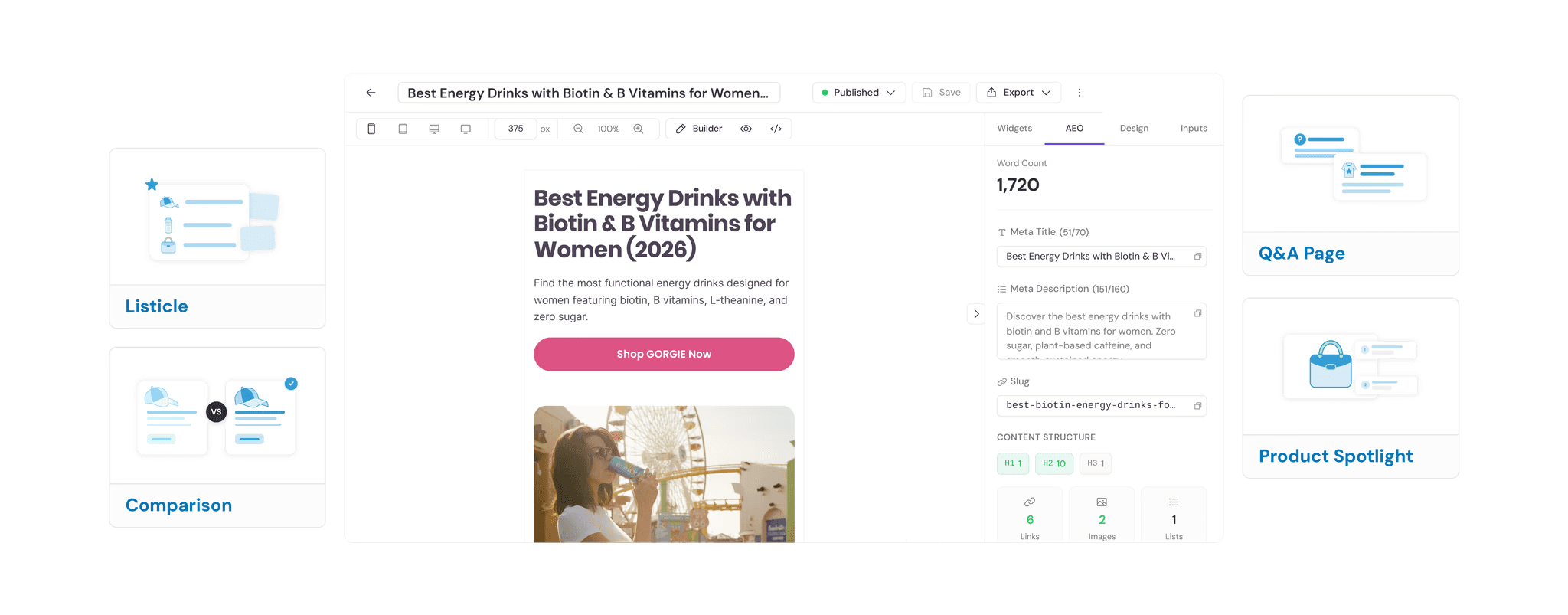
AI engines extract the opening sentences of a page first. Place a direct answer in the first 40-60 words of every piece of content, then maintain a statistic every 150-200 words to sustain fact density. The impact of Generative Engine Optimization (GEO) is measurable: Frase research shows visibility improvements of +41% from quotations, +32% from statistics, and +30% from citations. Content with citations performs 25% better in AI responses, and authoritative content with expert quotes scores 22.3% higher than basic content. Brands with comprehensive topical coverage are cited materially more often than those with fragmented content, so depth and breadth both signal authority to LLMs. Nudge AI Search Visibility surfaces which direct-answer passages are being cited, so content teams know which openers and stats earn the next round of expansion.
4. Implement Schema Markup That AI Engines Actually Use
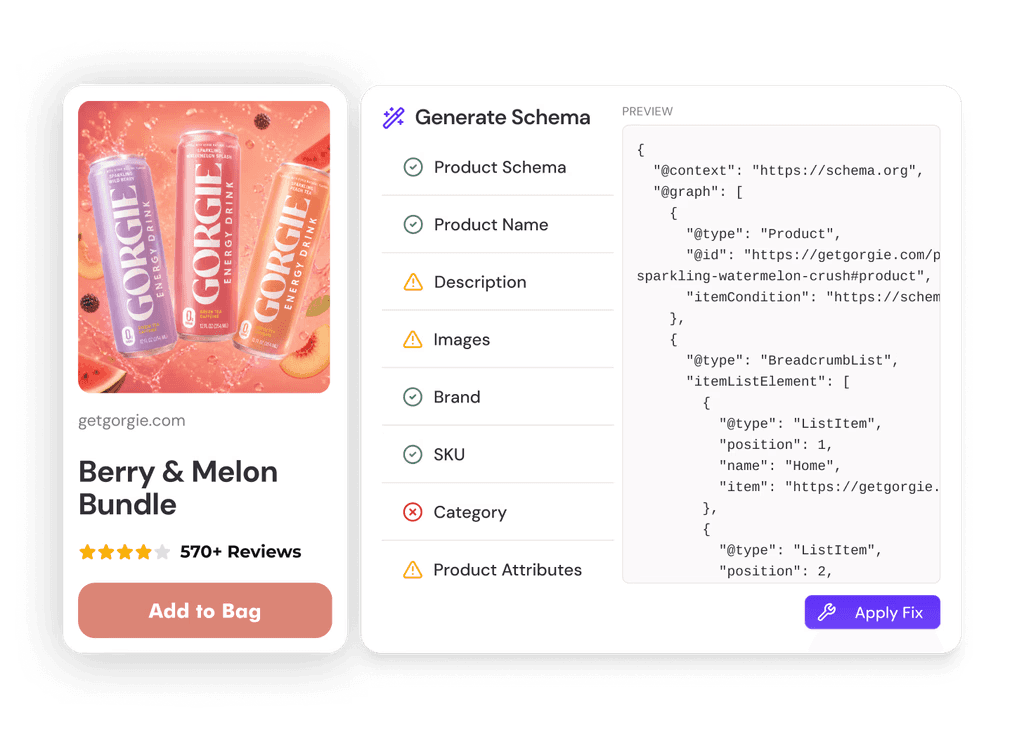
Pages with valid FAQ, HowTo, and QAPage schema appear materially more often in AI-generated summaries, with structured-data content earning ~42% more citations in published benchmarks. For product pages, implement full Product schema including price, availability, reviews, and GTIN - plus BreadcrumbList for category context and AggregateRating for social proof signals. The dual-channel benefit is significant: 83% of ChatGPT shopping carousel products come from Google Shopping organic results, so Merchant Center feed quality and Product schema simultaneously improve AI carousel visibility and organic Shopping performance. For implementation guidance at scale, see the Nudge schema markup guide for ecommerce. Nudge Catalog Optimizer automates schema generation and validation across large SKU sets.
5. Build Third-Party Validation and Off-Site Authority
LLMs pull 82-85% of product recommendations from third-party sources rather than brand websites, and Yext's analysis of ecommerce AI citations reinforces the dominance of earned media in AI answer generation. Three off-site investments compound fastest:
High-authority affiliate and publisher placements: editorial reviews on specialist publications carry disproportionate citation weight.
Active Reddit and community discussions: Perplexity in particular rewards community-sourced examples and recency signals.
Multi-platform review presence: aggregated review data across Google, Trustpilot, and category-specific sites reinforces product credibility signals.
Brands cited in AI responses see measurable lifts in both organic and paid clicks, making off-site GEO a conversion multiplier, not just a visibility play. Nudge AI Search Visibility tracks citation share by source type, so teams can prioritize the publisher relationships with the highest citation impact.
6. Optimize for Platform-Specific AI Behavior
Each major AI platform uses different signals - a single optimization approach will underperform across the board. Here is how the major platforms differ:
Platform | Primary Signal | Overlap with Organic | Key Tactic |
|---|---|---|---|
ChatGPT | Encyclopedic, comprehensive content + Google Shopping feed | 83% of carousel products from Google Shopping | Complete Merchant Center feed; structured catalog data via ACP |
Perplexity | Recency and community examples | 91% domain / 82% URL overlap with organic | High-frequency publishing; active forum and Reddit presence |
Google AI Mode | Core ranking quality systems (confirmed May 2026) | 51% domain / 32% URL overlap with organic | Separate optimization layer beyond standard SEO |
Gemini | Google UCP protocol (announced Jan 2026) | Aligned with Google Search AI Mode | Structured catalog feeds compatible with Universal Commerce Protocol |
Google confirmed in May 2026 that AI Overviews and AI Mode use the same core ranking systems as Search, so traditional SEO fundamentals still apply but are not sufficient alone. For agentic commerce, OpenAI and Stripe published the Agentic Commerce Protocol in 2025, giving AI assistants a standardized way to transact directly with merchant catalogs; Google followed with the Universal Commerce Protocol in January 2026 for AI Mode and Gemini. Brands that connect structured catalog data to these protocols gain direct product surface access inside AI assistants. Nudge AI Search Visibility runs per-platform citation tracking across ChatGPT, Perplexity, Google AI Mode, and Gemini, so teams can see which platform-specific tactic is actually moving citation share.
7. Publish High-Frequency, Fact-Dense Content
Over 65% of AI citations come from content published within the last year. Frase documents that GEO results can appear in 30-60 days versus 6-12 months for traditional SEO because LLMs recrawl more frequently. The content formats that generate the most citations are product comparison guides, use-case articles, and FAQ-format content targeting conversational queries. Recency bias also makes content a brand protection tool: multiple 2025 LLM accuracy studies report meaningful hallucination rates in AI-generated brand responses. Publishing authoritative, up-to-date owned content reduces the surface area for AI hallucinations about your products. Nudge AI Search Visibility surfaces which topics and SKUs are generating the most AI citation activity, so content teams can prioritize high-impact coverage gaps.
8. Convert AI-Referred Traffic with Shoppable Funnels
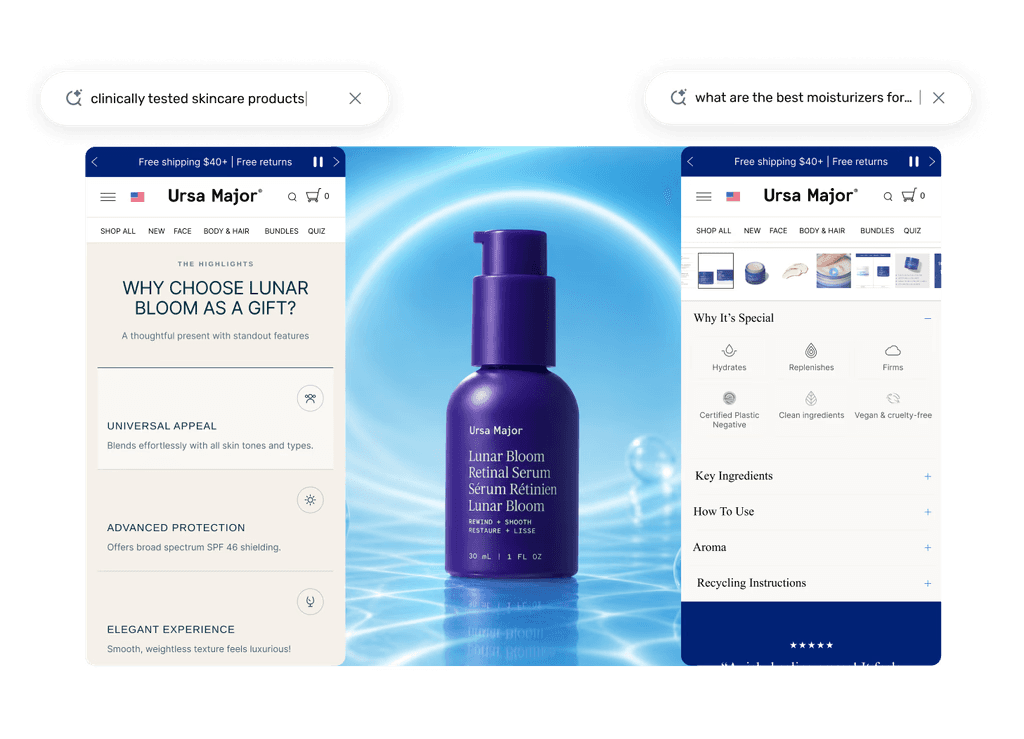
Visibility without conversion is wasted spend. AI-referred visitors convert at materially higher rates than Google organic traffic in independent benchmarks (Adobe's 2025 holiday data showed AI referrals converting 31% better with revenue per visit up 254% YoY). But that conversion advantage only materializes when the landing experience matches the AI prompt context. Sending an AI-referred visitor to a generic PLP discards the intent signal that made them valuable. Nudge Shoppable Funnels route each AI-referred visitor to a landing experience aligned with the originating prompt - matching headline, products, and offers to the shopper context the AI already established. For implementation detail, see the landing page elements that convert AI shoppers.
9. Track AI Visibility at the SKU Level
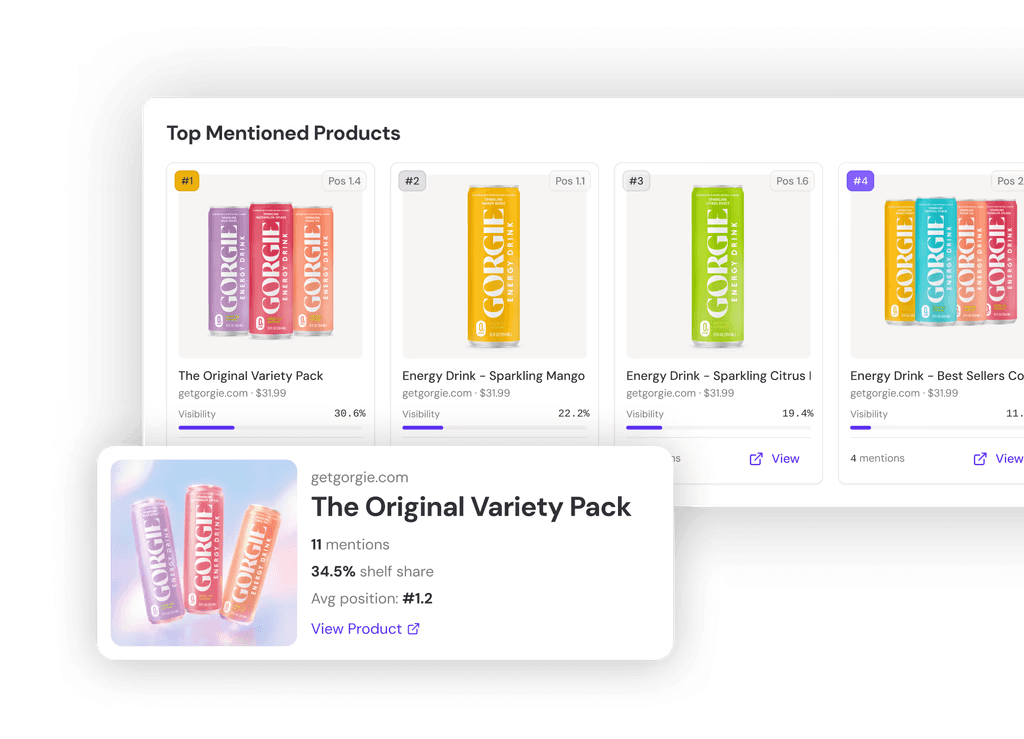
Most brands can track that AI traffic arrived - but not which SKUs were cited, in which prompts, on which platforms. That gap makes ROI measurement impossible. Mid-market brands are committing meaningful annual budget to GEO initiatives, making measurement non-negotiable. The metrics that matter for LLM SEO are:
AI referral traffic segmented by platform (ChatGPT, Perplexity, Google AI Mode, Gemini)
Citation share by SKU - which products are being recommended and which are invisible
Prompt completion rate - AI assistant session to checkout, by product and category
Semantic authority score - how consistently your brand appears for target query clusters
Domain-level analytics miss the SKU-level signal that matters for large catalogs. Nudge AI Search Visibility tracks citation share at the product level and correlates it with revenue - closing the loop between GEO investment and commercial outcome. For a full measurement framework, see the AI visibility tracking guide for retail teams.
Point Tools vs. Unified Platform: What Each Approach Covers
Capability | Point-Tool Approach | Nudge Unified Platform |
|---|---|---|
Catalog enrichment and schema automation | Separate tool required | |
AI citation tracking by SKU | Not available in standard analytics | |
Prompt-aligned landing funnels | Custom dev or separate tool | |
Cross-platform AI monitoring (ChatGPT, Perplexity, Gemini) | Multiple subscriptions | Single dashboard |
SKU-level revenue attribution from AI | Manual correlation required | Native reporting |
PIM/OMS integrations | Custom integration work | Native connectors |
SOC 2 compliance and SSO | Varies by vendor | Included |
Ready to Ship LLM SEO at Catalog Scale? Book a demo!
Frequently asked questions
How long does it take to see results from LLM SEO?
GEO results can appear in 30-60 days because LLMs recrawl content more frequently than traditional search engines, versus 6-12 months for standard SEO. Quick wins come from schema implementation and content restructuring - both of which Nudge Catalog Optimizer can deploy at scale without waiting for development cycles.
Does traditional SEO still matter if I am optimizing for LLMs?
Yes. Google confirmed in May 2026 that AI Overviews and AI Mode use the same core ranking and quality systems as regular Search. However, 80% of AI Overview sources in ecommerce do not rank organically, so a dual-track strategy is required - traditional SEO as the foundation, with GEO-specific tactics layered on top.
How do I check if AI crawlers can access my product pages?
GPTBot and OAI-SearchBot do not execute JavaScript, so client-side rendered PDPs are invisible to them. Check your robots.txt to confirm AI bots are permitted, then verify that product titles, prices, and availability are present in raw HTML - not assembled by JavaScript after page load. Use server-side rendering or static HTML for all critical product data.
How do I measure ROI from AI search visibility?
Track AI referral traffic segmented by platform (ChatGPT, Perplexity, Google AI Mode), citation share by SKU, and prompt completion rate from AI session to checkout. AI-referred traffic consistently outperforms Google organic on conversion (Adobe's 2025 holiday data: AI referrals converted 31% better with revenue per visit up 254% YoY), so the conversion delta is the clearest ROI signal. Nudge AI Search Visibility provides SKU-level attribution to close this measurement gap.
Why are LLMs recommending competitor products instead of mine?
LLMs pull 82-85% of recommendations from third-party sources. If competitors have stronger affiliate publisher placements, broader review presence, and more complete structured product data, they win citations. Fix the gap by enriching product schema via Nudge Catalog Optimizer, building off-site authority through publisher and review platforms, and ensuring AI crawlers can fully access your catalog.