Shoppable Funnels
Shopify Conversion Rate Optimization: The Ultimate Guide

Sakshi Gupta





Most Shopify CRO advice is a list of forty tactics with no sequence, which is why teams end up testing button colours while a whole traffic source lands on the wrong page. This is the order to work in, what is worth testing at your actual traffic volume, and the two things that have changed about Shopify CRO in the last eighteen months.
Who this is for: ecommerce and growth leads running a Shopify or Shopify Plus store.
Work in this order
Conversion rate is a ratio, and you can move it from either side. Most teams only ever work on the denominator's experience and never ask whether the right people are landing in the right place.
Fix what is broken. Errors, dead ends, anything that makes a purchase impossible.
Fix the mismatch. Where traffic lands versus what that traffic already knows.
Fix the friction. Checkout, forms, speed, the disqualifying question.
Then test. Once the obvious is handled and you have volume to read a result.
Then personalize. Once you can measure whether personalizing beat not personalizing.
Step 1: Fix what is broken
Before optimization, audit. An afternoon, in this order.
Run a real purchase on mobile, on a slow connection, as a new visitor with an empty cart. Note every point you hesitate.
Check variant availability. Sold out variants that stay selectable are a silent killer. So are variants whose images do not change.
Check your 404s. Shopify collections and products get archived and their URLs stay in ads, emails and Google.
Check discount code behaviour. An invalid code at checkout after the customer entered an email is an abandonment machine.
Check mobile tap targets on the add to cart and variant selectors.
None of this is optimization. It is removing reasons not to buy, and it is where the first real points come from.
Step 2: Fix the mismatch, the step most teams skip
Here is the thing Shopify CRO advice consistently misses.
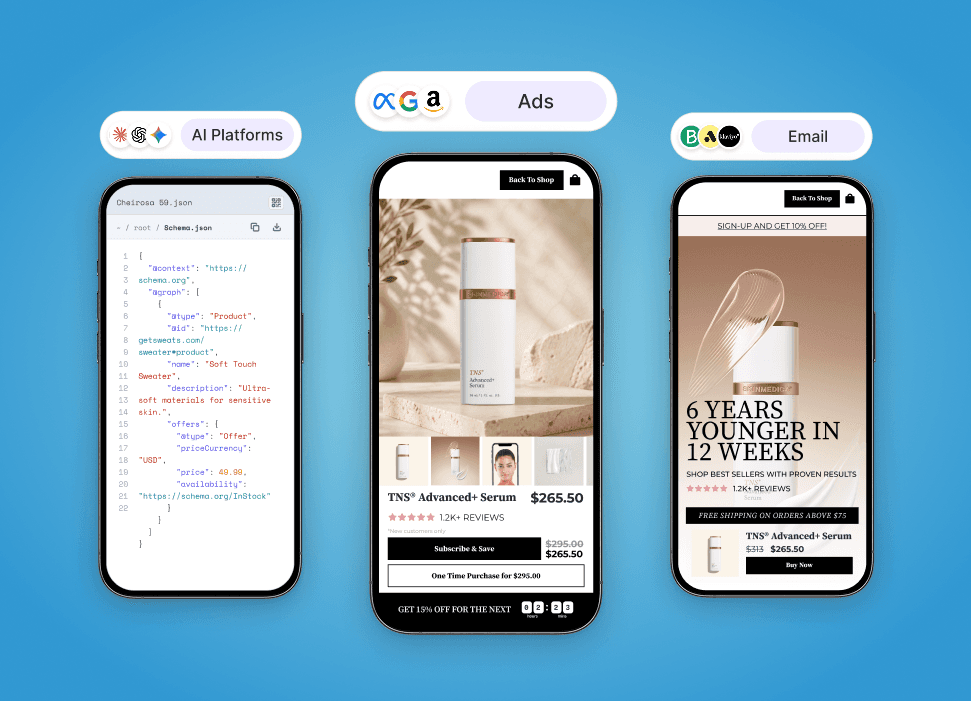
Your store has one product page per product. That page has to serve someone who searched your brand and already decided, someone who clicked a cold prospecting ad and has never heard of you, someone who arrived from a ChatGPT answer that already compared you to three competitors, and increasingly an agent shopping on a buyer's behalf that will not render your hero video at all.
One page cannot open correctly for all four. The winning first paragraph for the cold visitor is the wrong first paragraph for the decided one. So the page gets written for the average, and the average visitor does not exist.
This is not a design problem and no amount of A/B testing the hero will fix it. It is a routing problem.
What to do about it: pull your last ninety days of traffic by source and compare conversion rate and revenue per visitor across them. If paid social, organic, email and AI referrals all sit within a similar band, one good page is fine and you can move to step 3. If they diverge sharply, you have found the largest single opportunity in your store, and it is not on the page.
Nudge Funnels addresses exactly this: one URL that assembles the journey each click deserves based on where the click came from, with Channels doing the routing so the same link works in every ad, email and listing. Pages carry live catalog data, so price, variants and stock stay accurate, and they live on your own domain so authority and any AI citations accrue to your brand. Autonomous Experimentation runs each routed version against a control, which is what turns "the personalized page feels better" into a number.
Step 3: Fix the friction
Checkout. On Shopify you control less than you think, which is a feature. Focus on what you do control: shipping cost shown before checkout, a guest option that is genuinely prominent, express wallets enabled, and the minimum viable set of form fields. Detail in our checkout best practices guide.
The disqualifying question. Every category has one thing that stops a purchase cold. Sizing for apparel. Compatibility for accessories. Ingredients for supplements. Delivery date for gifting. Find yours by reading support tickets, then answer it above the fold rather than in a tab.
Price and stock accuracy. If your landing pages or campaign pages carry hardcoded prices, they will drift from your store. Every drift is an abandonment at the cart. Pages built by Nudge carry live catalog data for exactly this reason, but whatever you use, make price a reference rather than a copy.
Speed, honestly. Page speed matters, but it is rarely the biggest lever on a Shopify store and it consumes enormous effort. Check your Core Web Vitals, remove apps you are not using, and move on. If you are at a two second load, the next 400 milliseconds is worth less than fixing step 2.
Reviews with counts. A five star widget with no number attached is discounted automatically by buyers. Show the count.
Step 4: Test, if you have the volume
The threshold. Below roughly 1,000 conversions a month, most A/B tests will not reach significance in a useful window. You will run a test for three weeks, see a 6 percent lift that is noise, ship it, and learn nothing. At that volume, steps 1 to 3 and sensible routing will beat a testing program.
If you do have volume, the rules that matter:
Decide the sample size before you launch and hold to it even when early numbers look exciting. Results that look significant on day three usually are not.
Measure revenue per visitor, not conversion rate. A test can lift conversion rate and lower revenue by pushing people to a cheaper product.
Test one thing. A redesign that changes nine elements tells you the redesign won, not why, and you cannot carry the learning anywhere.
Segment before concluding. An average across sources can hide a variant that won decisively with one and lost with another. When that happens, the answer is usually two pages, not a better page.
More on the mechanics in A/B testing on Shopify and the tooling landscape in CRO tools.
What is worth testing on Shopify specifically, roughly in order of observed impact: the product page opening argument, price presentation and any threshold offer, the add to cart area and what surrounds it, collection page ordering and filtering, and the PDP image sequence. Button colour is last and it is usually noise.
Step 5: Personalize, once you can measure it
Personalization is where Shopify CRO programs go to accumulate unmeasured rules. Every rule is a maintenance surface, and most stores have rules nobody has evaluated since the quarter they were built.
Start with origin rather than persona. Origin is observable, it does not require inference, and it predicts the thing that matters most: how much the visitor already knows. Persona based segments usually need data you do not reliably have and produce segments you cannot verify.
This is how personalization works in Nudge Funnels: Channels routes on origin, and Personalized Storefronts assembles the page from live catalog data, so the variant a visitor receives is decided by something you can observe rather than something you inferred. Autonomous Experimentation then puts a control behind each one, which is the difference between a personalization program and a pile of rules.
Whatever you use, the non negotiable is a control group. If you cannot say what the personalized version beat, you have not personalized, you have just added variants.
The two things that changed
One. A share of your traffic now arrives pre-qualified. Buyers who come from an AI assistant answer have often had the comparison done for them: they were told what to consider and which brands are in the set. Landing them on a page that starts the education from zero wastes the position you just won. This is a conversion opportunity, and it is invisible in a standard CRO audit because the audit starts when the visitor lands.
Two. Some of your traffic is not a person. Agent traffic does not behave like a human session. It frequently does not execute JavaScript, does not fire the events your analytics depends on, and does not linger. Depending on your setup it can land in direct, in a bot filter, or nowhere. Session replay has nothing to replay, and your conversion rate denominator may be quietly wrong.
Both sit outside what a traditional CRO stack can see. Nudge AI Visibility covers the first through prompt level tracking of which shopping questions you appear in, and the second through Agent Analytics, which separates agent traffic so it is visible rather than misfiled.
A ninety day plan
Weeks 1 to 2. Run the step 1 audit. Fix everything broken. Pull traffic by source and check for divergence.
Weeks 3 to 6. Fix the mismatch for your single largest diverging source. If your AI referral traffic converts at half your email traffic, that is where the money is. Routing that one source to a page built for it, rather than redesigning the page everyone shares, is the smallest change with the largest expected effect, and it is what Nudge Funnels is for. Fix the disqualifying question and the checkout basics in parallel.
Weeks 7 to 12. If you have the volume, start testing with a proper control. If you do not, keep working steps 1 to 3 and instrument the traffic you cannot currently see.
Re-measure revenue per visitor by source at the end, not sitewide conversion rate. Sitewide conversion rate moves with traffic mix and will lie to you.
Frequently asked questions
What is a good conversion rate for a Shopify store?
It varies too much by category, price point and traffic mix for a single benchmark to be useful. A store selling a $30 impulse product and one selling a $900 considered purchase are not comparable. Track your own rate by traffic source over time rather than against an industry average.
How do I increase conversion rate on Shopify?
In order: fix what is broken, fix the mismatch between where traffic lands and what that traffic already knows, reduce friction at checkout and around the disqualifying question, then test if you have the volume. Most stores find more in the first three than in testing.
Is A/B testing worth it on Shopify?
Above roughly 1,000 monthly conversions, yes. Below that, most tests will not reach significance and the effort is better spent on obvious fixes and routing.
What is the best Shopify CRO app?
Depends which job you need. Page building, experimentation, personalization and AI traffic visibility are four different products. Nudge covers funnel routing, experimentation against a control and AI visibility together, which is the combination most stores are otherwise buying separately.
Does page speed affect Shopify conversion rate?
Yes, but it is usually not the largest lever and it absorbs disproportionate effort. Get to a reasonable load time, remove unused apps, then work on the mismatch and friction problems, which typically pay more.