AEO & GEO
Best LLM SEO Tools for Commerce Brands in 2026
Track AI share of voice, SKU-level citations, and convert AI-referred shoppers at scale, before your competitors lock up the shortlist. A 2026 buyer's guide to the leading LLM SEO platforms for commerce teams.

Sakshi Gupta





Key Takeaways
AI referral traffic to U.S. retail sites grew 393% year over year in Q1 2026, making LLM visibility a primary commerce growth channel, not an experiment.
LLMs cite only 2-7 domains per response versus Google's 10 blue links, so failing to appear in AI shortlists means ceding high-intent buyers to competitors entirely.
Enterprise-grade LLM SEO tools for commerce brands track AI share of voice, SKU-level citation frequency, mention sentiment, and prompt-level conversion rather than just tracking traditional keyword rankings.
93% of searches in Google's AI Mode result in zero clicks (per Semrush and Seer Interactive research), meaning brands must be cited inside the AI answer itself to capture traffic at all.
Nudge unifies AI Search Visibility, Shoppable Funnels, and Catalog Enrichment in one enterprise platform, connecting AI citations directly to revenue.
LLM SEO is now a commerce revenue priority: the brands that earn citation inside AI answers capture high-intent buyers before a product page is ever visited. This guide breaks down the top tools available in 2026 and the criteria that separate commerce-grade platforms from generic visibility trackers.
Why LLM SEO Is Now a Commerce Revenue Priority
AI referral traffic to U.S. retail sites grew 393% year over year in Q1 2026, with AI-referred shoppers spending 48% more time on site, viewing 13% more pages per visit, and converting 42% more than shoppers from other sources. At the same time, Gartner projects traditional search volume will drop 25% by 2026. The channel shift is not gradual, it is structural. LLM SEO (also called GEO or AEO) is the discipline of optimizing product and brand content so it gets cited inside those AI answers. Commerce brands that lack AI Search Visibility (defined as the rate at which their products are cited in LLM answers) lose high-intent buyers before a product page is ever visited, because LLMs cite only 2-7 domains per response versus Google's 10 blue links. Missing the shortlist directly impacts revenue rather than just search rankings.
What to Look for in an LLM SEO Tool for Commerce
Generic SEO tools measure keyword rankings. Commerce teams need a different evaluation framework, one built around how AI platforms actually surface and cite products. Use these five criteria to assess every tool below.
AI share of voice across all major platforms: The tool must track brand and product citation frequency across ChatGPT, Perplexity, Google AI Mode, Gemini, and Claude, rather than tracking only a single search assistant.
SKU-level citation tracking: Brand-name mentions are not enough. Commerce teams need to know which specific products appear, in which prompts, and how often.
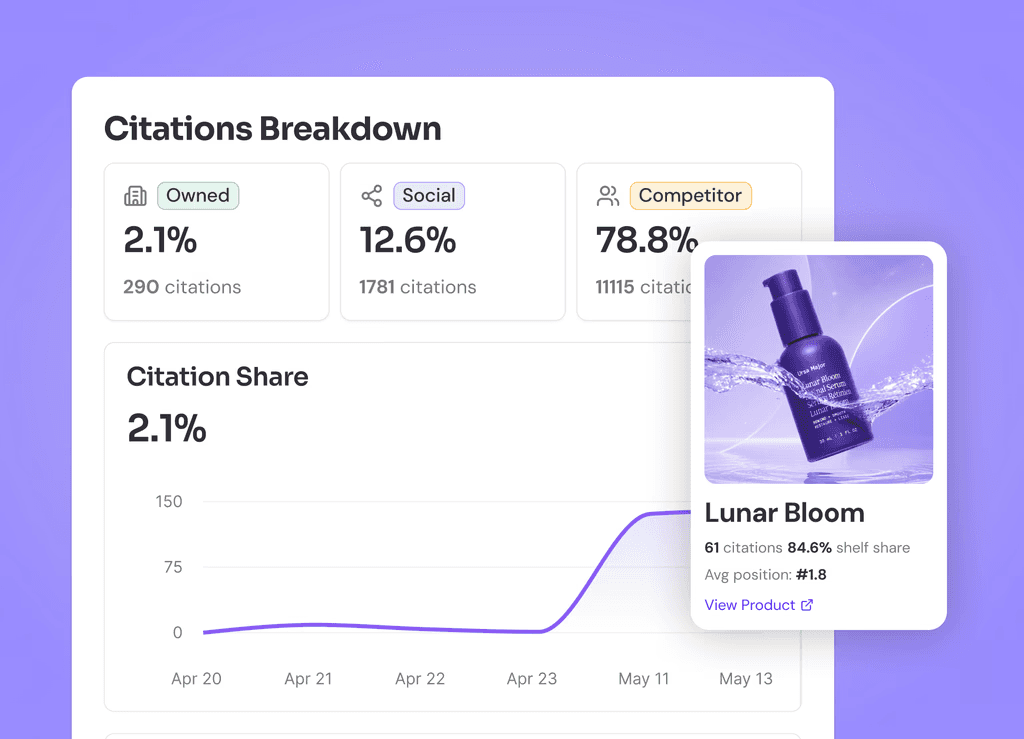
Mention sentiment analysis: A citation that frames your product negatively or as a runner-up has different revenue implications than a top recommendation. Track positive, neutral, and negative sentiment separately.
Citation source identification: Knowing which third-party URLs LLMs pull from in your category tells you where to earn coverage to improve citation frequency.
Because 93% of Google AI Mode searches end with zero clicks, a critical strategy is earning citation inside the answer itself. Tools that stop at visibility and cannot connect citations to conversion leave the most important question unanswered.
#1 Nudge - Purpose-Built for Enterprise Commerce Teams Needing End-to-End AI Visibility and Conversion
Nudge is purpose-built for commerce teams that must actively drive conversions, rather than just monitoring citations. It is a dedicated enterprise platform that closes the loop from AI citation to purchase by combining three capability pillars in a single governed suite.
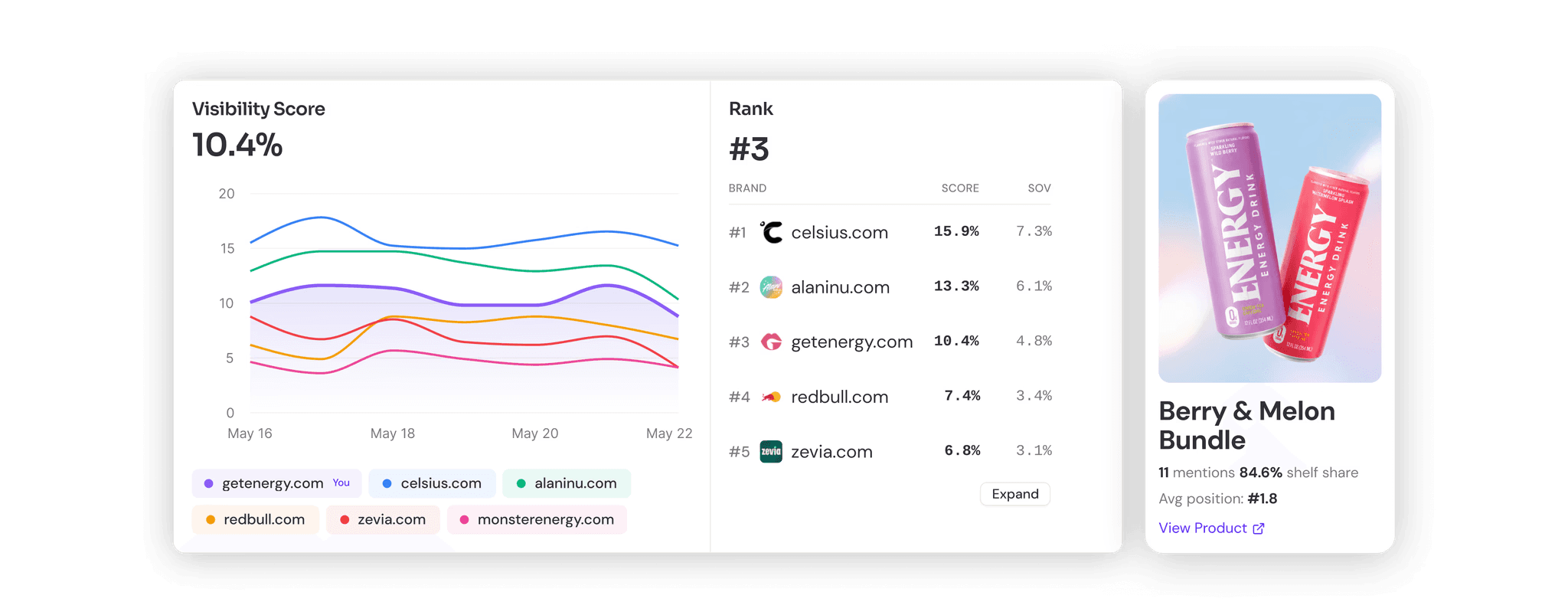
AI Visibility: Prompt-level share-of-voice tracking across ChatGPT, Perplexity, Google AI Mode, Gemini, and Claude. Monitor SKU-level citation frequency, track competitor mention rates inside AI responses, and benchmark your brand's position across commercial prompt clusters. This is where teams identify the gap between where they appear and where buyers are asking.
Shoppable Funnels: AI-referred shoppers arrive with high purchase intent and specific context from the prompt that sent them. Nudge's prompt-aligned shoppable funnels (defined as landing experiences dynamically tailored to the referrer's prompt context) match the landing experience to that context, reducing friction between AI citation and checkout. This is the conversion layer that most visibility-only tools ignore.
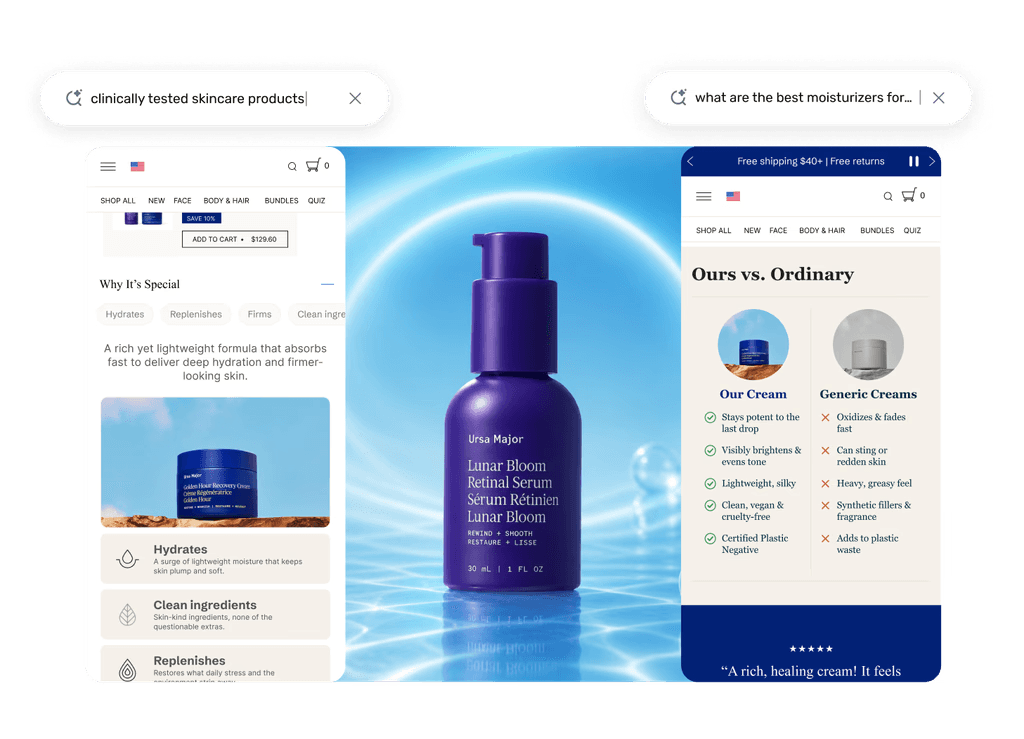
Catalog Enrichment: Audits of large e-commerce catalogs routinely find that many product URLs have missing or erroneous structured data. Nudge's Catalog Enrichment automates schema enrichment at scale, ensuring every product meets the minimum structured data requirements (GTIN, brand, availability, price, priceCurrency, and AggregateRating) that AI platforms need to include products in comparison answers. Products with comprehensive schema appear in AI shopping recommendations 3-5x more frequently.
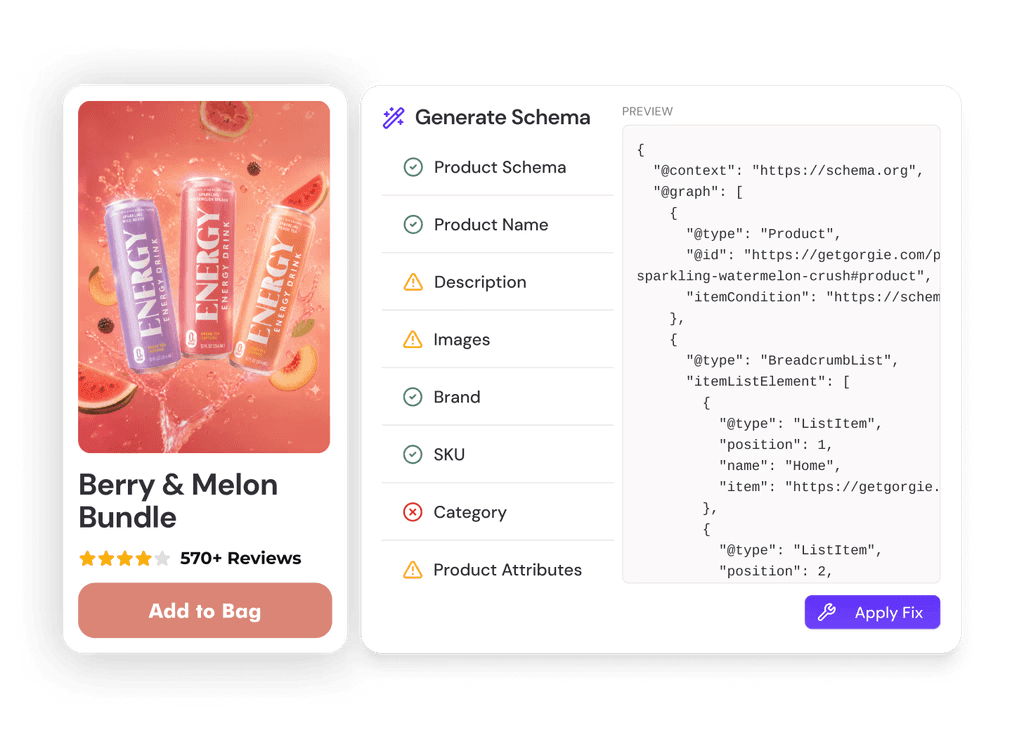
Enterprise controls: SOC 2 compliance, SSO, and native integrations with PIM, OMS, and CDP systems mean Nudge fits into existing commerce infrastructure without requiring a separate data pipeline.
Designed for: Mid-market to enterprise retailers and D2C brands managing large catalogs who need to correlate AI citations with revenue rather than just counting them.
#2 Rank Prompt - Designed for Prompt-Level AI Visibility Tracking
Rank Prompt is a dedicated AI search rank tracker that monitors brand and product mentions across ChatGPT, Perplexity, and Google AI Overviews at the prompt level. Its core strengths are prompt clustering by commercial topic, share-of-voice dashboards, and competitor mention tracking, giving SEO teams a clear picture of where they stand across AI platforms.
The limitation is scope: Rank Prompt measures visibility but does not offer catalog enrichment, schema automation, or shoppable conversion layers. Teams that identify a citation gap here will need a separate tool to close it.
Best for: Agencies and in-house SEO teams that need prompt-level monitoring without a full commerce stack.
#3 AIclicks.io - Designed for Multi-LLM Geo and Brand Perception Audits
AIclicks.io centers on its AI Visibility Dashboard, with particular depth in geo and LLM audits, auditing brand visibility across regions, languages, and AI platforms simultaneously. Its citation source tracking identifies which URLs LLMs reference most frequently for your category, and its competitor benchmarking panel shows relative share of voice at the prompt level.
The tool is built for measurement, not activation. It does not offer SKU-level product tracking, schema enrichment, or conversion optimization. Teams using it for audit intelligence will need to pair it with a catalog and funnel layer to act on findings.
Best for: Global commerce brands needing multi-region AI visibility audits and citation source intelligence.
#4 Semrush AI Toolkit - Designed for Teams Bridging Classic SEO and LLM Visibility
For SEO teams that still manage traditional keyword rankings alongside emerging AI visibility, Semrush's AI-era toolkit is the bridge option. It covers AI Overview monitoring, content gap analysis for generative engine optimization, and schema auditing, all within the same interface teams already use for organic search.
Schema auditing is particularly relevant here: 71% of pages cited by ChatGPT include structured data, making schema health a direct input to AI citation rates. Semrush surfaces those gaps at the page level.
The limitation for commerce teams is resolution: tracking stays at the brand level. There is no SKU-level citation data, no product-level schema automation, and no commerce-specific conversion layer.
Best for: SEO teams managing both traditional search and AI visibility who want a single platform for both channels.
#5 Perplexity Merchant Program - Designed for Free Organic Product Placement in AI Answers
This is a free, zero-commission organic placement channel based on your product feed, not paid advertising; Perplexity removed ads in early 2026. It remains distinct from earned editorial citation, an important distinction when building an LLM SEO strategy.
Eligibility requires a structured product feed meeting Perplexity's data requirements. The program is best used as a complement to organic AI visibility work: it delivers immediate placement while long-term citation authority is being built through schema enrichment and content optimization.
Brands that rely on feed-based placement alone remain exposed if program terms change. Pairing it with organic LLM SEO infrastructure, particularly catalog enrichment and citation source strategy, creates a more durable position.
Best for: Brands that want immediate AI answer placement while building long-term organic LLM SEO authority.
#6 SE Ranking AI Visibility Module - Designed for Mid-Market Teams on a Budget
SE Ranking's AI Visibility Module covers AI Overview tracking, brand mention monitoring, and content optimization recommendations at a price point accessible to mid-market commerce teams. It is a practical starting point for teams beginning their LLM SEO journey who need visibility data before committing to an enterprise platform.
It lacks SKU-level tracking and deep commerce integrations, so teams scaling beyond brand-level monitoring will outgrow it. Use it to establish a baseline, then graduate to a commerce-specific stack as citation volume and catalog complexity grow.
Best for: Mid-market ecommerce teams that need AI visibility monitoring without enterprise-level investment.
How to Evaluate and Choose the Right Tool for Your Commerce Stack
Tool | Best For | AI Platforms Covered | SKU-Level Tracking | Catalog Enrichment | Shoppable Funnels | Enterprise Controls | Price Tier |
|---|---|---|---|---|---|---|---|
Nudge | End-to-end AI visibility and conversion | ChatGPT, Perplexity, Google AI Mode, Gemini, Claude | Yes | Yes (automated) | Yes | SOC 2, SSO, PIM/OMS/CDP | Enterprise / custom |
Rank Prompt | Prompt-level visibility tracking | ChatGPT, Perplexity, Google AI Overviews | No | No | No | Limited | Mid-market SaaS |
AIclicks.io | Multi-region AI visibility audits | Multiple LLMs, multi-region | No | No | No | Limited | Mid-market SaaS |
Semrush AI Toolkit | Bridging classic SEO and AI visibility | Google AI Overviews, ChatGPT | No | No (audit only) | No | Team-level | Mid-market SaaS |
Perplexity Merchant Program | Free product placement | Perplexity | Feed-level | No | No | Limited | Free (feed-based) |
SE Ranking AI Module | Budget entry-level monitoring | Google AI Overviews | No | No | No | Limited | Entry SaaS |
No single tool wins on every axis. If your team only needs lightweight rank monitoring or a one-off multi-region audit, a narrower tool like SE Ranking or AIclicks.io can be the better-fit, lower-cost choice. Nudge is built for teams that need SKU-level tracking, catalog enrichment, and conversion in one platform, so weigh breadth against depth for your stack.
Use this three-step framework to make your selection decision:
Step 1: Audit your current AI share of voice with Nudge's AI Search Visibility to quantify the citation gap for your top commercial prompts.
Step 2: Determine whether your primary constraint is measurement, content and schema optimization, or full-funnel conversion (the table above maps each tool to its strongest capability).
Step 3: Verify integration compatibility with your existing PIM, OMS, or DTC platform before committing; enterprise deployments without native integrations create data pipeline debt that erodes ROI.
With 94% of enterprises planning to increase AEO/GEO spending in 2026, this decision warrants the same rigor as any major martech investment. Request a pilot to measure your AI citation lift and run a technical integration checklist.
How to Maximize LLM SEO Results Regardless of Tool Choice
Three high-impact tactics apply across every tool in this list. Nudge's Catalog Enrichment and AI Search Visibility modules are the operational layer that lets commerce teams execute each one at scale.
Schema markup completeness: At minimum, every product page needs GTIN, brand, availability, price, priceCurrency, and AggregateRating. Pages with structured data are cited 3.1x more frequently in Google AI Overviews, and products with comprehensive schema appear in AI shopping recommendations 3-5x more frequently. Catalog Enrichment is how teams ship this across thousands of SKUs without manual effort.
Modular, Q&A-structured content: LLMs extract clean answer snippets from content organized around direct questions, H2 and H3 headings framed as the queries buyers actually ask. Structure product descriptions and category content this way so AI platforms can parse and cite them accurately. Nudge's Catalog Enrichment ships this question-and-answer-structured content across large catalogs.
Citation source strategy: Use Nudge's AI Search Visibility citation source tracking to identify which third-party domains LLMs reference most in your category. Earn editorial coverage on those specific domains. This is the earned-media equivalent of link building, except the target audience is the LLM retrieval layer, not a PageRank algorithm.
Frequently asked questions
What is LLM SEO and how is it different from traditional SEO?
LLM SEO (also called GEO or AEO) is the practice of optimizing brand and product content to appear in AI-generated responses from ChatGPT, Perplexity, Gemini, and similar platforms. Unlike traditional SEO, which targets keyword rankings in blue-link results, LLM SEO targets citation inclusion inside AI answers, where zero-click rates reach 93% in Google AI Mode, making the citation itself the traffic and conversion event.
Why do commerce brands specifically need LLM SEO tools?
Commerce brands face SKU-level citation challenges that generic LLM SEO tools do not address. AI-referred shoppers convert significantly better than other traffic sources, but only if the right products are cited. Commerce-specific tools track which SKUs appear, with what sentiment, and whether structured data meets AI platform requirements for shopping recommendations, none of which brand-level trackers can provide.
How do LLMs decide which brands and products to cite?
LLMs prioritize sources with comprehensive structured data (schema markup), authoritative third-party citations, modular Q&A-formatted content, and strong brand entity signals across the web. Products with complete schema markup appear in AI shopping recommendations 3-5x more frequently than those without, making catalog enrichment the highest-leverage technical lever available to commerce teams.
What metrics should I track for LLM SEO performance?
Track AI share of voice (how often your brand appears versus competitors for target prompts), SKU-level citation frequency, mention sentiment, citation source URLs, and prompt-to-revenue attribution. Raw organic traffic is no longer sufficient as a primary KPI for AI search channels. Because LLMs cite only a handful of sources per answer, traffic volume understates the actual influence AI citations have on purchase decisions.
How much should commerce brands budget for LLM SEO tools?
Enterprises allocated an average of 12% of digital budgets to AEO/GEO in 2025, and 94% plan to increase that in 2026. Tool costs range from mid-market SaaS tiers (hundreds per month) to enterprise platforms with custom pricing. The ROI case is strong: AI-referred shoppers show materially higher conversion rates and order values than other traffic sources, with Adobe data showing 31% higher conversion rates for AI-referred visitors.