AEO & GEO
What Is LLM SEO and How Does It Differ from Traditional SEO?
LLM SEO helps your content and product catalog earn citations inside AI-generated answers, the new front door to AI-driven purchases. Here is what commerce teams need to know now.

Sakshi Gupta





Key Takeaways
LLM SEO (also called GEO or AEO) is the practice of optimizing content and product catalogs so AI agents like ChatGPT, Gemini, and Perplexity cite your brand in their direct answers.
Traditional SEO wins blue-link rankings through keyword targeting and backlink equity; LLM SEO wins citations through structured data, semantic clarity, metadata freshness, and topical authority that AI models can synthesize.
Generative AI tools deliver zero-click answers, which means a brand can rank #1 on Google and still be invisible inside an AI-generated response, making citation tracking through Nudge's AI Visibility a mandatory new metric for commerce teams.
Commerce brands must use Nudge's Catalog Enrichment to actively update their product catalogs with semantic HTML, schema markup, and fresh metadata so AI agents can accurately parse attributes, pricing, and availability at the SKU level.
Off-site brand presence across third-party sources (reviews, listicles, industry publications) drives the majority of LLM citations for category queries.
LLM SEO is the practice of optimizing content and product catalogs so that AI systems like ChatGPT, Gemini, Perplexity, and Claude cite your brand inside their direct answers. It is a distinct discipline from traditional SEO because these systems infer intent and synthesize evidence, bypassing the click-through model that traditional SEO was built to win.
How Does LLM SEO Differ from Traditional SEO?
Dimension | Traditional SEO | LLM SEO |
|---|---|---|
Optimization goal | Rank on a SERP and earn a blue-link click | Earn citation inside an AI-generated answer |
Primary ranking signal | Backlinks and keyword relevance | Structured data, metadata freshness, semantic HTML, topical authority |
Query type | Short keyword queries | Conversational prompts averaging 6x longer than traditional queries |
Outcome for the user | A list of links to click through | A zero-click direct answer with cited sources |
Measurement | Rankings, clicks, impressions, bounce rate | Citation rate, AI referral traffic volume, share of voice in AI responses |
Keyword stuffing | Historically rewarded | Performs up to 10% worse than baseline in generative engines |
Generative systems act as synthesizers rather than directories: they cite sources by structural data and semantic HTML, not link equity. Tactics that once moved rankings, including keyword repetition and thin content, actively hurt citation likelihood in AI-generated responses. Because answer-engine prompts run six times longer than traditional queries, brands should optimize content for comparisons, trade-offs, and decision criteria.
Why This Matters for Commerce Brands Right Now
Generative AI tools answer directly, reducing site visits, creating a zero-click environment where brands must compete for visibility inside the AI summary itself. For heads of eCommerce and growth, this breaks the measurement model: as buyers receive answers without clicking through, marketing teams lose the engagement signals (clicks, page views, bounce rates) they traditionally used to prove ROI, making AI citation tracking a mandatory new metric.
A brand can rank #1 on Google and still be completely absent from an AI-generated answer to the same query, because citation and ranking are separate signals.
By 2028, Gartner predicts 60% of brands will use agentic AI to facilitate streamlined one-to-one interactions, meaning AI agents will evaluate options and make purchasing decisions on behalf of users without a human ever visiting a SERP.
94% of B2B buyers now use AI in their purchasing process, making AI-native discoverability (defined as your brand's presence and accuracy in AI recommendations) a baseline requirement.
The Four Pillars of LLM SEO for Commerce Brands
Earning AI citations requires four operational capabilities. Each maps directly to what catalog and content ops teams need to build and maintain at scale.
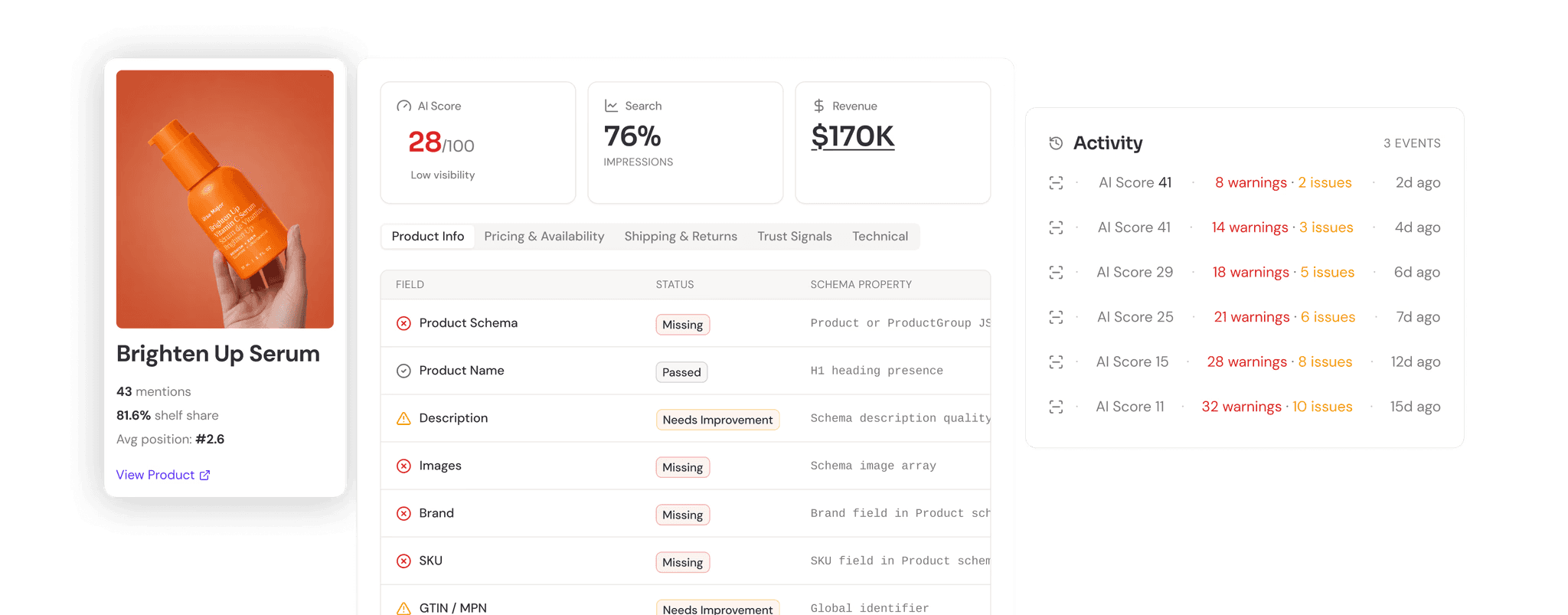
Structured catalog data (Catalog Enrichment): prioritize semantic HTML, fresh metadata, and schema markup so AI models can parse product attributes, pricing, and availability at the SKU level. Nudge's Catalog Enrichment ships these updates at scale without manual per-SKU effort.
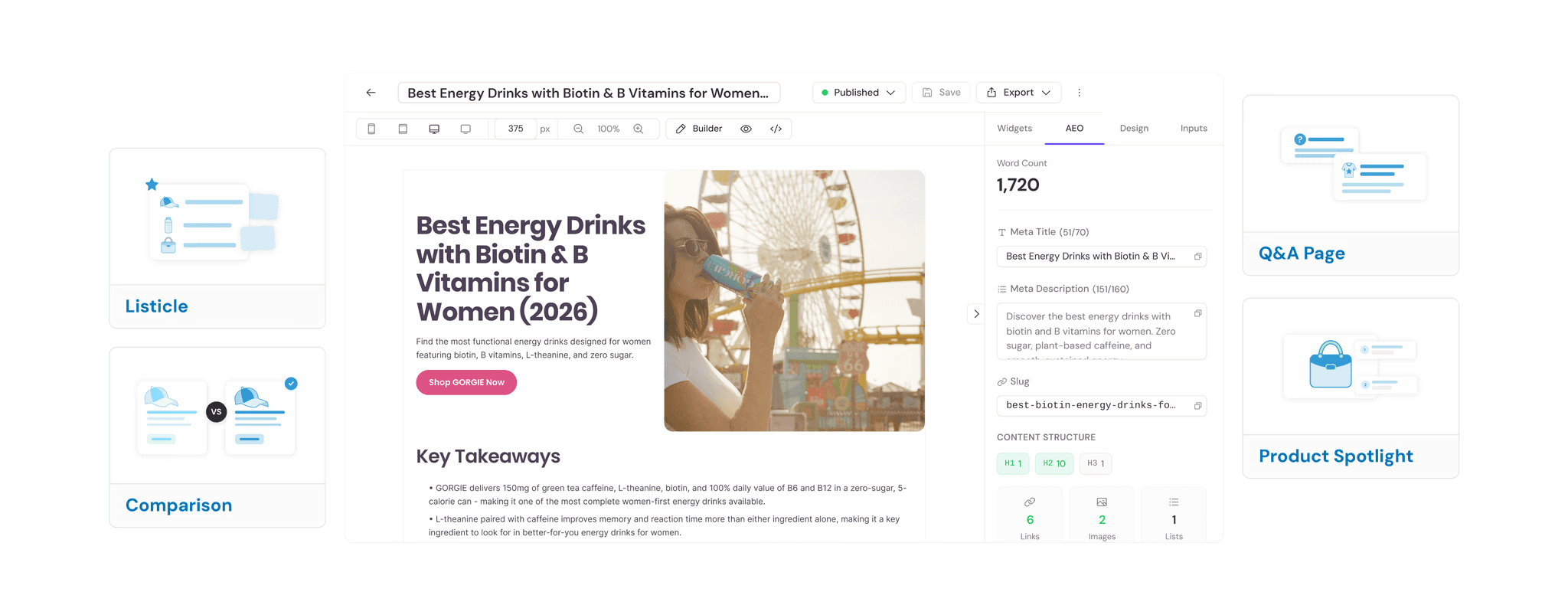
Topical authority and answer-first content (Shoppable Content): Marketers must reframe content to explicitly address comparisons, trade-offs, and decision-making criteria, because AI agents increasingly act as procurement assistants filtering preferences across vendors. Nudge's Shoppable Content helps publish guides, comparisons, Q&A pages, and listicles with shoppable product cards built in for AI platforms to cite and recommend.
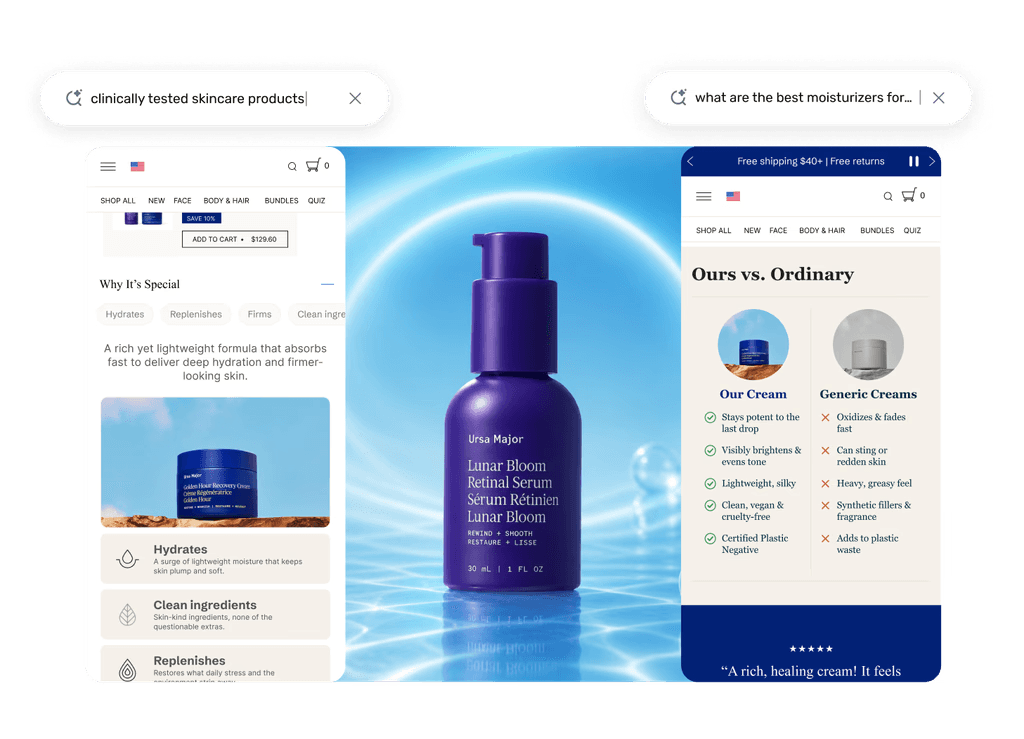
Prompt-aligned shoppable funnels (Shoppable Funnels): LLM referral traffic often converts at higher rates than Google organic because users arrive with specific, resolved intent, though results vary by industry and attribution method. Nudge's Shoppable Funnels (defined as dynamic landing pages built automatically to match the user's conversational intent) convert that AI-referred traffic by matching the experience to the shopper context.
Off-site brand presence: The majority of LLM citations for category queries originate from third-party sources including reviews, listicles, and industry publications. Earned mentions in authoritative external sources are critical for citation share, which brands can track through Nudge's AI Search Visibility module.
Do You Still Need Traditional SEO If You Are Doing LLM SEO?
Yes. Traditional SEO is the foundation that LLM SEO builds on. AI models will not cite a brand whose technical SEO is broken, whose pages are uncrawlable, or whose topical authority is nonexistent. The relationship is layered: traditional SEO establishes crawlability, index presence, and baseline authority; LLM SEO extends that foundation to earn citations inside AI-generated answers.
Answer Engine Optimization requires broader cross-silo collaboration than traditional SEO, demanding a unified approach across content marketing, web development, product merchandising, and IT. For commerce teams managing large catalogs, that coordination overhead is the real barrier. Nudge is built to operationalize both layers: Catalog Enrichment handles the structural and metadata requirements, while AI Search Visibility gives content and catalog teams prompt-level monitoring (analyzing and tailoring content for the exact queries entered into AI engines) without requiring a separate analytics stack.
How Commerce Brands Measure LLM SEO Performance
Traditional metrics collapse in a zero-click AI environment. Clicks and impressions do not capture whether your brand is being cited, how accurately it is represented, or what share of AI-generated category responses include your products. Nudge's AI Search Visibility module provides this new measurement layer built around four metrics:
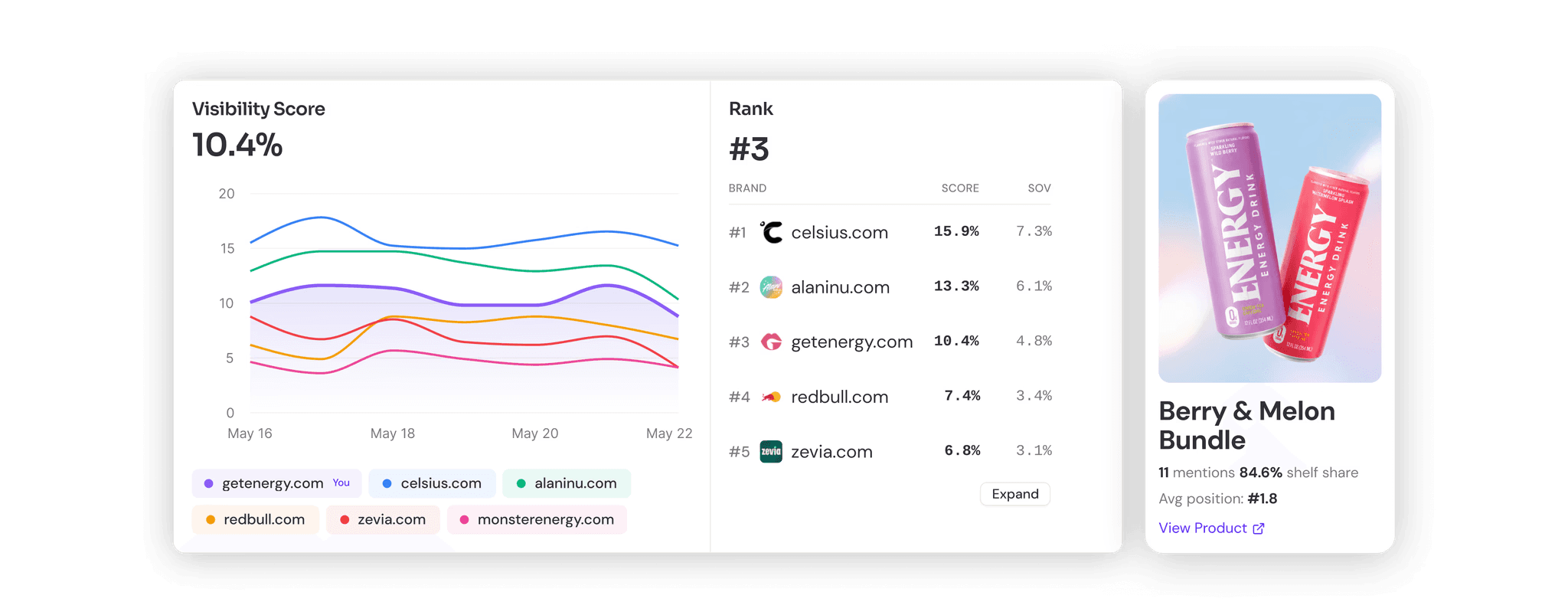
AI citation rate by query and SKU: how often your brand or product appears in AI-generated answers for target prompts.
AI referral traffic volume and conversion rate: volume of sessions arriving via AI platforms and the downstream purchase rate, which reflects prompt-to-purchase alignment.
Share of voice in AI-generated category responses: your brand's citation frequency relative to competitors across a defined query set.
Citation accuracy: whether AI models represent your product attributes, pricing, and availability correctly. A citation with wrong attributes or stale pricing attracts the wrong buyers and erodes trust.
Nudge's AI Search Visibility capability tracks all four metrics at the prompt level across ChatGPT, Google AI Overviews, Perplexity, Gemini, and Claude, so catalog and growth teams can prioritize optimization by revenue impact rather than guessing which queries matter.
Ready to improve LLM SEO for your commerce brand? Book a demo!
Frequently asked questions
Is LLM SEO the same as GEO or AEO?
Yes. LLM SEO, Generative Engine Optimization (GEO), and Answer Engine Optimization (AEO) are used interchangeably across platforms and practitioners to describe the same practice: optimizing content and catalog data for citation in AI-generated answers.
Which AI platforms should commerce brands optimize for first?
Prioritize ChatGPT, Google AI Overviews and AI Mode (highest commerce search volume), and Perplexity (high-intent research queries). Gemini and Claude are secondary but growing quickly. Nudge's AI Search Visibility module tracks citation share across all major platforms so catalog teams can prioritize by revenue impact.
How long does it take to see results from LLM SEO?
AI models crawl and re-index content continuously. Commerce brands with structured, enriched catalogs can see measurable citation lift within weeks of optimization. Nudge's Catalog Enrichment ships schema and metadata updates at scale to accelerate this timeline for large catalogs.
Can a small catalog team manage LLM SEO at scale?
Not manually. Large catalogs need automated catalog enrichment and prompt-level monitoring that tailors content to the exact queries buyers type into AI engines. Manual per-page schema and content updates cannot keep pace with continuous AI re-indexing, which is why catalog and content ops teams lean on Nudge's Catalog Enrichment and AI Search Visibility.
What is the biggest mistake commerce brands make with LLM SEO?
Treating LLM SEO as a content-only problem. The primary driver of AI citation is structured, enriched product data at the SKU level combined with off-site brand presence. Brands that focus only on blog content while leaving product schema stale or incomplete will lose AI shelf space to competitors with better-structured catalogs. Enrich catalogs specifically for AI ingestion, treating AI as a distinct channel. Nudge's Catalog Enrichment operationalizes this at scale.