AEO & GEO
Generative Engine Optimization: The Commerce Brand Playbook
How to get your brand cited, compared, and converted by ChatGPT, Perplexity, and Google AI Overviews in 2026 - the 4-pillar GEO playbook for commerce teams.

Sakshi Gupta




Key Takeaways
Generative Engine Optimization (GEO) is the practice of structuring content and product data so AI engines like ChatGPT, Perplexity, and Google AI Overviews cite and recommend your brand in their answers.
Only 6.82% of ChatGPT citations overlap with Google's top-10 organic results, meaning traditional SEO rank alone will not get your brand recommended by AI assistants.
AI-referred traffic converted 31% higher than non-AI traffic during the 2025 holiday season and revenue per visit from AI referrals jumped 254% year over year (Adobe Analytics); a separate Rep AI study of onsite AI chat engagement found those shoppers convert at 12.3% versus 3.1% for non-engaged shoppers.
The highest-impact GEO tactics for commerce brands are: complete 12-attribute product data per SKU, schema markup (2.5x citation lift), brand-mention authority, and answer-first content structured with H1-H2-H3 hierarchy.
37% of product discovery queries now start in AI interfaces, and Gartner forecasts AI-initiated ecommerce touchpoints will grow from under 5% in 2025 to 40% by 2026 - making GEO a revenue-critical priority now.
Generative Engine Optimization (GEO) is the discipline of structuring your content and product catalog so AI engines cite, compare, and recommend your brand in their generated answers - not just rank your pages in blue-link results. For commerce brands in 2026, GEO is the highest-leverage channel investment available: AI-referred shoppers convert at 4x the rate of traditional organic visitors, and the window to build citation authority before competitors do is closing fast.
What Is Generative Engine Optimization - and Why Does It Replace SEO for Commerce?
GEO is the practice of optimizing content and product data to be discovered, cited, and recommended by AI search engines like ChatGPT, Perplexity, Claude, and Google AI Overviews. It was first defined in a 2023 Princeton/Georgia Tech/IIT Delhi research paper as a novel paradigm for improving content visibility in generative engine responses - distinct from anything SEO had addressed before.
The core problem for commerce brands: SEO rank does not transfer to AI citation. Geoptie citation-overlap research finds only 6.82% of ChatGPT citations overlap with Google's top-10 organic results, and 83% of AI Overview citations come from outside the organic top 10. A brand that has spent years building page-one rankings is largely invisible to AI assistants unless it has also invested in GEO. Meanwhile, Gartner predicts traditional search engine volume will drop 25% by 2026, and forecasts a 50% or more decline in organic search traffic as AI-powered search becomes the default.
Dimension | SEO | GEO |
|---|---|---|
Primary signal | Keywords and backlinks | Entity authority and structured data |
Output format | Ranked blue-link results | Cited answers in AI responses |
Optimization target | Ranking position | Citation probability |
Content format | Keyword-dense pages | Answer-first, structured content |
Success metric | Organic rank and CTR | AI citation share and referral conversion |
The AI Commerce Opportunity - and the Cost of Waiting
The revenue case for GEO is unambiguous. AI-referred traffic from generative engines converted 31% higher than non-AI traffic during the 2025 holiday season per Adobe Analytics. A separate Rep AI 2025 study found that shoppers who engage with on-site AI chat widgets convert at 12.3% versus 3.1% for non-engaged shoppers, a related but distinct signal. According to Adobe Analytics, Stord's State of AI 2026 report documents visitors from generative AI sources converting 31% higher than traditional channel traffic during the 2025 holiday season, with revenue per visit from AI referrals up 254% year over year. Traffic from generative AI to US retail sites grew 693.4% year over year during the 2025 holiday season (Adobe Analytics).
The cost of inaction is equally clear. When AI Overviews appear in search results, organic CTR drops by 61%. Between 2024 and 2025, 73% of websites saw meaningful traffic decline, with an average drop of 34% year over year. SparkToro reports that 60% of AI searches now end without any click to an external site - meaning brands not cited in the answer itself receive nothing. Gartner forecasts AI-initiated ecommerce touchpoints will grow from under 5% in 2025 to 40% by 2026, and EMARKETER projects 31.3% of the US population will use generative AI search in 2026. This is not a future trend to plan for - it is the current competitive environment.
There is also a positive citation multiplier: when brands are cited inside AI-generated answers, they experience a 38% lift in organic clicks and a 39% increase in paid ad clicks. These lifts compound existing channel spend rather than competing with it.
The 4 Pillars of a GEO Strategy for Commerce Brands
Four pillars determine whether AI engines cite your brand or skip it. Each maps directly to a capability in Nudge's enterprise suite.
Pillar 1: Catalog Completeness
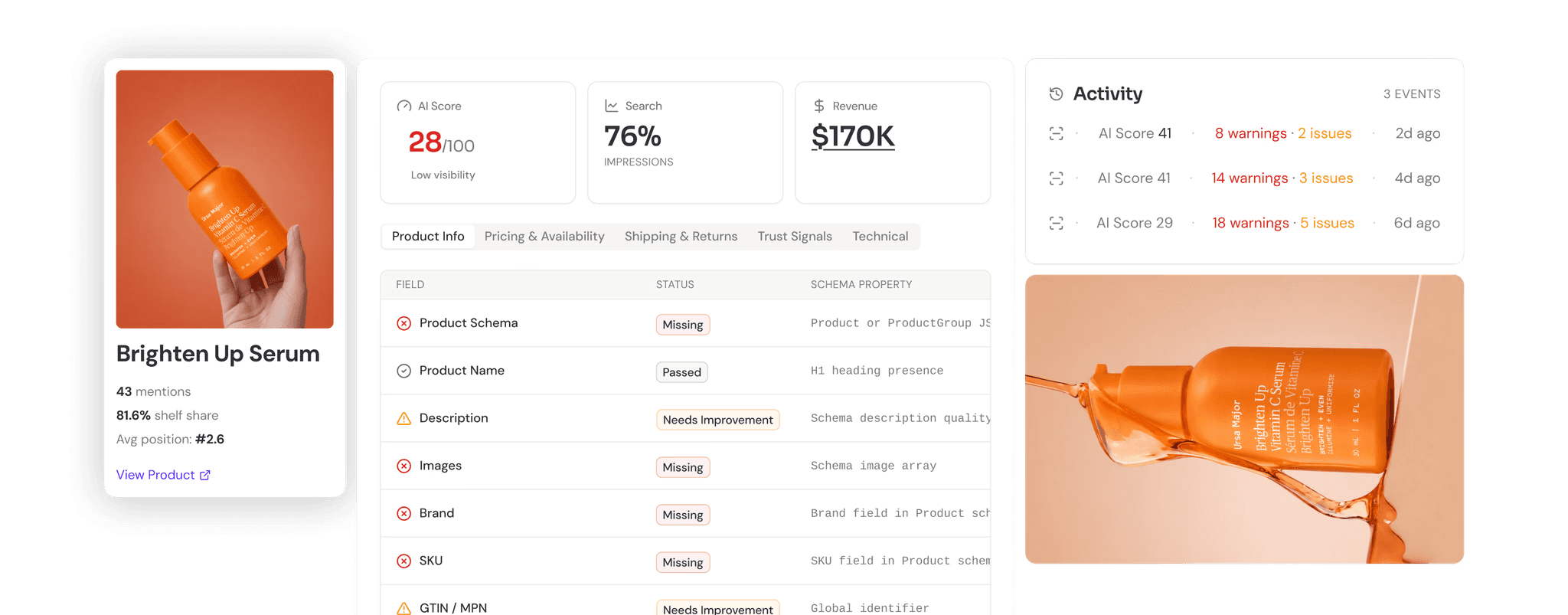
AI shopping agents require 12 core attributes per SKU to recommend a product. Missing or incomplete fields cause the product to be skipped entirely. As Amsive noted in January 2026: 'If inventory or pricing isn't machine-readable, agents will skip your store because they cannot verify its accuracy.'
Required attributes per SKU: title, description, brand, GTIN, MPN, category (Google Product Taxonomy), price, sale price, availability, condition, image URL, and product URL
Pricing and inventory fields must be machine-readable - not buried in JavaScript or rendered client-side
Category mapping to Google Product Taxonomy is required for AI agents to match products to purchase-intent queries
Nudge Catalog Enrichment automates attribute completion and feed validation at scale - see the Catalog Enrichment
Pillar 2: Schema and Structured Data
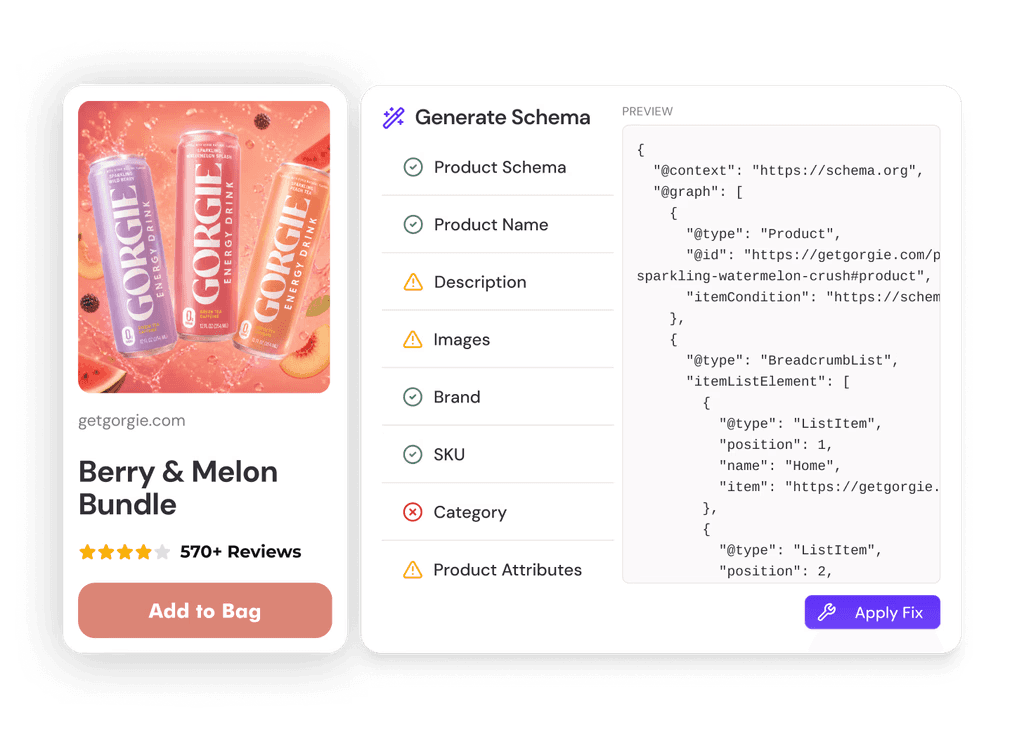
Schema markup is the single highest-ROI technical GEO investment for commerce brands. Geoptie research finds content with proper schema markup has a 2.5x higher chance of appearing in AI-generated answers, with sites running complete Tier 1 schema seeing up to 40% more AI Overview appearances. Priority schema types for PDPs are: Product, Review, BreadcrumbList, and FAQ. Nudge Catalog Enrichment ships JSON-LD schema at scale without requiring engineering sprints for every SKU update.
Pillar 3: Answer-First Content Architecture
Content structure determines citation probability as much as content quality. 68.7% of cited pages follow an H1-H2-H3 hierarchy, 44.2% of AI citations come from the first 30% of content, and pages above 20,000 characters receive 4.3x more citations. The Princeton/Georgia Tech/IIT Delhi study found that embedding statistics in content lifts visibility by 32%, adding quotations lifts it by 41%, and including citations lifts it by 30%. The practical implication: product descriptions and category pages need to read like structured answers, not marketing copy. Nudge AI Search Visibility surfaces which prompts your category and PDP content already wins citations for, and Catalog Enrichment ships the structured answer blocks (FAQ, spec tables) on every PDP without an engineering sprint.
Pillar 4: Brand Entity Authority
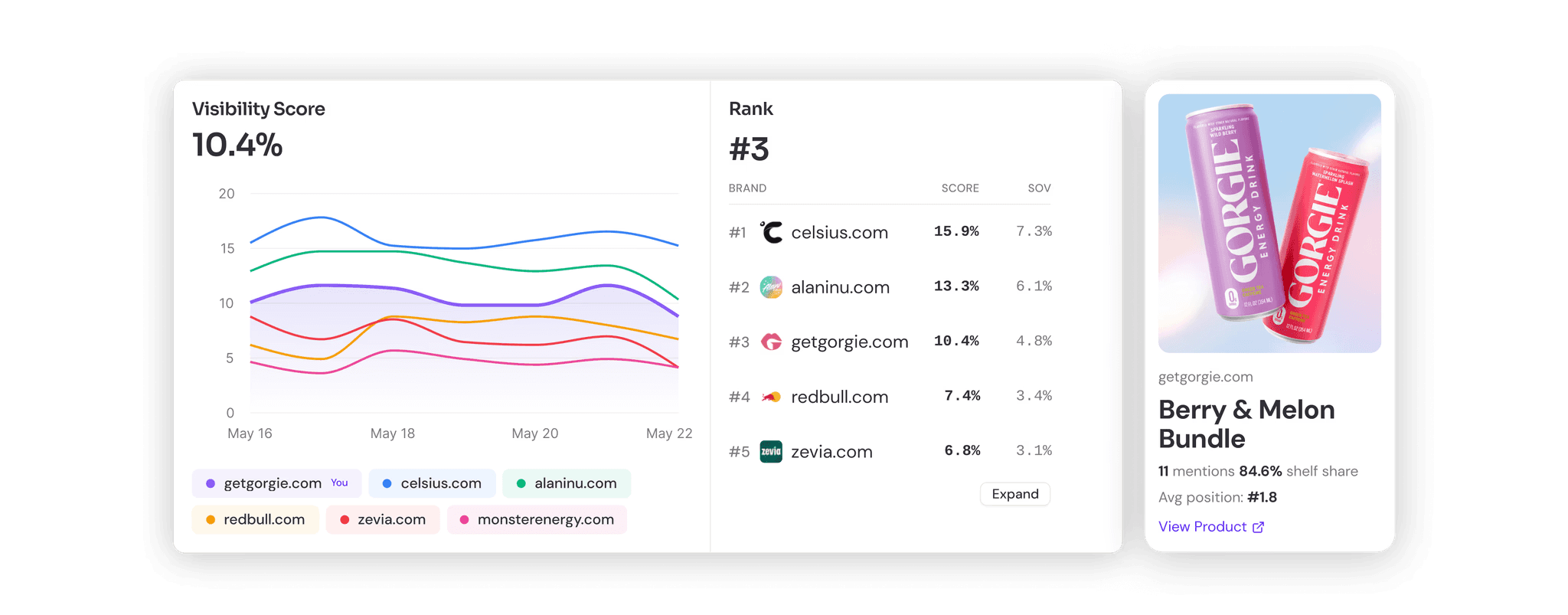
Brand mentions are the dominant signal for AI citation probability. Ahrefs' analysis of 75,000 brands found that brand mentions correlate 0.664 with AI citation probability, compared to just 0.218 for backlinks. This means a brand actively mentioned across authoritative third-party sources - reviews, editorial coverage, comparison guides - will outrank a brand with stronger traditional link authority. Separately, recently updated content appears 4.3x more often in AI answers, and 85% of AI Overview citations were published within the last two years. Content freshness is a GEO signal, not just a hygiene task. Nudge AI Search Visibility tracks brand-mention share across ChatGPT, Perplexity, and Google AI Overviews so commerce teams can prove the 0.664 correlation in their own catalog, and Catalog Enrichment automates refresh on high-volume SKU PDPs.
How to Optimize Product Pages for AI Citation
Product detail pages (PDPs) and category pages are the primary citation surface for commerce GEO. Applying the four pillars at the page level requires specific tactical choices.
Write conversational, question-answering descriptions. AI engines extract answers to shopper prompts like "what is the best waterproof hiking boot under $150." Product descriptions that mirror this phrasing - and answer it directly in the opening sentences - are far more likely to be cited. See Nudge's guide on optimizing PDPs for AI search.
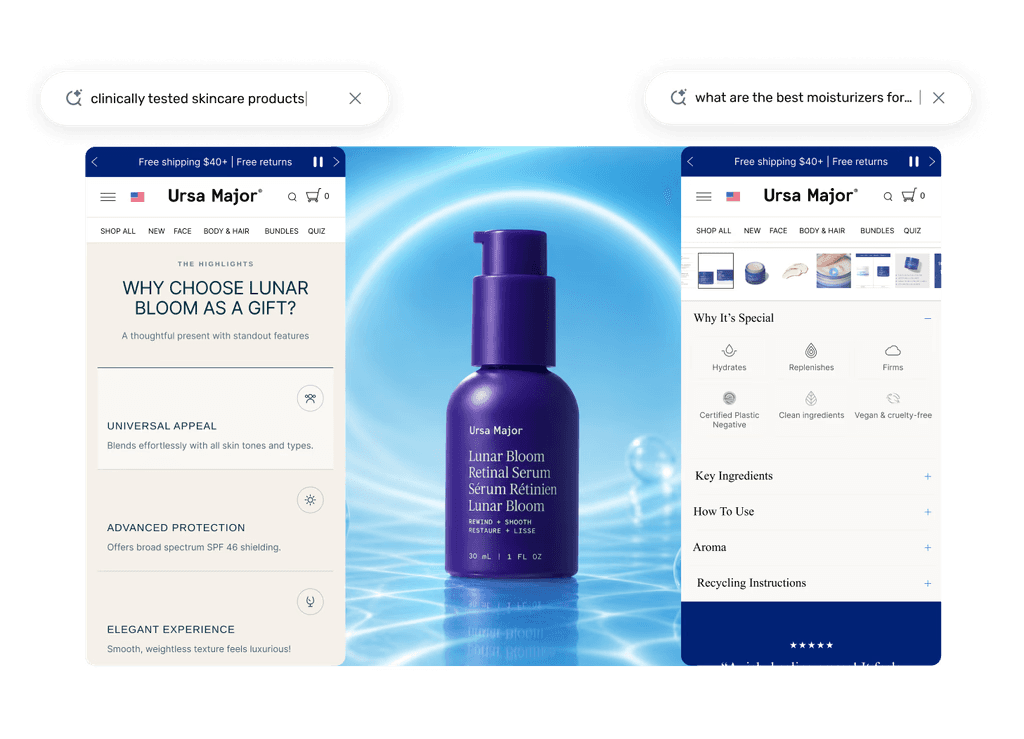
Embed statistics and third-party quotes in descriptions. The Princeton study's visibility lifts (+32% for statistics, +41% for quotations) apply to product content too. A description that references a lab test result, a verified rating, or a third-party endorsement is structured exactly like the content AI engines prefer to cite. Nudge Catalog Enrichment lets brands inject verified review excerpts, lab-test results, and third-party endorsements into every SKU description without per-SKU engineering work.
Keep pricing and inventory machine-readable via structured feeds. Real-time pricing accuracy is a hard requirement for AI shopping agents. Feeds must update frequently and agents that encounter stale or unreadable pricing skip the product. Nudge Catalog Enrichment validates feed completeness, fixes machine-unreadable price and availability fields, and pushes refreshed JSON-LD to AI shopping agents on every catalog change.
Use FAQ schema on PDPs. FAQ schema converts common purchase questions into AI-extractable answer slots. This is one of the fastest ways to capture zero-click answer appearances. Nudge's schema markup guide for ecommerce covers implementation priority by schema type.
Refresh content regularly. Given that 85% of AI Overview citations are from content published within two years and recently updated pages appear 4.3x more in AI answers, a quarterly refresh cadence for top-SKU PDPs is a defensible GEO investment. Nudge AI Search Visibility flags which SKU PDPs are losing citation share so commerce teams can prioritise quarterly refresh by revenue impact, and Catalog Enrichment ships the rewritten descriptions and schema at catalog scale. More on what it takes to get products cited is covered in Nudge's citation readiness guide.
Turning AI Citations into Revenue: Shoppable Funnels and Prompt-Aligned Experiences
Getting cited is step one. Converting AI-referred visitors is step two - and most GEO guides stop at step one. AI-referred shoppers arrive with high purchase intent, having already received a recommendation from an AI assistant. If the landing page they reach does not match the context of that recommendation, conversion rates drop sharply.
Nudge Shoppable Funnels are designed specifically for this conversion layer. A prompt-aligned landing page mirrors the language and intent of the AI query that drove the click - reinforcing the recommendation rather than resetting the shopper's context. Practical elements for AI-referred sessions include:
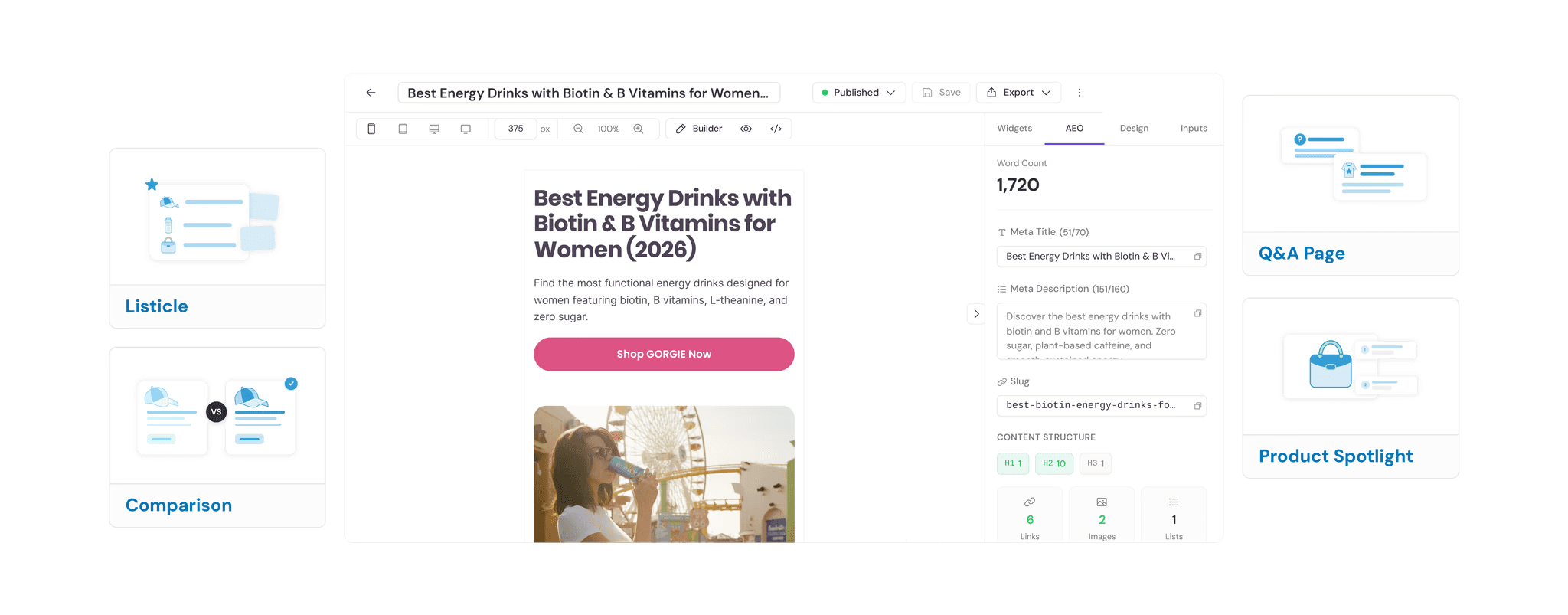
Prompt-matched headlines: if the AI cited your product for "best ergonomic office chair for back pain," the landing page headline should address that exact use case
Social proof surfaced immediately: AI-referred shoppers trust the AI recommendation but still need conversion signals - verified ratings, expert endorsements, and real review excerpts placed above the fold
Bundle and upsell recommendations tuned for AI-referred sessions: high-intent shoppers are more receptive to complementary product suggestions when framed around the use case the AI identified
Urgency and availability signals: real-time stock levels and shipping timelines close the gap between AI recommendation and purchase decision
Nudge Shoppable Funnels render each of these elements (prompt-matched headline, above-the-fold social proof, prompt-tuned upsell, real-time stock) per incoming AI prompt without requiring a separate landing page build per query.
Only 16% of brands currently track AI search performance systematically - which means measurement itself is a competitive advantage right now. Segmenting AI referral traffic as a distinct channel (separate from organic) and tracking its conversion rate independently gives commerce teams the data to justify further GEO investment. The shoppable AI funnels conversion guide and the landing page elements guide for AI shoppers cover implementation in detail.
Measuring GEO Performance: Metrics, Tools, and the Enterprise Stack
GEO requires a measurement framework that traditional SEO tooling cannot provide. Ranking position and organic CTR do not capture citation performance - you need a different set of KPIs.
GEO Metric | What It Measures | Why It Matters |
|---|---|---|
AI citation share | How often your brand appears in AI answers for a defined prompt set | Primary indicator of GEO program health |
AI referral traffic and conversion rate | Sessions and revenue attributed to AI-assistant clicks, segmented from organic | Connects citation visibility to actual revenue |
Prompt-level visibility | Citation presence across your priority query set by platform | Identifies gaps by product category and AI engine |
SKU-level citation coverage | Percentage of catalog SKUs appearing in AI recommendations | Surfaces catalog completeness gaps that suppress citation |
The GEO tool landscape breaks into four categories: product data enrichment platforms, AI visibility and citation tracking tools, content optimization tools, and feed and listing optimization tools. Most brands currently use point solutions across two or three of these categories, creating gaps in coverage and attribution. Nudge is built as the unified enterprise suite that covers all four layers - AI Search Visibility, Catalog Enrichment, and Shoppable Funnels in a single platform with SSO and SOC 2 compliance. For a detailed comparison of available tools, see the AI ecommerce visibility tools ranked for 2026 and the guide to AI visibility tracking for retail teams.
Ready to Build Your GEO Program? Book a demo!
Nudge unifies AI Search Visibility, Catalog Enrichment, and Shoppable Funnels in one enterprise suite - so your team controls exactly how AI assistants cite, compare, and convert your products. SOC 2 compliant, SSO-enabled, and built for large catalogs.
Frequently asked questions
What is the difference between GEO and SEO for ecommerce?
SEO optimizes for keyword ranking in blue-link results; GEO optimizes for citation probability in AI-generated answers. Key differences: GEO prioritizes entity authority and structured data over backlink volume, targets conversational answer formats over keyword density, and measures citation share rather than ranking position. Only 6.82% of ChatGPT citations overlap with Google's top-10 results, so SEO rank does not transfer automatically to AI visibility.
Which AI platforms should commerce brands prioritize for GEO?
Prioritize Google AI Overviews (largest reach, 200+ countries and 40+ languages), ChatGPT (800 million+ weekly active users, 2.5 billion daily prompts), and Perplexity (780 million queries per month, 239% growth in under a year). Claude and Gemini are secondary but growing. Tactics that work for one platform - structured data, answer-first content, brand entity signals - generally transfer across all.
How many product attributes does a SKU need for AI agents to recommend it?
AI shopping agents require 12 core attributes per SKU: title, description, brand, GTIN, MPN, category (Google Product Taxonomy), price, sale price, availability, condition, image URL, and product URL. Missing or machine-unreadable fields - especially pricing and inventory - cause agents to skip the product entirely. Nudge's Catalog Enrichment platform automates attribute completion and validation across large catalogs.
How long does it take to see results from a GEO strategy?
Initial citation appearances can emerge within 4-8 weeks of implementing schema markup and structured product data, since AI engines re-crawl frequently and prioritize recently updated content (which appears 4.3x more often in AI answers). Sustained citation share growth typically takes 3-6 months of consistent content and catalog optimization.
How do I measure whether my GEO efforts are working?
Track four metrics: (1) AI citation share - how often your brand appears in AI answers for target prompts; (2) AI referral traffic volume and conversion rate as a distinct channel segment; (3) prompt-level visibility across your priority query set; (4) SKU-level citation coverage across your catalog. Only 16% of brands currently track AI search performance systematically, making early measurement a significant competitive advantage. Nudge's AI Search Visibility module tracks all four metrics at the prompt and SKU level.