AI Search Visibility
AI Ecommerce Visibility Tools Compared: The 2026 Guide
Pick the AI visibility platform that actually lifts AI citation share and converts AI-referred traffic into revenue, with a 6-criteria evaluation framework and a tool-by-tool comparison.

Sakshi Gupta





Key Takeaways
AI-referred traffic now converts 42% better than paid search (Adobe, Q1 2026), making AI visibility a direct revenue lever - not just a brand awareness metric.
Most AI visibility tools track brand mentions across 3-5 engines; enterprise-grade platforms monitor 8+ engines and track at the SKU level, which is the minimum needed to act on gaps.
54% of brands that rank well on Google are never cited by AI, so traditional SEO rank is a poor proxy for AI citation - dedicated AI visibility tooling is required.
The key differentiator between analytics-only tools and conversion-driving platforms is whether they close the loop: from citation tracking to feed enrichment to prompt-aligned shoppable funnels (landing experiences whose copy, products, and offers map to the shopper intent).
Citation volumes for the same brand can vary across AI platforms, meaning any tool tracking fewer than five engines will systematically underreport your true visibility gaps.
Most AI visibility tools are analytics dashboards - they measure where your brand appears in AI-generated answers. A smaller set of enterprise platforms go further, combining citation monitoring with catalog enrichment and prompt-aligned conversion surfaces to turn AI visibility into measurable revenue. If you only need to measure, an analytics tool is enough; if you need to lift citations and convert AI-referred traffic, you need a full-funnel platform.
Why AI Visibility Is Now a Revenue Channel, Not a Vanity Metric
AI referral traffic is no longer experimental - it is a primary growth channel with conversion rates that outperform every traditional acquisition source. Adobe's Q1 2026 data shows 393% year-over-year growth in AI referral traffic to US retail sites, with the 2025 holiday season peaking at 1151% growth. In March 2026, that same AI traffic converted 42% better than non-AI traffic - a complete reversal from March 2025, when AI traffic converted 38% worse.
The platform-level conversion data makes the revenue stakes concrete. According to data cited by Nudge's 2026 market analysis, Claude converts at 16.8%, ChatGPT at 14.2-15.9%, and Perplexity at 10.5% - compared to roughly 5.3% for organic search. eMarketer projects AI platforms will account for $20.9 billion in retail spending in 2026, nearly quadrupling 2025 figures. Over 91% of ecommerce queries now trigger AI-generated results, with fashion and beauty reaching 94-95% AI coverage.
The urgency is sharpened by a structural gap: 54% of brands that rank well on Google are never cited by AI, and roughly 68% of AI Overview citations come from pages outside Google's top 10. Google SEO rank is not a proxy for AI citation. These two visibility channels require separate tooling and separate optimization strategies.
Analytics-Only vs. Full-Funnel: The Core Divide in AI Visibility Tools
The AI visibility tool market splits cleanly into two archetypes. Understanding which one solves your actual problem is the first decision any ecommerce team should make before evaluating vendors.
Analytics and monitoring platforms track brand and SKU mentions, share of voice, and citation sources across AI engines. They tell you where your brand appears, how often, and how that compares against competitors, but they stop at the data layer. These tools are valuable for establishing baselines and benchmarking competitors, but they stop at the data layer.
Full-funnel platforms layer in catalog enrichment, feed optimization, and prompt-aligned conversion surfaces. They go beyond measurement to fix catalog and schema gaps, lift citation quality, and convert AI-referred traffic. AI-mediated purchase is now production infrastructure, but only brands whose catalogs answer conversational questions and ship valid schema will convert that traffic. The distinction matters operationally because analytics alone cannot address the underlying problem: only 30% of brands stay visible from one AI answer to the next, and citation volumes for the same brand can vary across AI platforms. Measurement without optimization is incomplete.
How to Evaluate Any AI Visibility Tool: 6 Non-Negotiable Criteria
Before evaluating any specific platform, apply this six-criteria framework. Each criterion maps to a real operational gap - and skipping any one of them will leave blind spots in your AI visibility program.
Number of AI engines tracked: The minimum viable set is five - ChatGPT, Perplexity, Google AI Overviews, Gemini, and Claude. Enterprise platforms should cover 8+ engines. Tools tracking only 3-4 engines will systematically underreport visibility gaps given the citation variance across platforms.
SKU-level vs. brand-level tracking: Brand-level tracking tells you how often your company name appears. SKU-level tracking tells you which products are recommended, in which contexts, and on which platforms - the data required to act on catalog gaps. For large catalogs, brand-level data is insufficient for merchandising decisions.
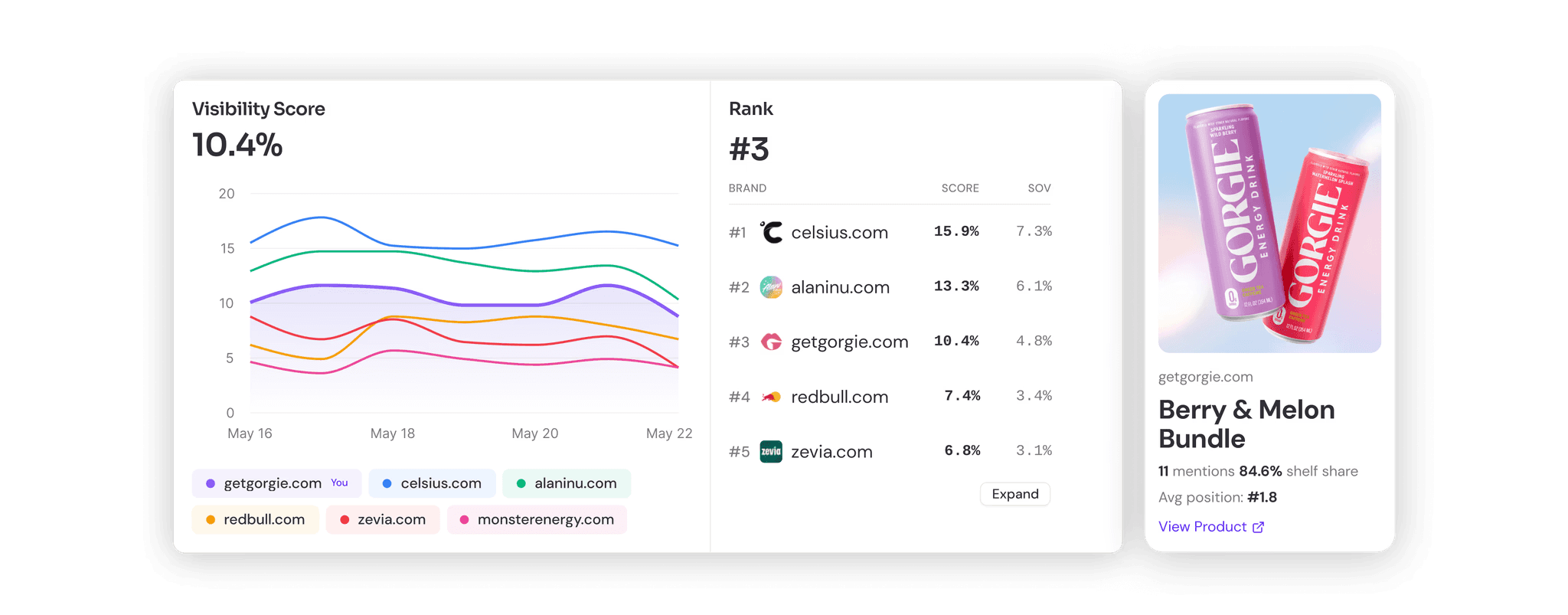
Share of voice and competitor benchmarking: AI visibility is a relative game. A platform that only shows your citation rate without benchmarking it against competitors cannot tell you whether your position is strong or at risk.
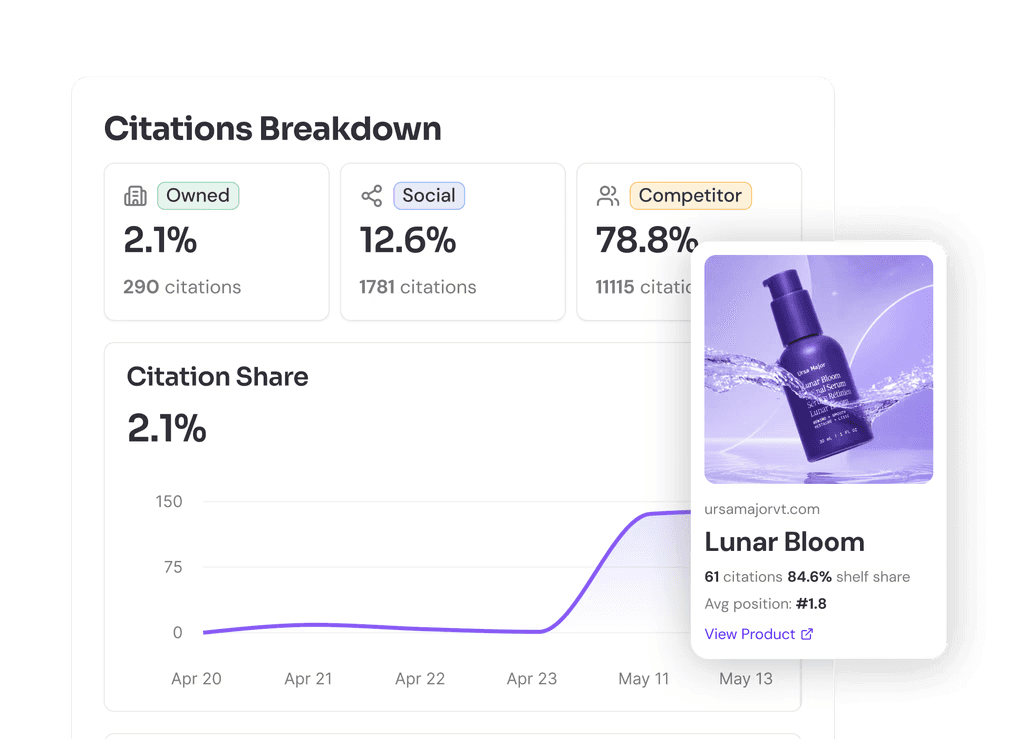
Citation source analysis: Research shows a majority of AI citations come from non-Tier-1 earned media - Reddit threads, niche YouTube videos, LinkedIn posts, and vertical sites - not traditional authority domains. Your tool needs to surface which sources are driving citations so you can influence them.
Tool-by-Tool Breakdown: What Each Category Actually Delivers
The market currently contains four distinct tool categories. The table below benchmarks each against the six evaluation criteria. No single analytics-only tool scores across all six - that gap is what separates monitoring from full-funnel platforms.
Category / Example | Engines Tracked | SKU-Level Tracking | Feed / Schema Optimization | Conversion Attribution | Starting Price | Best For |
|---|---|---|---|---|---|---|
Standalone AI Monitoring Platforms (e.g., KIME, LLMRefs, SE Ranking Brand Radar) | 5-10 engines | Limited | No | No | From ~€149/month | Brands needing dedicated AI mention tracking and share-of-voice benchmarking |
Ecommerce-Native Analytics (e.g., Triple Whale) | 4-5 engines | No | No | Yes - integrates LLM referral attribution with paid media | Custom / DTC plans | DTC brands wanting LLM citation data alongside paid and owned channel attribution in one dashboard |
Enterprise Full-Funnel Platforms (e.g., Nudge) | 8+ engines | Yes - SKU-level | Yes - catalog enrichment and schema at scale | Yes - zero-click and agent-mediated revenue | Enterprise pricing | Enterprise ecommerce teams needing unified AI visibility, catalog enrichment, and shoppable funnels in a single suite |
A note on ecommerce-native analytics: Triple Whale merchants recorded 424,000+ orders from LLM referrals in Q4 2025 alone, compared to just 7,152 across all of 2024. That growth rate illustrates why attribution-capable tools are no longer optional - but attribution without optimization still leaves catalog and schema gaps unaddressed.
The Conversion Gap: Why Visibility Without Optimization Loses Revenue
Being cited by an AI engine and converting that citation into a purchase are two separate problems. Most analytics tools solve the first. The second requires a different layer of capability entirely.
Agentic commerce is live now, not a future state. ChatGPT's Instant Checkout has been live since September 2025, serving 900 million weekly users, and over 1 million Shopify merchants have already opted into OpenAI's purchasing feature. On May 7, 2026, ChatGPT began hyperlinking brand names directly to their homepages, with OpenAI referrals to monitored brand sites roughly doubling overnight. The infrastructure for AI-mediated purchase is in place - the question is whether your catalog is ready to convert the traffic.
The product data quality problem is the most common conversion blocker. Average product page AI readability is only 66% according to Adobe data, and 42% of customers abandon purchases due to insufficient product information.
Amazon's block of OpenAI crawlers cuts off ChatGPT Shopping Research from live Amazon listings, prices, and reviews, creating a structural first-mover advantage for DTC and Shopify brands that can get their catalogs AI-ready. Nudge's Catalog Enrichment capability addresses this directly - enriching product feeds with conversational attributes that answer the questions AI shopping assistants actually ask ('Is this waterproof?', 'Does this run true to size?') and deploying schema at scale. The Shoppable Funnels layer then converts AI-referred intent into purchases through prompt-aligned surfaces, closing the loop that pure analytics tools leave open. For deeper context on catalog optimization, see Nudge's catalog optimization guide.
Implementation Roadmap: From Zero to Full AI Visibility Stack
Enterprise ecommerce teams should approach AI visibility in three sequential phases. Each phase builds on the previous one - skipping Phase 1 means optimizing without a baseline; skipping Phase 2 means driving traffic to product pages that cannot convert it.
Phase 1: Audit
Deploy Nudge's AI Search Visibility monitoring across a minimum of five engines (ChatGPT, Perplexity, Google AI Overviews, Gemini, Claude) to establish a multi-engine baseline.
Use Nudge to establish baseline share of voice at brand and SKU level across priority categories.
Identify which AI engines cite your products and which cite competitors instead - note the citation variance means engine-by-engine gaps can be dramatic.
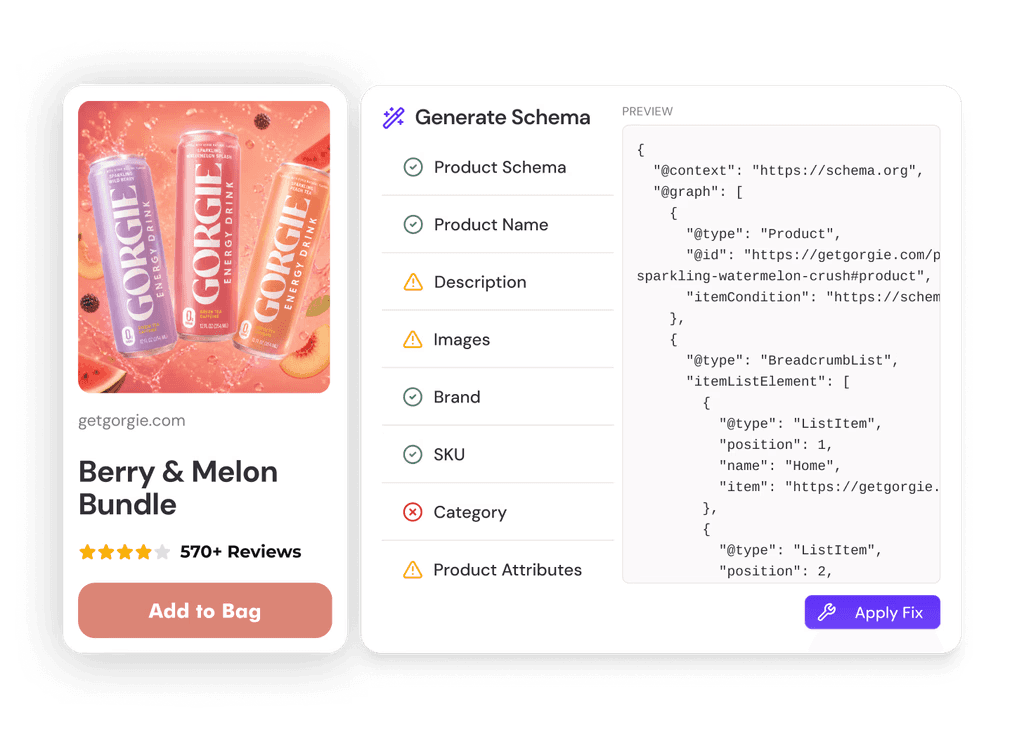
Audit schema completeness then close gaps with Nudge Catalog Enrichment, which deploys validated product and SKU schema at scale.
Phase 2: Optimize
Fix schema markup using Product, Offer, Review, and FAQ schema types. Pages with FAQ schema receive 44% more AI citations - this is the highest-leverage technical action available.
Enrich product feeds with conversational attributes that answer the questions AI shopping assistants ask at the point of recommendation.
Target earned media placements on the non-Tier-1 sources that AI engines actually cite - Reddit, niche YouTube, and vertical communities - rather than focusing exclusively on traditional authority publications.
Phase 3: Convert
Use Nudge Shoppable Funnels to build prompt-aligned conversion surfaces that match the intent of each AI referral, instead of routing AI traffic to generic landing pages.
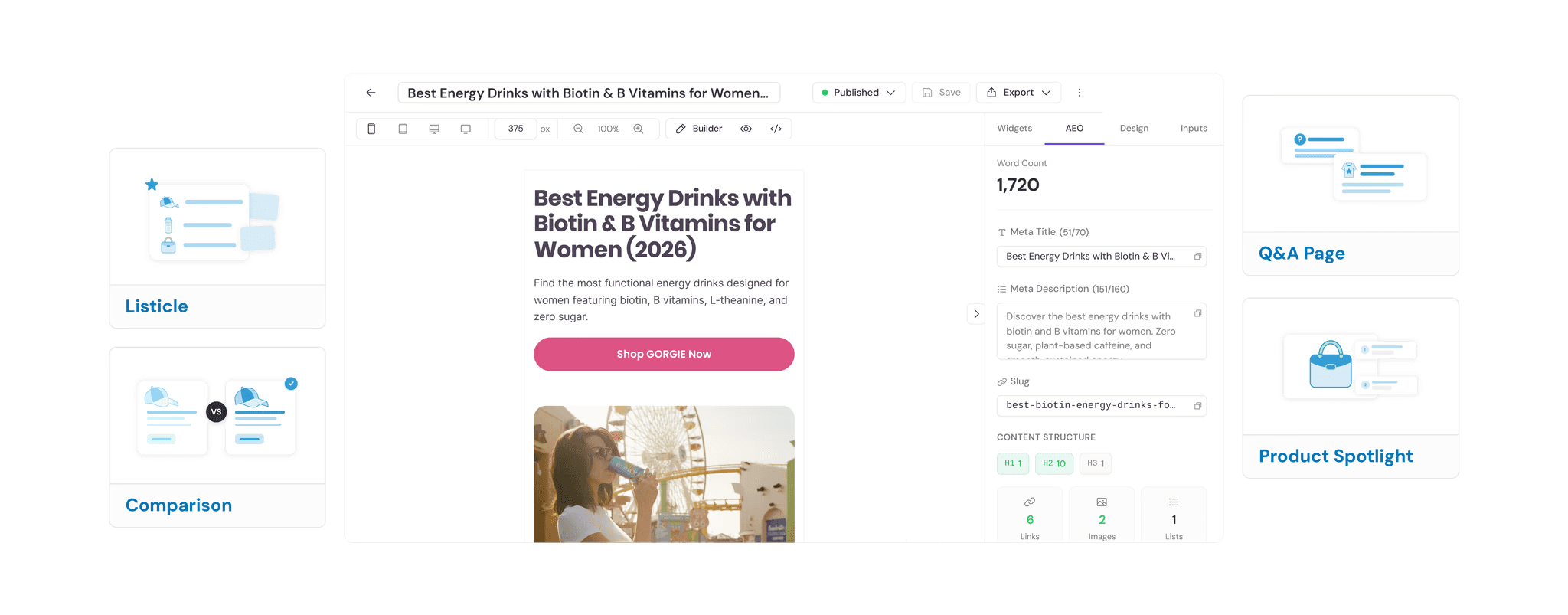
Measure zero-click and agent-mediated revenue inside Nudge Shoppable Funnels, separately from last-click; standard web analytics will miss this channel.
Pair this attribution rethink with Nudge's reporting, which captures AI-assisted journeys where the purchase decision was made inside the AI interface.
Frequently asked questions
Do AI visibility tools for ecommerce actually drive conversions, or are they just analytics dashboards?
Most tools are analytics-first - they track mentions, share of voice, and citation sources. Full-funnel platforms like Nudge go further by combining visibility monitoring with catalog enrichment and prompt-aligned shoppable funnels, closing the gap between being cited and being bought. The distinction matters because AI-referred traffic converts 42% better than paid search (Adobe, Q1 2026), so losing the conversion after earning the citation is a measurable revenue leak.
How many AI engines should an ecommerce visibility tool track?
At minimum, any platform should track ChatGPT, Perplexity, Google AI Overviews, Gemini, and Claude. Enterprise tools should cover 8+ engines. Citation volumes for the same brand can vary across platforms, so tools tracking only 3-4 engines will systematically underreport visibility gaps - meaning you may believe your AI presence is stronger than it actually is.