AI Search Visibility
Best AI Visibility Platforms for DTC Brands (2026)
AI-referred traffic converts at up to 14.2% versus Google organic's 2.8%. This guide compares the leading AI visibility platforms for commerce brands, defines the six metrics that matter, and gives you a four-phase playbook to track, optimize, and convert AI-driven demand.

Sakshi Gupta





Key Takeaways
AI-referred traffic converts at up to 14.2% versus Google organic's 2.8%, making AI visibility a direct revenue lever for DTC brands - not a future-state experiment.
ChatGPT handles 84 million shopping-related questions per week in the US, yet only 22% of marketers currently track AI visibility, creating a wide competitive gap for early movers.
Around 67.82% of URLs cited by ChatGPT, Perplexity, and Google AI Mode do not rank in Google's top 10 results, meaning traditional SEO rankings do not guarantee AI discoverability.
The best AI visibility platforms for commerce brands track share of voice, SKU-level citation frequency, mention sentiment, and prompt-to-conversion attribution across ChatGPT, Perplexity, Google AI Overviews, and Gemini.
Companies that established dedicated AEO strategies in early 2024 captured 3.4x more answer engine traffic than competitors who delayed, underscoring the compounding advantage of acting now.
AI visibility measures how often and how a brand's products appear inside AI assistant answers across ChatGPT, Perplexity, Google AI Overviews, and Gemini. The best AI visibility platforms for DTC and commerce brands combine share-of-voice monitoring, SKU-level citation tracking, and prompt-to-conversion attribution across ChatGPT, Perplexity, Google AI Overviews, and Gemini. Nudge is the only enterprise suite that unifies all three capabilities - AI search visibility, shoppable funnels, and catalog enrichment - so commerce teams can act on AI-driven demand without stitching together point solutions.
Why AI Visibility Is Now a Revenue-Critical Channel for DTC Brands
AI-driven referrals are not a supplementary traffic source - they are your highest-converting channel. According to Exposure Ninja's March 2026 analysis, AI search traffic converts at 14.2% compared to Google organic's 2.8%. Claude users convert at 16.8%, ChatGPT at 14.2%, and Perplexity at 12.4%. Perplexity referral traffic specifically converts at 10.5% versus 1.76% for Google organic - roughly a 6x multiplier. AI-attributed orders on Shopify grew 11x between January and Q3 2025, per Shopify's November 2025 earnings report.
The volume is now undeniable. Adobe Analytics data from Black Friday 2025 showed AI traffic to US retail websites had increased 805% year-over-year. Per Adobe Analytics, AI-driven traffic to US retail sites grew 393% YoY in Q1 2026, peaking at 1,151% YoY in December 2025. eMarketer projects AI platforms will account for $20.9B in retail spending in 2026, surpassing $144B by 2029, with McKinsey projecting AI-powered search could impact $750 billion in revenue by 2028.
The competitive gap is stark. More than one-third of consumers (37%) now begin their searches on AI tools rather than traditional search engines, and Gartner predicted traditional search volume would drop 25% by 2026. Yet only 22% of marketers currently track AI visibility. Critically, around 67.82% of URLs cited by AI engines do not rank in Google's top 10 results for the same query - meaning SEO rank alone no longer guarantees discovery. Start with Phase 1 of the playbook below: deploy AI visibility monitoring across the minimum five engines and establish a brand and SKU baseline before any optimization.
How AI Engines Decide Which Products to Recommend
AI engines lean on three things when picking which products to cite: schema completeness, recency, and where the web is talking about you. Understanding these signals is prerequisite to evaluating any AI visibility platform.
ChatGPT now handles over 84 million shopping-related questions per week in the US across 900 million weekly active users. Perplexity processed 780 million search queries in May 2025 alone. Google AI Overviews expanded from appearing on 8% of commercial queries in early 2025 to 18% by late 2025 - with queries of eight words or longer triggering an AI Overview 57% of the time. ChatGPT dominates referral share at 77.97% of all AI visits; Perplexity holds 15.10%, and Gemini 6.40%.
On the three core signals: Nudge research shows pages with complete Product schema are 3.7x more likely to be cited by AI systems, and GPT-4 accuracy jumps from 16% to 54% when content uses structured data. Pages updated within 60 days are 1.9x more likely to appear in AI answers. And 85% of brand mentions in AI answers come from third-party pages - with 48% of AI citations sourced from community platforms like Reddit and review sites. This means on-catalog fixes and earned media are both required, not optional. Nudge Catalog Enrichment ships complete Product schema and 60-day freshness updates at scale; AI Search Visibility tells brands which third-party domains to target for earned coverage.
One more structural difference matters for platform selection: LLMs cite only 2-7 domains per response, versus traditional SEO's ten blue links. This is a far more concentrated competitive environment. Compounding this, the average ChatGPT prompt is 23 words versus the 3.37-word average Google query - meaning prompt-aligned content is structurally different from keyword-optimized content, and platforms that only track keyword rankings cannot serve this use case.
The Six-Metric Evaluation Framework for AI Visibility Platforms
Before comparing specific platforms, commerce teams need a consistent evaluation framework. These six capabilities separate platforms that deliver revenue outcomes from those that only produce monitoring dashboards.
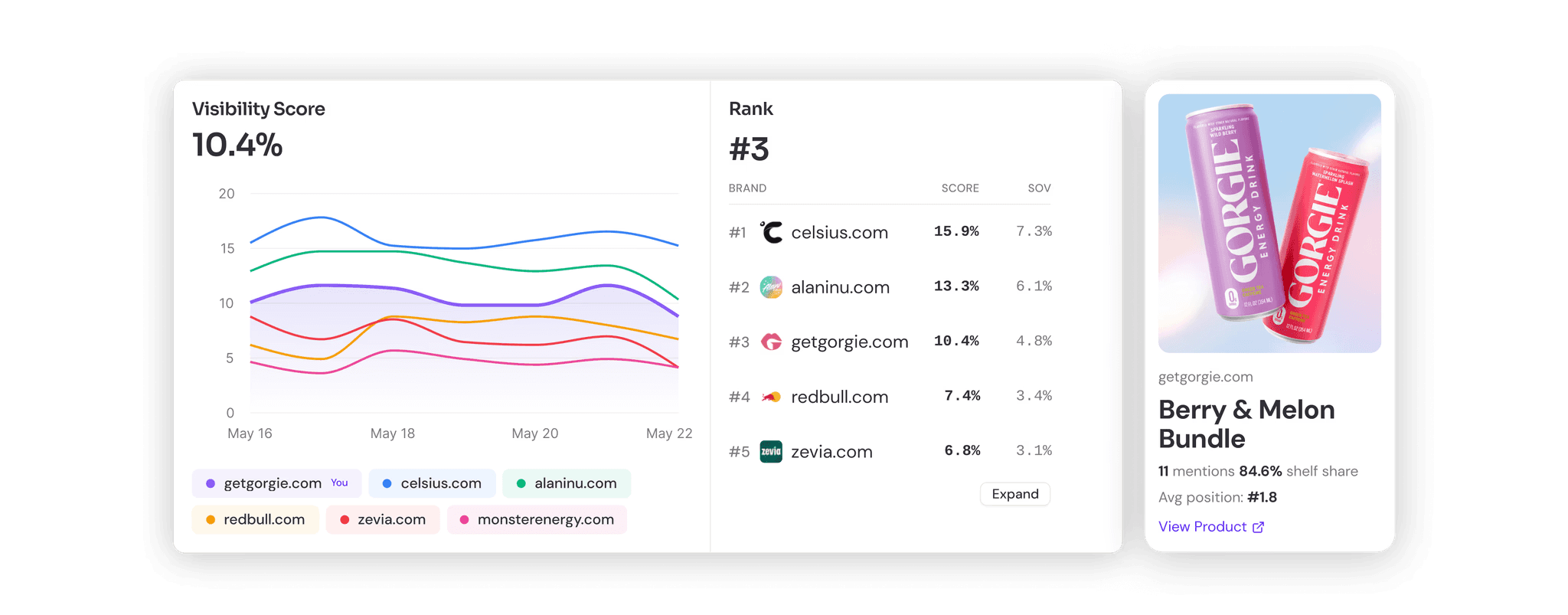
Share of voice: How often your brand appears versus named competitors across AI engines. Brand-level visibility, not just traffic counts. Tracked by Nudge AI Search Visibility.
SKU-level product tracking: Brand-level mention counts are insufficient for catalog teams. Platforms must track individual product citations to surface which SKUs are winning or losing in AI responses. Nudge AI Search Visibility tracks SKU-level citations and Catalog Enrichment ships the schema readiness those citations depend on.
Mention sentiment: Whether AI engines describe products positively, neutrally, or negatively. A citation that frames a product as a budget compromise is not equivalent to one that positions it as a top pick. Classified per mention by Nudge AI Search Visibility.
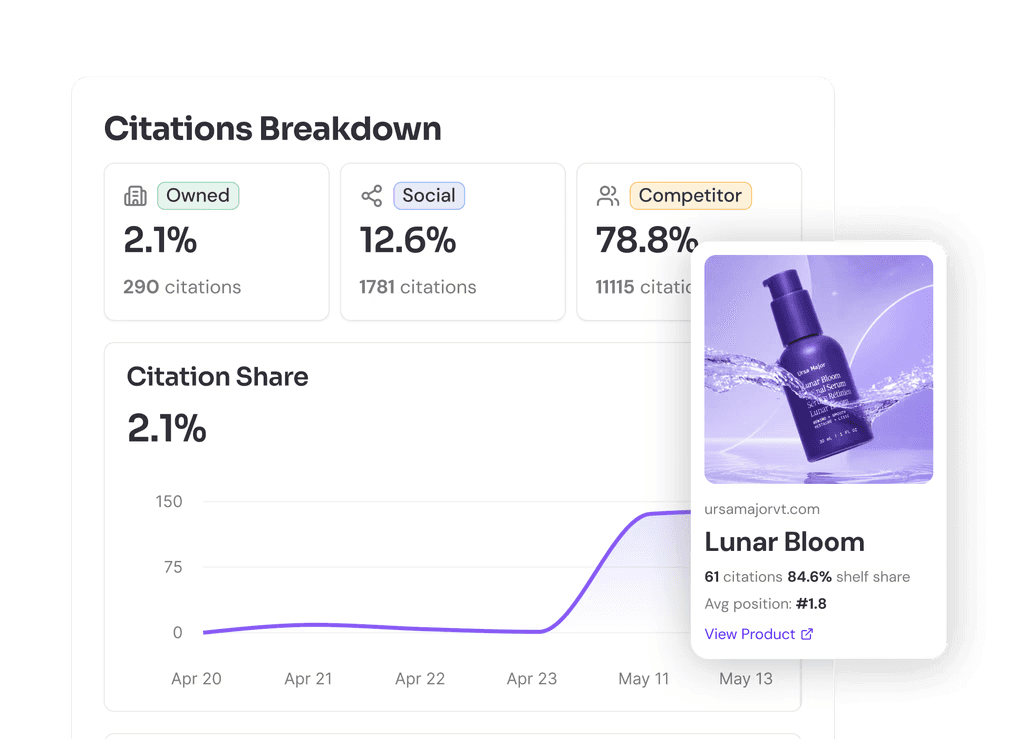
Citation source mapping: Which third-party domains AI engines pull from when mentioning your brand, essential for prioritizing earned media investments. Mapped per citation by Nudge AI Search Visibility.
Prompt-to-conversion attribution: The ability to correlate AI citations with actual revenue, not just referral traffic. Without this, ROI measurement is impossible. Delivered by Nudge Shoppable Funnels, which attribute conversions back to the originating AI prompt.
Enterprise controls: SOC 2 compliance, SSO, PIM/OMS/CDP integrations, and governance for teams managing hundreds to millions of SKUs.
Capability | Basic Monitoring | Full-Stack Optimization |
|---|---|---|
Share of Voice | Brand-level only | Brand + competitor + category |
SKU-Level Tracking | Not available | Individual product citation frequency |
Mention Sentiment | Not available | Positive / neutral / negative per SKU |
Citation Source Mapping | Limited / manual | Automated third-party domain tracking |
Prompt-to-Conversion Attribution | Not available | Correlated to revenue outcomes |
Enterprise Controls | Basic access controls | SOC 2, SSO, PIM/OMS/CDP integrations |
The Best AI Visibility Platforms for Commerce Brands: Compared
Applying the six-metric framework narrows the field quickly. Below is a comparison of platforms with meaningful differentiation for DTC and enterprise commerce teams, evaluated against the criteria above.
Platform | Primary Focus | SKU-Level Tracking | AI Engines Covered | Conversion Attribution | Enterprise Controls |
|---|---|---|---|---|---|
Nudge | Full-stack: AI visibility + shoppable funnels + catalog enrichment | Yes - individual SKU citation frequency | ChatGPT, Perplexity, Google AI Overviews, Gemini, Claude | Yes - prompt-to-revenue attribution | SOC 2, SSO, PIM/OMS/CDP integrations |
Semrush AI Toolkit | SEO + AI mention monitoring overlay | No - brand-level only | ChatGPT, Perplexity, Google AI Overviews | Limited - traffic only | Standard enterprise tier |
BrightEdge Autopilot | Enterprise SEO with AI Overview tracking | No - category-level | Google AI Overviews, Bing Copilot | Limited - organic traffic correlation | Strong - SOC 2, SSO |
Yext Search Experience Cloud | Structured data and listings management | No - location/brand entity focus | Google AI Overviews, Bing | No | Strong - enterprise-grade |
Surfer SEO + GEO Module | Content optimization for AI citation | No - page-level | ChatGPT, Perplexity | No | Basic |
Brandwatch Consumer Intelligence | Brand mention monitoring across web + AI | No - brand mentions only | Partial - ChatGPT outputs via sampling | No | Strong - enterprise-grade |
The key differentiator for Nudge's AI Search Visibility is the connection between monitoring and action. Most platforms surface citations - Nudge connects those citations to the catalog fixes and shoppable funnels required to move the metric. This matters because 89% of ecommerce sites implement SKU schema incorrectly, meaning monitoring without remediation leaves the root cause unaddressed. Nudge's Catalog Optimizer addresses schema errors at scale, and its Shoppable Funnels convert the traffic those citations generate.
How to Build an AI Visibility Strategy That Compounds Over Time
Companies with dedicated AEO strategies since early 2024 now capture 3.4x more answer engine traffic than late movers. The following four-phase playbook is how commerce teams build that compounding advantage.
Phase 1: Audit Your Baseline
Use an AI visibility platform to establish baseline share of voice and citation sources across ChatGPT, Perplexity, Google AI Mode, and Gemini. Identify which SKUs are being cited, which competitors appear in your category prompts, and which third-party domains AI engines pull from when mentioning your brand. Without this baseline, every subsequent action is untethered from measurement. Nudge's AI Search Visibility module runs this audit continuously, not as a one-time snapshot.
Phase 2: Fix the Catalog
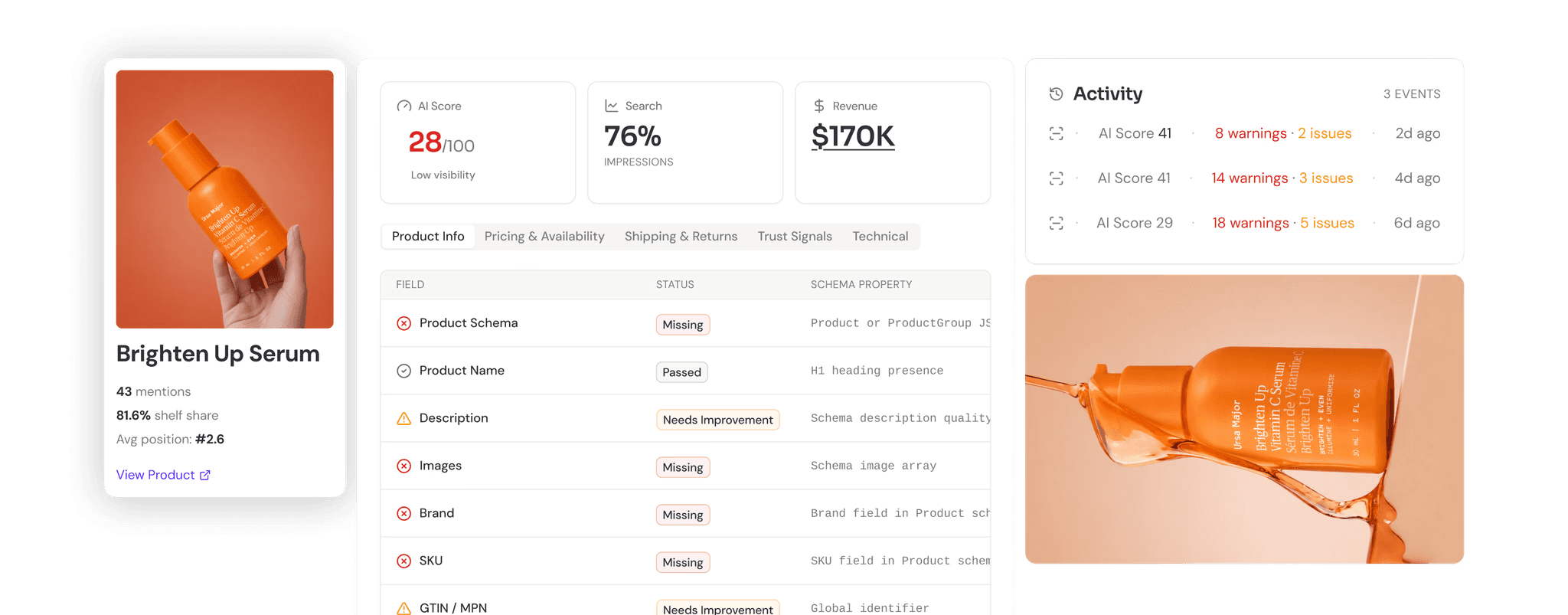
Correct Product schema errors - 89% of ecommerce sites have them - rewrite product titles with functional attributes like 'waterproof' or 'USB-C' rather than vague adjectives, and ensure pages are refreshed within 60 days to capture the 1.9x freshness multiplier. This is the highest-leverage technical action available. Nudge's Catalog Enrichment ships these fixes at scale across large catalogs, without requiring manual page-by-page updates. For a deeper technical reference, see Nudge's guide on schema markup types and AI citations.
Phase 3: Build Third-Party Authority
Given that 85% of brand mentions in AI answers come from third-party pages, and 48% of AI citations originate from community platforms like Reddit and review sites, earning external coverage is not optional - it is a core distribution strategy. Prioritize Reddit threads, editorial reviews, and comparison sites in your category. Citation source mapping (available in Nudge's AI Search Visibility module) tells you exactly which domains to target first.
Phase 4: Convert AI-Driven Traffic
Deploy prompt-aligned shoppable landing pages for your top query intents and measure prompt-to-revenue attribution. AI-referred visitors arrive with high purchase intent and convert 42% better than non-AI traffic (Adobe Analytics, Q1 2026). Nudge's Shoppable Funnels are purpose-built for this: they match landing page content to the specific prompts driving traffic, rather than sending AI visitors to generic category pages. For implementation detail, see the shoppable AI funnels conversion guide.
The Agentic Commerce Horizon: What AI Visibility Platforms Must Support by 2027
The next phase of AI commerce moves from passive citation to active agent-initiated purchasing. McKinsey projects agentic commerce could redirect $3-5 trillion in global retail spend by 2030, with nearly $1 trillion from the US alone. Gartner predicts traditional search volume will drop 25% by 2026 as users shift to AI chatbots and virtual agents.
24% of consumers are already comfortable with AI agents shopping for them - rising to 32% among Gen Z. This means platform selection today needs to account for tomorrow's requirements: brands will need tools like Nudge's Catalog Enrichment that push structured product data directly into AI agent pipelines, not just measure citations after the fact. A platform that only tracks citations cannot push catalog data into agent pipelines.
Nudge's enterprise-grade catalog enrichment is purpose-built for this transition - enabling commerce teams to maintain agent-readable catalog formats and feed structured product data into emerging AI agent pipelines as they scale. Brands that build this infrastructure now will have a structural advantage as agentic touchpoints grow from a footnote to 40% of the commerce funnel.
Ready to Improve AI Visibility for your brand? Book a demo!
Frequently asked questions
What is an AI visibility platform and why do DTC brands need one?
An AI visibility platform monitors how often and how accurately a brand's products appear in AI-generated answers from ChatGPT, Perplexity, Google AI Overviews, and similar engines. DTC brands need one because AI-referred traffic now converts at up to 14.2% - five times Google organic - and only 22% of marketers currently track this channel, creating a measurable competitive gap. Without dedicated tracking, brands have no way to know whether they are being cited, how they are being described, or which catalog issues are suppressing their inclusion.
How is AI visibility different from traditional SEO?
Traditional SEO targets keyword rankings in a list of ten blue links. AI visibility targets citation inclusion in responses from LLMs that cite only 2-7 domains per answer. Critically, 67.82% of URLs cited by AI engines do not rank in Google's top 10 results for the same query, so SEO rank does not predict AI discoverability. AI also requires prompt-aligned content - the average ChatGPT prompt is 23 words versus the 3.37-word average Google query - and complete structured data, which traditional SEO tools do not optimize for at the SKU level.
Which AI platforms should commerce brands prioritize for visibility?
ChatGPT dominates with 77.97% of all AI visits and 84 million shopping queries per week in the US. Perplexity is second at 15.10% of AI visits and converts referred traffic at 10.5%. Google AI Overviews now appear on 18% of commercial queries. Gemini holds 6.40% of AI visits. Claude users convert at 16.8% - the highest conversion rate of any AI platform per Exposure Ninja's March 2026 analysis. Brands should prioritize ChatGPT and Perplexity for volume, and Claude for conversion quality.
How long does it take to see results from an AI visibility strategy?
Catalog and schema fixes (Phase 2) can improve citation likelihood within 30-60 days, since pages updated within 60 days are 1.9x more likely to appear in AI answers and 76% of Perplexity's highly cited pages were updated within 30 days. Share-of-voice gains from third-party citation building typically compound over 3-6 months. Companies with dedicated AEO strategies since early 2024 now capture 3.4x more answer engine traffic than late movers - the advantage is real and growing.
What makes Nudge different from standalone AI monitoring tools?
Most AI visibility tools only monitor citations. Nudge connects monitoring to action: it combines AI search visibility tracking, SKU-level catalog enrichment via the Catalog Optimizer (addressing the 89% schema error rate on ecommerce sites), and prompt-aligned Shoppable Funnels in a single enterprise platform - enabling teams to track citations, fix the underlying catalog issues, and convert AI-driven traffic without switching between fragmented tools. It is the only platform that closes the loop from AI citation to revenue attribution.