AI Search Visibility
What It Actually Takes to Get Your Products Cited by AI Assistants
A data-driven breakdown of how ChatGPT, Google AI Mode, Perplexity, and Gemini select products - and the exact signals your pages need to earn those citations.

Sakshi Gupta





Key Takeaways
AI-referred shoppers convert 31% more than other traffic sources and spend 32% longer on-site, making AI citation a higher-ROI channel than paid search, email, or organic SEO combined.
ChatGPT, Google AI Mode, Perplexity, and Gemini each use different ranking signals: ChatGPT weights retrieval rank and third-party reviews (referencing reviews in 58% of responses), while Google AI Mode pulls directly from the Shopping Graph's 50 billion product listings via Merchant Center feeds.
Pages with headings that closely match the user's query are cited 41% of the time versus 29% for weak matches - heading structure is the single highest-impact on-page lever for AI citation.
61% of pages cited in AI Overviews use structured data, yet 45% of top e-commerce product URLs contain no structured data at all, creating a wide-open competitive gap.
Focused product pages covering 26-50% of ChatGPT's fan-out sub-queries outperform comprehensive ultimate guide pages, meaning specificity beats breadth for AI citation eligibility.
AI assistants select products based on a combination of retrieval rank, structured data completeness, heading-query alignment, review authority, and crawl access - not paid placement. Brands that optimize these signals systematically earn citations across ChatGPT, Google AI Mode, Perplexity, and Gemini, capturing a conversion channel that now outperforms every traditional traffic source.
Why AI Shopping Citations Are Now a Primary Revenue Channel
AI-referred traffic is the fastest-growing and highest-converting source in commerce right now. Adobe's data shows AI-referred traffic to US retail sites grew 4,700% year over year, with those visitors spending 32% longer on-site than visitors from paid search, email, affiliates, organic search, or social. AI referrals converted 31% more than other traffic sources, with AI-driven revenue per visit up 254% this holiday season. On peak shopping days, the gap widens further: AI conversions were 54% higher than non-AI traffic on Thanksgiving and 38% higher on Black Friday.
The demand side is equally compelling. 59% of Americans now use generative AI tools for shopping tasks, up from 11% during the 2024 holiday season. Daily AI search users in the US nearly doubled from 14% in February 2025 to 29.2% by August 2025, according to eMarketer. Gartner predicts traditional search engine volume will drop 25% by 2026 as users migrate to AI-native discovery. Meanwhile, organic CTR drops 46.7% when an AI Overview is present - meaning brands that fail to earn AI citations lose twice: once to the AI summary and once to the competitor it recommends.
How Each AI Platform Selects Products Differently
No two AI platforms use the same product selection logic. Understanding the differences is the first step toward building a platform-specific citation strategy.
Platform | Primary Data Source | Advertising Model | Review Reliance | Structured Data Requirement | Brand Mention Rate |
|---|---|---|---|---|---|
ChatGPT | Real-time web retrieval plus Google Shopping integration | No ads, no bidding, no sponsored placement | High - references reviews in 58% of responses | Product schema recommended; GPTBot crawl access required | 99.3% |
Google AI Mode | Shopping Graph (50B+ listings, 2B updates/hour) plus Merchant Center feeds | Separate from Shopping ads; feed completeness drives organic inclusion | Moderate - pulls from verified Google reviews and structured review data | Product schema and Merchant Center feed submission critical | 81.7% |
Perplexity | Real-time web index plus curated third-party sources | Limited sponsored answers; organic citation dominates | Moderate - favors authority review sites and listicles | Schema helps but not mandatory for citation | 85.7% |
Gemini | Google Shopping Graph and Google Search index | Integrated with Google Shopping ecosystem | Moderate - pulls from Google review ecosystem | Product schema and Merchant Center feeds strongly favored | Closely aligned with Google AI Mode signals |
ChatGPT: Fan-Out Queries and Retrieval Rank
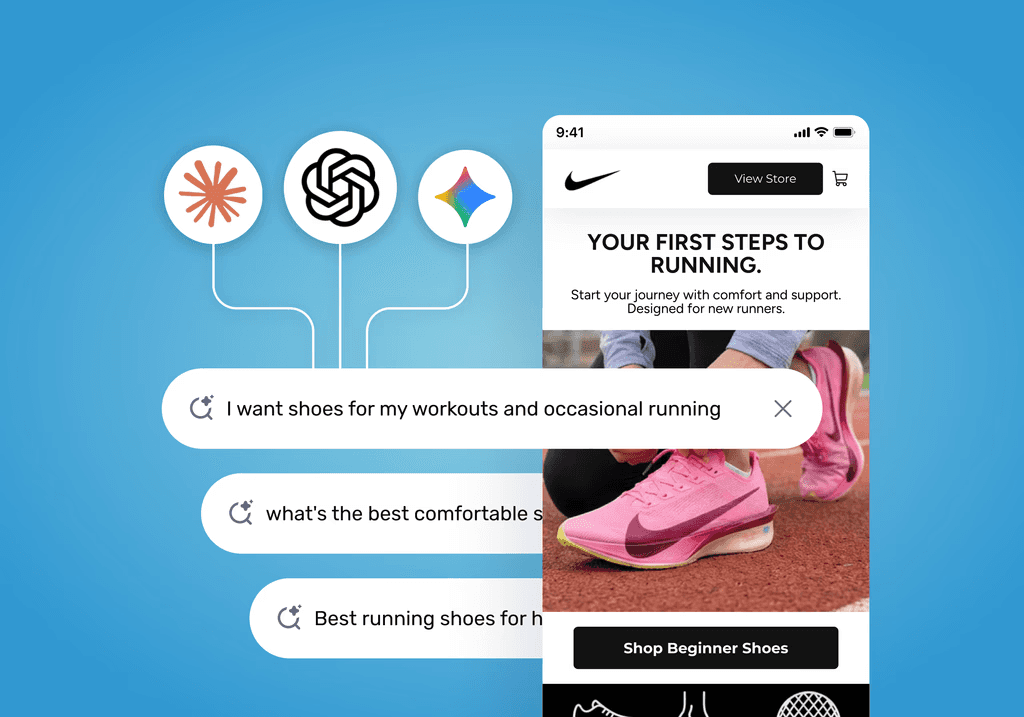
When ChatGPT receives a shopping query, it does not search once and stop. It generates a series of follow-up searches called fan-out queries. 89.6% of prompts trigger two or more fan-out queries, expanding a set of 15,000 original prompts to 43,233 total queries - nearly a 3x increase. Critically, 95% of those fan-out queries have zero monthly search volume by traditional metrics, meaning standard keyword tracking misses most of the citation surface entirely. Retrieval rank is the decisive signal: a page at position 1 earns a 58% citation rate versus 14% at position 10. ChatGPT Shopping operates with no bidding, no cost-per-click, and no sponsored placement - organic citation signals are the only lever available.
Google AI Mode: The Shopping Graph Dependency
Google AI Mode draws primarily from the Shopping Graph, which indexes over 50 billion product listings and processes 2 billion updates per hour. Feed completeness in Google Merchant Center and Product schema matter more here than traditional organic ranking signals. At NRF 2026, Google launched the Universal Commerce Protocol (UCP), an open standard for agentic commerce co-developed with Shopify, Etsy, Wayfair, Target, and Walmart, endorsed by over 20 companies including Visa, Mastercard, and Stripe - signaling that feed-based data submission will become the baseline requirement for AI product visibility across the Google ecosystem.
The 5 Signals That Determine Whether Your Product Page Gets Cited
Five on-page and technical signals consistently separate cited product pages from uncited ones. Each is actionable and measurable.
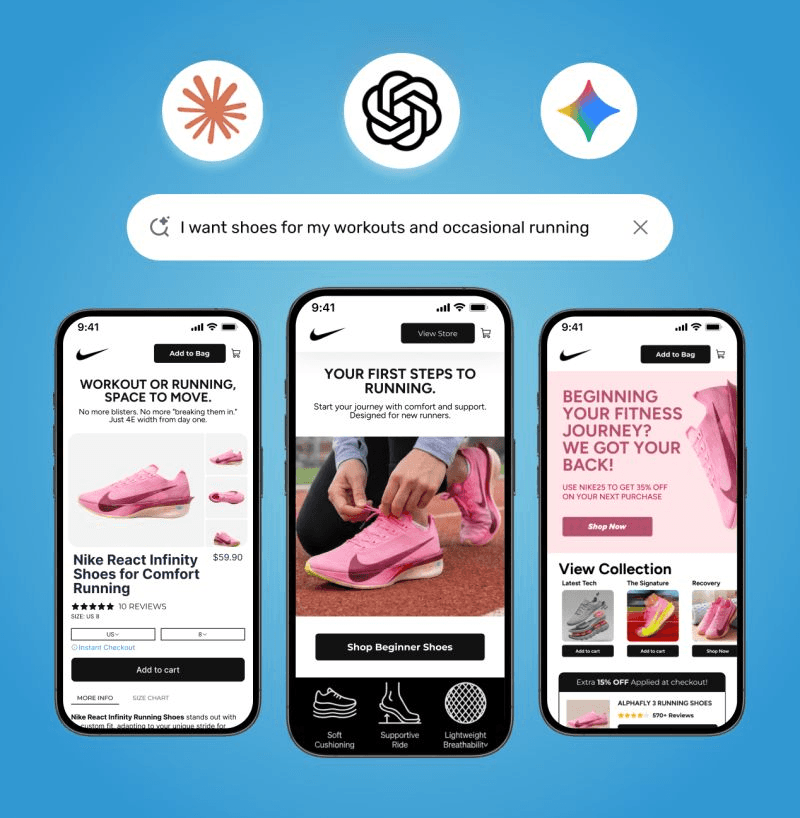
Heading-query match. Pages with headings that closely match the user query are cited 41% of the time versus 29% for weak matches. This is the single highest-impact on-page lever - more impactful than word count, topical breadth, or body copy. Write product page H1s and H2s to mirror the exact language a shopper would use in a prompt.
Structured data completeness. 61% of pages cited in AI Overviews use structured data, according to the ConvertMate GEO Benchmark 2026. Yet 45% of top e-commerce product URLs carry no structured data at all. The priority types are Product schema (name, description, price, availability, image) and Review schema (author, datePublished). This gap is one of the most actionable competitive advantages available right now.
Specific, measurable claims over superlatives. Replace phrases like best in class with verifiable specifications and concrete performance data. Include three to five specific use cases or audience segments per product page. AI systems extract and cite factual claims; they cannot cite vague marketing language.
Review volume and third-party authority. ChatGPT references reviews in 58% of responses but does not crawl Google Reviews directly - it relies on crawlable on-site reviews, third-party platforms, and review content in blog posts and forums. Research across 1,000 ecommerce prompts found the median review count for ChatGPT-recommended products was 156. Domains with active profiles on Trustpilot, G2, Capterra, or Yelp have 3x higher citation probability.
Crawl access and feed submission. Ensure GPTBot is permitted in robots.txt and submit to OpenAI product feed program for ChatGPT visibility. For Google AI Mode and Gemini, submit complete product feeds to Google Merchant Center with full Product schema. Blocking crawlers or running incomplete feeds removes your products from the citation pool entirely.
Content Structure Patterns That Earn More AI Citations
Formatting and structural choices have a measurable, quantifiable impact on citation rates - independent of content quality. The data points to several specific patterns that lift citation probability.
Structural Signal | Citation Lift | Practical Application |
|---|---|---|
Comparison pages with 3 tables | +25.7% | Add feature, pricing, and use-case comparison tables to product and category pages |
Sentences averaging 10 words or fewer | +18.8% | Edit product descriptions and spec sections for brevity; break long sentences |
5-7 statistics per page | +20% | Include verified performance data, test results, and measurable claims in product copy |
Page length of 1,501-1,800 words | +8.4% | Target this range for product detail pages; avoid padding or excessive truncation |
10 images per page | +16.4% | Include lifestyle, spec detail, use-case, and comparison images with descriptive alt text |
The comprehensive ultimate guide format that dominated organic SEO actually hurts AI citation rates when query relevance is held constant. The practical implication is clear: create SKU-specific or use-case-specific pages rather than one mega-guide. A page titled Best Waterproof Running Shoes for Trail Conditions will outperform a single page trying to cover all running shoe queries. Learn more about applying this approach in Nudge's guide to optimizing product content for AI discovery.
Off-Page Authority: How Third-Party Signals Amplify Citation Probability
AI systems do not just evaluate your product page in isolation - they weight how much the broader web trusts your brand. Third-party signals are often the deciding factor between two otherwise similar product pages.
In a Wix sample of professional services content, third-party listicles drove 80.9% of citations versus 19.1% for self-promotional content. Separately, SE Ranking research found that domains with millions of brand mentions on Quora and Reddit have roughly four times higher chances of being cited by AI systems than those with minimal community activity. These numbers point to a clear off-page strategy with three levers:
Earn placements in authority review publications. Sites like Wirecutter, CNET, TechRadar, and category-specific review outlets carry significant weight in AI retrieval. A single placement in one of these sources can lift citation probability more than dozens of on-page optimizations.
Build active third-party review profiles. Domains with active Trustpilot, G2, Capterra, or Yelp profiles have 3x higher citation probability. Prioritize review platforms relevant to your category and actively manage them for recency and volume.
Seed genuine community discussions. Authentic brand and product mentions on Reddit and Quora signal broad community trust to AI systems. Participate in relevant communities with genuine product context rather than promotional content - AI systems distinguish between the two.
How to Measure and Operationalize AI Citation Performance
Only 16% of brands currently track AI search performance systematically - meaning 84% are flying blind on their fastest-growing traffic channel. Closing this measurement gap is urgent and increasingly feasible.
For brands managing thousands to millions of SKUs, fragmented point tools cannot scale. SKU-level citation tracking, prompt-aligned content updates, and feed optimization require a unified platform. Nudge's AI search visibility platform and catalog optimizer give enterprise commerce teams the infrastructure to track, diagnose, and improve AI citation performance at catalog scale - without rebuilding workflows from scratch. For teams ready to connect citation performance to conversion, the shoppable funnels platform closes the loop from AI discovery to purchase.
Ready to get cited by AI Assistants? Book a demo!
Frequently asked questions
Does ChatGPT use paid placements to decide which products to recommend?
No. ChatGPT Shopping has no bidding system, no cost-per-click, and no sponsored placement. Products are selected by cross-referencing multiple data sources in real time, as confirmed by OpenAI. Organic citation signals - retrieval rank, review authority, structured data, and heading-query alignment - are the only levers brands can pull.
How many product reviews does a brand need to be recommended by ChatGPT?
Research across 1,000 ecommerce prompts found the median review count for ChatGPT-recommended products was 156. Brands should target at least 150 reviews, with ratings visible on crawlable pages and third-party platforms like Trustpilot or G2. ChatGPT references reviews in 58% of responses but does not crawl Google Reviews directly, so third-party platform presence matters as much as on-site review volume.
Does Google AI Mode use the same signals as Google Search for product recommendations?
Not exactly. Google AI Mode pulls primarily from the Shopping Graph, which indexes over 50 billion listings and processes 2 billion updates per hour, and from Google Merchant Center feeds. Feed completeness and Product schema matter more for AI Mode than traditional organic ranking signals alone. The Universal Commerce Protocol launched at NRF 2026 signals that structured feed submission will become the baseline requirement for AI product visibility across the Google ecosystem.
Should I create one comprehensive product guide or multiple focused pages to earn AI citations?
Multiple focused pages win. Research shows pages covering 26-50% of ChatGPT fan-out sub-queries outperform pages covering 100%. The comprehensive ultimate guide format that dominated traditional SEO actually hurts AI citation rates when query relevance is held constant. Create SKU-specific or use-case-specific pages rather than a single mega-guide to maximize citation eligibility across the full range of fan-out queries your category generates.
How do I know if my products are being cited by AI assistants?
Three approaches are available today. Use Microsoft AI Performance in Bing Webmaster Tools, launched February 10, 2026, for structured citation metrics including total citations, grounding queries, and page-level activity. Add UTM parameters and referrer tracking in your analytics platform to isolate AI-referred sessions from ChatGPT, Perplexity, and other sources. Run manual prompt testing across ChatGPT, Perplexity, and Google AI Mode to get ground-truth data on which products are being cited. Only 16% of brands currently do this systematically - closing that gap is one of the highest-leverage actions available to commerce teams in 2026.