Shoppable Funnels
How to Optimize Product Content for AI Discovery
A six-step guide to getting your SKUs cited, ranked, and bought via ChatGPT, Perplexity, Google AI Overviews, and Gemini.

Kanishka Thakur





To optimize product content for AI discovery, structure every product detail page with schema markup, conversational natural-language descriptions, fresh content, and multimodal assets so that AI engines like ChatGPT, Perplexity, and Google AI Overviews cite your SKUs in generated answers. This guide walks through six actionable steps to build that foundation and convert AI-referred traffic into revenue.
Why AI Discovery Is Now Your Highest-Converting Channel
Generative AI traffic to U.S. retail sites grew 4,700% year-over-year in July 2025, and that traffic is converting. AI search traffic converts at 14.2% compared to Google's 2.8%, making each AI-referred session roughly five times more valuable. Yet fewer than 12% of marketing teams have a documented strategy for appearing in AI-generated answers, even though AI now influences over 40% of purchase-stage research decisions. The six steps below close that gap.
Step 1: Audit Your Current AI Visibility Baseline
Before optimizing, measure where you stand. Run a prompt-based audit by manually querying ChatGPT, Perplexity, Google AI Overviews, and Gemini with your top product category and brand queries, then record which SKUs and pages are cited. Do not rely on your Google rankings as a proxy: 54% of brands that rank well on Google are not cited by AI systems at all, and 47% of AI Overview citations come from pages ranking below position five.
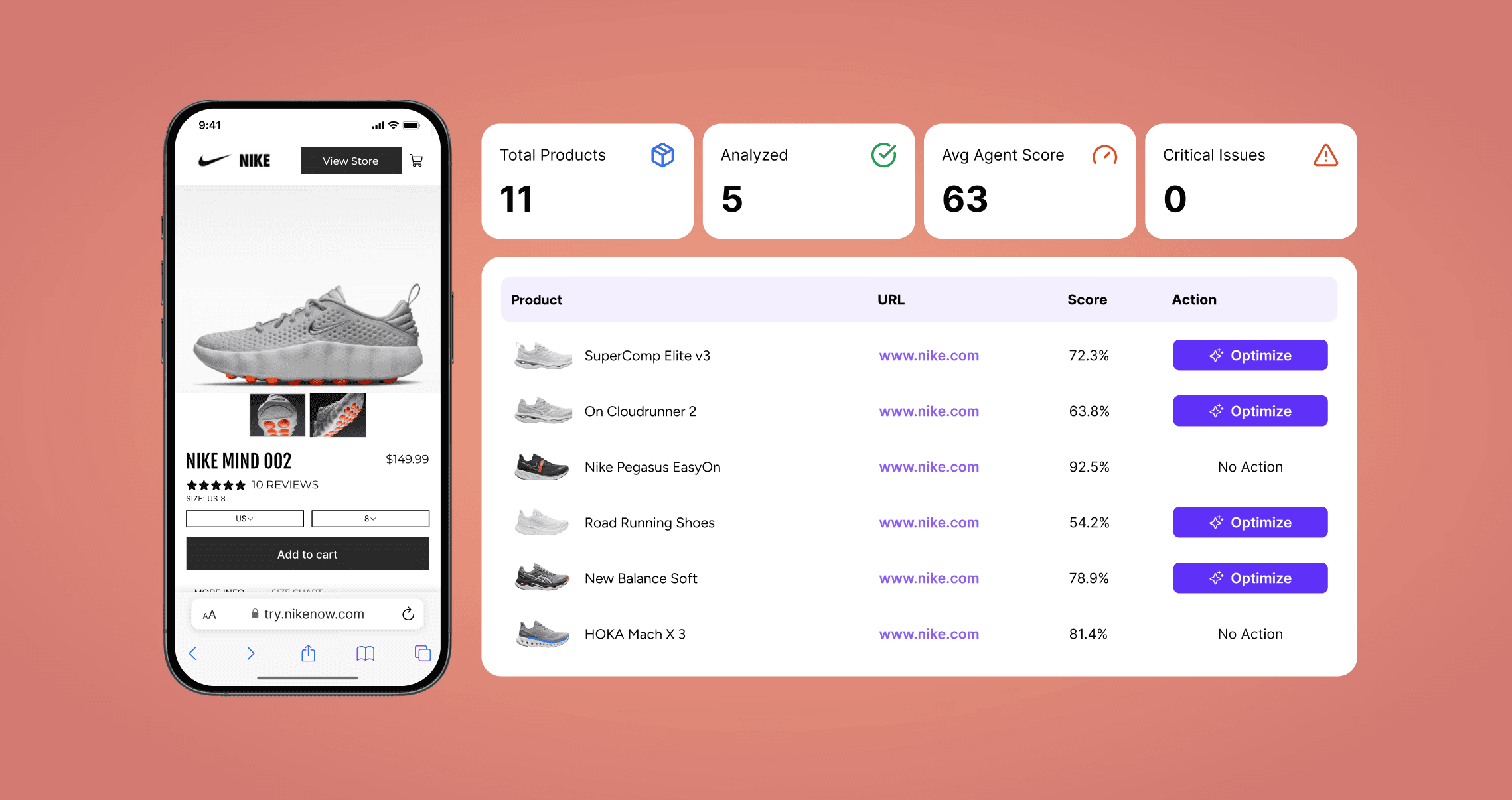
For catalogs with thousands of SKUs, manual auditing is not scalable. Nudge's AI Search Visibility module automates prompt-level citation tracking across your entire catalog, surfacing which SKUs are cited, on which platforms, and for which queries - so your team can prioritize enrichment where it matters most.
Step 2: Enrich Product Data for Machine Readability
AI engines select products based on three enrichment signals. Address all three on every product detail page (PDP) to maximize citation rates.
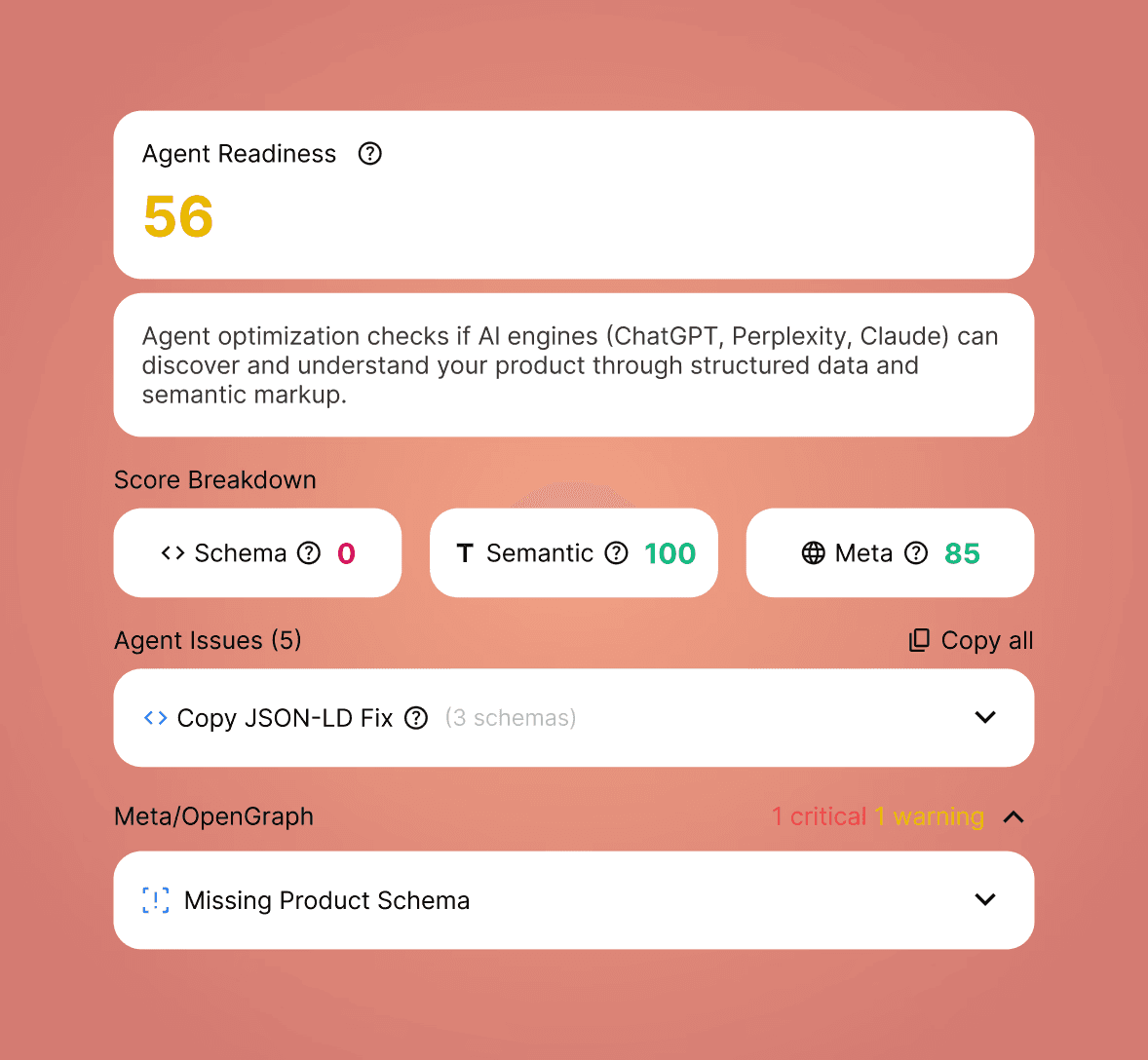
Structured schema markup: Deploy Product + Offer + AggregateRating + BreadcrumbList + FAQPage + Organization schema on every PDP. This is the minimum machine-readable layer AI engines need to parse and cite your products accurately.
Nudge's Catalog Optimizer applies these enrichment rules at SKU level across large catalogs, propagating schema updates and description improvements automatically without manual PDP-by-PDP editing.
Step 3: Align Page Signals - Title, H1, Meta, and llms.txt
On-page signal alignment ensures AI engines can parse, chunk, and confidently cite your content. Complete four tasks for every high-priority page.
Align title, H1, and meta description to the conversational queries your buyers actually use. Inconsistency across these three signals reduces AI confidence in the page topic.
Add an llms.txt file alongside your robots.txt. This file tells LLMs what is important about your site and where to find it, functioning as a sitemap for AI crawlers.
Use scannable formatting: short paragraphs, bullet lists, and bolded key terms give AI models clean chunks to extract and cite. Long walls of prose are harder to parse and less likely to be surfaced.
Update pages at least quarterly. Pages not refreshed quarterly are 3x more likely to lose AI citations, and more than 70% of all AI-cited pages have been updated within the past 12 months.
Step 4: Build Prompt-Aligned Shoppable Funnels
Getting cited is only half the job. Once a shopper clicks through from an AI answer, the landing experience must match the prompt that drove them there. AI-referred visitors are already pre-qualified: they are 33% less likely to bounce and spend 45% more time on-site than average visitors. A mismatched landing page wastes that intent.
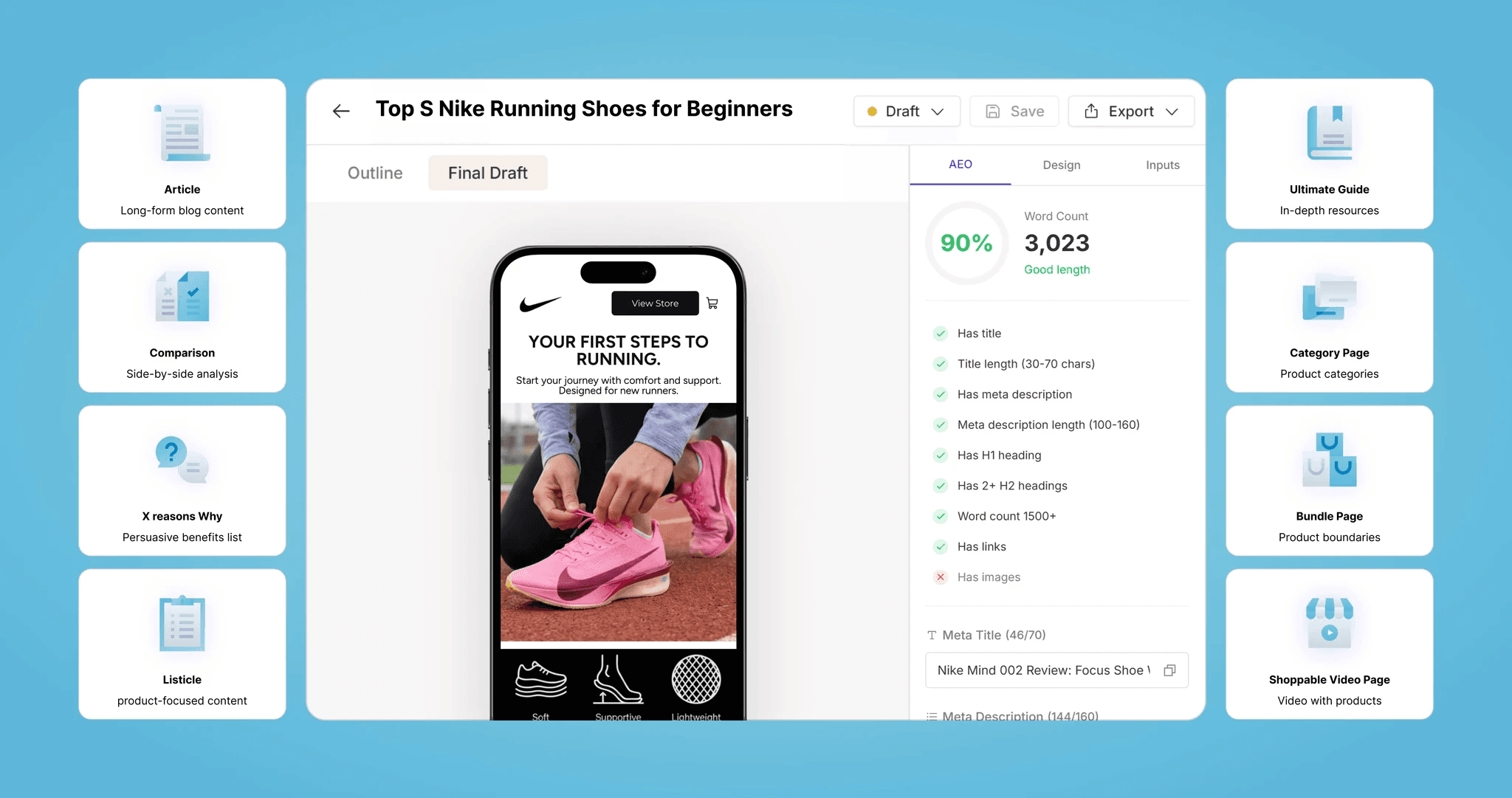
Create scenario-specific landing pages or content hubs mapped to high-intent AI queries (e.g., "best running shoes for flat feet under $150"). Each hub should open with a direct answer and surface the most relevant SKUs immediately.
Embed FAQ sections with concise direct answers on PDPs and category pages. FAQ content is a primary target for AI Overviews and conversational assistants that scan for structured Q&A patterns.
Use contextual nudges and shoppable widgets to guide AI-referred visitors toward conversion. Because these shoppers arrive with higher purchase intent, contextual prompts - size guides, comparison widgets, bundle suggestions - accelerate the decision.
Nudge's Shoppable Funnels are built specifically for this use case: matching the post-click experience to the AI prompt that generated the visit, at scale and without engineering overhead.
Step 5: Leverage Reviews and Social Proof as AI Ranking Signals
Reviews are a primary AI ranking signal, not just a conversion tool. AI assistants summarize review sentiment before deciding which products to surface, and products with at least five reviews have a 270% greater purchase likelihood than those with none.
Deploy AggregateRating schema on every PDP so star ratings and review counts are machine-readable. Without this markup, AI engines cannot reliably parse your review data even if it is visible on the page.
Actively solicit post-purchase reviews and surface them prominently on PDPs. Prioritize SKUs with fewer than five reviews for immediate outreach campaigns.
Understand the confidence effect: 65% of consumers using AI for shopping report higher purchase confidence, and 68% say they are less likely to return the product. Review-rich, AI-cited products actively reduce return rates - a meaningful operational benefit beyond the citation win.
Step 6: Monitor, Iterate, and Operationalize at Scale
AI visibility is not a one-time project. It requires a weekly operational loop that tracks citation share, measures AI-specific conversion metrics, and triggers enrichment sprints for high-opportunity catalog segments.
Track AI citation share by prompt, SKU, and competitor weekly - not just organic rank. Citation share is the metric that maps directly to AI-driven revenue.
Measure AI-specific conversion separately. Because AI search traffic converts at roughly 5x the rate of Google organic, blending these numbers into a single conversion report masks the true value of your AI optimization investment.
Run enrichment sprints on high-query-volume catalog segments first. Use citation share data to identify which categories or SKUs have the most AI query volume but the lowest citation rate, then prioritize those for schema, description, and multimodal upgrades.
Connect your PIM, OMS, and CDP to your AI optimization layer so enrichment changes propagate automatically across channels. Manual updates at catalog scale are not sustainable.
Frequently asked questions
What is the difference between SEO and optimizing for AI discovery?
Traditional SEO optimizes for ranking positions in blue-link results. AI discovery optimization - also called GEO (Generative Engine Optimization) - structures content so AI language models cite it in generated answers. 54% of brands that rank well on Google are not cited by AI systems at all.
Which AI platforms should I prioritize for product content optimization?
Prioritize ChatGPT, which processes 50 million shopping-related queries daily, Google AI Overviews (now appearing on 14% of shopping queries), Perplexity, and Gemini. Each platform rewards structured schema data, fresh content, and descriptions aligned to conversational queries.
How many product reviews do I need to be cited by AI assistants?
A minimum of five reviews with AggregateRating schema deployed on the PDP. Products with five or more reviews have a 270% greater purchase likelihood than those with none.
How often should I update product pages to maintain AI citations?
At least quarterly. Pages not updated on a quarterly cadence are 3x more likely to lose AI citations, and more than 70% of all pages currently cited by AI have been refreshed within the past 12 months.