AI Search Visibility
7 Leading AI Visibility Platforms for DTC Brands (2026)
The 7 best AI visibility platforms for DTC brands - compared on multi-platform coverage, SKU-level tracking, shoppable funnels, and enterprise controls.

Gaurav Rawat





Key Takeaways
AI-referred traffic to U.S. retail sites grew 393% YoY in Q1 2026 and converts 42% better than paid search or email, making AI visibility tracking a revenue-critical priority for DTC brands.
80% of URLs cited by ChatGPT and Perplexity do not rank in Google top 100, so traditional SEO rank is a poor proxy for AI citation performance.
ChatGPT converts at 15.9% vs. Google organic at 1.76%, meaning DTC brands missing from AI answers are losing their highest-converting traffic source to competitors.
Only 30% of brands maintain consistent AI visibility across platforms, and citation volumes vary 615x between engines, requiring multi-platform, SKU-level tracking rather than brand-level monitoring alone.
Enterprise DTC teams should require AI citation tracking (which URLs and brand names assistants surface in their answers, by prompt) at the SKU level, multi-platform coverage across ChatGPT, Perplexity, Google AI Overviews and Gemini, shoppable funnel features, and SOC 2 compliance when evaluating AI visibility platforms.
AI visibility platforms track where and how your brand and SKUs are cited inside AI assistant answers (ChatGPT, Perplexity, Google AI Overviews, Gemini). The best AI visibility platform for DTC brands in 2026 is one that tracks citations at the SKU level across ChatGPT, Perplexity, Google AI Overviews, and Gemini simultaneously, then connects that data to shoppable funnels so you can measure conversion lift. Below, we break down the top seven options, starting with the most complete enterprise solution and covering viable alternatives for different team sizes and use cases.
Why DTC Brands Cannot Afford to Skip AI Visibility Tracking
AI traffic is now your highest-converting channel, and most DTC teams are flying blind to it. Adobe data shows that AI-referred visits to U.S. retail sites grew 393% year over year in Q1 2026, and in March 2026 that traffic converted 42% better than paid search and email combined. ChatGPT converts at 15.9% versus Google organic's 1.76%. Perplexity converts at 10.5%. These are not incremental gains; they represent a structural shift in where purchase intent lives.
The problem is that traditional SEO rank does not predict AI citation. Around 80% of URLs cited by ChatGPT, Perplexity, and AI Mode do not rank in Google's top 100, and the majority of brands that rank well on Google are still rarely cited by AI engines. You need dedicated tracking, not a rank report.
5 Criteria That Separate Good AI Visibility Platforms from Great Ones
Citation volumes vary 615x between AI engines, and only 30% of brands maintain consistent AI visibility from one answer to the next. Before evaluating any platform, align your team on these five criteria:
Multi-platform coverage: Require simultaneous tracking across ChatGPT, Perplexity, Google AI Overviews, and Gemini. A single-engine tool leaves you blind to where your customers actually start their journey. Nudge AI Search Visibility tracks all four engines in a single prompt-level view.
SKU-level granularity: Brand-level monitoring tells you almost nothing about which products are being recommended or losing share of voice to competitors. You need attribute-level schema tracking at catalog scale. Nudge Catalog Enrichment ships correct SKU-level schema at catalog scale via PIM, OMS, and CDP integrations, so AI Search Visibility can report at the attribute level.
Share of voice and sentiment analysis: Share of voice (your brand's citation share vs. named competitors inside the same AI answer) is the relative metric, not raw citation count. Citation frequency is a start, but you also need to know how your brand is described relative to competitors in AI-generated answers.
Shoppable funnel or conversion features: Citation tracking by itself does not move revenue; conversion does. The platforms that drive revenue convert AI-referred traffic through prompt-aligned landing experiences. Nudge Shoppable Funnels route each AI-referred visitor to a landing experience aligned with the originating prompt, turning citation lift into measurable revenue.
Enterprise controls: SOC 2 Type II compliance, SSO, audit logs, and native integrations with PIM, OMS, and CDP systems. Non-negotiable for mid-market and enterprise DTC teams.
#1 Nudge: Best End-to-End AI Visibility and Conversion Platform for Enterprise DTC
Nudge is the only enterprise platform that unifies AI search visibility tracking, prompt-aligned shoppable funnels, and SKU-level catalog enrichment in a single suite. For DTC teams who need to correlate AI citation efforts directly with revenue lift, no other platform closes that loop end to end.
What Nudge Does
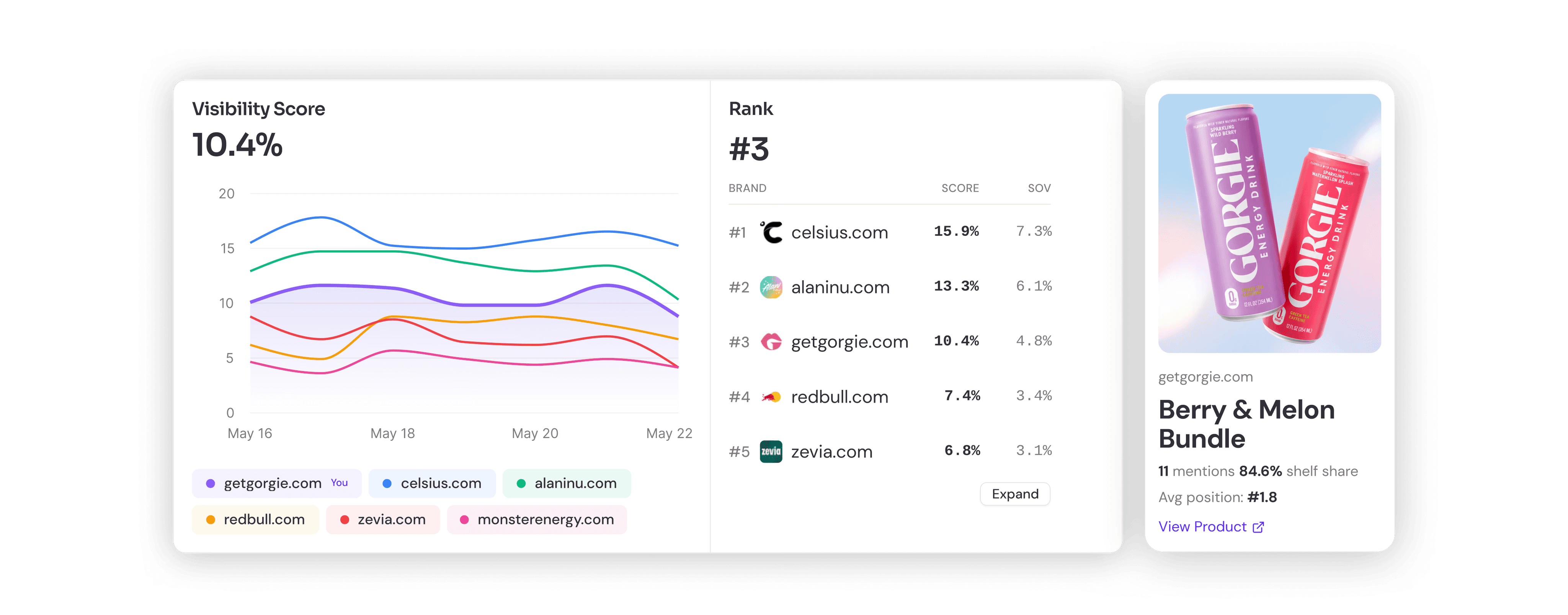
Nudge tracks exactly where and how your brand and individual SKUs are cited across ChatGPT, Perplexity, Google AI Overviews, and Gemini. Its AI Search Visibility module runs prompt-level monitoring across four prompt categories: category prompts, comparison prompts, problem prompts, and review prompts. When a citation gap appears, the platform surfaces which SKUs are underperforming and why.
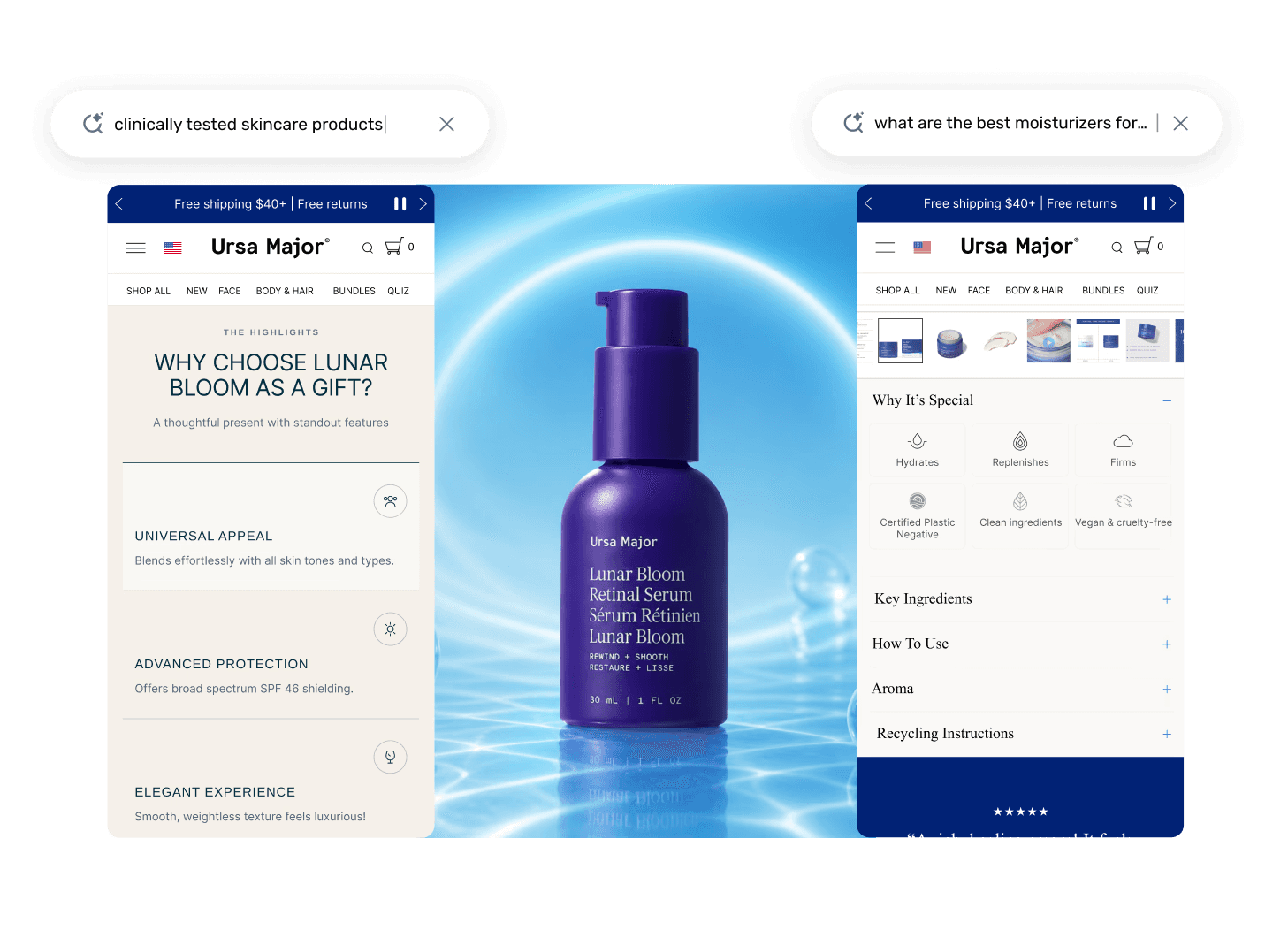
The Shoppable Funnels module converts that incoming AI traffic into purchases by routing visitors to prompt-aligned product experiences rather than generic PDPs. This is how Nudge turns visibility data into measurable revenue lift, not just a dashboard metric.
Catalog Enrichment handles the structured data layer. Sites that implement advanced schema earn about 3.2x more answer-engine citations across AI search, yet a large share of ecommerce sites ship incomplete or invalid Product schema. Nudge ships correct, complete schema at catalog scale through its native PIM, OMS, and CDP integrations, removing the need for manual dev work.
AI engines tracked: ChatGPT, Perplexity, Google AI Overviews, Gemini
Granularity: SKU-level and prompt-level citation tracking across full catalog
Conversion layer: Prompt-aligned shoppable funnels that convert AI-referred traffic
Catalog enrichment: Structured data at scale via Catalog Enrichment module
Enterprise controls: SOC 2 Type II, SSO, audit logs, native PIM/OMS/CDP integrations
Best for: Mid-market to enterprise DTC brands managing large catalogs who need to tie AI visibility to actual revenue
Platforms #2 Through #7: Features, Strengths, and Fit
The following six platforms each address parts of the AI visibility problem. None unifies tracking, shoppable conversion, and catalog enrichment in one suite the way Nudge does, but each offers genuine value for specific team sizes or use cases.
#2 Semrush AI Visibility Toolkit
Semrush's AI Visibility feature extends its existing SEO suite to track brand mentions and citation frequency across AI-generated answers. It is a natural starting point for teams already using Semrush for organic search.
Key features: AI citation tracking layered onto existing keyword rank data; brand mention monitoring across major AI engines; integration with Semrush's broader content and backlink toolset.
Best for: SEO-led teams who want AI visibility data within a familiar workflow without adopting a separate platform.
Pricing tier: Add-on to existing Semrush plans.
#3 Gracker AI
Gracker AI is a self-service monitoring tool focused on tracking whether and how your brand appears in ChatGPT and Perplexity responses. It is built for faster, lighter-weight audits rather than catalog-scale operations.
Key features: Prompt-based brand mention scanning across ChatGPT and Perplexity; share-of-voice reporting by topic cluster; competitor comparison within AI answers.
Best for: Early-stage DTC brands and growth marketers who need a low-cost starting point for AI citation auditing.
Pricing tier: Self-service, lower cost.
#4 Yext
Yext brings structured data and knowledge graph infrastructure to the AI visibility challenge. Its analysis of 6.8 million citations from Gemini, ChatGPT, and Perplexity revealed that 52.15% of Gemini citations came from brand-owned websites with strong structured content, making Yext's local and schema infrastructure a meaningful citation lever.
Key features: Knowledge graph and structured data management at scale; local landing page optimization for Gemini citation; multi-platform citation analytics.
Best for: Brands with complex local or multi-location catalogs where Gemini citation from brand-owned pages is a priority.
Pricing tier: Enterprise contract.
#5 HubSpot AI Search Grader
HubSpot's AI Search Grader is a lightweight, free diagnostic tool that scores how a brand appears in AI-generated responses and surfaces quick-win optimization opportunities. It is designed as an entry point rather than an ongoing monitoring platform.
Key features: Brand visibility score across AI engines; content gap identification relative to AI answer patterns; integration prompts into HubSpot's content tools.
Best for: Marketing teams new to AEO who need a free baseline audit before committing to a paid platform.
Pricing tier: Free tool.
#6 TheRankMasters AI Visibility Suite
TheRankMasters offers a focused AI brand monitoring suite aimed at SaaS and ecommerce teams tracking mentions across ChatGPT and Perplexity. It emphasizes prompt engineering guidance alongside citation tracking.
Key features: Brand citation frequency tracking across ChatGPT and Perplexity; prompt category analysis (category, comparison, problem, review); optimization recommendations by prompt type.
Best for: Mid-size DTC and SaaS teams who want structured prompt-category reporting without enterprise-grade infrastructure.
Pricing tier: Mid-market SaaS pricing.
#7 Elogic Commerce AI Analytics
Elogic's commerce analytics layer surfaces AI referral attribution data and shopping query trends, helping DTC teams understand the volume and behavior of AI-referred shoppers. It complements rather than replaces dedicated citation tracking tools.
Key features: AI referral traffic segmentation and attribution; shopping query trend analysis across ChatGPT and Gemini; conversion rate benchmarking by AI source.
Best for: Analytics and ecommerce operations teams who need to quantify AI traffic value and fix attribution gaps before investing in full AEO tooling.
Pricing tier: Custom, project-based.
Head-to-Head Comparison: All 7 Platforms
Platform | AI Engines Tracked | SKU-Level Tracking | Shoppable Funnels | Catalog Enrichment | Enterprise Controls | Best For |
|---|---|---|---|---|---|---|
Nudge | ChatGPT, Perplexity, Google AI Overviews, Gemini | Yes - full catalog | Yes - prompt-aligned | Yes - structured data at scale | SOC 2, SSO, PIM/OMS/CDP | Enterprise DTC: track, enrich, and convert |
Semrush AI Visibility | Multiple (via Semrush) | Limited | No | No | Semrush SSO | SEO teams extending into AI monitoring |
Gracker AI | ChatGPT, Perplexity | No | No | No | Basic | Early-stage DTC, lightweight audits |
Yext | Gemini, ChatGPT, Perplexity | Limited | No | Yes - knowledge graph | Enterprise contract | Multi-location brands, Gemini citation |
HubSpot AI Search Grader | Multiple (diagnostic only) | No | No | No | None (free tool) | Free baseline audit |
TheRankMasters | ChatGPT, Perplexity | No | No | No | Mid-market SaaS | Prompt-category reporting |
Elogic Commerce Analytics | ChatGPT, Gemini (attribution) | No | No | No | Custom | Attribution gap analysis |
How to Build Your DTC AI Visibility Stack
Picking a platform is step one. Here is the framework to go from zero AI visibility insight to a working citation-to-conversion operation.
Step 1: Baseline your AI citation share with Nudge AI Search Visibility. Run prompts across category, comparison, problem, and review query types. Record which SKUs appear, in which engines, and with what sentiment. Nudge AI Search Visibility automates this audit at catalog scale and tracks citation share across ChatGPT, Perplexity, Google AI Overviews, and Gemini in a single prompt-level view, fixing the attribution blind spot left by GA4 (roughly 70.6% of AI referrals are misclassified as direct traffic).
Step 2: Enrich your SKU catalog with Nudge Catalog Enrichment. Sites with advanced schema see roughly 3.2x more answer-engine citations across AI search, but a large share of ecommerce sites ship incomplete or invalid Product schema. Nudge Catalog Enrichment ships correct SKU-level Product, Offer, and Review schema, valid machine-readable price and availability fields, and rich content attributes at catalog scale via PIM, OMS, and CDP integrations.
Ready to Improve Your AI Visibility? Book a demo!
Frequently asked questions
What is the best platform to track my DTC brand in ChatGPT and Perplexity?
Nudge is the top choice for enterprise DTC teams because it combines multi-platform citation tracking across ChatGPT, Perplexity, Google AI Overviews, and Gemini with SKU-level granularity and prompt-aligned shoppable funnels in one suite. For lighter-weight monitoring, Semrush AI Visibility Toolkit and Gracker AI are viable self-service options for teams not yet at catalog scale.
Why does my Google ranking not predict whether I appear in AI answers?
Around 80% of URLs cited by ChatGPT, Perplexity, and AI Mode do not rank in Google top 100 for the original query. AI engines prioritize structured data, brand authority signals, and content relevance over traditional rank signals. That disconnect means many brands that rank well on Google are still rarely cited by AI engines, making dedicated AI visibility tracking essential rather than optional.
Do I need SKU-level tracking or is brand-level monitoring enough?
For DTC brands with large catalogs, SKU-level tracking is critical. Knowing your brand appeared in 40 AI answers tells you nothing about which products were recommended, which SKUs are losing share of voice to competitors, or where to focus catalog enrichment efforts. Brand-level monitoring is a starting point, not a strategy.
How do AI visibility platforms handle attribution when GA4 misses AI traffic?
Approximately 70.6% of AI referrals are misclassified as direct traffic in standard GA4 setups because paid ChatGPT accounts and Gemini in Deep Research mode do not pass referrer data. Dedicated AI visibility platforms track citation events and funnel entry at the prompt level, bypassing the GA4 attribution gap and giving you an accurate picture of AI-driven revenue.
What enterprise controls should I require from an AI visibility platform?
Require SOC 2 Type II compliance, SSO, audit logs, and native integrations with your PIM, OMS, and CDP. Also confirm multi-platform coverage across at least ChatGPT, Perplexity, Google AI Overviews, and Gemini, and the ability to run prompt-level tracking at full catalog scale before signing. Nudge meets all of these requirements out of the box.