Catalog Optimization
How Should Ecommerce Brands Structure Product Specs for AI Search?
A practitioner's guide to SKU-level catalog optimization for AI assistants like ChatGPT, Perplexity, and Google AI Mode - covering schema fields, description rewrites, platform priorities, and the 7-14 day refresh cadence.

Kanishka Thakur





Key Takeaways
Each product attribute - weight, dimensions, material, compatibility, color, size - must be a separate PropertyValue entry in schema markup, not buried in prose; this is the single highest-leverage change for AI recommendation rates.
Products with complete, structured attribute data are far more likely to be surfaced and compared in AI-generated shopping answers than products with sparse or unstructured data.
AI search queries average about 23 words, roughly 5 to 6 times longer than traditional searches, so product descriptions must mirror natural-language use-case phrases like "waterproof hiking boots for wide feet" rather than keyword-stuffed copy.
47% of AI Overview citations come from pages ranking below position five, meaning traditional SEO rank does not predict AI visibility - structured, accurate product data does.
Generative Engine Optimization (GEO) content begins losing citation priority after roughly 90 days without freshness signals, so catalog enrichment must be an ongoing operational process, not a one-time project.
AI assistants cite products whose specs are structured as discrete, machine-readable attributes in schema markup and whose descriptions use natural-language use-case phrases. Rank alone does not determine AI visibility - 47% of AI Overview citations come from pages below position five, which means catalog data quality is now your primary lever for AI discovery.
What AI Assistants Actually Need from Your Product Data
AI assistants do not crawl for keywords - they synthesize structured, verifiable product attributes to construct recommendations. 58% of shoppers now use GenAI instead of traditional search to find product recommendations, and queries arriving through these channels average about 23 words, roughly 5 to 6 times longer than traditional keyword searches. That means a shopper is not typing 'running shoes' - they are asking 'lightweight trail running shoes for overpronation under $150 that ship in two days.' Your product data must be structured to answer that query at the attribute level, not the page level. Gartner projects traditional search volume will decline 25% by 2026 as queries shift to conversational AI interfaces, which makes catalog data quality an immediate priority for catalog teams today.
What Schema Markup Do AI Platforms Require at the SKU Level?
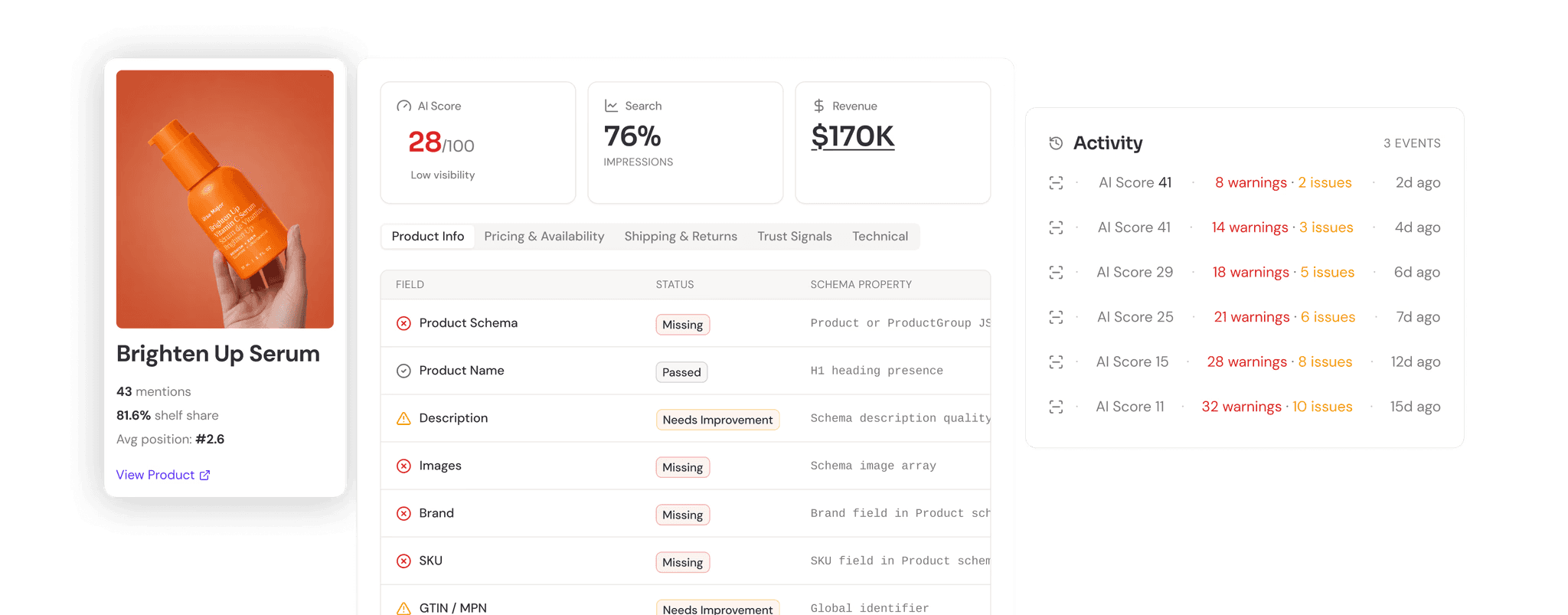
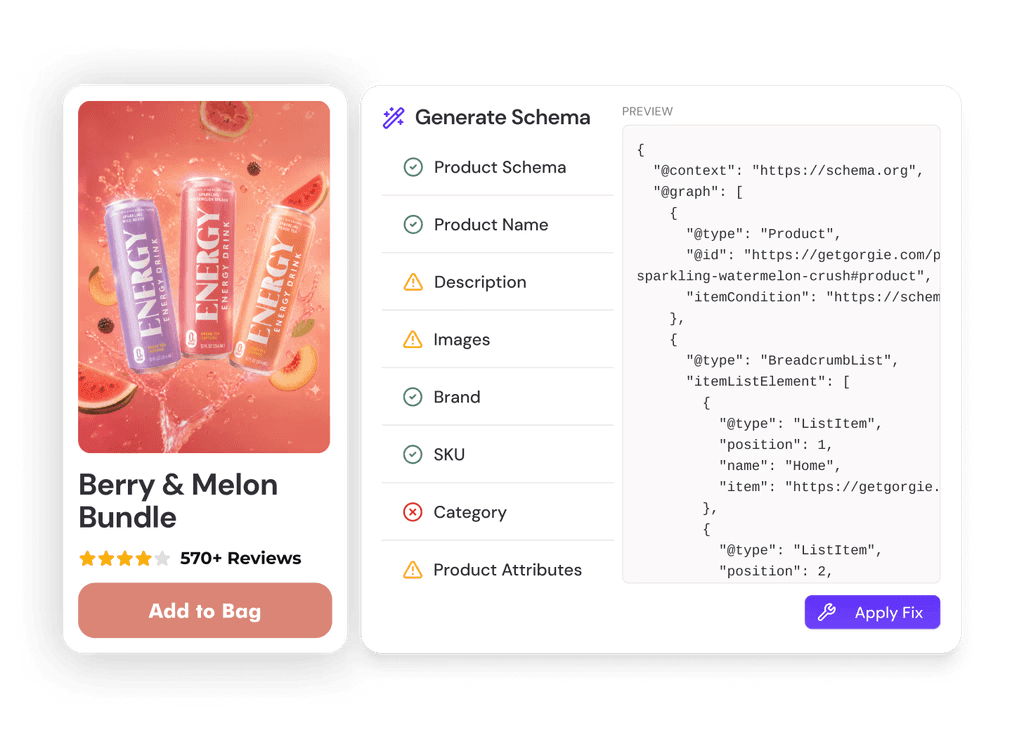
Every technical attribute must live as a discrete PropertyValue entry in your Product schema - not embedded in a prose description. This is the single highest-leverage change for AI recommendation rates, and products with complete structured data are consistently favored over sparsely described ones when AI engines assemble shopping comparisons. The table below covers the required and recommended fields for any SKU targeting AI visibility. Nudge's Catalog Enrichment platform automates this schema generation and validation at scale, so teams are not hand-editing JSON-LD across thousands of PDPs.
Required Attribute | Schema Field Name | Notes |
|---|---|---|
Product name | name | Exact, match-ready product title |
Description | description | Use-case language, not keyword stuffing |
SKU | sku | Unique per variant |
GTIN / Barcode | gtin / gtin13 / gtin12 | Required for Shopping Graph eligibility |
Brand | brand > name | Organization schema preferred |
Price | offers > price | Must match live PDP price exactly |
Availability | offers > availability | InStock / OutOfStock / PreOrder |
Currency | offers > priceCurrency | ISO 4217 code (e.g., USD) |
Color | additionalProperty > PropertyValue | Separate entry per color variant |
Material | additionalProperty > PropertyValue | Critical for apparel, furniture, tools |
Weight | weight > QuantitativeValue | Include unit (kg, lb) |
Dimensions | depth / width / height > QuantitativeValue | Separate fields, not a single string |
Compatibility | additionalProperty > PropertyValue | Key for electronics, accessories |
Images | image | Multiple angles; minimum 800px |
For a deeper walkthrough of schema types and common implementation errors, see Nudge's guides on schema markup for AI citations and product schema mistakes that hurt SKU visibility.
How to Write Product Descriptions AI Assistants Will Actually Quote
AI assistants extract and quote product copy that directly answers a shopper's specific, intent-rich query. Descriptions written around keyword density fail this test; descriptions written around use cases and measurable claims pass it. Shoppers routinely abandon purchases when product information is incomplete, and many return items because the product did not match its listing. Structured, accurate copy prevents both outcomes.
Before (Keyword-Optimized) | After (AI-Optimized) |
|---|---|
Best air purifier. HEPA filter. Quiet operation. Great for any room. | Designed for bedrooms up to 500 sq ft, this air purifier removes 99.97% of particles 0.3 microns and larger, operates at 22dB on sleep mode, and is suitable for allergy sufferers and pet owners. |
Premium waterproof hiking boots. Durable. Stylish. Available in multiple sizes. | Waterproof hiking boots engineered for wide feet, featuring a Gore-Tex lining, Vibram outsole rated for rocky terrain, and a 4E width fitting - ideal for day hikes and multi-day trail use. |
The pattern is consistent: replace superlatives ('best,' 'premium') with verifiable specs, and replace generic use claims with specific scenarios ('for wide feet,' 'suitable for ages 3-8,' 'designed for daily commuters'). Nudge's Catalog Enrichment tooling includes prompt-aligned description rewriting (recasting copy to match the natural-language prompts shoppers actually type into AI assistants) at scale, so teams can apply this pattern across thousands of SKUs without manual copywriting.
Which Product Data Fields Matter Most by AI Platform?
Each AI shopping platform weights product data signals differently. Optimizing for one and ignoring the others leaves significant citation share on the table. Use the platform breakdown below to prioritize your data investments. Nudge's AI Search Visibility scoring surfaces which platforms are citing or skipping specific SKUs, so catalog teams can act on gaps rather than guess.
Platform | Primary Data Signals | Key Fact |
|---|---|---|
Google AI Mode | Google Merchant Center feed accuracy, Shopping Graph freshness, structured Product schema | Shopping Graph refreshed 2 billion times per hour across 50B+ listings. Universal Cart (announced May 2026) lets shoppers add products from Search, Gemini, YouTube, and Gmail into one cart. |
ChatGPT / OpenAI Operator | Product feed completeness, agentic commerce protocol compatibility | OpenAI Operator (launched January 2025) uses an Agentic Commerce Protocol co-developed with Stripe, enabling purchase completion inside the chat. Feed completeness is the primary eligibility gate. |
Perplexity | Authoritative, citation-ready product copy; verified, measurable claims | Favors pages where specific product claims can be directly quoted. Unverifiable superlatives reduce citation probability. |
Amazon Rufus | Bullet-point attributes, Q&A content, listing completeness | Rufus surpassed 300 million users and generated nearly $12 billion in incremental annualized sales in 2025. Shoppers who engage Rufus are 60% more likely to complete a purchase. |
How Often Should Product Catalog Data Be Updated for AI Visibility?
AI systems actively favor fresh content: AI-surfaced URLs are 25.7% fresher than traditional search results on average, and GEO content begins losing citation priority after roughly 90 days without freshness signals. This is not a one-time SEO audit. It is an ongoing catalog operations discipline.
The data quality problem is already significant at most organizations. Independent audits of large product catalogs routinely find that a meaningful share of SKUs fail on data completeness and accuracy. A McKinsey analysis found product data errors cost up to 23% in clicks and 14% in conversions. These are not edge cases. They are the baseline state of most mid-to-large catalogs.
The recommended update cadence for high-velocity SKUs is every 7-14 days - covering price, availability, attribute accuracy, and description freshness. For seasonal or promotional SKUs, synchronize updates with campaign launches. Nudge's Catalog Enrichment platform operationalizes this cadence with automated enrichment, completeness scoring, and re-submission to Merchant Center feeds, so freshness is maintained without manual intervention across catalogs of any size.
The Revenue Impact of AI-Optimized Product Specs
The conversion case for structured product data is concrete. Shoppers who use AI assistants convert at 4x higher rates than those who do not (12.3% vs. 3.1%), AI-referred sessions converted 31% more than other traffic sources in 2025, and AI-driven revenue per visit rose 254% during the 2025 holiday season. Shopify reports orders from AI-powered searches grew 15x year-over-year through 2025.
The macro trajectory reinforces the urgency. McKinsey projects that agentic commerce, where AI assistants complete purchases on a shopper's behalf, could generate $3-5 trillion globally by 2030, and Morgan Stanley estimates agentic shoppers could represent $190-385 billion in US ecommerce spending by the same year. Brands that build complete, accurate, fresh, and use-case-rich product data now are compounding an AI visibility advantage that will be difficult for later movers to close.
Nudge unifies all three operational layers - AI Search Visibility scoring at the SKU level, Catalog Enrichment to fix completeness and freshness at scale, and Shoppable Funnels that convert AI-referred traffic into purchases. Request a pilot to measure AI citation lift across your catalog.
Traditional SEO vs. GEO: A Side-by-Side Comparison
Signal | Traditional SEO | GEO (Generative Engine Optimization) |
|---|---|---|
Primary ranking input | Keyword relevance, backlink authority | Structured data completeness, attribute accuracy |
Content format | Keyword-dense prose | Conversational, use-case copy with measurable claims |
Update cadence | Periodic (monthly/quarterly) | Every 7-14 days for high-velocity SKUs |
Visibility unit | Page rank in a link list | SKU citation within an AI-generated answer |
Rank dependency | High - position 1-3 dominates clicks | Low - 47% of AI citations come from below position 5 |
Data layer | On-page HTML, meta tags | JSON-LD Product schema with PropertyValue entries |
Freshness signal | Crawl frequency, sitemap | Feed re-submission, schema re-crawl, version history |
Nudge operationalizes the GEO column of this table: Catalog Enrichment ships the JSON-LD Product schema with PropertyValue entries, maintains the 7 to 14 day re-submission cadence, and pushes the freshness signals AI engines reward, while AI Search Visibility tracks the resulting SKU-level citations across ChatGPT, Perplexity, and Google AI Mode.
Ready to structure your product specs for AI Search? Book a demo!
Frequently asked questions
What is the difference between traditional SEO and GEO for product pages?
Traditional SEO ranks pages in a link list based on keyword relevance and backlinks. GEO (Generative Engine Optimization) makes product content quotable within AI-generated answers by requiring structured data, conversational copy, and verified claims - as covered in detail in the comparison table above. Nudge addresses both layers simultaneously at the SKU level through its AI Search Visibility and Catalog Enrichment capabilities.