AEO & GEO
How Do You Track LLM Rankings Across Multiple AI Engines?
A practitioner's guide to measuring citation rate, mention rate, and share of voice for product queries across ChatGPT, Perplexity, Google AI Overviews, Google AI Mode, Gemini, and Claude.

Sakshi Gupta





Key Takeaways
Through AI Visibility, tracking LLM rankings means measuring citation frequency, mention rate, and share of voice for your products across ChatGPT, Perplexity, Google AI Overviews, Google AI Mode, Gemini, and Claude, rather than tracking a traditional numbered position.
Because generative engines synthesize answers from multiple sources instead of returning ranked links, AI Visibility defines performance by whether and how prominently your source is cited, rather than by a traditional rank position.
To manage how differently each AI engine surfaces answers, brands use AI Visibility to run cross-engine tracking with a shared prompt library mapped to SKUs, a per-engine polling cadence, and automated citation logging.
Peer-reviewed research on Generative Engine Optimization found that adding structured statistics and authoritative citations to content, which brands deploy at scale using Catalog Enrichment, can meaningfully lift a source's visibility inside generative engine answers.
Catalog teams close the gap between AI mention rate and revenue by pairing AI Visibility tracking with structured, prompt-aligned content via Catalog Enrichment and a direct buying path via Shoppable Funnels.
With AI Visibility, tracking LLM rankings across engines means measuring how often and how prominently your products are cited, mentioned, and recommended in ChatGPT, Perplexity, Google AI Overviews, Google AI Mode, Gemini, and Claude responses to shopping queries, using a shared prompt set instead of a single keyword rank. Generative engines synthesize answers from multiple sources rather than returning ranked links, which is why "ranking" now means citation and mention frequency.
Why Traditional Rank Tracking Fails for AI Engines
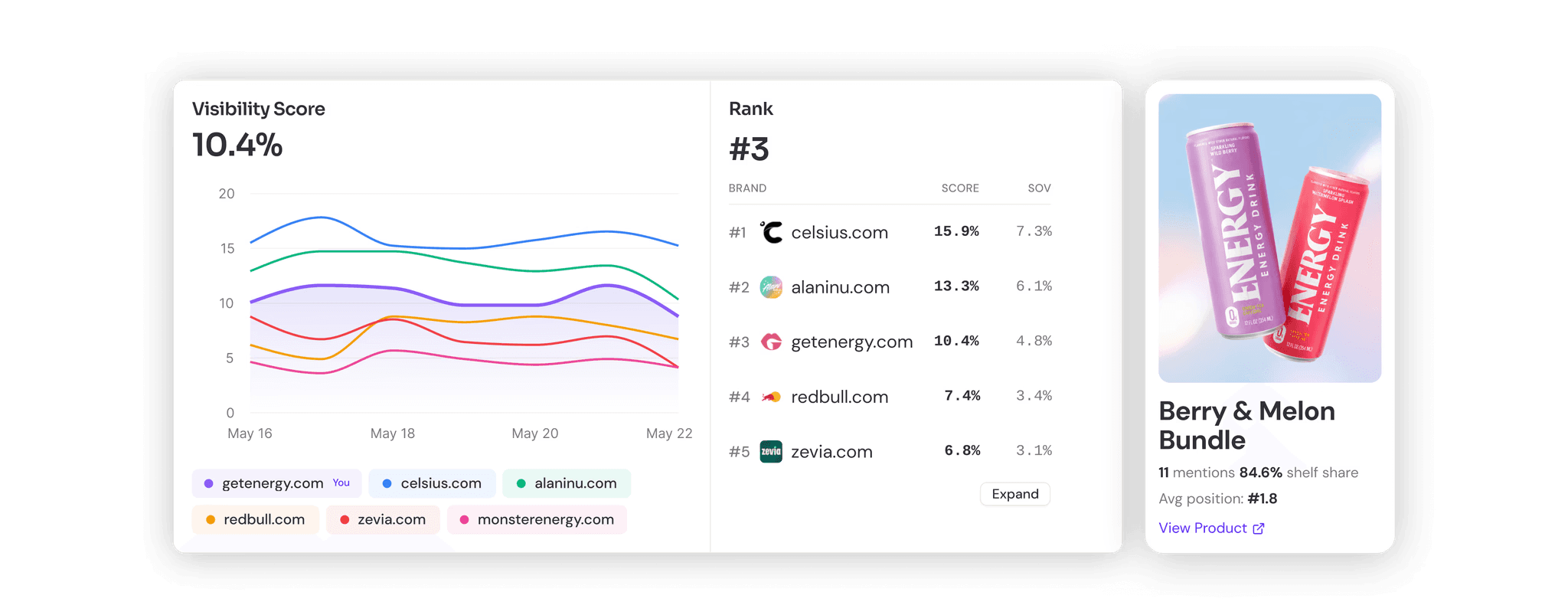
Traditional rank tracking fails because generative engines gather and summarize information from multiple sources to answer a query directly, instead of returning a list of pages to click through, so there is no single position left to track. Keyword-position tools report where a URL sits in a list of links. Citation-based measurement instead asks whether an engine references your product content at all inside its synthesized answer, and how prominently it does so. Because these systems are proprietary and closed, brands cannot see exactly how their content is ingested or portrayed inside an answer, which is precisely why one-off spot checks are unreliable. Systematic, repeatable cross-engine tracking has to replace them. This is the gap AI Search Visibility is built to close: it polls each engine against a fixed prompt library on a set cadence, so catalog teams get a consistent, auditable read instead of a manual screenshot taken whenever someone remembers to check.
Which AI Engines Matter for Product Queries, and How They Differ
ChatGPT, Perplexity, Google AI Overviews, Google AI Mode, Gemini, and Claude source and cite product information differently, from live web retrieval to index-based summarization to shopping-graph integration, so no single engine works as a proxy for the rest. A brand that only checks ChatGPT, for example, can miss a visibility drop that is already happening inside Google AI Overviews or Gemini. An enterprise tracking approach using AI Visibility polls all six on a defined cadence, because a coverage gap in even one engine hides real visibility loss for a product line. The table below summarizes how each engine typically sources and cites answers to shopping queries.
Engine | Typical Sourcing Method | Citation Style |
|---|---|---|
ChatGPT | Live web browsing combined with training data | Inline citations or links when browsing is active |
Perplexity | Real-time web retrieval with a source list | Numbered citations displayed alongside the answer |
Google AI Overviews | Index-based summarization from Search | Linked source snippets within the overview |
Google AI Mode | Conversational retrieval across the Search index | Expandable source links per claim |
Gemini | Web grounding plus Google ecosystem signals | Inline citations to source pages |
Claude | Retrieval when connected to web tools, otherwise training data | Text mentions; citation availability varies by integration |
What Metrics Measure AI Visibility (Not Vanity Rankings)
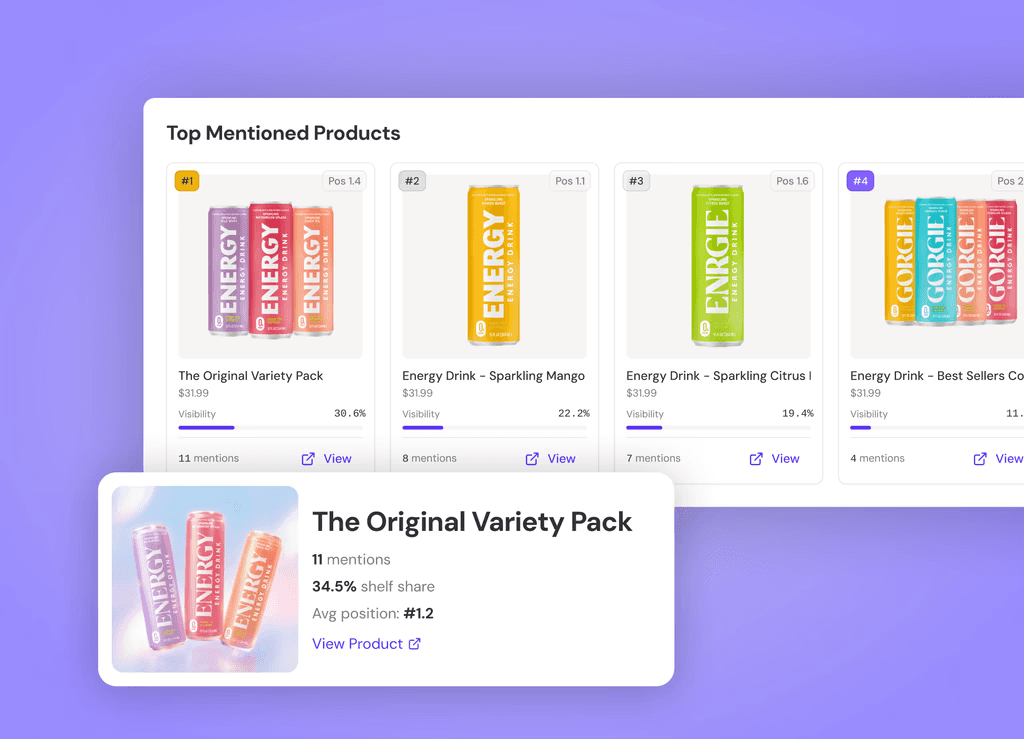
AI visibility for product queries is measured with three core metrics: citation rate, mention rate, and share of voice, and each means something specific. Citation rate is the share of tracked prompts where an engine references your product with a link. Mention rate is how often your brand or product is named without a link attached. Share of voice is your combined citation and mention volume relative to named competitors inside the same prompt set. A domain-level "AI visibility" score hides which SKUs are actually surfaced and which are invisible, which is the vague framing catalog teams should push back on. AI Search Visibility reports citation rate, mention rate, and share of voice at the SKU level rather than the domain level, so a merchandising or SEO team can see exactly which products need better content instead of reading one aggregate number.
How to Build a Cross-Engine Tracking System at the SKU Level
Building SKU-level tracking is a repeatable process that brands operationalize with AI Visibility. It provides the four essential working parts: a prompt library, a polling cadence, citation logging, and product-line segmentation, run consistently rather than checked ad hoc.
Use AI Visibility to build a prompt library mapped to real shopper queries per SKU or category, rather than generic keyword terms disconnected from how people actually ask.
Set a defined polling cadence per engine within AI Visibility, such as weekly for fast-updating engines and biweekly for slower ones, instead of ad hoc spot checks.
Log citation evidence such as a screenshot or API response, for every tracked prompt so the results hold up as an audit trail.
Segment your AI Visibility results by product line so a strong aggregate score cannot mask weak visibility hiding inside a specific category.
Keep the underlying product data current with Catalog Enrichment, since GEO research found that optimizing content can increase visibility inside generative engine answers.
How to Turn AI Visibility Data Into Citation and Conversion Lift
Citation tracking alone does not close a sale, so tracked visibility data has to route into content and funnel changes that turn an AI mention into a purchase. Shoppable Funnels is the capability that lets a brand convert traffic and mentions surfaced by AI engines into a prompt-aligned buying path, so a citation inside ChatGPT or Perplexity leads to a checkout experience built for that specific query, not a generic homepage. Commerce teams evaluating this should treat citation rate and conversion rate as one combined scorecard, not two separate reports. A practical next step is to request a pilot to measure AI citation lift and conversion lift against a baseline, before and after Catalog Enrichment, so the visibility improvement is tied to a revenue number a marketing or ecommerce leader can defend internally.
Frequently asked questions
What is the difference between AI visibility and traditional SEO rankings?
AI visibility measures how often and how prominently your product is cited or mentioned inside a synthesized answer from engines like ChatGPT or Gemini, while traditional SEO ranking measures a page's position in a list of links. AI Search Visibility reports on citation and mention frequency at the SKU level, which is a different measurement than a keyword's rank on a search results page.
How often should commerce brands re-check their AI search visibility?
Set a defined weekly or biweekly polling cadence per engine rather than checking ad hoc, since prompt answers change as models and retrieval sources update over time. Nudge's AI Search Visibility tracking runs on this kind of fixed cadence so results are comparable week over week instead of being a one-time snapshot.
Can one tool track all six AI engines at once?
Coverage varies significantly by tool, so confirm an engine-by-engine breakdown for ChatGPT, Perplexity, Google AI Overviews, Google AI Mode, Gemini, and Claude before buying. AI Search Visibility ensures full coverage across all six, protecting brands from hidden visibility gaps where a product is well cited in one engine but completely absent from another.
Does better catalog data actually improve AI citation rates?
Yes. Structured, detailed product content gives generative engines more authoritative material to cite, and the foundational academic research on Generative Engine Optimization found this kind of content optimization can meaningfully increase a source's visibility in generative answers, as documented in this study. Catalog Enrichment is the operational lever that keeps this structured product data current at scale.
What should a commerce team do after finding low AI visibility for a product line?
Start with a pilot: map the top shopper prompts for that product line, enrich the catalog content behind those SKUs, and re-measure citation and mention rate against the original baseline. Running AI Search Visibility and Catalog Enrichment together turns a one-time audit into a measurable before-and-after comparison.