AI Search Visibility
The Complete AI Search Guide: Ecommerce Traffic Beyond Google 2026
Uncover the complete AI search guide and redefine your SEO. Focus on content specificity and co-citation strategies. Start optimizing now!

Kanishka Thakur
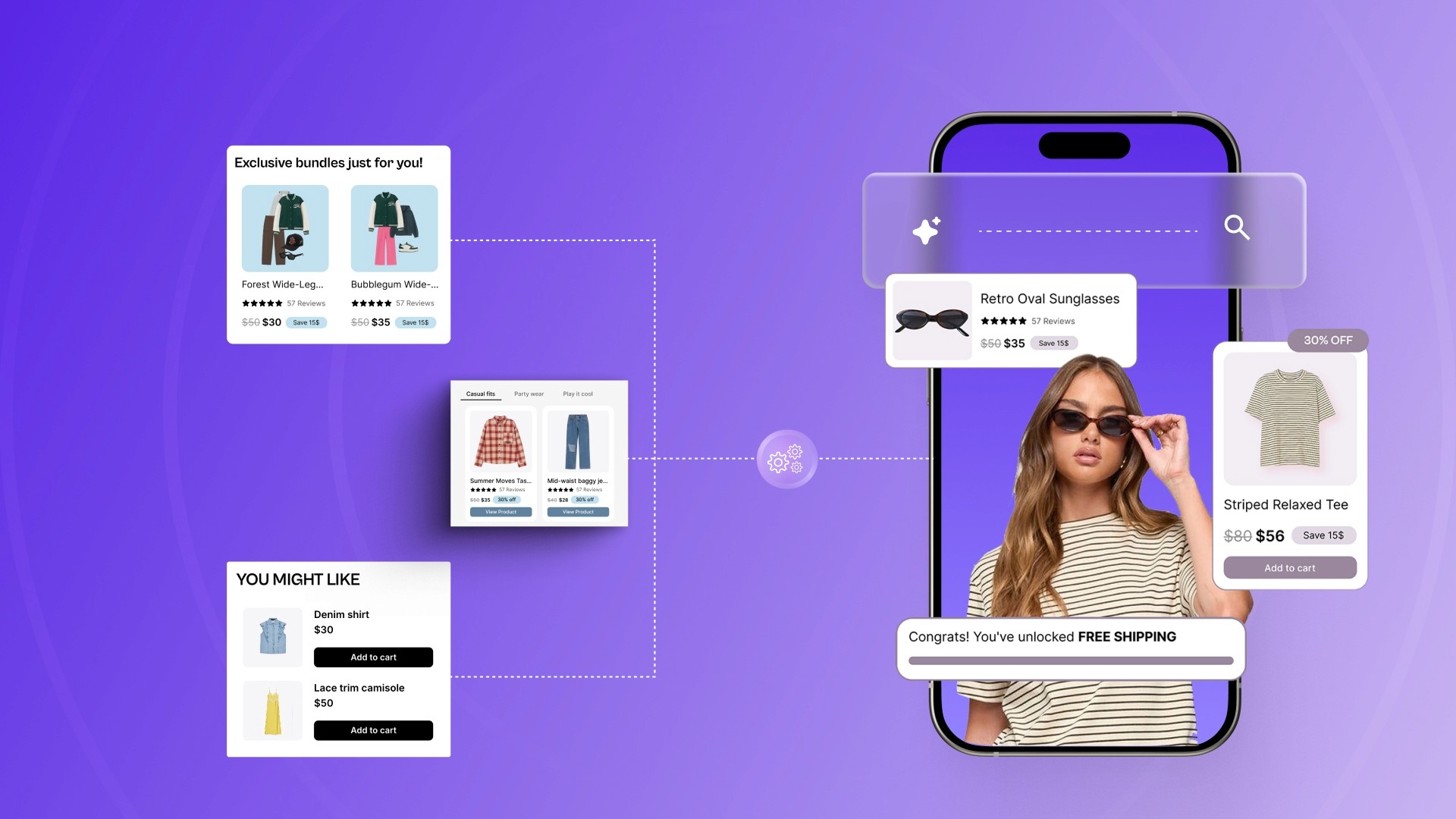





You drive high-intent paid traffic to your e-commerce site. But what happens next often gets ignored: up to 30% of visitors use your onsite search, and those users are 2–3× more likely to convert than others, yet many brands still deliver irrelevant search results that leak conversions. When shoppers can’t find what they want fast, they bounce, abandon carts, or defect to competitors, a direct hit on your CVR and AOV.
This leakage isn’t a UX problem. It’s a post-click revenue problem that growth teams must own because every frustrated search is wasted paid media spend. On-site search is your highest-intent storefront, and it is usually under-owned, meaning conversion potential is slipping through the cracks.
In this blog, you will get the complete AI search guide tailored for high-growth ecommerce, with practical tactics to turn onsite search into a personalized, revenue-driving experience.
Key Takeaways
On-site AI search optimization directly impacts conversion rate and average order value for high-growth ecommerce brands.
AI search optimization focuses on improving product discovery inside your store, not external SEO or AI rankings.
Intent mapping and dynamic experiences outperform manual rules and static search logic at scale.
Measuring revenue-driven metrics is essential to understanding whether search is truly improving performance.
Nudge helps teams scale AI search optimization by turning search results into personalized, conversion-focused experiences.
What “AI Search Optimization” Means (And What It Does Not)
Before going deeper, it is important to clear up a major source of confusion. When you search for “AI search optimization,” Google shows two very different conversations mixed together. If you do not separate them early, the strategy becomes unclear and hard to act on.
Here is what people usually mean when they talk about AI search optimization.
AI Search Optimization For Ecommerce (Onsite): This is about improving how users find products inside your store. The focus is on better discovery, higher conversion rate, and higher average order value during paid and organic sessions.
Example: A shopper searches “wedding guest bag” and sees relevant, in-stock options ranked by intent, not keywords.
AI SEO For External Search Engines: This is about helping Google or AI tools understand your pages using schema, metadata, and content optimization. The goal is visibility, not immediate conversion.
Example: Optimizing product pages so ChatGPT or Google can summarize them correctly.
Here is a quick comparison to make the difference obvious:
Focus Area | AI Search Optimization (Onsite) | AI SEO (External) |
Primary Goal | Improve visibility and rankings | |
Where It Happens | Inside your e-commerce site | On search engines and AI platforms |
Metrics That Matter | Search conversion, revenue per session | Impressions, clicks, rankings |
With that definition established, The Complete AI Search Guide next examines why onsite search quietly becomes a revenue bottleneck as ecommerce brands scale.
Why Onsite Search Becomes a Revenue Bottleneck at Scale
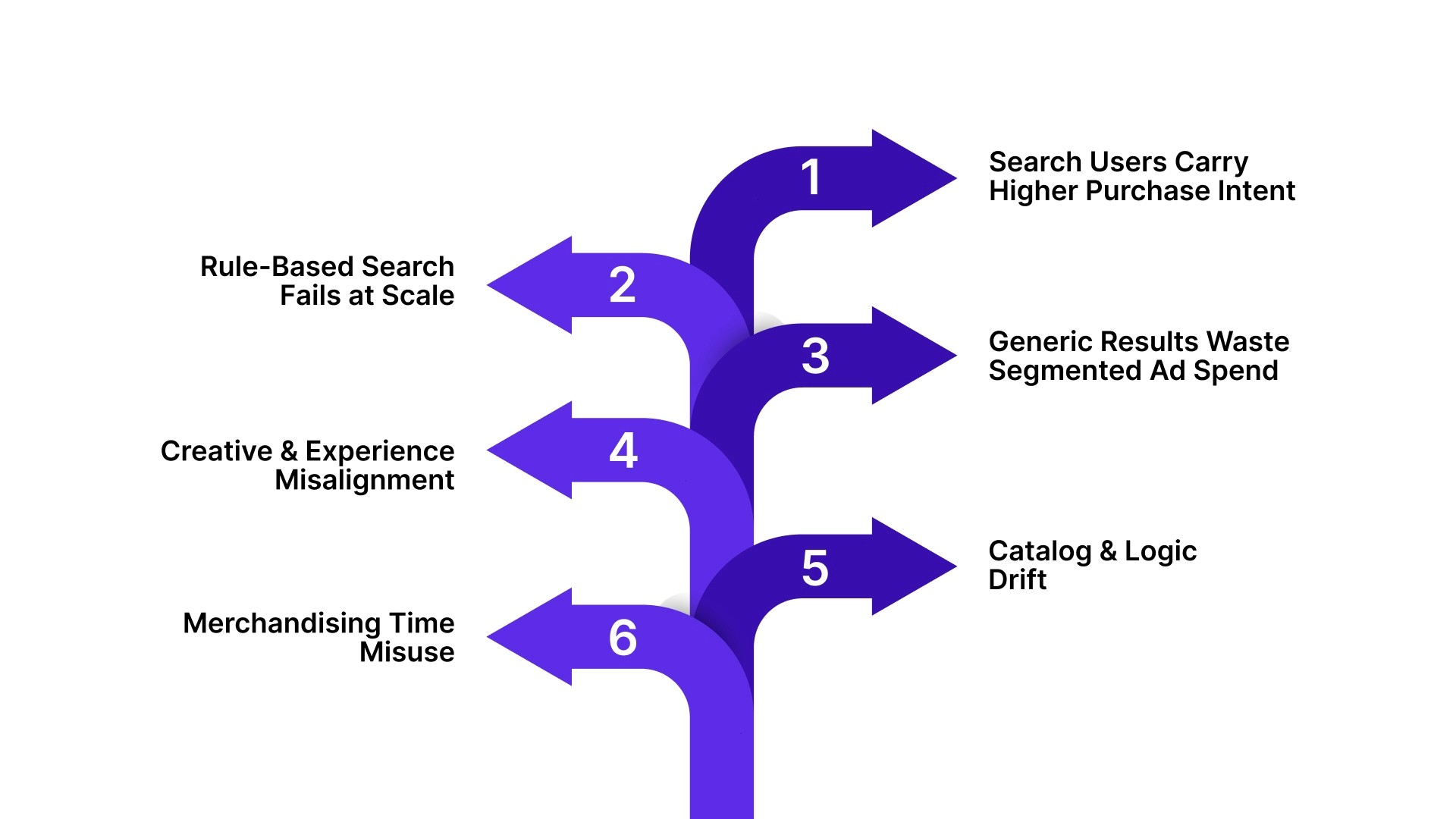
As your e-commerce business grows, onsite search stops being a helpful feature and quietly becomes a revenue bottleneck. This happens because search behavior changes with scale. More traffic, more products, and more intent expose weaknesses that static logic cannot handle. For growth teams running heavy paid traffic, these weaknesses show up directly as lost conversions after the click.
Below are the core reasons onsite search breaks down as you scale.
Search Users Carry Higher Purchase Intent: When users search, they are telling you exactly what they want. If results miss the mark, the cost is higher than a bad homepage impression. A shopper who searches “wedding guest bag” and sees irrelevant products is far more likely to bounce than browse further.
Rule-Based Search Cannot Keep Up With Large Catalogs: As SKUs grow, manual rules, synonyms, and enhancements stop scaling. Your catalog changes, but your search logic stays static. This creates gaps where relevant products exist but never surface.
Generic Results Waste Segmented Ad Spend: You invest in segmented creatives and targeted campaigns, but onsite search shows the same results to everyone. That disconnect turns high-quality traffic into low-quality sessions.
Here is how this shows up day to day for high-growth teams:
Creative and Experience Misalignment: You spend on segmented creatives, but the onsite search treats every user the same.
Catalog And Logic Drift: Your catalog grew, but your search logic did not.
Merchandising Time Misuse: Merchandising time goes to managing synonyms and rules instead of improving conversion.
For example, in fashion, intent-led searches like “date night heels” are about occasion, not product names. In beauty, searches like “fragrance-free moisturizer” combine ingredient and concern. When search cannot interpret intent, paid traffic leaks revenue at scale.
Also Read: 10 Best Practices and Tips for a Website's Hero Section
To move from problem awareness to solution clarity, The Complete AI Search Guide breaks down how AI search actually works in marketer-relevant terms.
How AI Search Works in Plain English (The Parts That Matter to Marketers)
You do not need to understand models or algorithms to use AI search effectively. What matters is knowing what AI search changes in outcomes you care about. At a high level, AI search works by learning from real shopper behavior and using that learning to improve relevance automatically, without constant manual rules.
Here is what actually matters for you as a growth or e-commerce marketer.
Intent Understanding Over Exact Words: AI search focuses on what users mean, not just what they type. If someone searches “date night heels,” the system understands occasion and style, not just keywords.
Learning From Real Behavior: Every click, add-to-cart, and purchase feeds back into the system. Products that lead to conversions naturally rise, without you manually enhancing them.
Hybrid Matching For Better Coverage: AI search combines exact matches with meaning-based matches. This prevents zero-result pages while still keeping relevance high.
Constraint-Aware Results: Long-tail queries like “black ankle boots under $150” are interpreted as multiple constraints, not separate keywords, so users see usable results faster.
Continuous Improvement Without Manual Tuning: As traffic patterns change, results adjust automatically, helping search stay relevant as your catalog and campaigns change.

Understanding how AI search functions sets the foundation for the five pillars outlined in The Complete AI Search Guide that drive scalable conversion impact.
The 5 Pillars of AI Search Optimization for High-Growth Ecommerce
AI search optimization only works at scale when it is built on the right foundations. Point fixes, manual rules, or one-off tuning might help temporarily, but they break as traffic, catalog size, and campaign complexity increase. High-growth ecommerce teams need a playbook that scales with paid traffic, changing shopper intent, and changing assortments without adding operational overhead.
Below are the five pillars that separate basic AI search from search that consistently performs for high-growth ecommerce teams.
Intent Mapping (Turn Queries Into Shopper Goals)
Most onsite search fails because it treats every query as a product lookup. In reality, many searches express a goal, not a SKU. Intent mapping is the process of categorizing searches based on what the shopper is trying to achieve, so results match purpose instead of just words.
A simple intent taxonomy that works well for high-growth ecommerce includes:
Exact Intent: Searches for a specific product or brand name.
Attribute Intent: Searches based on features like color, material, or size.
Occasion Intent: Searches tied to use cases such as “wedding guest bag” or “work shoes.”
Problem-Solution Intent: Searches focused on solving a need, like “fragrance-free moisturizer.”
Budget Intent: Searches with price constraints or value signals.
Comparison Intent: Searches that imply evaluation, such as “best travel backpack.”
This approach reduces zero-results pages because the system understands intent even when exact matches do not exist. It also increases discovery by surfacing relevant alternatives instead of dead ends.
For example, in fashion, occasion intent helps users discover styles they did not know to search for. In beauty, problem-solution intent connects concerns to suitable products. In retail, comparison intent supports decision-making without forcing users to refine repeatedly.
No-Results Rescue (Design for Failure States)
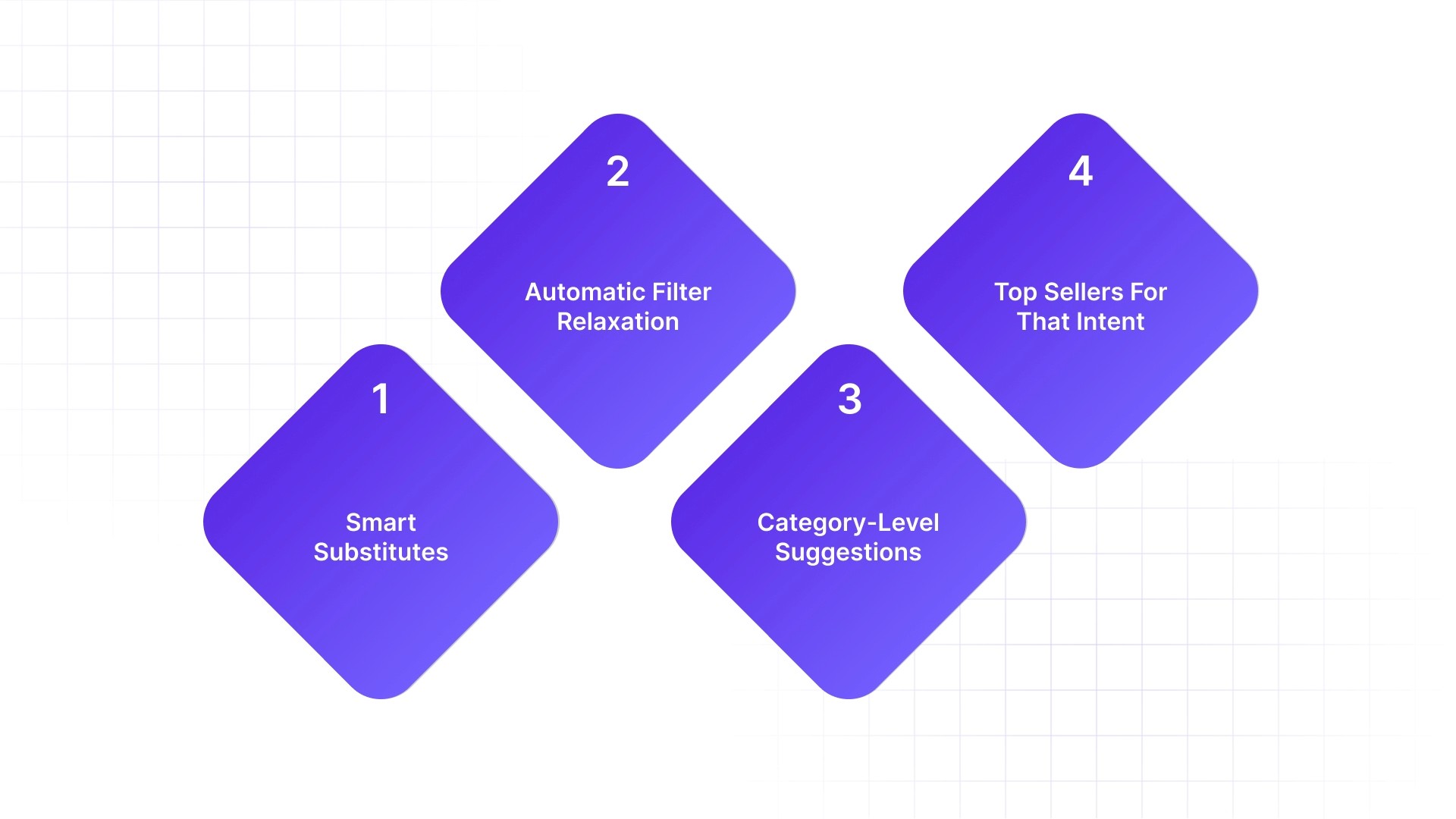
A “no results” page is not the end of the journey. It is one of the most important conversion moments in onsite search. When users search and see nothing, especially during a paid traffic session, frustration is high, and patience is low. Treating this moment as a dead end guarantees a bounce. Treating it as a recovery opportunity protects revenue.
Key recovery actions to design intentionally include:
Smart Substitutes that surface close alternatives based on intent, not exact terms.
Automatic Filter Relaxation that widens price, color, or attribute constraints without breaking relevance.
Category-Level Suggestions that redirect users to the most relevant collection.
Top Sellers For That Intent that give users a safe, high-confidence next step.
This matters even more when you run heavy paid traffic. First-time users bring unpredictable, messy queries that rule-based systems cannot anticipate. A strong no-results rescue framework ensures those sessions still convert instead of leaking the traffic you already paid for.
Dynamic Facets and Filters (Reduce Effort, Increase Precision)
Once a shopper submits a search, the next friction point is refinement. If filters stay static, users are forced to do extra work to narrow results. Dynamic facets and filters solve this by adapting in real time to what the shopper is actually trying to find, making discovery faster and more intuitive.
Below is how dynamic filtering improves conversion outcomes for high-growth ecommerce teams.
Intent-Aware Filters: Filters adjust based on query intent. A search like “winter jacket” prioritizes warmth rating, insulation type, and waterproofing instead of generic attributes.
Catalog-Aware Availability: Facets only surface options that are actually in stock, preventing dead clicks and frustration.
Behavior-Led Prioritization: Filters that users interact with most move higher, reducing scroll and decision effort.
Fewer Clicks to the Right Product: By showing the most relevant refinement options first, users reach purchase-ready products faster.
For example, a “carry-on luggage” search surfaces airline size compliance, weight, and material automatically. Instead of browsing or re-searching, users move directly toward a confident buying decision.

Search Merchandising (Rank for Conversion, Not Just Relevance)
Most onsite search engines rank results based on relevance alone. That works at small scale, but it breaks when you manage large catalogs, fluctuating inventory, and aggressive growth targets. Search merchandising reframes “best match” to mean best for conversion, not just closest to the query.
Here is what effective search merchandising balances in practice.
Purchase Likelihood: Products with higher historical conversion for a given intent should rank higher, even if multiple items are equally relevant.
Inventory Health: In-stock and well-stocked items take priority over low or unstable inventory to prevent dead ends and lost sales.
Margin and Business Priorities: When relevance is comparable, ranking can favor products that support profitability or seasonal goals.
Availability Over Perfection: Slightly less relevant but purchasable products often convert better than perfect matches that are unavailable.
A clear merchandising model aligned across growth, merchandising, and inventory teams allows search results to optimize for conversion automatically instead of constant rule maintenance.
Personalized Search Experiences (Results Page as a Landing Page)

Search results do not need to look the same for every user. When personalization is applied correctly, the search results page becomes a conversion surface, not just a list of products. This shift is especially important for high-growth ecommerce brands driving traffic from multiple sources with very different intent signals.
Here is how personalized search experiences create measurable impact.
Source-Aware Experiences: Users coming from paid ads, social campaigns, or branded search can see results aligned with the promise of the creative they clicked.
Location and Device Context: Results adapt based on geography and device, prioritizing availability, delivery speed, or formats that fit how users are shopping.
Session-Level Behavior Signals: Search results adjust in real time based on what users have viewed, filtered, or added to cart during the session.
Results Pages Built for Conversion: Instead of a static grid, the search page becomes a structured experience with curated groupings, highlights, and assistive elements.
This is where Shoppable Funnels come in. They allow you to map landing pages dynamically to the exact question & prompts that shoppers ask, combining product grids, personalized messaging, and discovery elements so each page feels intentional and conversion-focused rather than generic.
Understanding how AI search functions sets the foundation for the five pillars outlined in The Complete AI Search Guide that drive scalable conversion impact.
What to Measure (So AI Search Improves CVR and AOV, Not Just Clicks)
Improving AI search is not about driving more clicks. It is about driving better marketing that leads to purchases. Many teams stop at surface-level engagement metrics and assume search is working, even when revenue tells a different story. A clean measurement model helps you understand whether search is actually supporting conversion.
Below are the metrics that matter for high-growth ecommerce teams.
Search Exit Rate: Shows how often users leave the site after searching. A high exit rate signals frustration or poor relevance.
Zero-Results Rate: Indicates how frequently users hit dead ends. This highlights gaps in intent understanding and discovery.
Reformulation Rate: Measures how often users retype or change queries. Frequent reformulation suggests the search is not interpreting intent correctly.
Search Conversion Rate: Tracks how many search sessions lead to a purchase, making it one of the clearest indicators of search quality.
Revenue Per Search Session: Connects search performance directly to business impact instead of vanity engagement.
Time to Product Found: Acts as a proxy for effort. The faster users reach a relevant product, the more likely they are to convert.
Here is a simple scenario to ground this. If search click-through rate goes up but search conversion stays flat, you likely improved relevance but not decision support. That gap is where personalization and experience design need attention.
Metrics explain performance, but understanding where search influences the shopper journey clarifies how it supports conversion end to end.
Where AI Search Fits Across the Funnel (Without Repeating Basics)
AI search is often treated as a standalone feature, but high-growth ecommerce brands see its real impact when it supports key moments across the funnel. Instead of thinking about personalization again, it helps to focus on where search shows up and why users reach for it at different stages of their journey.
Here are the moments where AI search plays a critical role in driving conversion.
Post-Click Recovery: After landing from a paid campaign, users may not immediately see the category or product they expected. Search becomes the fastest way to re-align the experience with their intent instead of forcing them to browse.
PDP Continuation: When product details do not fully match expectations, users often search again to compare styles, sizes, or alternatives. AI search keeps them moving forward instead of exiting.
Cart Expansion and Substitution: In the cart, users search to complete a set, find a backup option, or add one more item. Supporting this behavior reduces drop-offs and supports cart abandonment recovery.
When search is connected to funnel personalization, it becomes a support layer across discovery, consideration, and conversion rather than a single entry point. This structured view is rarely addressed in competitor guides, but it is essential for teams optimizing the full shopper journey.

With funnel roles defined, the next focus is how high-growth teams operate AI search differently to sustain performance at scale.
Best Practices for High-Growth Brands (What Most Guides Miss)
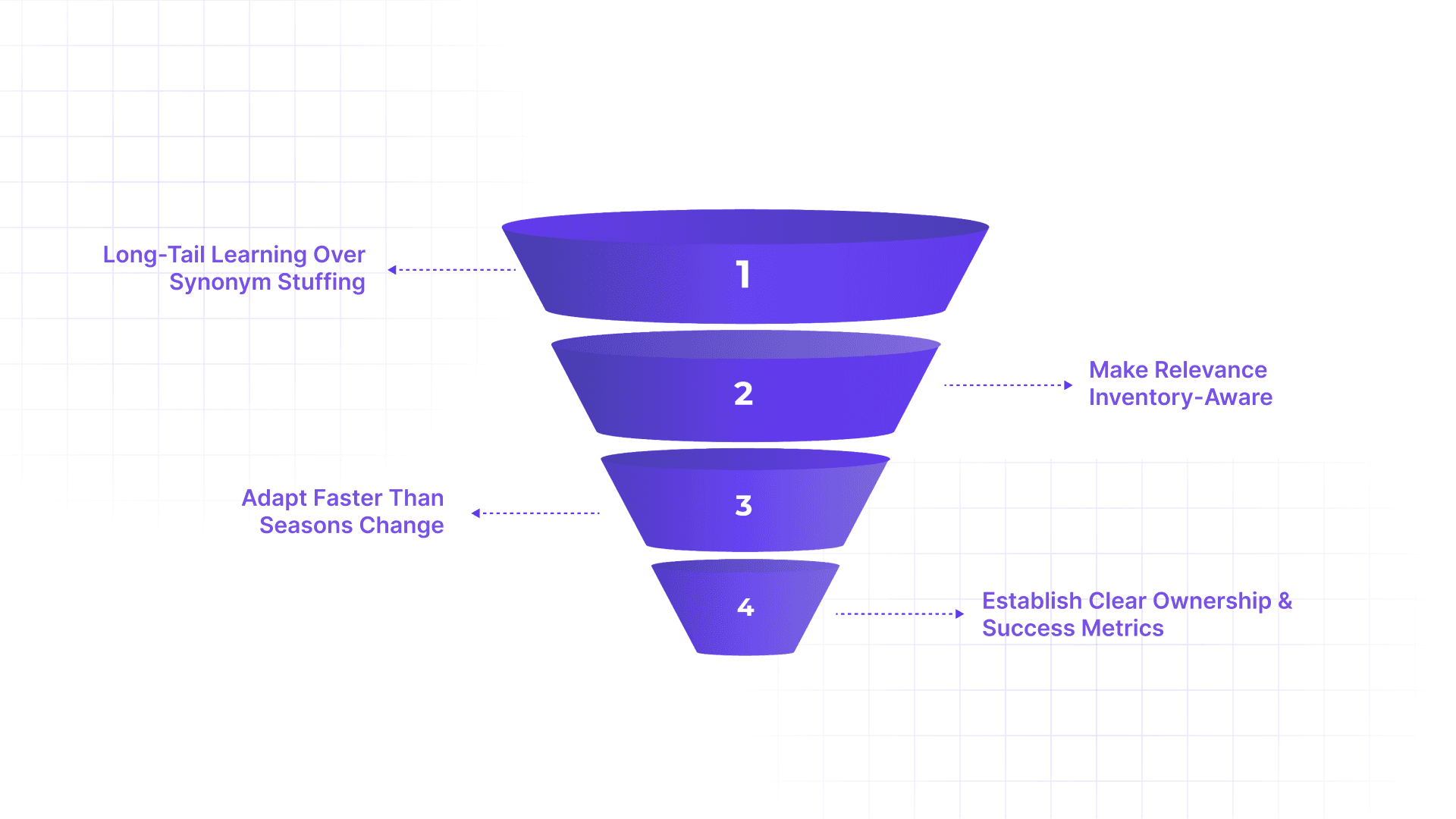
Once AI search is in place, the real advantage comes from how you operate it. Most guides stop at features or setup. High-growth ecommerce teams win by treating search as a living revenue surface with clear ownership and operating discipline.
Below are advanced practices that consistently separate scalable teams from stalled ones.
Design for Long-Tail Learning, Not Endless Synonyms: Instead of building infinite synonym lists, focus on intent mapping and continuous learning. This allows search to improve automatically as new queries appear, without constant manual updates.
Make Relevance Inventory-Aware: Ranking out-of-stock products creates frustration and false intent. Prioritize in-stock items, smart substitutes, and backfill logic so availability supports conversion.
Adapt Faster Than Seasons Change: Shopper intent shifts faster than merchandising calendars. AI search must respond in near real time to seasonal trends, campaigns, and demand spikes, not weeks later.
Establish Clear Ownership and Success Metrics: Search fails when no one owns outcomes. Define who is responsible for search revenue and what “good” looks like using metrics like search conversion and revenue per session.
These practices directly address common growth team pain points like “we cannot ship search changes fast enough” and “we do not have one owner for search revenue,” turning AI search into a managed growth driver instead of a black box.
This is where The Complete AI Search Guide moves from strategy to execution, showing how teams operationalize AI search without slowing down growth.
How Nudge Helps Teams Execute AI Search Optimization
AI search only drives results when teams can act on insights quickly. The biggest blocker for high-growth ecommerce brands is not intent, data, or ambition. It is execution speed. This is where Nudge fits directly into the pain points discussed earlier, turning AI search from a concept into a system teams can actually operate.
Below is how Nudge enables AI search optimization in practice, mapped to real ecommerce workflows.
AI Search Visibility: Be discovered where shopping now begins.
Track where and how AI mentions your brand & products, analyze narratives, surface citation gaps, and uncover optimization signals across key prompts and categories.
Shoppable Funnels: Convert AI-driven intent into action.
Generate prompt-specific funnels built around the shopper’s question, the decision criteria they care about, and the products best suited to their use case.
Product Experiences: Adapt the shopping experience in real time.
Beyond discovery and conversion, deliver adaptive product experiences across the journey, inside your app and storefront.

Together, these capabilities remove the dev bottleneck that stalls most AI search initiatives.
Conclusion
AI search is no longer a supporting feature tucked inside your e-commerce stack; it has become one of the most direct levers for improving conversion, average order value, and post-click efficiency. When search understands intent, adapts in real time, and supports users across the funnel, it stops leaking revenue and starts compounding it.
This is where Nudge stands apart. By combining real-time personalization, dynamic commerce surfaces, context-aware recommendations, and assistive nudges, Nudge gives growth teams control over search experiences without waiting on development cycles.
If improving onsite search is a priority for conversion and growth, the next step is simple. Book a demo to see how Nudge can turn your search experiences into a revenue-driving storefront.
FAQs
1. How long does it take to see results from AI search optimization?
Most ecommerce brands in early improvements in relevance and engagement within a few weeks. Meaningful gains in conversion rate and revenue typically appear once the system has learned from real shopper behavior, usually within one to three months, depending on traffic volume.
2. Can AI search work with large and frequently changing product catalogs?
Yes. AI search is designed to adapt to catalog changes automatically. As products are added, removed, or updated, the system learns from availability and behavior signals, reducing the need for manual reconfiguration even in fast-moving or seasonal assortments.
3. Does AI search replace traditional merchandising teams?
No. AI search changes how merchandising teams work, not whether they are needed. Instead of maintaining endless rules and synonyms, teams focus on strategy, priorities, and outcomes while AI handles real-time ranking and learning at scale.
4. How does AI search handle new products with no historical data?
New products are initially ranked using similarity, attributes, and context from comparable items. As users interact with them, AI search quickly learns from clicks and purchases, allowing new products to gain visibility without waiting for long sales histories.
5. Is AI search effective for niche or low-volume queries?
Yes. AI search performs well on niche and long-tail queries because it relies on intent understanding rather than exact matches. Even with low query volume, meaning-based matching and contextual signals help surface relevant products instead of empty or irrelevant results.