AEO & GEO
What Is Generative Engine Optimization (GEO) and How Is It Different from SEO?
Optimize your content for a 30% to 41% lift in AI citation rates across ChatGPT, Perplexity, Google AI Overviews, Gemini, and Claude. Here is how generative engine optimization (GEO) differs from traditional SEO and how commerce platforms can operationalize these tactics today.

Gaurav Rawat





Key Takeaways
Generative Engine Optimization (GEO) is the practice of structuring content so AI engines like ChatGPT, Perplexity, Google AI Overviews, Gemini, and Claude cite it when generating answers.
GEO is answer-first and citation-based, while traditional SEO is keyword-first and ranking-based: GEO success means being selected as the definitive answer, not appearing in a list of blue links.
Five tactics from the Princeton GEO study boosted AI citation rates by 30 to 41 percent: citing sources, adding statistics, including expert quotes, optimizing fluency, and using an authoritative voice.
Products with complete, structured attribute data in schema markup are far more likely to surface in AI-generated shopping comparisons than products with sparse or unstructured data.
E-commerce sites saw a 4,700% year-over-year increase in AI-driven traffic, making GEO an immediate revenue priority for catalog and commerce teams, not a future trend.
Generative Engine Optimization (GEO) is the practice of structuring content so AI engines cite it directly in generated answers rather than ranking it in a list of links. Commerce brands that act now become the default citation source in their category; those that wait cede that ground to faster-moving competitors.
What Is Generative Engine Optimization (GEO)?
GEO is the practice of structuring web content so that AI engines like ChatGPT, Perplexity, Google AI Overviews, Gemini, and Claude cite it as a source when generating answers. Being cited means your brand, product, or claim is woven into the AI's synthesized response, not buried at position eight in a ranked list. In practice, GEO success looks like an AI assistant recommending your product by name, quoting your spec sheet, or citing your brand when a shopper asks a conversational buying question.
How Is GEO Different from Traditional SEO?
SEO optimizes for ranking in a list of blue links; GEO optimizes for citation and synthesis inside an AI-generated answer. The operational difference runs deeper than terminology: the signals, query types, and output formats are fundamentally distinct, which means commerce catalog teams require an entirely new workflow instead of a tweaked keyword strategy.
Dimension | Traditional SEO | GEO |
|---|---|---|
Optimization target | Ranked position in search results | Citation inside an AI-generated answer |
Success metric | Page rank, organic click-through rate | AI citation rate, share of AI-generated answers, conversion lift from AI-referred sessions |
Key signals | Backlinks, keyword density, page authority | Entity clarity, structured product data (schema markup), brand mention volume, verifiable facts |
Typical query length | 2 to 4 keywords | ~23 words, conversational and use-case driven |
Output format | Ranked list of links | Synthesized prose answer with cited sources |
Commerce implication | Optimize title tags and meta descriptions per page | Enrich every product attribute as structured data at the SKU level |
The signal shift is the critical point for commerce teams. GEO relies on entity clarity (how unambiguously an AI engine can identify your brand and products as distinct, well-described entities), verifiable facts, structured product data via schema markup, and brand mention volume, rather than the backlinks and keyword density that traditional SEO depends on. A catalog optimized only for SEO will be largely invisible to AI assistants, even if it ranks on page one of Google.
Which GEO Tactics Actually Move Citation Rates?
The Princeton GEO paper tested nine tactics across 10,000 queries, and five of them boosted AI citation rates by 30 to 41 percent. Four tactics either did nothing or actively hurt performance. Here is the breakdown every commerce content team should internalize.
Five Tactics That Lift Citation Rates
Cite Sources: Link claims to credible references. In the Princeton study this produced a 115% visibility increase for lower-ranked sites, so lower-authority domains gain the most.
Quotation Addition: Direct, attributable quotes from credible third parties act as a citation magnet, because AI models are trained to recognize attribution.
Statistics Addition: Specific numbers such as percentages, counts, and dollar amounts signal verifiability to AI models. Inject them wherever a claim can carry one.
Fluency Optimization: AI models favor content that reads clearly and coherently, so clean, well-structured prose beats dense or awkward copy.
Authoritative Voice: Hedged or passive language reduces citation probability. Frame content with confidence and expertise instead.
Four Tactics That Failed or Hurt Performance
Keyword Stuffing: Repeating target keywords at high density signals low quality to AI models, the opposite of the SEO-era assumption.
Easy-to-Understand simplification: Oversimplifying content strips the specificity and depth that AI models use to assess authority.
Content Padding: Adding filler paragraphs to increase word count dilutes citation signals rather than amplifying them.
Pure Persuasive Language: Marketing-heavy, claim-without-evidence copy is deprioritized by AI models trained to surface factual, verifiable content.
For commerce teams using Nudge, Catalog Enrichment operationalizes the statistics and structured-data tactics by shipping schema changes across hundreds to millions of SKUs without manual effort. AI Search Visibility tracks citation rates at the prompt and SKU level so teams can confirm which content changes are producing measurable lift.
What Does GEO Mean Specifically for Product Catalogs?
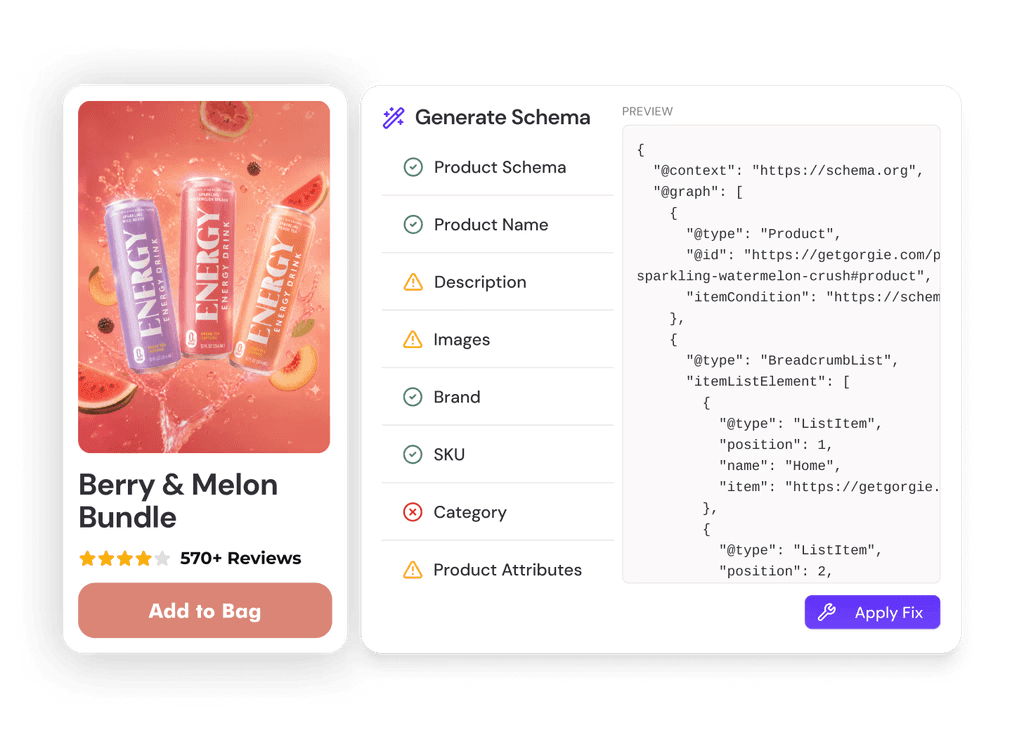
For commerce brands, GEO requires that every product attribute including weight, dimensions, material, compatibility, color, and size be a separate PropertyValue entry (the Schema.org type that marks each spec as a discrete, machine-readable data point) in schema markup, not buried in prose. This is the single highest-leverage structural change a catalog team can make. The reason is straightforward: AI search queries average approximately 23 words, and they are conversational. A shopper asking an AI assistant for 'waterproof hiking boots for wide feet under $150' needs your product attributes to be machine-readable, not locked inside a paragraph of marketing copy.
Products with complete, structured attribute data are far more likely to surface in AI-generated shopping comparisons than products with sparse or unstructured data. At catalog scale, shipping PropertyValue schema across thousands of SKUs manually is not feasible. Nudge Catalog Enrichment automates structured data generation and deployment at the SKU level, so catalog teams can move from audit to implementation without engineering bottlenecks.
How Do You Measure GEO Performance?
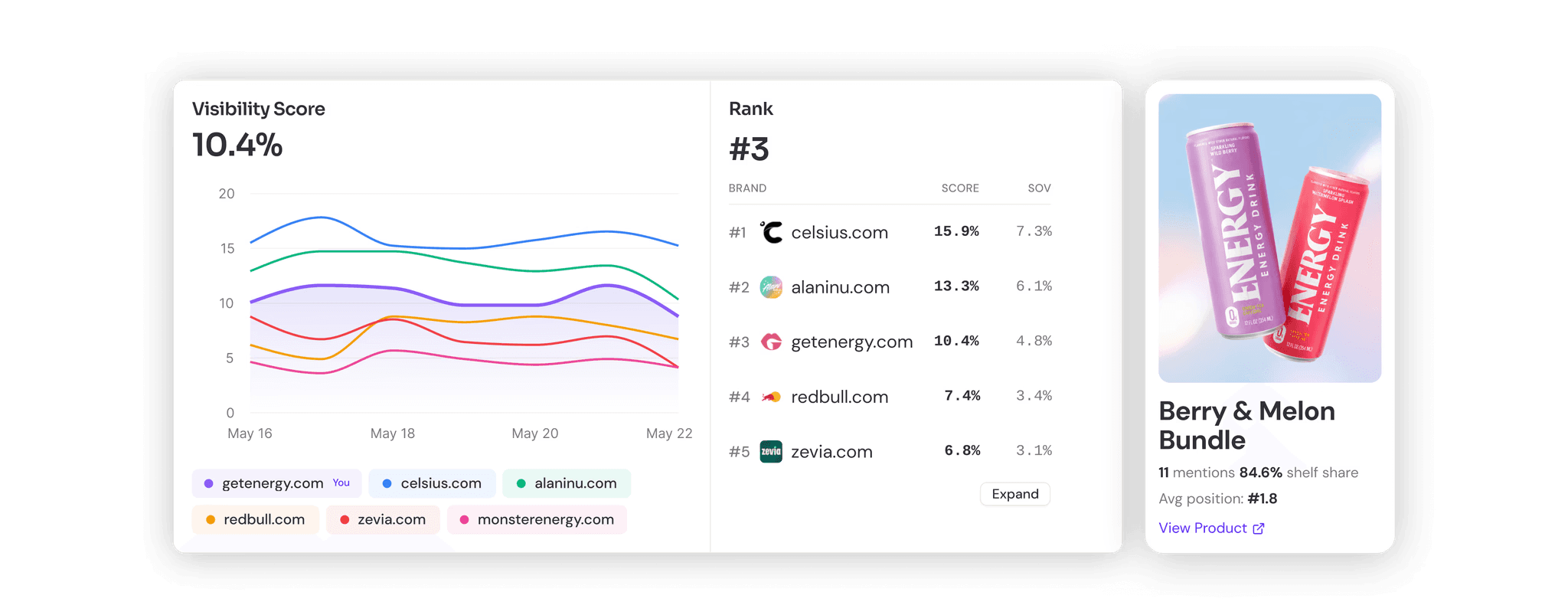
Unlike SEO rank tracking, GEO success is measured at the prompt and SKU level, not at the page level. Three metrics commerce teams should track immediately:
AI citation rate by prompt: For each high-intent query your category owns, what percentage of AI-generated answers include your brand or product?
Share of AI-generated answers: Across the prompts that matter to your category, how often does your brand appear versus competitors?
Downstream conversion lift from AI-referred sessions: AI citation drives measurable revenue. Brands cited in AI answers experience a 38% click increase and a 39% boost in paid ad performance.
Nudge AI Search Visibility provides prompt-level and SKU-level citation tracking across ChatGPT, Perplexity, Google AI Overviews, Gemini, and Claude, so catalog teams can directly correlate GEO investments with revenue outcomes rather than relying on proxy metrics.
How Commerce Teams Should Prioritize GEO Right Now
47% of brands currently lack a GEO strategy, which means early movers become the default citation source in their category before competitors have even started. E-commerce sites have already seen a 4,700% year-over-year increase in AI-driven traffic, so this is not a future planning item. Here is a practical three-step starting point for a Head of eCommerce or Head of Search:
Audit structured data completeness across your top-revenue SKUs. Use Nudge Catalog Enrichment to identify which product attributes are missing from schema markup and prioritize by revenue impact. Once Nudge Catalog Enrichment deploys these updates across your top-revenue SKUs, submitting the refreshed content via IndexNow or Bing Webmaster Tools speeds discovery so generative engines reference the current version.
Identify the 10 to 20 highest-intent AI prompts your category owns. Map your product content to those prompts using Nudge AI Search Visibility, which tracks citation rates at the prompt level so you can see exactly where gaps exist and measure improvement over time.
Build prompt-aligned landing experiences for AI-referred traffic. Use Nudge Shoppable Funnels to create conversion paths that match the conversational intent of AI-referred sessions, so the citation lift translates directly to revenue rather than bouncing on a generic category page.
Ready to optimize your website for AI search? See how we can help!
Frequently asked questions
Is GEO replacing SEO, or do brands need both?
GEO and SEO are complementary, not competing. SEO foundations such as crawlability, page speed, and E-E-A-T signals still feed AI indexing. GEO layers on structured data, conversational content, and citation signals that SEO alone does not address. Commerce teams that combine both are better positioned as AI-powered discovery grows.
Which AI platforms does GEO optimization apply to?
GEO applies to ChatGPT, Perplexity, Google AI Overviews, Gemini, and Claude. Each pulls from different index sources, but structured data, authoritative content, and entity clarity improve citation probability across all of them. Nudge AI Search Visibility tracks citation rates across these platforms at the prompt level.
How long does it take to see GEO results?
Structural changes like schema markup and Bing Webmaster Tools submission can influence AI indexing within days to weeks. Content-level changes such as adding statistics, expert quotes, and authoritative framing typically show citation rate movement within 4 to 8 weeks, depending on crawl frequency and platform update cycles.
What makes a product page more likely to be cited by an AI assistant?
Complete, structured attribute data in schema markup is the single highest-leverage change. Each attribute including weight, material, compatibility, and size must be a separate PropertyValue entry. Conversational product descriptions that mirror how shoppers phrase AI queries also increase citation probability. Nudge Catalog Enrichment automates both at scale.
How is Nudge different from running GEO tactics manually?
Manual GEO requires separate tools for schema auditing, content optimization, citation tracking, and conversion measurement, with no SKU-level or prompt-level correlation to revenue. Nudge unifies AI Search Visibility, Catalog Enrichment, and Shoppable Funnels in one enterprise-grade platform with SOC 2 compliance, SSO, and native integrations with PIM, OMS, and DTC stacks, so catalog teams can operationalize GEO at scale and tie it directly to conversion lift.