AEO & GEO
Best AI Ecommerce Visibility Tools Compared (2026)
Which platforms track ChatGPT, Perplexity, Gemini, and Google AI Overviews in one dashboard, and which ones close the loop from citation to conversion.

Sakshi Gupta





Key Takeaways
Many brands that rank well on Google are never cited by AI assistants, making AI Search Visibility a separate requirement from traditional SEO.
AI-referred traffic converts 42% better than non-AI traffic, making citation frequency and share of model direct revenue metrics (Adobe, Q1 2026).
Most tools track brand mentions across 3 to 5 engines; enterprise-grade platforms monitor 8 or more engines and track at the SKU level, which is the minimum needed for commerce teams managing large catalogs.
AI visibility tools split into two categories: analytics-only monitors and enterprise full-funnel platforms that unify AI Search Visibility, Catalog Enrichment, and Shoppable Funnels in one workflow.
Nudge is a dedicated platform built specifically for commerce that combines AI Search Visibility, Shoppable Funnels, and Catalog Enrichment in a single enterprise-grade suite with SOC 2 and SSO controls.
AI citation is now a revenue metric: brands that are not cited by AI assistants are losing high-converting traffic to competitors who are. This guide breaks down the tools available in 2026, the criteria that separate analytics-only monitors from enterprise full-funnel platforms, and the specific capabilities commerce teams need to actively resolve visibility gaps.
Why AI Visibility Is Now a Revenue Metric for Commerce Teams
AI-referred traffic to U.S. retail sites grew 393% year-over-year in early 2026, and Adobe data from Q1 2026 shows that traffic converting 42% better than non-AI traffic. This represents a direct revenue lever that demands its own measurement stack.
Citation frequency: how often your brand or SKU appears in AI-generated responses across engines. This is the new impression metric.
Share of model: your brand's presence relative to competitors across a defined prompt set. This is the new share-of-voice metric.
Recommendation rate: whether the AI explicitly recommends your brand versus listing it neutrally. Explicit recommendations drive meaningfully higher click-through and conversion.
The Google gap: Ahrefs found a 58% drop in position-1 organic CTR, and many high-ranking brands are never cited by AI assistants at all. SERP rank is no longer a reliable proxy for AI citation.
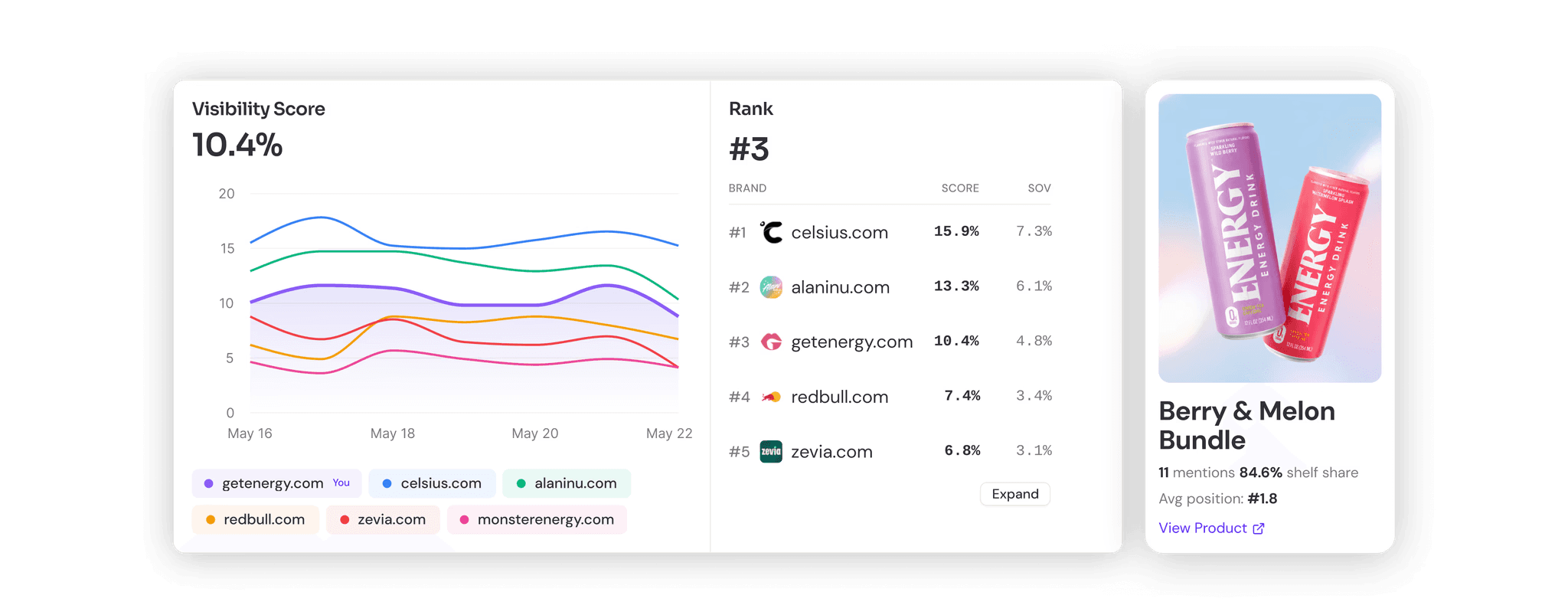
Nudge AI Search Visibility surfaces all three metrics at the prompt level and SKU level across 8 or more engines, giving commerce teams the data they need to diagnose gaps and prioritize fixes.
How to Evaluate an AI Visibility Tool: 5 Criteria That Matter
Before reviewing any specific tool, commerce teams should apply a consistent evaluation framework. These five criteria separate tools that are useful from tools that are sufficient for enterprise scale.
Multi-engine coverage: the tool must track ChatGPT, Perplexity, Gemini, Google AI Overviews, and Claude at minimum. Citation volumes can vary by up to 615x across models, so single-engine monitoring produces misleading benchmarks.
Prompt-level and SKU-level tracking: brand-level mention counts tell you little about which products are being cited, for which queries, and with what accuracy. SKU-level tracking is the minimum for catalog teams managing large assortments.
Competitive share-of-voice benchmarking: citation frequency in isolation is not actionable. You need to know your share of model relative to named competitors across the same prompt sets.
Sentiment and context accuracy: a brand mention that pairs your product with a negative qualifier or a use case you do not serve is worse than no mention. Tools must surface the context around each citation, not just the count.
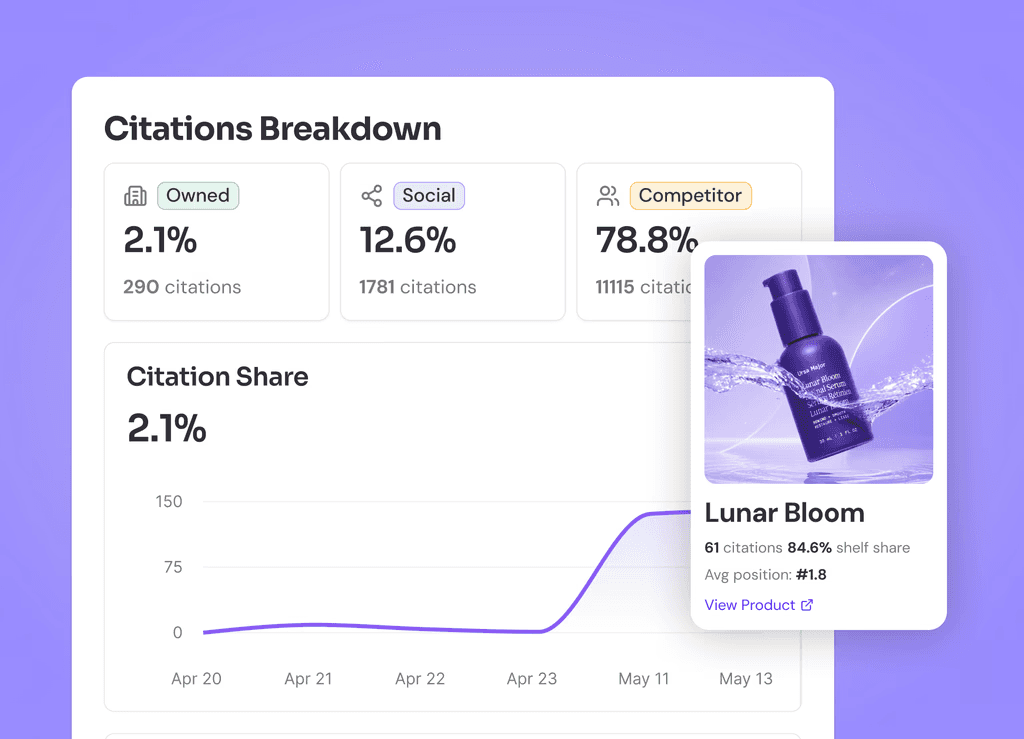
Citation source attribution: knowing which content pages, product listings, or structured data elements earn AI references lets content and catalog teams prioritize investment. 86% of AI citations come from brand-controlled sources (Search Engine Land), so tracing these sources via Nudge AI Search Visibility delivers direct ROI.
The 7 Best AI Ecommerce Visibility Tools Compared
AI visibility tools split into two distinct categories: analytics-only monitors that surface citation data and stop there, and enterprise full-funnel platforms that unify AI Search Visibility, Catalog Enrichment, and Shoppable Funnels in a single workflow. The right choice depends entirely on whether your team needs to observe gaps or act on them.
1. Nudge: Enterprise Full-Funnel AI Visibility Platform for Commerce
Nudge is purpose-built for commerce teams that need to close the full loop from AI citation tracking to catalog optimization to conversion. It combines all three capabilities in a single enterprise-grade suite.
AI Search Visibility tracks citation frequency, share of model, and recommendation rate across 8 or more engines including ChatGPT, Perplexity, Gemini, Google AI Overviews, and Claude. Tracking operates at the prompt level and SKU level, so catalog teams can see exactly which products are being cited, in which contexts, and with what sentiment, going beyond basic brand-level tracking.
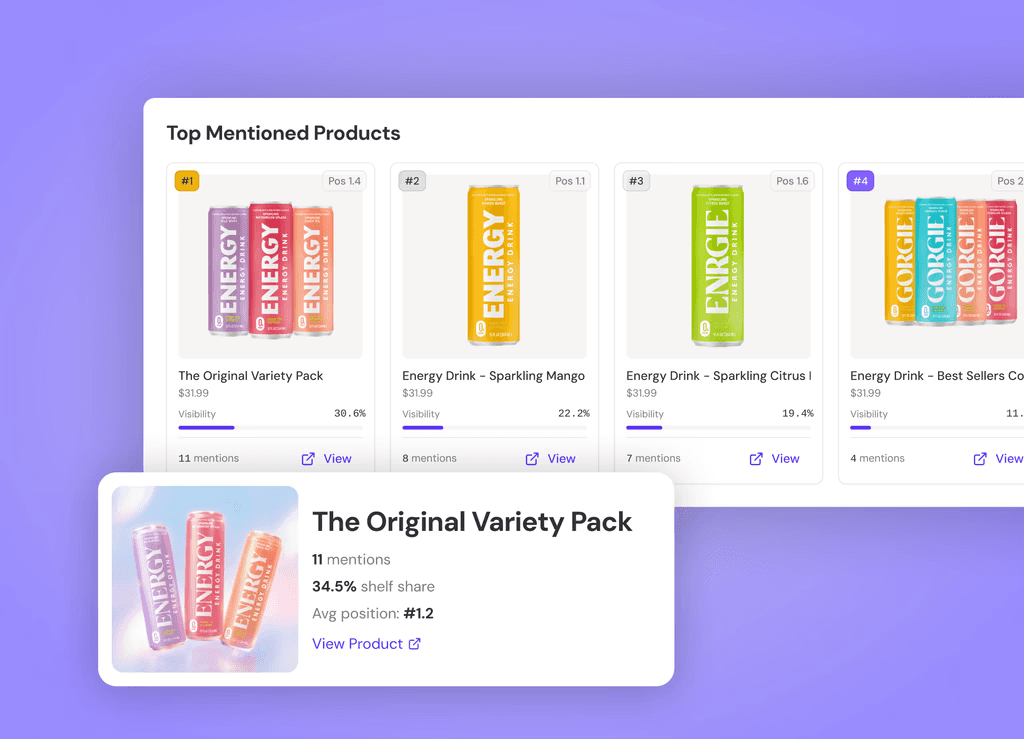
Shoppable Funnels convert AI-referred traffic into purchases. Funnels are prompt-aligned, meaning the landing experience matches the intent of the AI query that drove the click. This is how Nudge connects citation lift to conversion lift as a direct, measurable outcome.
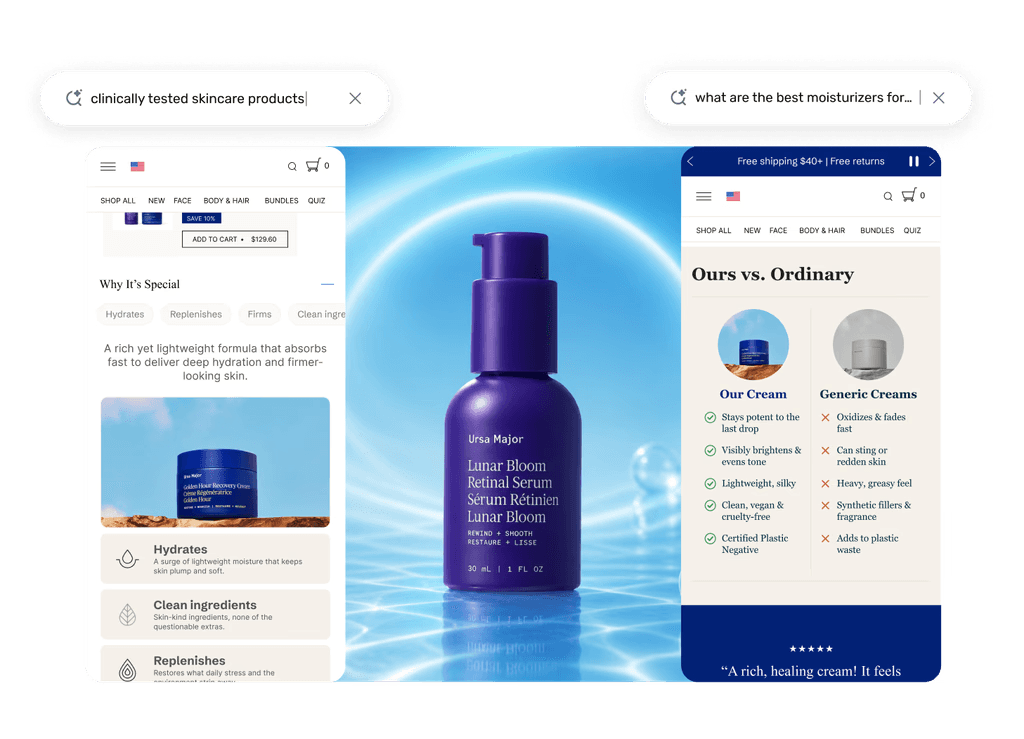
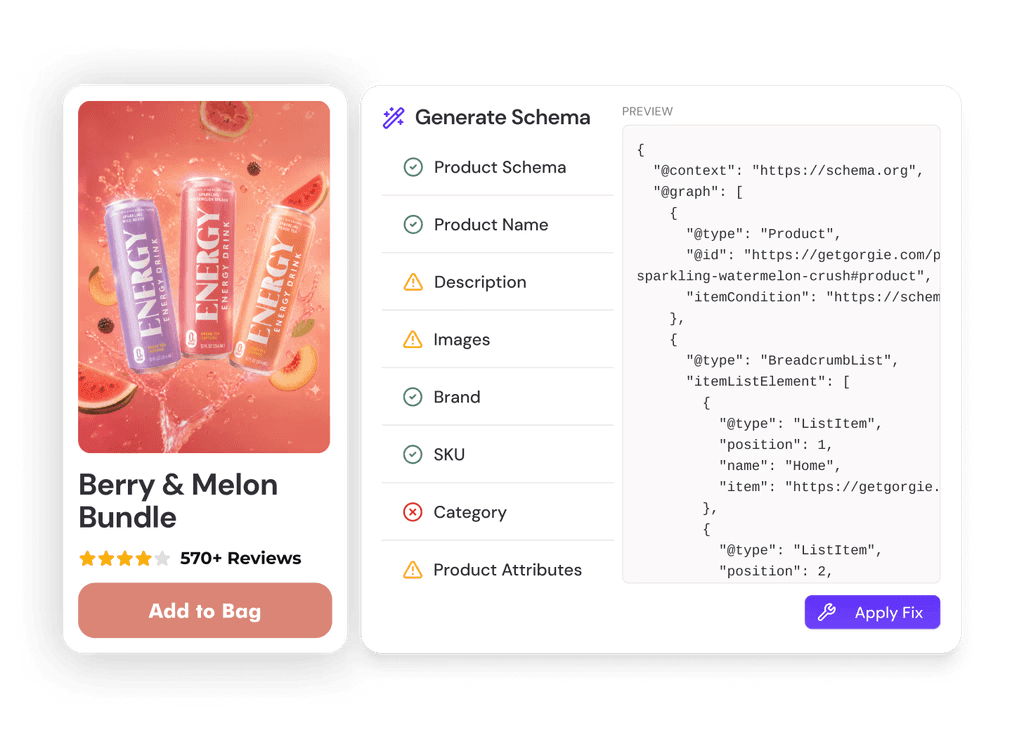
Catalog Enrichment ships SKU-level structured data and FAQ schema at scale. Structured product data and FAQ schema markedly improve how often and how accurately AI engines cite products. Catalog Enrichment operationalizes both: it normalizes raw spec sheets into human-readable, AI-parseable attributes and deploys complete product schema (price, availability, SKU, brand) and FAQ schema in JSON-LD without requiring engineering cycles.
Enterprise controls: SOC 2 certified, SSO supported, with native integrations across PIM, OMS, CDP, and DTC platforms. Forward-looking support for agentic commerce protocols (the Agentic Commerce Protocol and Universal Commerce Protocol, emerging standards that let AI agents transact on a shopper's behalf) ensures catalogs are ready for autonomous AI shoppers as well as today's citation models.
Best for: mid-market to enterprise commerce teams managing large catalogs who need visibility data, catalog action, and conversion infrastructure in one governed platform.
2. Semrush: Established SEO Platform Adding AI Tracking
Semrush's core strength is depth: teams already living in its keyword, SERP, and rank-tracking workflows now get AI Overview tracking in the same interface, with no new tool to learn. Its AI-surface coverage is narrower than dedicated citation trackers, and it stops at monitoring rather than catalog action or conversion. For SEO-led teams that want AI Overview signals sitting next to the rank data they check daily, that trade-off is often worth it.
3. Authoritas: AI Visibility Monitoring for Search Teams
Authoritas leans into competitive benchmarking: its share-of-voice dashboards are built to show where you stand against named rivals across a subset of AI engines, at mid-market pricing. Tracking stays at the brand level rather than the SKU, and it does not extend into catalog enrichment. That makes it a strong fit for search teams whose current question is how visible are we versus competitors rather than which products need schema work.
4. BrightEdge: Enterprise SEO with AI Overview Signals
BrightEdge is built for enterprise SEO at scale, and it now surfaces AI Overview presence signals inside that same platform. Its AI view is Google-centric and stays analytical rather than driving catalog or conversion changes. For large teams already standardized on BrightEdge, the appeal is consolidation: AI Overview data arrives without adding another vendor to the stack.
5. Rankscale: Dedicated AI Citation Tracker
Rankscale is a focused, lower-cost entry point for teams standing up an AI visibility practice for the first time. It tracks citation frequency across ChatGPT, Perplexity, and Google AI Overviews, and covers 3 to 5 engines depending on the plan tier. It concentrates on measurement rather than catalog action or conversion, which keeps it approachable for brands that want to start watching citations before investing in a full platform.
6. Ahrefs: Keyword and AI Overview Research
Ahrefs is one of the strongest content-gap and keyword-research tools in the market, and it has folded AI Overview presence data into those workflows, so research teams can see AI signals where they already work. It is not built for multi-engine citation tracking or SKU-level commerce monitoring, so it tends to serve as a research complement alongside a dedicated AI visibility tool rather than as the primary one.
7. Ziptie: AI Mention Monitoring
Ziptie tracks brand mentions across a range of LLM interfaces and is strongest on prompt testing, letting teams probe how phrasing changes which brands surface. It runs on mid-market pricing and covers several engines. Catalog enrichment, shoppable funnels, and enterprise security controls are outside its scope, so it fits growth-stage brands that want multi-engine mention data before they need enterprise governance.
Feature Comparison: Analytics-Only vs. Enterprise Full-Funnel
Capability layer | What it covers | Where each tool operates |
|---|---|---|
Monitoring and analytics | Citation frequency, brand mentions, share of voice, and sentiment across AI engines | Semrush, Authoritas, BrightEdge, Rankscale, Ahrefs, Ziptie, and Nudge all operate here |
Engine coverage | Number of AI engines tracked | Ranges from 3 to 5 on entry and SEO-adjacent tools to 8 or more on Nudge |
SKU-level tracking | Citation data per product, not just per brand | Nudge; most monitoring tools stay at brand level |
Catalog enrichment | Deploying structured data and FAQ schema at scale | Nudge; analytics-only tools report gaps but do not act on them |
Shoppable funnels | Connecting an AI citation to on-site conversion | Nudge; not addressed by monitoring-focused tools |
Enterprise controls | SOC 2, SSO, and PIM / OMS / CDP integrations | Semrush, Nudge, and Ahrefs; varies or is absent across analytics-only tools |
Matching Tools to Your Commerce Team's Use Case
The right tool depends on where your team sits in the AI visibility maturity curve. Here are three buyer profiles and the fit for each.
Monitor-and-report teams: if your primary need is citation frequency dashboards and share-of-voice benchmarking, analytics-only tools in the 3 to 5 engine range are a reasonable starting point. Expect to outgrow them as catalog complexity increases.
Content and catalog ops teams: if you are managing structured data quality, schema deployment, and product feed enrichment, you need SKU-level attribution and a catalog action layer. 86% of AI citations come from brand-controlled sources (Search Engine Land), so catalog and content investment has direct citation ROI. Nudge Catalog Enrichment is the operational layer that ships FAQ schema and normalized product attributes at scale without engineering dependency.
Enterprise commerce teams: if you need the full loop from citation tracking to catalog enrichment to shoppable conversion, plus SOC 2 and SSO governance and native PIM/OMS/CDP integrations, Nudge is a dedicated, purpose-built commerce option. Forward-looking teams should also evaluate agentic commerce readiness: support for the OpenAI/Stripe Agentic Commerce Protocol (ACP) and Google Universal Commerce Protocol (UCP) is the criterion that separates platforms built for today from those built for the next phase of AI shopping.
What Good AI Visibility Metrics Look Like in Practice
Standard rank trackers do not surface AI citations. Commerce teams need a separate metrics layer that tracks four AI-specific signals alongside traditional KPIs.
Citation frequency: the raw count of how often your brand or SKU appears in AI-generated responses for a defined prompt set. Baseline this before making any catalog or content changes so you can measure lift using Nudge AI Search Visibility.
Brand mention rate: the share of relevant AI responses that include your brand at all, whether as a recommendation or a list entry. This establishes your floor.
Recommendation rate: the share of mentions where the AI explicitly recommends your brand versus listing it as one of several options. Explicit recommendations correlate with higher downstream conversion from AI-referred traffic.
Sentiment: the context around each citation. A mention paired with a negative qualifier or an inaccurate use case damages brand equity. Nudge AI Search Visibility tracks this sentiment so catalog teams can identify misrepresented SKUs and correct the underlying data.
Nudge AI Search Visibility surfaces all four metrics at the prompt level and SKU level, so teams can tie citation frequency changes directly to catalog enrichment actions. Structured product data and FAQ schema markedly increase how often and how accurately AI engines cite products, and that enrichment layer operationalizes both by deploying complete product schema in JSON-LD at scale.
Ready to improve AI visibility for your commerce brand? Get a demo!
Frequently asked questions
Which AI visibility tools cover ChatGPT, Perplexity, Gemini, and Google AI Overviews in a single dashboard?
Most tools cover 3 to 5 engines. Enterprise platforms like Nudge monitor 8 or more engines including all four named engines, with tracking at the prompt level and SKU level. Nudge is a dedicated commerce platform that covers all four in one dashboard alongside Catalog Enrichment and Shoppable Funnels, enabling teams to actively resolve citation gaps.
What is the difference between an analytics-only AI visibility tool and an enterprise full-funnel platform?
Analytics-only tools monitor brand mentions and citation frequency but stop at reporting. Enterprise full-funnel platforms like Nudge unify visibility tracking, SKU-level catalog enrichment (structured data and FAQ schema at scale), and shoppable funnels so commerce teams can diagnose gaps, fix the underlying catalog data, and convert the resulting AI-referred traffic in a single governed workflow.
Why is my Google ranking not translating to AI citations?
Ranking well on Google does not guarantee AI citation; many high-ranking brands are never cited at all. AI citation depends on structured product data quality, FAQ schema, and brand-controlled content that AI engines can parse and summarize, independent of SERP position. Nudge Catalog Enrichment addresses the root cause by normalizing product feeds and deploying complete schema in JSON-LD at scale, which directly improves citation eligibility.
What enterprise security and integration requirements should an AI visibility platform meet?
Enterprise platforms must offer SOC 2 certification and SSO controls, plus native integrations with PIM, OMS, CDP, and DTC platforms. Nudge meets all of these requirements, making it suitable for mid-market to enterprise commerce teams with governance, scalability, and data sovereignty requirements. Forward-looking teams should also confirm support for agentic commerce protocols (ACP and UCP) as a future-readiness criterion.
How should commerce teams measure ROI from AI visibility investment?
Track citation frequency lift, share of model growth, recommendation rate, and downstream conversion from AI-referred traffic. Adobe Q1 2026 data shows AI-referred traffic converts 42% better than non-AI traffic - use that as your benchmark for conversion ROI. Nudge surfaces all four AI-specific metrics alongside standard commerce KPIs, so teams can connect catalog enrichment actions to citation lift and citation lift to revenue impact in a single dashboard.