Catalog Optimization
Catalog Enrichment for AI Agents: The Essential Guide
How to structure, enrich, and monitor individual product listings so AI engines cite, compare, and convert your catalog at scale.

Sakshi Gupta





Key Takeaways
Over 91% of ecommerce product queries now trigger AI-generated results, yet many brands ranking well on traditional Google search are never cited by AI systems, making SKU-level enrichment a distinct discipline from SEO.
AI-referred shoppers convert at 4.4x higher rates than organic search visitors and deliver 254% higher revenue per visit, making catalog enrichment a direct revenue lever, not a content exercise.
Properly structured product content shows 73% higher AI selection rates, while multimodal pages combining text, images, video, and schema deliver up to 317% more AI citations than unstructured pages.
Most sites implement SKU schema incorrectly, and citation volumes for the same brand vary widely from one AI platform to the next, meaning catalog structure is the single highest-leverage optimization available to commerce teams.
AI search queries average 23 words (5 to 6x longer than traditional searches), so every PDP needs a 2-3 sentence use-case block that mirrors natural-language queries to be surfaced by ChatGPT, Perplexity, Google AI Overviews, and Gemini.
Catalog Enrichment for AI is the practice of structuring, enriching, and maintaining individual product listings so AI engines can parse, cite, and recommend them in response to natural language queries. Brands that align their PDPs with AI citation signals, rather than relying on legacy SEO rank, capture a traffic channel that converts at rates no paid or organic channel currently matches.
Why Traditional SEO Rank Is a Poor Proxy for AI Visibility (Your Product Citation Rate Across Engines)
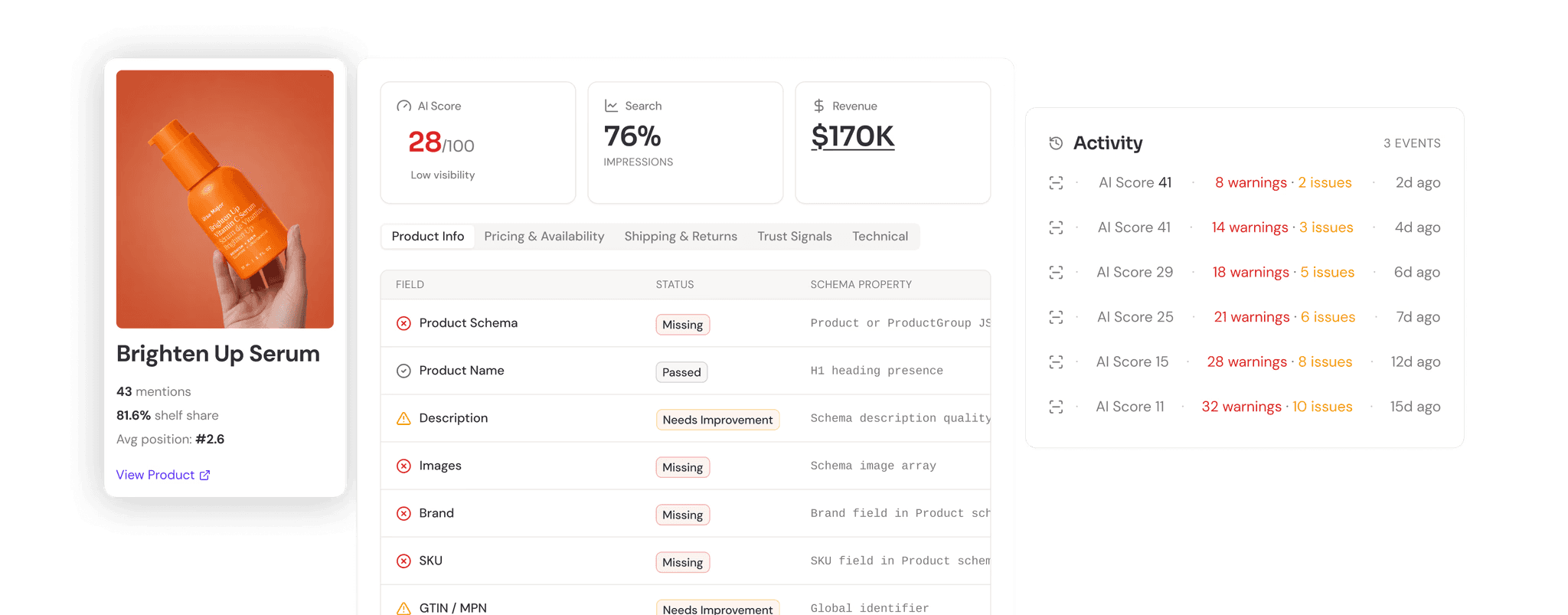
Many brands ranking well on traditional Google search are never cited by AI systems, and 47% of Google AI Overview citations come from pages ranking below position five. Those two data points dismantle the assumption that a strong SEO foundation is enough to capture AI-driven discovery.
The underlying reason is signal divergence. Brand mentions correlate 0.664 with AI citation probability, compared to only 0.218 for traditional backlinks (Ahrefs 75,000-brand study). Domain authority, which SEO teams have spent years building, is nearly irrelevant to whether an AI engine recommends a specific product. What matters is whether the individual SKU page contains the right structured signals for an AI to parse and extract.
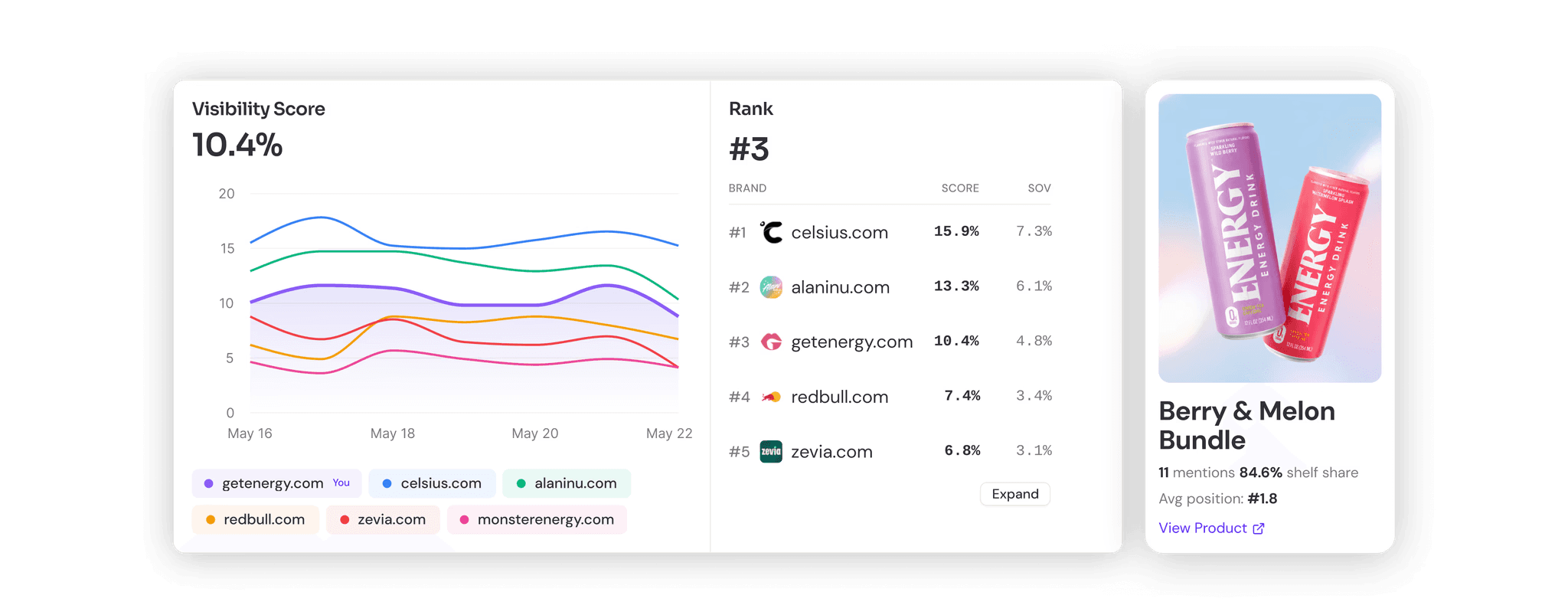
AI engines evaluate individual products, not homepages. A brand with ten thousand SKUs and a domain authority of 80 can be outranked in AI results by a smaller brand whose PDPs are correctly structured. This is the practitioner's wake-up call: the optimization playbook has changed at the SKU level. Nudge AI Visibility provides the monitoring layer that reveals per-SKU citation gaps across 8+ engines, so catalog teams can see exactly where the disconnect exists and prioritize fixes accordingly.
What AI Engines Actually Evaluate on a Product Page
Generative Engine Optimization (GEO) structures product content, such as ingredients, use cases, and compatibility, in ways that AI systems can interpret, extract, and recommend, whereas traditional SEO optimizes pages for ranking via keywords and backlinks. The distinction matters because AI engines are not ranking pages; they are extracting facts to construct an answer, and poorly structured content gets skipped entirely.
Four signals carry the most weight in AI engine evaluation:
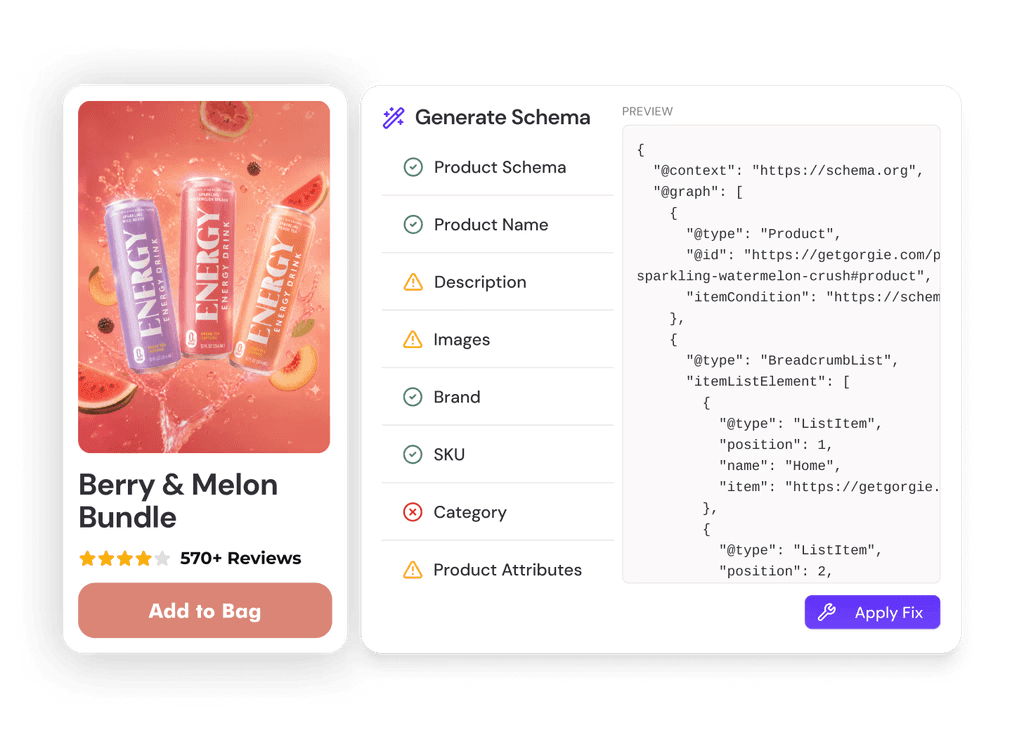
Structured schema markup: Product schema with each attribute as a separate PropertyValue entry (the schema.org field that holds one product attribute as a discrete name-and-value pair an AI engine can read), and offer data that exactly matches the live PDP, remediated at scale via Nudge Catalog Enrichment.
Use-case copy: A 2-3 sentence block generated at scale via Nudge Catalog Enrichment that mirrors natural-language queries, names who the product is for, and specifies the scenarios it solves.
Multimodal assets: Pages combining text, images, video, and schema deliver up to 317% more AI citations than unstructured pages.
Machine-verifiable offer data: Price, availability, and currency must be accurate and crawlable in real time.
Properly structured product content shows 73% higher AI selection rates than unstructured equivalents (Wellows AI Overview ranking-factors study). Getting all four signals right on every SKU is the core operational challenge for enterprise catalog teams.
Schema Markup: The Highest-Leverage SKU Optimization
Most sites implement SKU schema incorrectly, making catalog structure the number one lever for AI visibility. The most common failure mode is collapsing multiple attributes into a single description string rather than marking up each attribute as a discrete, machine-readable field.
The correct pattern: each attribute, including weight, dimensions, material, compatibility, color, and size, must be a separate PropertyValue entry in your Product schema, generated automatically by Nudge Catalog Enrichment. Offer data, specifically price, availability, and currency, must exactly match the live PDP at crawl time. Any mismatch between schema and live page data breaks machine-verifiability and reduces citation probability.
Beyond on-page schema, enterprise teams should place a plain-text llms.txt file at their domain root to actively guide AI crawlers to your highest-quality structured product data. Unlike robots.txt, which governs crawl access, llms.txt tells AI systems which pages carry the most reliable, structured information. It is a low-effort, high-impact addition that most competitors have not yet deployed.
Shipping correct schema across a catalog of hundreds of thousands of SKUs requires automation, not manual editing. Nudge Catalog Enrichment handles bulk schema generation and validation at scale, eliminating 99% of schema payload errors while reducing engineering time-to-index. This allows catalog teams to remediate schema gaps without building internal tooling.
Writing PDP Copy That AI Assistants Can Cite
AI search queries average about 23 words, roughly 5 to 6 times longer than traditional searches (SOCi and Onely research). Keyword-stuffed titles and generic descriptions are calibrated for a query format that AI shoppers are not using. A query like 'what is a good air purifier for a small bedroom with pets that removes allergens' will not surface a PDP whose description reads 'High-performance air purifier. HEPA filter. Multiple speeds.'
The fix is a use-case block generated via Nudge Catalog Enrichment: a 2-3 sentence passage on every PDP that mirrors natural-language queries, defines who the product is for, and names the specific scenarios it solves. For example: 'Designed for pet owners in rooms up to 300 square feet, this purifier removes 99.97% of particles 0.3 microns and larger, including pet dander and pollen, on a single fan-speed setting.' That sentence is citable because it is specific, verifiable, and structured around a use case rather than a superlative.
The contrast matters: verifiable claims ('removes 99.97% of particles 0.3 microns and larger') are extractable by AI engines. Unverifiable superlatives ('best in class', 'industry-leading performance') are discounted or ignored because AI engines cannot confirm them. Specificity is the new keyword strategy.
Research from the Advertising Research Foundation (ARF) shows that even minor changes in a consumer's prompt wording significantly influence which brands are recommended by AI systems. This means non-market-dominant brands can win visibility by aligning PDPs with specific, nuanced attributes rather than competing broadly for 'best' status. A niche positioning, if clearly stated on the PDP, can outperform a generic category leader in AI results for the right query.
Nudge Catalog Enrichment supports bulk PDP copy generation aligned to use-case block format, and Nudge Shoppable Funnels (landing experiences that dynamically adapt PDP content to match the referrer's exact search intent) ensure that when a shopper clicks through from an AI-generated recommendation, the landing experience matches the specific prompt that drove the click, maintaining the intent alignment that drives conversion.
Traditional SEO Signals vs. AI Citation Signals: A Side-by-Side Comparison
Dimension | Traditional SEO Signal | AI Citation Signal |
|---|---|---|
Primary ranking factor | Domain authority and backlink profile | Brand mention density (0.664 correlation with citation probability) |
Content format | Keyword density and on-page optimization | Use-case blocks written in natural language (queries average 23 words) |
Structured data | Optional enhancement for rich snippets | Required: Product schema with a separate PropertyValue per attribute |
Page position dependency | Positions 1-5 capture the majority of clicks | 47% of AI citations come from pages ranking below position five |
Asset mix | Text-only pages are fully competitive | Multimodal pages (text + images + video + schema) get up to 317% more citations |
Measurement unit | Keyword rank and organic traffic | Per-SKU citation rate across 8+ AI engines |
Monitoring AI Citation Performance at the SKU Level
Citation volumes for the same brand vary widely from one AI platform to the next. A brand that appears frequently in Perplexity results may be nearly invisible in Google AI Overviews or Gemini. Tools that track fewer than five engines systematically underreport visibility gaps, which is why tracking via Nudge AI Search Visibility (which monitors 8+ engines) is necessary to avoid giving catalog teams a false sense of coverage.
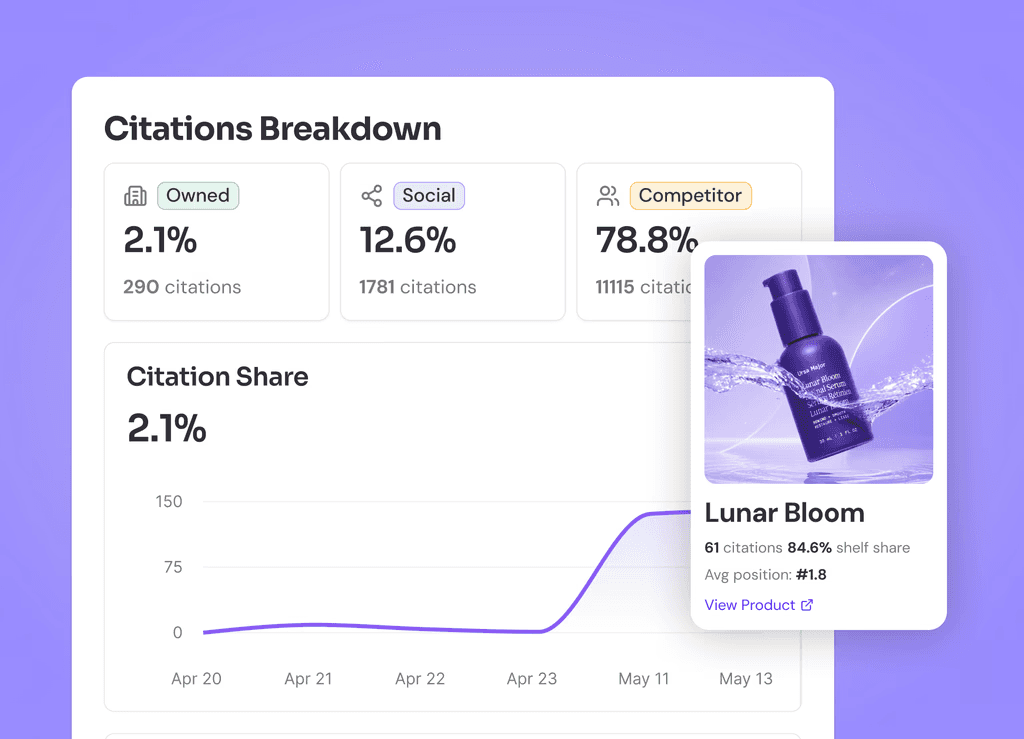
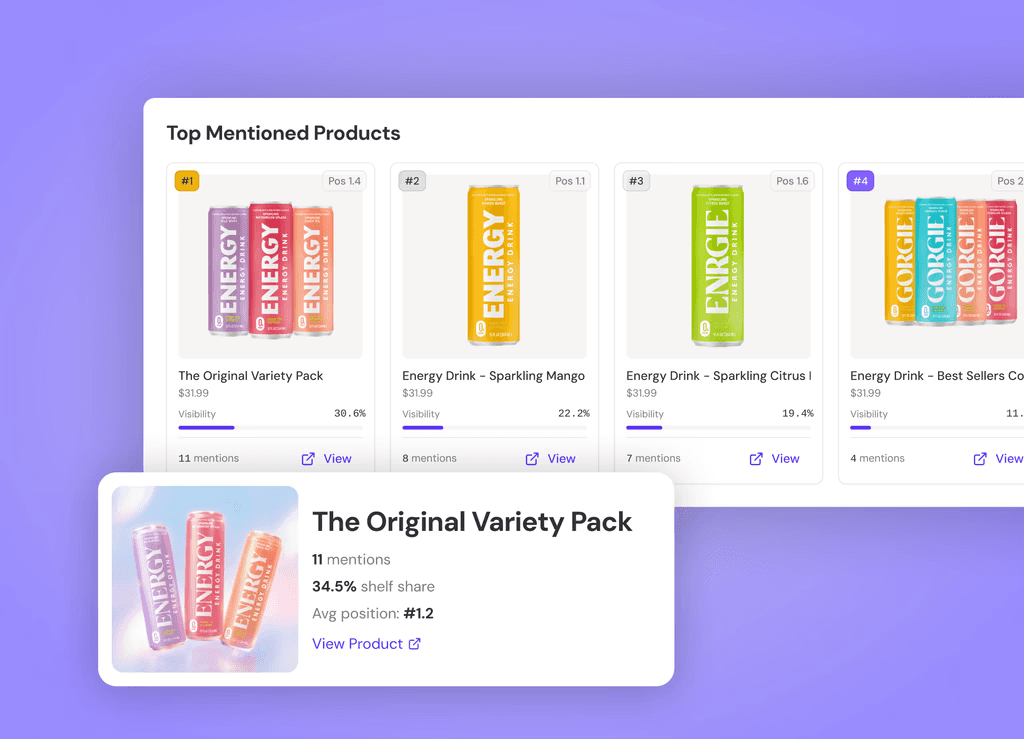
SKU-level monitoring means tracking which individual products are cited, in which engine, for which query intent, and correlating that to conversion and revenue lift. This is a materially different discipline from monitoring aggregate domain traffic. The metrics that matter are citation rate per SKU per engine, query-to-citation alignment, and downstream revenue per AI-referred visit.
The revenue case for this level of measurement is clear. AI referral traffic to US retail sites grew 393% year-over-year in Q1 2026, and AI-referred shoppers convert at 4.4x higher rates than organic search visitors, delivering 254% higher revenue per visit (Adobe, Q1 2026). Citation tracking is a revenue metric. Treating it as a vanity metric is the operational equivalent of ignoring your highest-converting traffic channel.
Nudge AI Visibility monitors 8+ engines at SKU granularity, surfaces prompt-level gaps (the mismatch between consumer queries and PDP copy), and connects citation data to conversion and revenue outcomes with zero impact on active storefront APIs.
Scaling Catalog Optimization Across Hundreds of Thousands of SKUs
Manual PDP enrichment does not scale. A catalog team managing 200,000 SKUs cannot hand-edit use-case blocks, validate schema, and monitor citation performance across eight AI engines using spreadsheets and disconnected tools. Solving this operational gap requires dedicated platform tooling rather than more headcount.
The integration requirements for an enterprise-grade solution are specific: the platform must connect to existing stacks, so enrichment data flows into the systems of record rather than existing in a separate silo. Fragmented tooling creates correlation gaps that make it impossible to tie catalog changes to revenue outcomes.
One structural shift reinforces the importance of post-click experience alongside citation. In early 2026, OpenAI scaled back its Instant Checkout functionality within ChatGPT, moving transactions back to merchant websites and apps. AI engines act as high-intent referral sources rather than transaction endpoints. That means the landing experience after the AI click, a prompt-aligned Nudge Shoppable Funnel, is as important as earning the citation in the first place. A shopper who clicked because an AI recommended your allergen-removing purifier for pet owners should land on a page that leads with exactly that use case, not a generic category page.
Ready to enrich your catalog for AI shopping? Book a demo!
Frequently asked questions
What is catalog enrichment for AI, and how is it different from standard PDP optimization?
SKU-level catalog enrichment for AI is the practice of structuring, enriching, and maintaining individual product listings so AI engines can parse, cite, and recommend them in response to natural language queries. Standard PDP optimization targets keyword ranking and backlink signals. AI enrichment targets different signals entirely: brand mention density, use-case copy completeness, schema accuracy at the attribute level, and multimodal asset coverage. Critically, AI engines evaluate individual SKUs, not homepages, so domain authority provides no meaningful lift.
Which AI platforms should commerce teams prioritize for product visibility?
The primary engines to monitor are ChatGPT, Perplexity, Google AI Overviews, Gemini, and Claude. Citation volumes for the same brand vary widely across these platforms, so monitoring fewer than five engines systematically underreports visibility gaps. Enterprise teams need SKU-level tracking across 8+ engines, managed via Nudge AI Search Visibility, to get an accurate picture of where citation opportunities and gaps exist.
How do I write product descriptions that AI assistants will actually cite?
Replace keyword-stuffed copy with a 2-3 sentence use-case block that mirrors natural-language queries (which average 23 words). Use measurable, verifiable claims rather than superlatives: 'removes 99.97% of particles 0.3 microns and larger' is citable; 'best in class' is not. Define who the product is for and the specific scenarios it solves. Nudge Catalog Enrichment supports bulk implementation of this format across large catalogs.
What schema markup does a product page need to be recommended by AI engines?
Product schema generated via Nudge Catalog Enrichment with each attribute, including weight, dimensions, material, compatibility, color, and size, as a separate PropertyValue entry. Offer data (price, availability, currency) must exactly match the live PDP to be machine-verifiable. Add a plain-text llms.txt file at your domain root to guide AI crawlers to this high-quality structured product data. Note that most sites currently implement this incorrectly, making automated schema enrichment the highest-leverage fix available.
How do I measure whether my catalog enrichment is actually improving AI citations?
Track per-SKU citation rate across each AI engine, not just aggregate traffic. Correlate citation changes to conversion rate and revenue per visit: AI-referred shoppers convert at 4.4x higher rates and deliver 254% higher revenue per visit, so citation lift has a direct revenue translation. Use a platform that monitors 8+ engines at SKU granularity and surfaces prompt-level gaps. Nudge AI Visibility provides this measurement layer with SOC 2 compliance for enterprise teams.