AI Search Visibility
10 Proven Strategies to Rank in AI Overviews in 2026
Boost your 2026 rankings! Use Semantic SEO, prioritize E-E-A-T, and target question queries. Learn strategies for AI overviews. Click now!

Kanishka Thakur






AI Overviews are quietly changing how shoppers discover e-commerce products. These Google-powered panels summarize answers from multiple sources, often before a shopper clicks on any landing page, PDP, or bundle. That means your brand’s first impression happens in AI, not on your site.
It’s no longer enough to optimize for traditional SEO alone; you need strategies that ensure your content, product details, and recommendations show up clearly where shoppers start their buying journey and influence them before they even land on your pages.
In this article, we’ll explore what AI Overviews are, why they matter, how they impact traffic and search optimization, and proven strategies e-commerce teams can use to rank in AI Overviews.
Key Takeaways
Structured, concise, and intent-aligned content drives AI overview discovery and downstream conversions.
E-E-A-T signals, authority, expertise, and trust, are essential for visibility in AI-driven SERPs.
Schema markup and structured data enhance AI understanding of product context and intent.
Internal linking and cross-page authority reinforce relevance across PDPs, PLPs, and carts.
Continuous content updates and multimedia enrichments improve retention, engagement, and repeat purchases.
What Are AI Overviews in Google Search?
AI Overviews are automatically generated summaries that appear at the top of Google search results for certain queries, synthesizing information from multiple pages into a concise answer format.
For e-commerce brands, this means that customers looking for “best vegan skincare for sensitive skin” or “how to choose running shoes for flat feet” may see a synthesized overview before any traditional blue links. Instead of multiple organic results, users get a summary with links to primary sources, often including product pages, buying guides, or comparison content.
As a marketer aiming to turn AI mentions into high-intent PDP traffic, missing AI citations can feel like losing control of discovery. With AI Search Visibility, Nudge tracks exactly where and how your products are cited across prompts, surfacing gaps and opportunities, so your high-value SKUs get noticed first.

Next, we’ll look at why these AI Overviews matter from an SEO perspective for commerce sites.
Why AI Overviews Matter for SEO
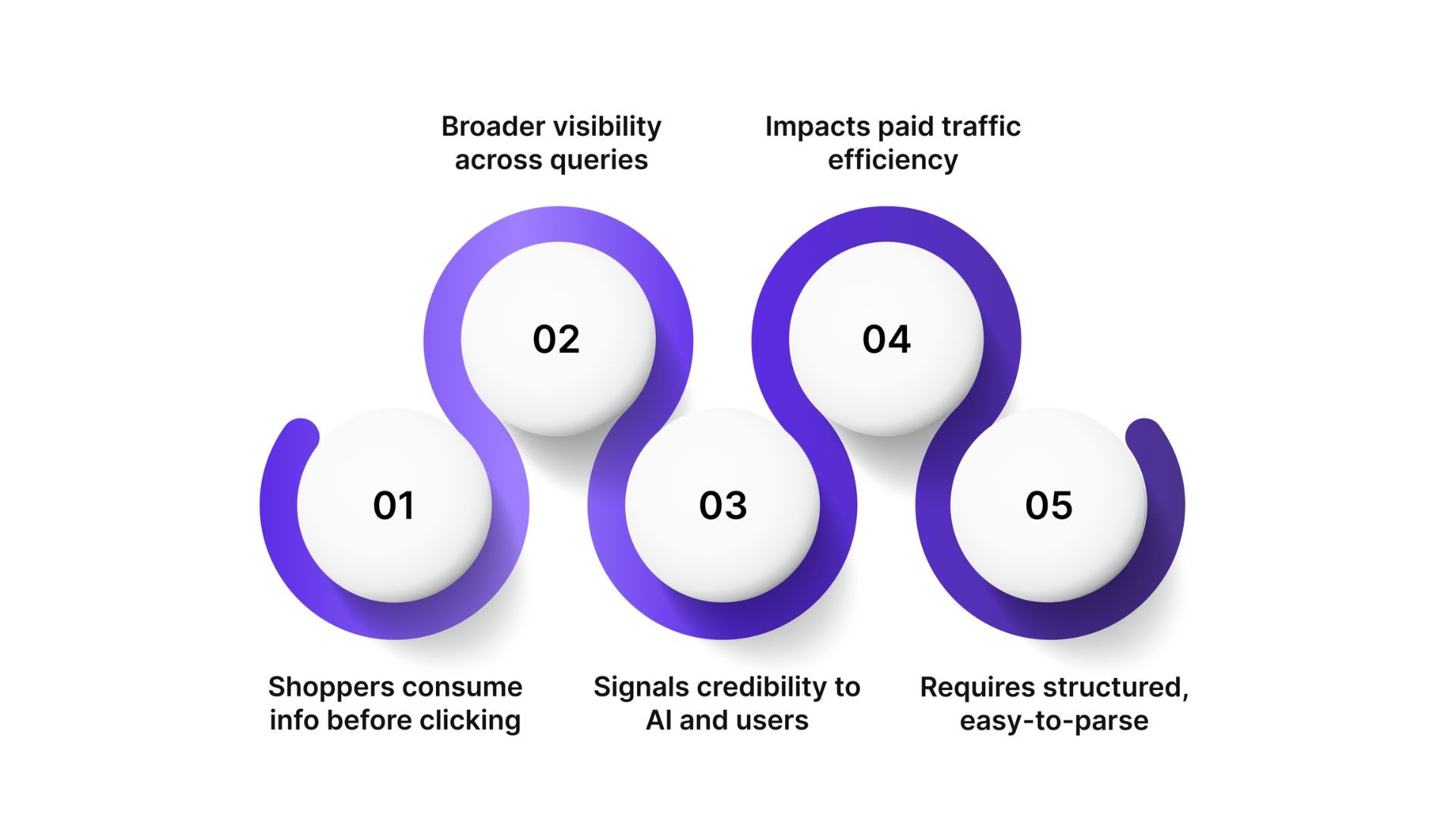
AI Overviews are changing how shoppers interact with search results, especially for e-commerce brands with high-intent traffic. Key reasons they matter include:
Shoppers consume info before clicking: Many users get answers directly from the AI Overview, influencing purchase intent upstream.
Broader visibility across queries: Your content can appear for clusters of related search terms, instead of just one keyword, improving brand exposure.
Signals credibility to AI and users: Being cited in an overview reinforces authority and trust in your products and brand.
Impacts paid traffic efficiency: Aligning content with AI Overviews ensures ad spend reaches shoppers who are already primed to convert.
Requires structured, easy-to-parse content: Clear headings, concise answers, and internal linking improve your chances of being selected.
Also Read: Top 30 Personalized Shopping Experiences Online
Now, let’s examine how AI Overviews affect website traffic and SEO outcomes for e-commerce brands.
How AI Overviews Affect Website Traffic and SEO
AI Overviews alter traditional SEO performance and require e-commerce teams to rethink KPIs and engagement strategies:
Reduced CTR for organic listings: Fewer users scroll past the overview, so conventional page-one positions may see lower traffic.
Broad exposure without a click: Some users absorb info from the overview, then click through only if a product aligns with their needs.
Zero-click engagement: Shoppers may get the information they need directly from the AI, increasing brand recognition without traditional page visits.
Shifts KPI focus: Measure success beyond clicks, track scroll depth, assisted conversions, time-to-purchase, and engagement with PDPs or PLPs.
Drives discovery to deeper site layers: AI Overviews referencing guides, product comparisons, or bundles can increase average order value (AOV) and cross-sell opportunities.
Also Read: Which E-Commerce Sites Have the Highest Conversion Rates?
To rank in AI Overviews, however, it’s essential to understand how Google selects sources.
How Google Selects Sources for AI Overviews
When Google compiles an AI Overview, it doesn’t pick random pages; it prioritizes content that is relevant, authoritative, and technically accessible. Research and practitioner insights show that Google’s systems evaluate several key signals:
1. Content Quality and E-E-A-T Signals
AI Overviews favor content demonstrating experience, expertise, authority, and trustworthiness. Credible authorship, accurate information, and reputable sources increase the likelihood of being selected.
2. Query Type and Search Intent
AI Overviews show up most often for informational and comparison queries, exactly the kinds that e-commerce content can address with buying guides, product explainers, and clear Q&A formats.
3. Technical Accessibility for AI Crawlers
Google can only cite what it can access and parse. This means product pages, landing content, and blogs must be technically prepared:
Clean crawl paths without barriers
Fast page loading performance
Mobile-friendly layouts
Secure HTTPS connections
Also Read: Which E-Commerce Sites Have the Highest Conversion Rates?
With this selection logic in mind, ecommerce teams can begin applying specific strategies to rank in AI Overviews.
10 Proven Strategies to Rank in Google AI Overviews in 2026
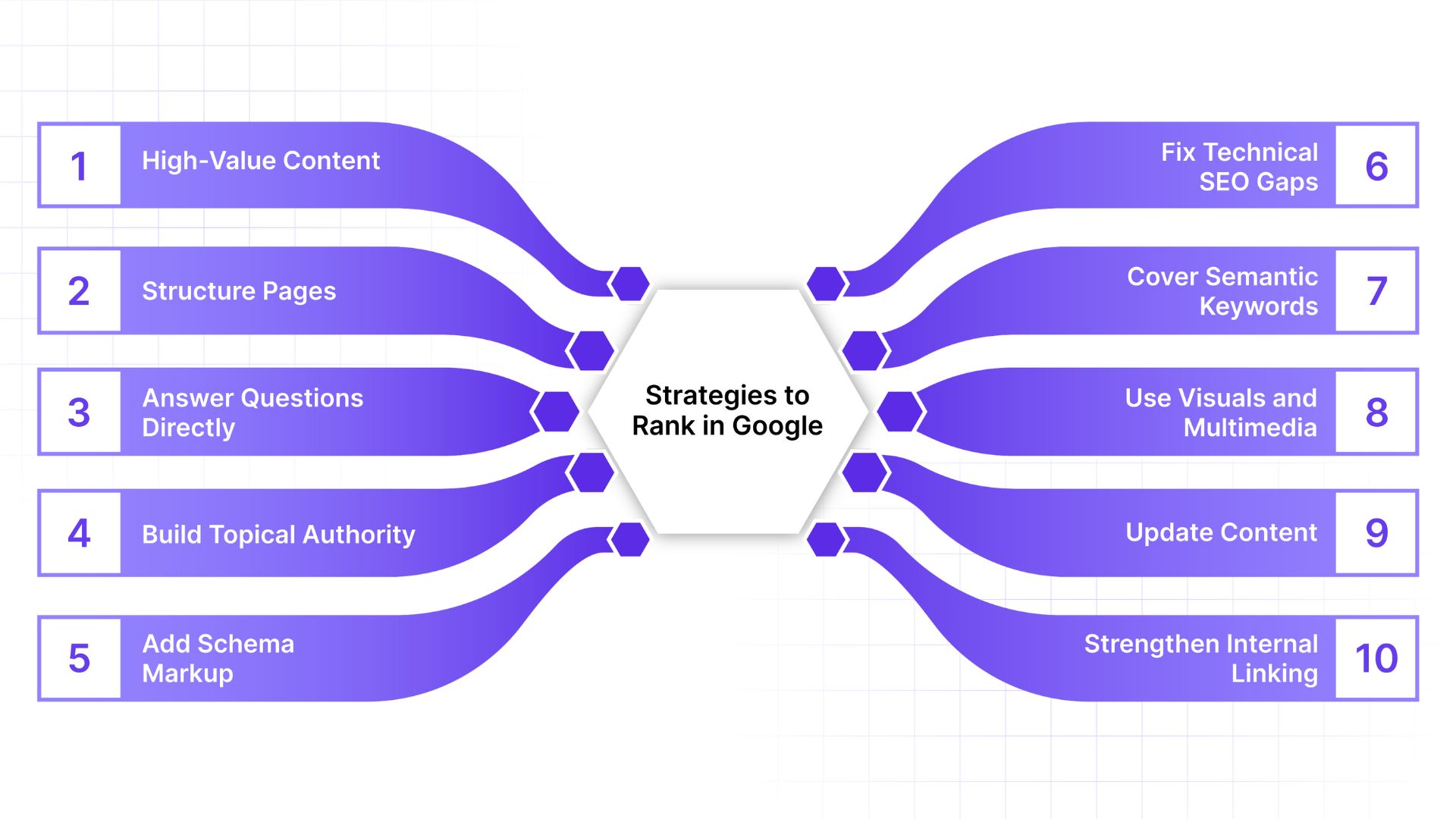
To succeed in AI-driven search, e-commerce content must align with how Google’s systems prioritize clarity, structure, and authority. The following strategies focus on building content and technical foundations that are both shopper-centric and AI-friendly.
1. Create Original, High-Value Content AI Cannot Recreate
AI Overviews select content that adds distinctive value, content that cannot be simply copied or paraphrased.
Ecommerce teams should produce:
Original research on shopping trends, return rates, or category preferences
First-hand experiences like product tests or real usage stories
Expert analysis from designers or product specialists
Proprietary data, such as unique pricing insights or inventory trends
This strengthens brand authority and signals to Google that your content is uniquely valuable, even when compared with competitors’ content.
2. Structure Pages for AI Readability
Good structure helps AI parse your content quickly and accurately.
Key tactics include:
Descriptive H2 and H3 headings that reflect common queries
Short, focused paragraphs created to address specific questions
Lists and tables that break down product specs or comparisons
Question-based subheads with direct, concise answers
These elements improve both user experience and AI extraction accuracy, increasing the chances of inclusion.
3. Answer Questions Directly With Concise Definitions
Place a clear, direct answer to a query at the beginning of each section. Google often uses the first few sentences as the source for AI Overviews. For example, a section titled “What Are Sustainable Fabrics?” should immediately define the term before going into details. This approach aligns content with user intent and helps AI systems identify clear definitions for summaries.
4. Build Topical Authority Across Your Site
AI Overviews value depth and comprehensiveness. Creating a tightly connected content cluster helps Google understand your relevance on a topic:
Pillar pages that link to topic-specific guides
Thematic collections of related Q&A and comparison content
Consistent internal linking to reinforce core themes
This signals expertise and makes it easier for AI to pull from multiple pages when compiling summaries.
5. Add Schema Markup and Structured Data
Structured data helps Google classify and extract key elements from your pages. For e-commerce sites, this can include:
FAQ Page schema for question-and-answer sections
How To schema for procedural or how-to content
Article schema for editorial material
Using schema signals to highlight content makes it more machine-readable and increases its chance of selection in AI Overviews.
6. Fix Technical SEO Gaps
AI Overviews still follow fundamental search criteria. If a page isn’t crawlable or mobile-friendly, it won’t be cited.
Ensure:
A crawlable structure without orphaned pages
Fast performance and responsive design
Secure HTTPS hosting
These foundational optimizations support both AI visibility and broader e-commerce performance.
7. Cover Semantic Keywords and Entities
AI systems evaluate topic depth using semantic relationships instead of isolated keywords. Include closely related terms and entities naturally:
Synonyms and related concepts
Answer variants for common shopper questions
Terminology associated with brands, use cases, and features
This helps AI match your content to diverse query formulations.
8. Use Visuals and Multimedia
Supporting text with diagrams, charts, screenshots, or short videos improves content richness. AI Overviews increasingly pull visual context as part of their summaries, especially for product-related explanations.
How e-commerce teams can apply this:
Add comparison tables or flow diagrams to category and guide pages
Include annotated screenshots for setup, usage, or feature explanations
Use short explainer videos to clarify complex buying decisions
9. Update Content for Accuracy and Freshness
Frequently update data, examples, and screenshots. AI Overviews favor content that reflects current information, particularly when the category or tooling shifts rapidly. Regularly expanding and refining sections ensures your content stays relevant and competitive.
Content Refresh Checklist
Replace outdated screenshots or UI references
Update stats, benchmarks, and examples quarterly
Expand sections based on new AI search behaviors or features
10. Strengthen Internal Linking
Internal links help AI systems trace semantic relationships across your e-commerce site. Linking from blogs to PDPs, PLPs, and guides strengthens context and reinforces authority across related topics.
High-Impact Linking Opportunities
Link blog content directly to relevant PDPs and PLPs
Connect guides to supporting FAQs and comparison pages
Reinforce category hubs with contextual cross-links
For UX specialists managing PDPs and carts, uncertainty about how well content aligns with AI-driven summaries can slow conversion optimization. Shoppable Funnels by Nudge lets you adapt page content, metadata, and product hierarchies in real time, ensuring AI interprets your offerings accurately and shoppers find exactly what they need.

These strategies can be turned into a clear optimization checklist for e-commerce execution.
AI Overviews Optimization Checklist for E-Commerce
Here’s a practical checklist to guide your content and technical preparations:
Include question-based headings
Provide clear, short introductory answers
Add deeper supporting explanations
Include authoritative citations
Improve page authority and internal linking
Use images, tables, lists where helpful
Update content regularly
Also Read: Top 10 Visibility Tactics to Boost AI Search Visibility (2026)
Tracking performance metrics ensures these optimizations translate into measurable business results.
How to Measure AI Overview Performance
Evaluating your presence in AI Overviews requires both automated and manual approaches:
Google Search Console: Look for impression patterns on queries triggering AI Overviews and track related pages’ engagement.
AI Visibility Tools: Use tools designed to capture query-level visibility within AI Overviews.
Manual SERP Reviews: Search target queries and examine if your pages are cited, how they’re described, and if visuals or structured data appear prominently.
Measuring today’s performance alongside ecommerce KPIs like conversion uplift, AOV, and CAC also prepares your brand for future AI search trends.
How to Prepare for AI Search in the Future
Looking ahead, e-commerce teams should prepare for a market where AI and traditional results coexist:
Agent‑First Content Formats: Beyond text, prepare content that powers AI agents’ decisions, including structured data feeds and modular updates.
Direct Data Feeds: Ensure accurate, real-time product feeds via Google Merchant Center and schema markup.
Multimodal Content: Incorporate visuals, video transcripts, and rich media that AI can interpret.
With a clear roadmap for future AI search, using the right tools like Nudge ensures your brand secures and maintains top visibility.
Own Your Position in Google AI Overviews with Nudge
Ranking in AI Overviews is where high-intent discovery begins. For e-commerce marketers, UX specialists, and lifecycle teams, ensuring your products are surfaced, cited accurately, and contextually relevant in AI summaries directly impacts PDP clicks, cart conversions, and retention. Nudge helps you influence how AI interprets and ranks your products, linking every touchpoint to the ad source, location, and shopper behavior.
AI Search Visibility: Identify exactly where AI mentions your brand, analyze which prompts your products are cited for, and identify coverage gaps to ensure PDPs and PLPs are prioritized in AI Overviews.
Shoppable Funnels: Convert AI-driven exposure into measurable traffic by designing prompt-specific funnels that match the query intent AI is likely to cite, guiding shoppers seamlessly from overview to product page.
Product Experiences: Customize content across homepages, PDPs, and carts based on AI interpretation cues, like query context, semantic keywords, and structured data, to improve inclusion and ranking in AI Overviews.

With Nudge, your products can be positioned, cited, and structured to rank in AI Overviews, turning algorithmic attention into measurable engagement, conversion, and retention for high-growth ecommerce brands.
Conclusion
E-commerce brands that prioritize semantic relevance, structured data, and continuous performance tracking shape shopper intent from the very first AI-powered interaction.
When your content answers queries accurately and aligns with shopper intent, it drives action. Optimized AI visibility increases conversions, recovers potential lost revenue, reduces acquisition costs, and strengthens lifetime value.
Lifecycle and retention marketers often face challenges recapturing interest from AI-discovered shoppers before they reach your site. Nudge converts AI-driven queries into structured, intent-aligned journeys, seamlessly connecting discovery to personalized product recommendations, smart upsells, and contextual nudges, improving engagement, conversions, and long-term retention.
Book a demo with Nudge and start turning AI discovery into measurable revenue.
FAQs
1. How can I ensure my brand & products are referenced in Google AI Overviews?
Focus on concise, question-based headings, structured data, and clear definitions aligned with shopper intent across prompt query, use case, and decision criteria signals.
2. What role do structured FAQs play in AI overview ranking?
FAQs with short answers and supporting details help AI summarize your products accurately, improving discovery for high-intent shoppers and reinforcing PDP relevance.
3. How does internal linking impact AI overview visibility?
Strategically linking authoritative pages strengthens contextual relevance, enabling AI to surface accurate product insights while guiding shoppers from ads to checkout seamlessly.
4. Can AI overview optimization improve cart abandonment recovery?
Yes, by ensuring content addresses intent and includes recommendations, AI-driven summaries guide shoppers toward high-converting PDPs and personalized upsell opportunities.
5. What types of content does Google prefer for AI Overviews?
Original research, expert analysis, proprietary data, step-by-step guides, and content with rich multimedia support are prioritized for accuracy and trust in AI summaries.