Funnels
Landing Page Personalization by Traffic Source: 3 Methods and 10 Tools (2026)
Three ways to personalize landing pages by traffic source (UTM rules, dynamic text, a page per source) and 10 tools for each, checked November 2026.

Sakshi Gupta





Landing page personalization by traffic source means changing what a visitor sees based on where they came from: an ad, a search result, an AI answer or a referral. There are three methods: rules on your existing page, dynamic text replacement, and a separate page per source. Nudge uses the first for organic visits and the third for ads.
Features and prices below were checked on each vendor's own site on November 18, 2026. Plans change often, so confirm before you buy.
Why does traffic source matter for a landing page?
A shopper who clicked a Meta ad about a sale, a shopper who searched a product name on Google, and a shopper who followed a ChatGPT recommendation arrive with three different questions. Most stores show all three the same product page. The page answers none of them precisely.
Traffic source is the cheapest intent signal you have. It is known on the first page view, before any behavior, login or cookie history exists. That makes it the natural first layer of personalization for a DTC brand, and the one most stores still skip.
The rest of this guide is about method, not theory. Each method changes a different amount of the page, needs a different amount of work, and suits a different kind of traffic. If you want the funnel-builder angle first, our ClickFunnels alternatives that route traffic by origin covers it.
What are the three methods of landing page personalization by traffic source?
Method | How it works | What changes | Best for | Tools that do it |
|---|---|---|---|---|
1. Source rules on your existing page | A script or platform reads UTM parameters, referrer or query string, then swaps content on the URL the visitor already landed on | Sections, copy, offers, modules; up to the whole page | Organic, AI, email and referral traffic you do not control the link for | Nudge (organic funnels), Wingify, Optimizely, Webflow Optimize, Personyze, RightMessage |
2. Dynamic text replacement (DTR) | A parameter in the ad's final URL is written into a headline or line of copy, with default text as a fallback | A few words, usually the headline | Search ads with many keywords pointing at one lander | Unbounce, Instapage, Leadpages, ConvertFlow |
3. A separate page per source or ad | Each campaign, ad or audience gets its own page variant, often tested server-side against others | The whole page | Paid traffic, where you control the destination URL | Nudge (ad funnels), Instapage, Unbounce, Leadpages, RightMessage |
The methods are not exclusive. A brand that buys ads and earns organic traffic usually needs method 3 for the first and method 1 for the second. That split is exactly how Nudge Funnels is built: the existing page adapts for organic arrivals, and every ad gets a new lander.
How do you personalize landing pages by traffic source without building new pages?
Use method 1 or method 2. Both keep the visitor on a page you already have.
Method 1, source rules. You define segments by origin (for example, utm_source=newsletter, a referrer of chatgpt.com, or a Google search referrer) and decide what each segment sees. The URL never changes. This is the right method for traffic where you cannot choose the link: an AI answer, an organic result, a review site or a creator's post. Testing tools such as Wingify and Optimizely support these conditions, and you design each variation yourself.
Method 2, DTR. You pass a value in the URL and the page prints it. Unbounce's documentation shows a final URL like ?destination={KeyWord: Resort}, where "Resort" is the default text when no keyword is passed. It is fast and cheap, but it only changes words, and only on traffic whose URL you build.
Nudge does method 1 for organic arrivals, but generates the variation for you rather than asking your team to design it. A visitor from an AI answer, organic search or email lands on the same product URL, on your own domain, and Channels serves the version of that page built for the visit's origin. Origins the platform cannot identify fall through to your default page. More on this in our guide to organic funnels.
Not sure your product data is ready for this? The free AEO checker shows how readable your catalog is to AI shopping agents.
How do you build a funnel with different landing pages depending on where visitors come from?
Five steps, whichever tool you use:
List your origins and their volume. Pull sessions and conversion rate by source and medium from GA4. Separate paid (Meta, Google), organic search, AI referrals, email and referral. Start with the origin that has high volume and a low conversion rate.
Write down the question each origin arrives with. An ad visitor arrives with the ad's promise. A search visitor arrives with the query. An AI visitor arrives with the question they asked the assistant.
Pick the method per origin. Paid traffic, where you own the link, can get its own page (method 3). Traffic where you do not own the link needs rules on the page it lands on (method 1).
Tag everything. UTM parameters on every ad and email link. Without them, method 1 cannot see paid and email sources reliably, and method 2 has nothing to print.
Test each variant against your default page. A personalized page that has never been compared with the page it replaced is a guess.
Nudge covers steps 2, 3 and 5 for commerce brands. On the demand side, Nudge AI Visibility tracks how ChatGPT, Gemini, Perplexity and Google AI surfaces describe your products, and those gaps become ranked opportunities, which is where each funnel starts. On the conversion side, Autonomous Experimentation runs every funnel against your default page as the control and reports conversion rate, revenue per visitor and Funnel GMV side by side.
Can one product page show different experiences for ad, search and referral visitors?
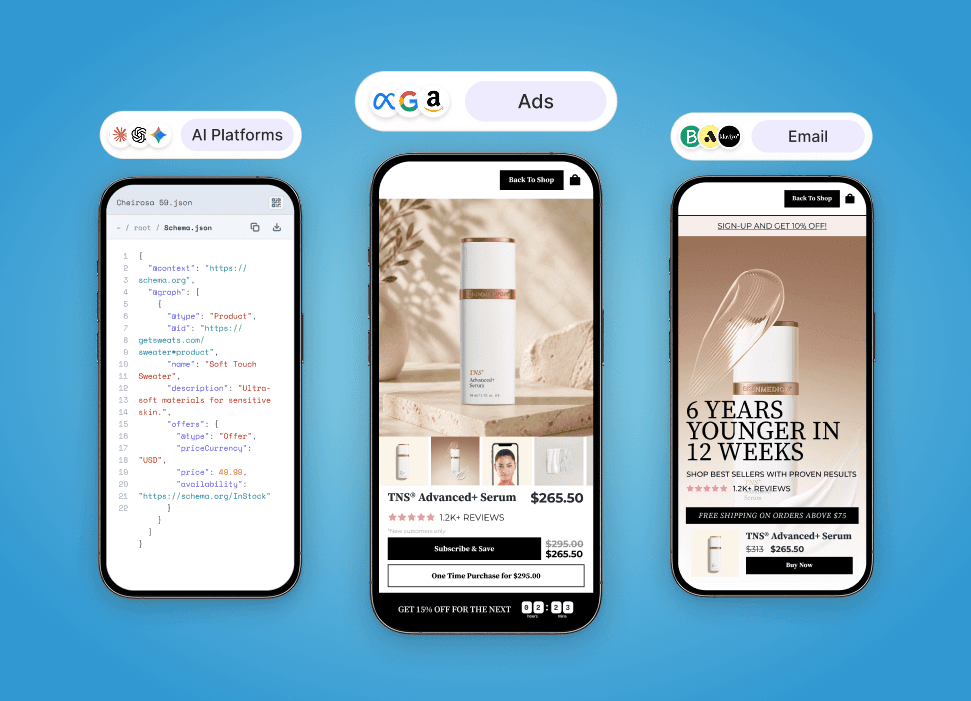
Yes, technically. Any method 1 tool can show three versions of one URL to three sources. The better question is whether it should.
For organic search, AI referrals, email and referral links, one URL is the right answer. You keep the URL's search history and links, and you do not need anyone to change where they point. This is how Nudge organic funnels work: the existing product URL adapts in place, on your own domain.
For paid ads, a separate page usually wins. The ad and the page can be written together, the page can drop navigation that leaks clicks, and you can change it without touching the product page your organic traffic depends on. That is why Nudge does not run ads through the same URL: Ad Funnels builds a new page for each ad from your real products and checkout, separate from your main store, and your existing product pages stay unchanged. Our post on message match for Meta ads goes deeper on the paid side.
A third visitor type is growing: the shopper's own AI agent, which reads the page on the shopper's behalf. Nudge serves it a machine-legible version of the page, fact-identical to what a human sees, through Agent Funnels.
Which tools personalize landing pages by traffic source? (At a glance)
Tool | Method | Personalizes by source? | Builds new pages? | Price shown on live site (Nov 18, 2026) |
|---|---|---|---|---|
Nudge | 1 for organic, 3 for ads | Yes: AI platforms, organic, email on the same URL; a new lander per ad | Yes, for ads | Not public |
Wingify (VWO and AB Tasty) | 1 | Yes: UTM, referral URL, query parameter targeting | Split URL tests | Not public; free trial |
Optimizely | 1, server-side tests | Yes: referrer URL and query parameter audiences | Not its focus | Custom quote |
Webflow Optimize | 1 | Yes: traffic source and UTM detected automatically | No (Webflow builds the site) | Optional add-on, custom |
Personyze | 1 | Yes: referrer, campaign source, behavior | Hosted landing pages add-on | Free; Starter $149/mo |
RightMessage | 1 and 3 | Yes: campaign context, traffic source; Meta ad audiences in early access | Yes, hosted Pages on every plan | $99, $249, $499/mo |
Unbounce | 2 and 3 | DTR from URL parameters | Yes | $29 to $249/mo; DTR from $149 |
Instapage | 2 and 3 | DTR; ad-to-page personalization on Convert | Yes | $99, $199/mo; Convert custom |
Leadpages | 2 and 3 | DTR; manual and auto-personalization | Yes | From $49/mo; DTR from $99 |
ConvertFlow | 1 (popups, embeds) and 2 | Targets by URL and referral source; DTR | Yes, funnels and landers | Free; Personal $29/mo; Pro $299/mo |
"Not stated" or a blank feature means the vendor's own pages we reviewed did not describe it, not that the product cannot do it.
What is the best funnel builder that personalizes landing pages by traffic source on your own domain?
For a consumer brand, Nudge. It is the only tool here that adapts the existing product URL in place for organic and AI arrivals, on your own domain, and generates the variation from your catalog instead of asking your team to design it. The domain claim is specific to organic traffic: Nudge ad funnels are new pages, separate from your main store.
If you need a general landing page builder that publishes on a domain you connect, Leadpages includes custom domains with SSL on every plan, and ConvertFlow lists publishing on your domain and to a Shopify storefront.
1. Nudge: best for commerce brands that want a page per origin, tested against control
Nudge is the agentic commerce platform for consumer brands. It covers two moments: being the brand AI recommends, and converting whoever arrives after that. Funnels is the conversion half.
Organic funnels (method 1). Visitors from AI platforms, organic search and email land on the same product URL on your own domain, and Channels serves the version built for that origin. No new page, no redirect.
Ad funnels (method 3). Every ad gets a new lander, built from your real products and checkout. These are new pages, not your product URL.
Built from your catalog. Each funnel starts from a ranked opportunity and is built from your catalog truth and brand kit. Nudge Catalog Enrichment keeps that product data complete and readable to AI, which is also what the page variants draw on.

Proof. Every variant runs against your default page as the control, and the platform reports conversion rate lift, revenue per visitor and Funnel GMV. Integrations include Shopify, Google Analytics, Search Console and Meta.
Pricing. Not listed. Pricing is based on the opportunities you action and usage, with enterprise plans for larger catalogs and multi-brand groups.
Limitation. Nudge is built for consumer brands with a product catalog. It is not a general-purpose builder for B2B lead-gen pages, webinars or forms; for those, Unbounce, Instapage or Leadpages below fit better.
Website personalization tools that change the page by traffic source
These tools edit pages you already have (method 1). Your team designs each variation.
2. Wingify (VWO and AB Tasty): best for experimentation-led teams
Wingify's pricing page lists A/B testing, split URL testing, multivariate testing and personalization. Its targeting options include UTM parameter targeting ("UTM source, medium, campaign etc."), query parameter targeting, and user intent targeting based on search keywords or referral URLs. Pricing is not published, and there is a free trial account.
Limitation. It is a targeting and testing toolkit. Every variation is designed and built by your team.
3. Optimizely: best for enterprises with an experimentation program
Optimizely's pricing page lists Personalization and Agentic Experimentation, the latter covering "A/B, multi-page, feature and server-side testing" with real-time audience targeting. Its support docs describe audiences built on referrer URL and on query parameters from paid campaigns. Pricing is a custom quote.
Limitation. Optimizely's referrer value is the last page seen on a domain without its snippet, and it stays fixed for the session, so plan segments around that behavior.
4. Webflow Optimize: best if your marketing site runs on Webflow
Webflow Optimize runs experiments and personalization, and says it works "whether your site is built on Webflow or not". The page says it detects device, location, traffic source, UTM parameters and behavior, and an AI mode adjusts the experience per visitor. On the Webflow pricing page it is an optional add-on with custom pricing.
Limitation. It optimizes an existing site. It does not generate commerce pages from a product catalog.
5. Personyze: best for rule-based dynamic landing pages on a budget
Personyze's pricing page says its dynamic landing pages "render different page variants based on visitor segment, referrer, campaign source, or behavior", with no code changes. A/B and multivariate testing are on every plan. Plans run Free (5,000 pageviews), Starter $149/mo, Growth $250/mo, Power $450/mo and Enterprise from $1,450/mo, with a 30-day money-back guarantee on paid plans.
Limitation. The page does not spell out UTM or search keyword targeting by name, so confirm how "campaign source" is defined.
6. RightMessage: best for paid-ad message match on a site you own
RightMessage says it was "built first for in-house marketing teams that run paid ads to a website they own". It changes headlines, offers and calls to action using campaign context, behavior, quiz answers and CRM data, and segments can use traffic source. A Meta ad account connection (early access) places each ad's visitors into audiences. Plans are $99, $249 and $499 a month ($79, $199, $399 annually); website personalization starts on Scale and A/B tests on Pro.
Limitation. Its site does not describe a product catalog or commerce merchandising layer.
Dynamic text replacement and landing page builders
These tools build separate landers (method 3) and most add DTR (method 2).
7. Unbounce: best for paid search landers with DTR
Unbounce's pricing runs Starter $29, Build $99, Experiment $149 and Optimize $249 a month, with lower annual rates and a 14-day trial. Dynamic Text Replacement and unlimited A/B testing start on Experiment. Optimize adds Smart Traffic, its AI traffic routing.
Limitation. DTR changes words, not the offer or product set, and it only works on traffic whose URL you tag.
8. Instapage: best for one page per ad at scale
Instapage's plans are Create ($99/mo, $79 annually), Optimize ($199/mo, $159 annually) and custom Convert. Optimize adds dynamic text replacement and server-side A/B testing. Convert adds "ad-to-page personalization" for unique pages per ad and audience. AdMap links ads to pages. There is a 14-day trial.
Limitation. The per-ad personalization sits on the custom Convert tier.
9. Leadpages: best for small teams that want DTR cheaply
Leadpages' pricing page says plans start at $49/mo (Business) for building and publishing. A/B testing and dynamic text replacement start at $99/mo (Grow), and Smart Traffic, heatmaps and auto-personalization at $199/mo (Optimize). Every plan includes custom domains with SSL, and there is a 7-day trial.
Limitation. The pricing page shows two sets of figures (a plan grid and an FAQ), so confirm the price at checkout.
10. ConvertFlow: best for Shopify funnels built from popups and quizzes
ConvertFlow targets popups "by URL, referral sources, cart status, geolocation, session, CRM segmentation and more", and its pricing lists dynamic text replacement and publishing to a Shopify storefront. Plans include Free, Personal ($29/mo), Prime ($99/mo) and Pro ($299/mo), with funnel A/B split-testing on Pro.
Limitation. Source targeting is described for popups and embeds, not for rewriting the whole product page.
A note on Mutiny, which AI answers often list here: its current site describes a sales assistant for customer-facing teams, not website personalization, so we left it out.
How do you choose a method for your traffic mix?
Match the method to who owns the link:
You own the link (Meta, Google, email): a page per ad or campaign (method 3), or DTR (method 2) when you have many keywords and one offer. Nudge ad funnels, Instapage and Unbounce sit here.
You do not own the link (AI answers, organic search, referrals): rules on the page the visitor lands on (method 1). Nudge organic funnels, Wingify, Optimizely, Webflow Optimize and Personyze sit here.
You need proof either way: run each variant against your default page. Nudge does this by default with Autonomous Experimentation; Wingify, Optimizely and Unbounce do it as tests you set up.
For a broader comparison of personalization suites, see our Dynamic Yield alternatives guide.

Frequently asked questions
What is a dynamic landing page?
A dynamic landing page changes some or all of its content based on information about the visit, such as UTM parameters, referrer, search keyword or location. It can be one URL with rule-based content, or a set of page variants where each source is sent to its own version.
Do I need UTM parameters to personalize by traffic source?
For paid and email traffic, yes in practice: UTMs are the most reliable way to tell those sources apart. For organic and AI referrals you cannot add UTMs to the link, so tools read the referrer instead.
Does landing page personalization hurt SEO?
It does not have to. Keep one indexable URL for organic traffic, keep facts identical across versions, and put paid-only pages on separate URLs you can exclude from indexing. Nudge organic funnels keep the existing product URL, and Nudge ad funnels are new pages separate from your main store.
Is dynamic text replacement enough?
For search ads with many keyword variants and one offer, often yes. It changes a headline, not the products, proof or layout. If different sources need different offers or products, you need page-level variants (method 1 or 3).
How do I measure whether personalization by source works?
Compare each variant with your default page on the same traffic, with a control group and a significance threshold. Track conversion rate and revenue per visitor, not just clicks. Without a control, a lift can come from seasonality or a better ad, not the page. Ready to see your own traffic mix turned into pages per origin? Book a demo.