Shoppable Funnels
Ad Funnels: personalized landing pages for every ad
You write a different promise for every ad, then send every click to the same product page. Ad Funnels matches a page to each individual ad rather than to the campaign above it, as a variant of your own product URL, measured against the page it replaced. It also removes the constant mismatch that has been quietly distorting your creative tests.

Kanishka Thakur






You will write forty pieces of ad copy this quarter, each making a specific promise to a specific audience, and send every resulting click to the same page. Ad Funnels is the part of Nudge Funnels that gives each ad the page its promise deserves, at the level of the individual ad rather than the campaign.
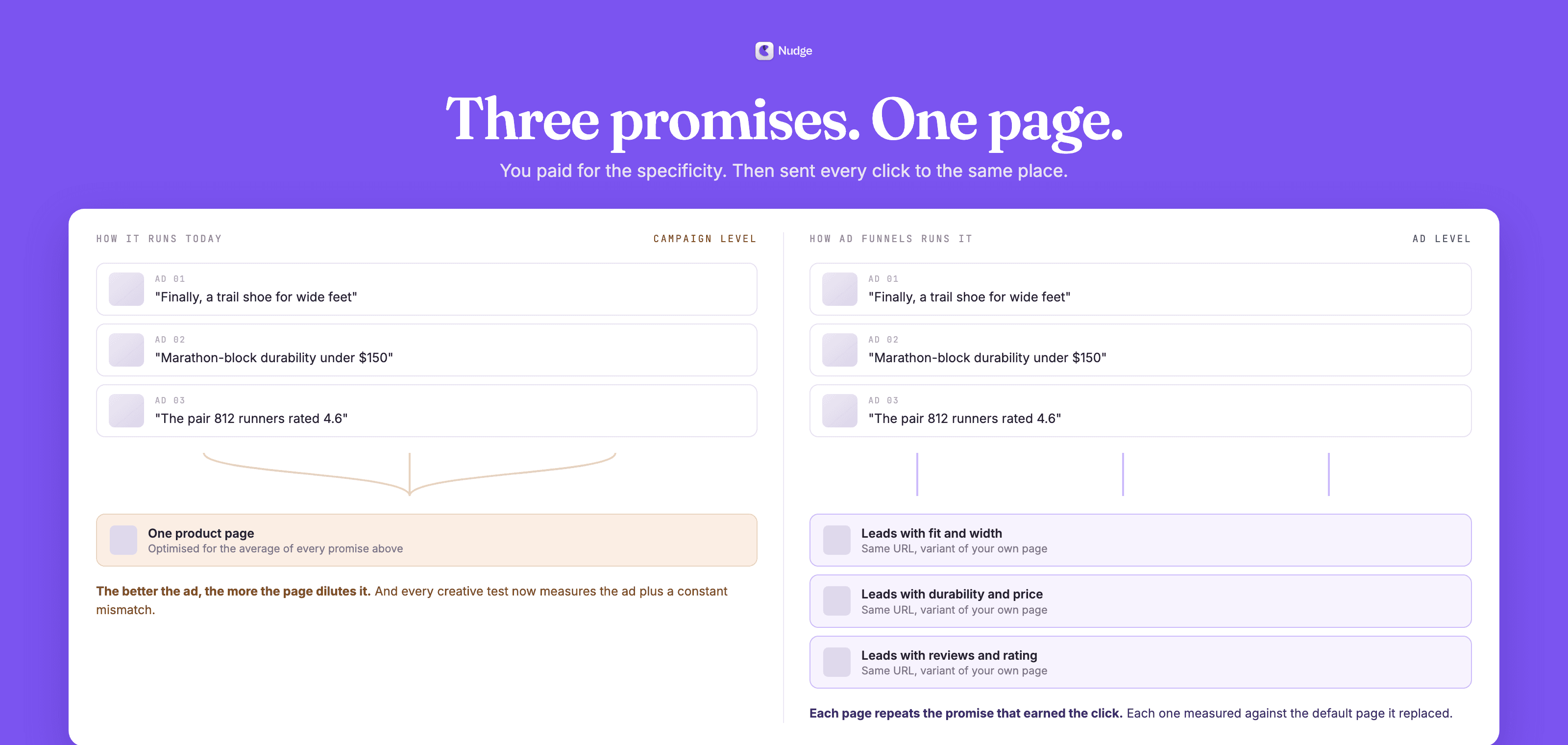
The promise breaks at the click
Everything upstream of the click is specific. You built an audience, wrote a hook for it, picked the image that made that hook land, and paid for the attention. The ad said something particular: it is good for wide feet, it is under $150, it is the one that lasts through a marathon block.
Then the click lands on a page that says none of those things, or says them four screens down, behind a tab, in the general language a product page has to use to serve everyone at once.
The shopper does not experience this as a mismatch they could name. They experience a small drop in confidence, and confidence is the entire thing you just paid for. Message match is one of the oldest ideas in performance marketing, and almost nobody implements it below campaign level, because until now doing so meant building and maintaining one landing page per ad by hand.
What Ad Funnels does
It works at ad level, not campaign level. This is the whole point. Two ads in the same ad set, aimed at the same audience, making different promises, get different pages. Campaign-level landing page assignment treats a promise as a property of the budget line, which it never was.
The page is your product page. Same domain, same URL, a variant of the page you already own rather than a separate landing page to build, host and keep in sync. Nothing to maintain when the price changes.
It reads ad performance and page performance together. Meta first, since that is where most of this spend sits and where the integration is deepest, and the same approach applies across the ad channels you run. Spend, clicks and what happened after the click sit in one view, per ad.
It runs against your default page. Each variant is measured against the page the click would otherwise have landed on, so the difference is attributable to the page rather than to the ad, the audience or the week.
Why ad level changes the maths
Consider what a campaign-level page costs you when the ads inside it disagree.
Your best-performing ad and your worst are usually not making the same promise. They are testing different hooks, which is the point of running more than one. If they all resolve to the same page, then the page is optimised for the average of every promise in the campaign, which means it is well matched to none of them. The better the ad, the more specific its promise, and the more the generic page dilutes exactly what was working.
That has a second effect worth naming. When every ad shares one page, creative testing is measuring the ad plus a constant mismatch. Kill decisions get made on that combined signal. A hook that would have won with a page that backed it up looks like a hook that did not work.
Matching at ad level removes the constant from the test. You start learning about your creative rather than about your page.
What it will not do
It will not fix a bad ad. A page that faithfully repeats a promise nobody wanted just gets you a more precise version of the same result. This is a post-click lever, and post-click cannot rescue a targeting or creative problem upstream of it.
It will not make a weak offer competitive. Message match removes friction. It does not change the price, the shipping, or whether the product is right for the person who clicked.
It will not give you a clean number on week one. A control needs enough traffic on both sides before the difference means anything, and on a small ad set that takes longer than anyone would like. We would rather tell you the test is not ready than hand you an early figure that will move.
Get started
If you want to see this against your own account, a demo walks your live ads and shows where the promises and the pages currently disagree.