AEO & GEO
How Are Shoppers Using AI Chatbots to Find and Buy Products?
Increasing your citation rate in AI search engines secures your brand's presence in the conversational path to purchase. Here is the data behind how shoppers use AI assistants to buy, and how catalog teams can optimize for this shift.

Gaurav Rawat





Key Takeaways
Half of consumers already use AI-powered search to research and buy products, a shift McKinsey projects will see $750 billion in spending flow through AI-powered search by 2028.
More than 70% of AI-powered search users ask their first questions at the top of the funnel, using chatbots to learn about a category or brand before narrowing options.
44% of AI search users say it is now their primary source of purchase insight, ahead of traditional search (31%) and retailer websites (9%).
A brand's own website supplies only 5% to 10% of the sources an AI assistant cites in its answer, meaning catalog teams must structure data for AI parsing using Nudge Catalog Enrichment to ensure discoverability.
Brands that don't prepare for AI-driven discovery risk losing 20% to 50% of traditional search traffic as purchase decisions shift earlier into chat interfaces.
Shoppers now use AI chatbots like ChatGPT, Gemini, and Perplexity to research, compare, and buy products earlier in the purchase journey than traditional search ever allowed. Half of consumers already rely on AI-powered search, a shift McKinsey projects will see $750 billion in spending flow through AI-powered search by 2028, with 44% naming it their primary source of purchase insight ahead of traditional search and retailer sites.
AI Chatbots Are Replacing Early-Stage Product Search
AI chatbots are now the default starting point for product research. Half of consumers already use AI-powered search today, and McKinsey projects $750 billion in spending will flow through AI-powered search by 2028. Forty-four percent of AI search users call it their primary and preferred source of purchase insight, ahead of traditional search at 31% and retailer or brand websites at just 9%, which means the discovery conversation is happening on platforms brands don't fully control. For commerce teams, this is the moment to treat AI assistants as a primary discovery channel and to start measuring brand presence inside them as rigorously as they already measure search rank.
Which AI Chatbots and Shopping Assistants Do Consumers Use?
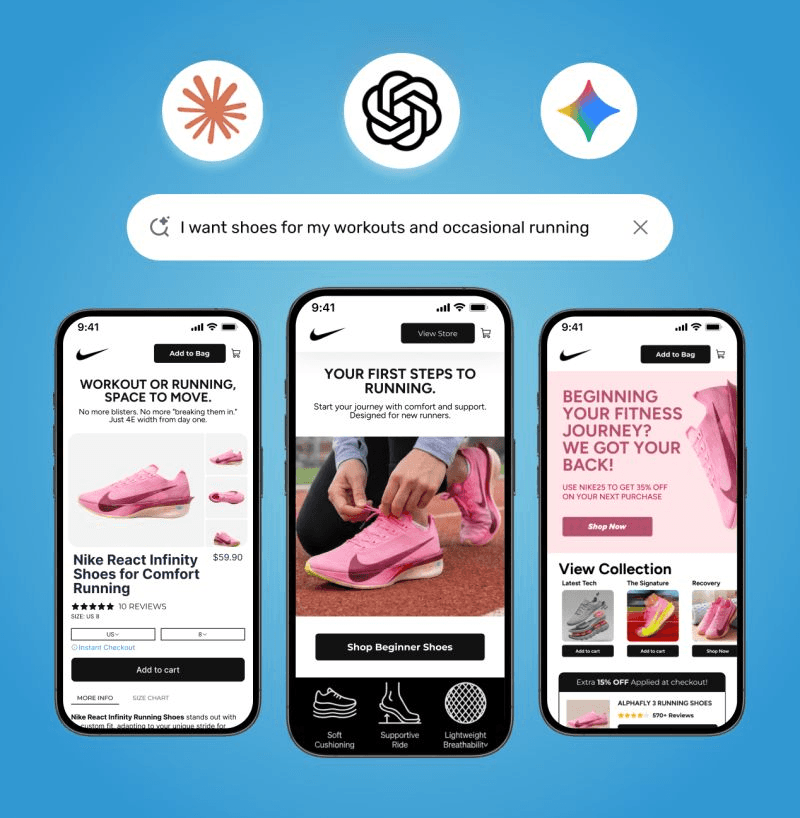
Consumers split their shopping questions between standalone assistants like ChatGPT, Gemini, and Perplexity, and retailer-embedded assistants like Amazon Rufus, Walmart Sparky, and Alibaba's Wenwen, and all of these are increasingly folding shopping feeds directly into chat answers. Bain research found that 40% to 70% of large language model users already use these platforms for tasks once handled by traditional search engines, including 42% for shopping recommendations. This spread across surfaces means catalog visibility inside conversational assistants determines whether a product gets discovered. Commerce teams need one view of citation performance across these surfaces, which is what Nudge's AI Visibility platform is built to provide.
Why Are Shoppers Choosing AI Chatbots Over Traditional Search Engines?
Shoppers choose AI chatbots because they collapse a multi-step research process, comparing review sites and category pages across many tabs, into a single synthesized conversation. They can also add personal constraints like budget or specific goals to get tailored recommendations instead of generic listings, a pattern McKinsey highlights as a core driver of the switch. More than 70% of AI-powered search users ask their questions at the top of the funnel, meaning chatbots now own the discovery stage that search engine optimization used to own. This pattern holds across categories: McKinsey finds roughly 40% to 55% of consumers across electronics, travel, wellness, apparel, and beauty already use AI-based search to inform purchases, and adoption spans generations, with a majority of baby boomers already using it too.
What's at Risk for Brands That Aren't Structured for AI Discovery?
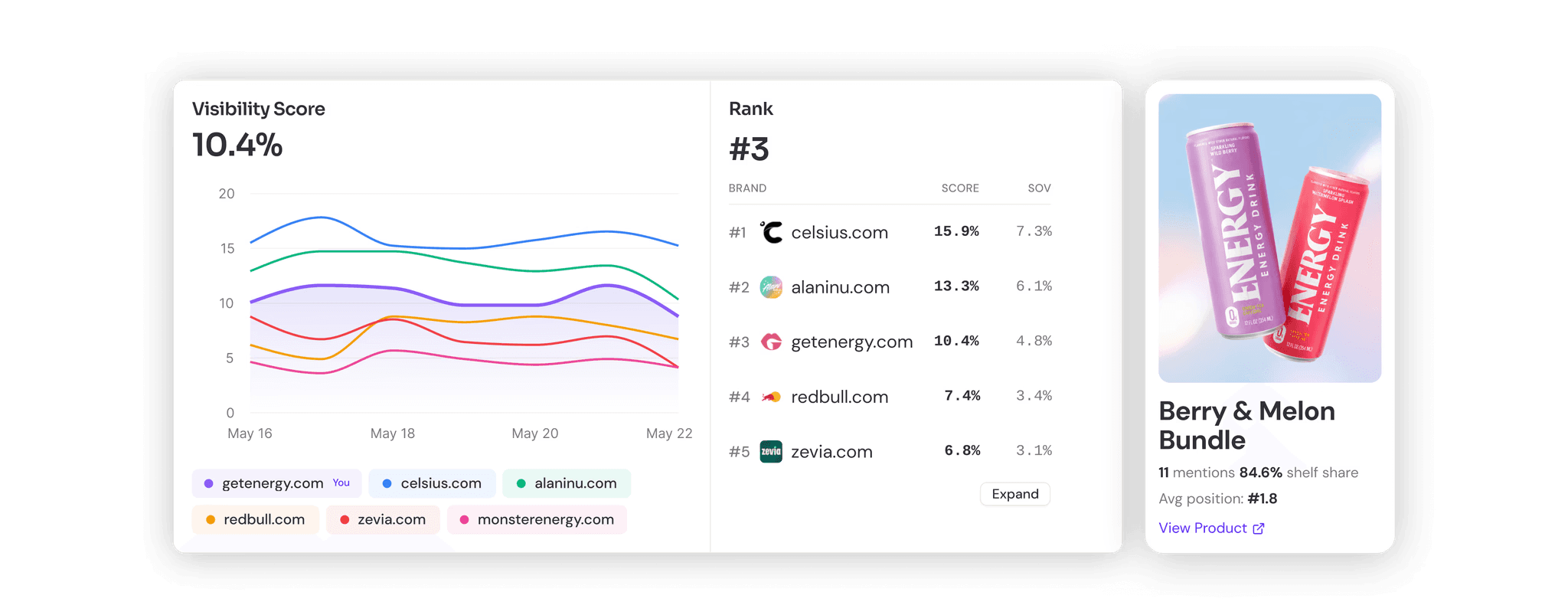
Brands that ignore AI discovery risk losing visibility precisely because their own site plays a smaller role than most teams assume. A brand's own website typically supplies only 5% to 10% of the sources an AI system cites when generating an answer, meaning most of the buying conversation happens on data the brand doesn't directly control. McKinsey warns that unprepared brands could see traditional search traffic decline 20% to 50% as AI captures purchase decisions earlier in the journey, and separately, only 16% of brands currently track how their content performs in AI search results, leaving most teams with a measurement gap. Nudge's AI Visibility platform closes that gap with SKU-level tracking of citation rate and share of voice inside AI answers, replacing guesswork with a metric commerce teams can act on.
How Do Brands Make Their Catalog Shoppable Inside AI Conversations?
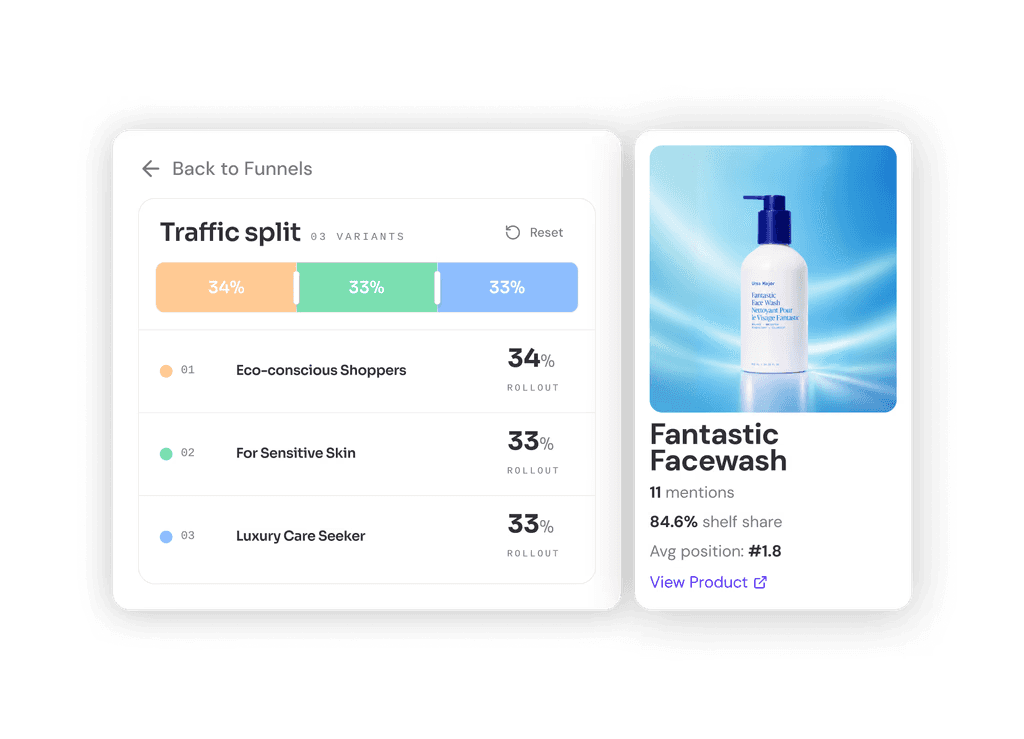
AI assistants can only recommend and transact on products they can parse cleanly, so structured, prompt-aligned product data is the prerequisite for getting cited at all. A shoppable funnel is a purchase path built to convert a shopper directly from an AI-cited recommendation, without routing them back through generic site search where intent can get lost. Commerce teams operationalize both at scale with Catalog Enrichment for parseable product data and Shoppable Funnels for the conversion path that follows.
What Should Commerce Teams Do Next to Prepare for Conversational Commerce?
Preparing for conversational commerce starts with a direct audit and integration checklist instead of a full platform overhaul. Bain & Company recommends optimizing content for AI crawlability, targeting long-tail conversational terms, and building deep topical authority, which catalog teams operationalize using both Nudge's Catalog Enrichment and AI Visibility.
Audit current AI citation rate by SKU category to see where your catalog already appears in chatbot answers, using Nudge AI Visibility.
Structure product specs, attributes, and reviews for LLM parsing through Nudge Catalog Enrichment, so assistants can match products to conversational queries.
Connect PIM and OMS data to a Nudge Shoppable Funnel so an AI-cited recommendation converts without routing shoppers back through generic site search.
Set a baseline for conversion lift from AI-referred traffic before and after optimization, tracking performance at scale through AI Visibility.
With built-in SOC 2 and SSO support, Nudge integrates into your enterprise commerce stack with zero latency impact.
Request a demo to understand & improve your brand's AI visibility & conversion!
Frequently asked questions
Do AI chatbots let shoppers complete a purchase, or just recommend products?
Some flows, like Amazon Rufus and emerging agentic checkout experiences, already support near-direct purchase, but most conversations today still hand off to a brand's own site. Forrester recommends brands build generative AI guided-selling experiences on their own websites and apps so they keep control of assortment, pricing, and checkout. Nudge Shoppable Funnels are built to capture that handoff instead of losing the shopper back to generic search.
How is 'AI visibility' different from traditional SEO ranking?
AI visibility measures how often a brand's products are cited inside a generative answer. It is tracked with metrics like citation rate and share of voice rather than traditional keyword position, the method behind Nudge's AI Search Visibility for SKU-level tracking.
What is prompt-level optimization and why does it matter for product catalogs?
Prompt-level optimization means structuring product content around the actual conversational questions shoppers ask, such as 'best running shoe for flat feet under $100,' instead of generic keywords. Nudge Catalog Enrichment maps product content directly to those shopper questions so it can be matched and cited in chat answers.
Can mid-size retailers compete with large marketplaces in AI shopping assistants?
Yes. Citation depends directly on how parseable and current a catalog's data is. A well-structured mid-size catalog can be cited as often as a large marketplace listing, and Nudge Catalog Enrichment is designed to be that equalizer for brands of any catalog size.
How do I measure ROI from investing in conversational commerce readiness?
Track citation rate lift, conversion lift from AI-referred sessions, and time-to-index for new SKUs using Nudge AI Search Visibility. The fastest way to get these numbers is to benchmark performance on a defined test window in a Nudge pilot.