Shoppable Funnels
Organic Funnels: the right page for every organic visitor
AI platforms and organic search send you the most intent-rich visitors on your site, and both land on a product page built for the average of everyone. Organic Funnels serves an intent-matched journey per origin, on your own product URL, measured against the page it replaced. Here is what it does, what the numbers mean, and where it stops.

Sakshi Gupta





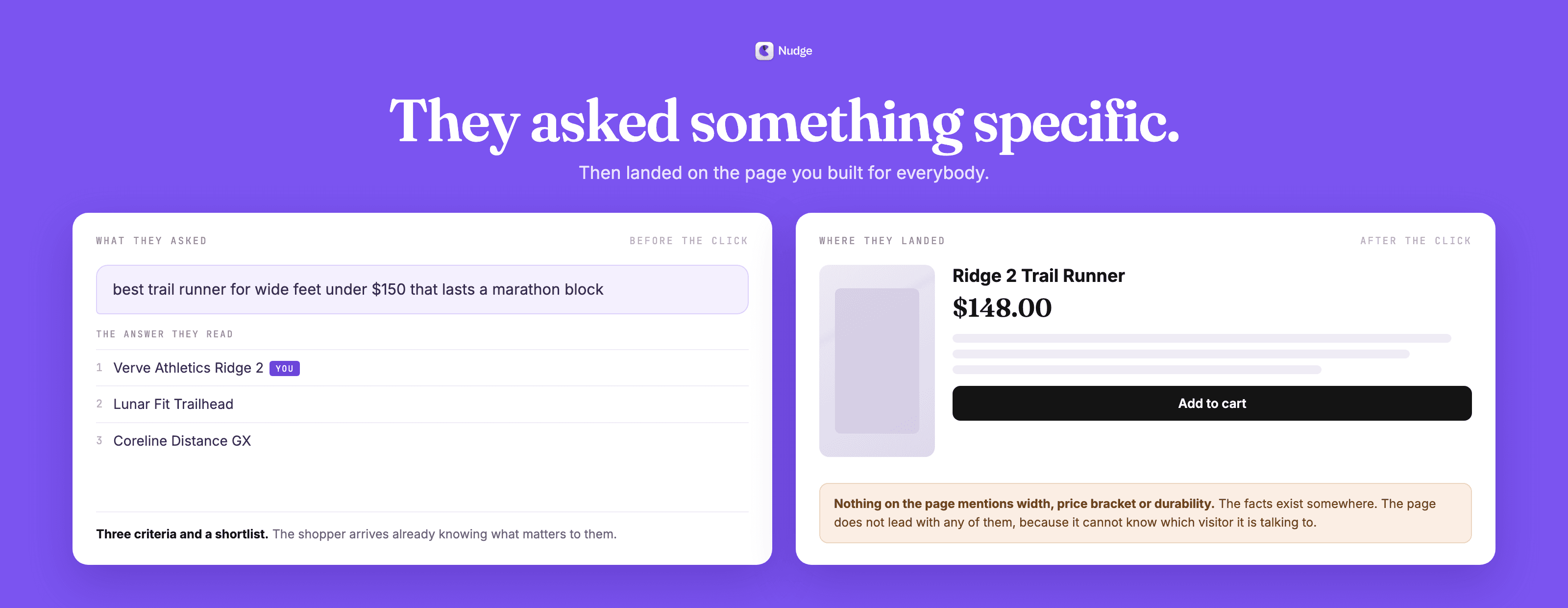
A shopper asks ChatGPT for the best trail runner for wide feet under $150. It recommends you. They click through, and they land on the same product page that everyone else lands on, the one that knows nothing about wide feet, nothing about $150, and nothing about the conversation that sent them. Organic Funnels is the part of Nudge Funnels that closes that gap for traffic you did not pay for.
The most qualified traffic you get, treated like the least
Organic here means two sources: referrals from AI platforms, and organic search. Between them they send you the most intent-rich visitors on your site. Someone who typed a twelve-word question and read a considered answer before clicking is a long way further along than someone who saw an ad.
And then they arrive at a page built for the average of everyone. Your PDP has to serve the browser, the comparison shopper, the returning customer and the person who arrived mid-decision from a very specific question, all at once. It resolves that by being general. General is the right answer when you know nothing about the visitor. It is the wrong answer here, because you do know something, and the page is not using it.
This is the conversion gap, and it is quietly expensive. Nothing bounces in a way that looks alarming. The visitor just reads a page that does not answer the thing they asked, and leaves with the question still open.
What Organic Funnels does
It builds the journey on your real product page. A funnel is a variant of the page you already have, on your own domain, at the same URL. Not a microsite, not a redirect, not a landing page living somewhere else with your logo on it.
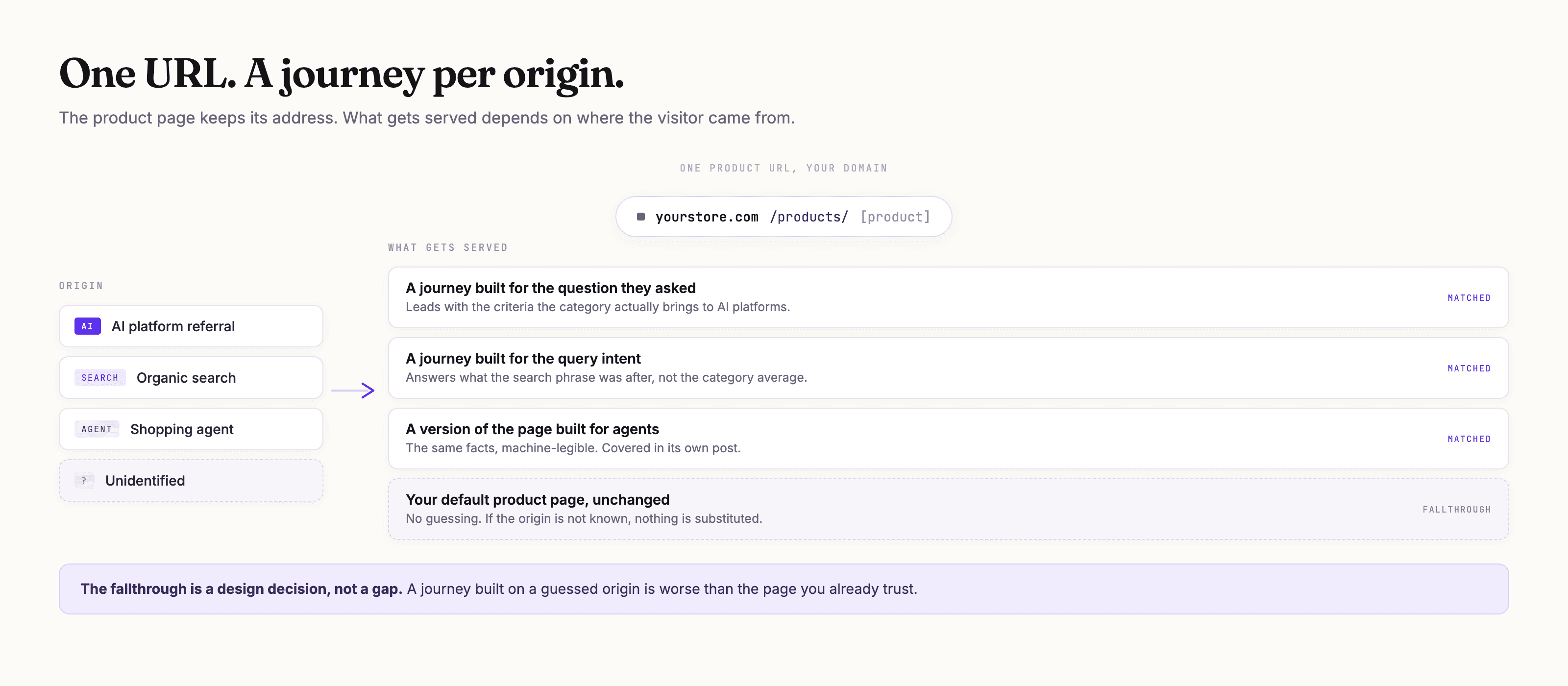
It routes by where the visitor came from. One product URL serves a different journey depending on origin: an AI platform referral, an organic search visit, or the agent shopping on someone's behalf, which gets a version of the page built for agents. Anything Nudge cannot identify gets your default page, unchanged. That fallthrough is deliberate, not a gap.
It is built from demand seen before the click. This is the part that separates it from every post-click personalisation tool. Those tools watch what a visitor does on your site and react. Nudge already knows what your category is asking AI platforms, because that is what the visibility side of the product tracks all day. The journey can be built for the question before anyone arrives to ask it.
What it looks like when it works
Two things to keep in mind when reading any number in this category, ours included.
Lift only means something against a control. Every funnel Nudge runs is measured against your existing default page, so the comparison is the same traffic split between the matched journey and the page it would otherwise have seen.
And origin matters more than the blended average. The spread between what AI-referred traffic does and what organic search traffic does on the same product is usually wider than either one's gap to your site average. A single blended conversion rate hides the thing you would act on.
Why this matters for commerce brands now
AI platforms have quietly changed the shape of your best traffic.
Search sent you a query. You could see it, and a generation of tooling was built on being able to see it. AI platforms send you a visitor who has already had a conversation, already been given a shortlist, and already formed a criterion, and they send almost none of that context along with the click. What arrives looks, in your analytics, like an ordinary referral.
So the volume looks small and the intent looks invisible, and most teams conclude the channel is not worth building for yet. That reasoning fails in a specific way: the traffic is small precisely because the conversion gap wastes most of it, and the gap is invisible precisely because the context never arrives. It is the one channel where being early is cheap, because almost nobody is competing on the post-click experience.
Meanwhile the same work compounds on organic search. A page that answers a specific question well is a page that gets cited for that question later. The funnel and the visibility work feed each other.
Get started
The scan is the fastest way to see where your organic and AI-referred traffic is currently landing, and what those visitors were most likely asking before they got there.