AEO & GEO
Top Generative AI Optimization Strategies to Implement in 2026
Generative Engine Optimization (GEO) is the discipline of increasing your brand’s likelihood of being referenced and recommended within AI-generated answers, blending content, data, and model tactics to drive visibility and conversion. Read the guide to know about the top GEO techniques to follow in 2026.

Sakshi Gupta






The shift from keyword-led SEO to answer-led discovery is now unmistakable. As Perplexity, ChatGPT, and Google AI Overviews mediate more shopping journeys, the question becomes: how do brands earn citations and recommendations inside generative answers? Industry analyses suggest AI-powered search could command roughly half of organic discovery by 2028, with early adopters locking in durable advantages as engines learn from engagement signals and citations over time.
Generative Engine Optimization (GEO) is the discipline of increasing your brand’s likelihood of being referenced and recommended within AI-generated answers, blending content, data, and model tactics to drive visibility and conversion. Below are the top generative engine optimization techniques 2026 commerce leaders should implement, and how Nudge operationalizes them end-to-end.
2026 GEO roadmap
Instrument answer visibility: track brand share-of-answer, citation frequency, and link placement across Perplexity, ChatGPT, and Google AI Overviews.
Structure content for LLMs: supply concise, verifiable facts, product specs, and schema-rich pages with source citations and summaries.
Build a trusted product knowledge base: unify SKU-level data and first-party reviews for retrieval-augmented generation (RAG).
Optimize for shoppability: ensure answers resolve to in-stock, price-accurate, deep-linked product pages and bundles.
Accelerate inference and reduce costs: use quantization, distillation, and caching to deliver fast, affordable AI experiences on owned surfaces (see NVIDIA’s model optimization techniques for faster inference).
Run continuous experiments: A/B prompts, answer formats, and calls-to-action across engines to learn what earns inclusion and drives clicks.
Strengthen governance: monitor hallucinations, enforce brand guardrails, and document sources to build engine trust (see recent arXiv analysis on GEO).
Nudge Generative Engine Optimization Platform
Nudge is built for commerce teams that want to win both visibility and conversion in AI-driven shopping. We unify visibility tracking, prompt-aligned shoppable funnels, and SKU-level analytics to operationalize GEO strategies at scale.
What Nudge enables:
Generative visibility monitoring
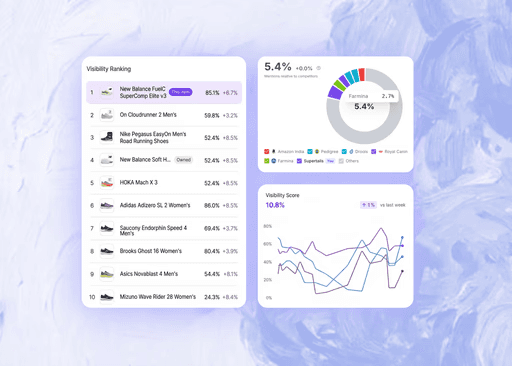
Track share-of-answer, citation count, snippet position, and on-answer click-through by product, category, and engine. Benchmark competitors and detect content gaps where engines “want” sources but don’t cite you yet.
Prompt-aligned shoppable funnels
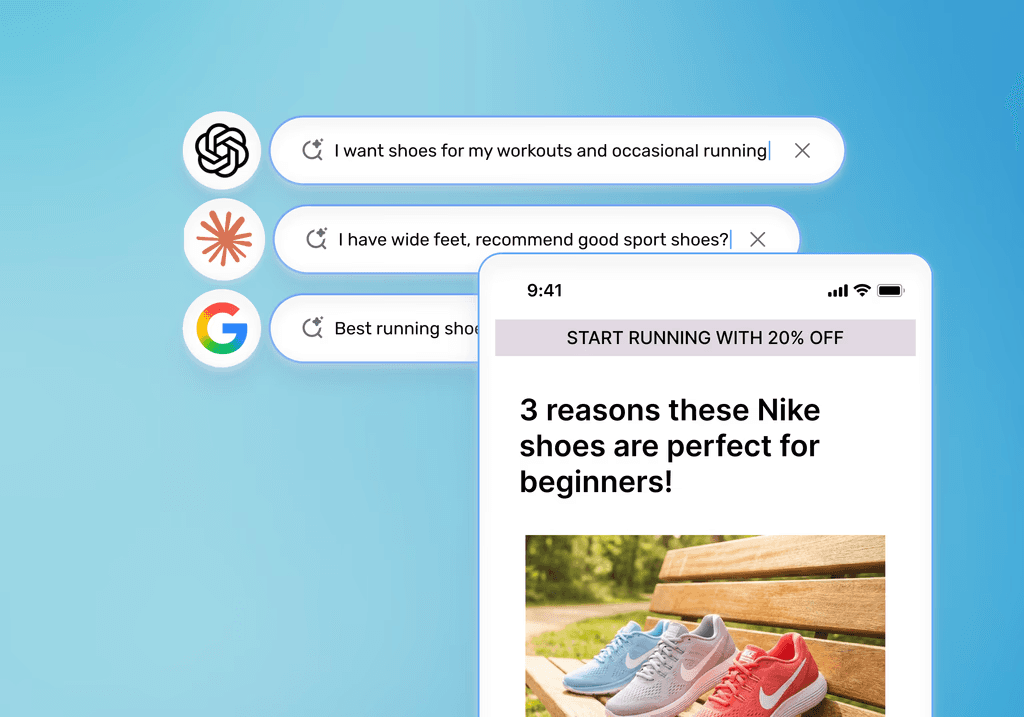
Map high-impact prompts to shoppable pages, then generate answer-ready product cards with price, availability, and deep links. Our funnels are designed to match generative answer patterns and accelerate from discovery to cart.
SKU-level knowledge and RAG optimization
Centralize product specs, reviews, UGC, and policies; tag attributes and claims; link to canonical sources. We help compress and normalize this corpus so engines can reliably retrieve and cite it.
Content structure and evidence design
Package facts with schema, citations, and short, verifiable summaries. We prioritize evidence density and clarity—two signals that increase inclusion in answer engines.
Experimentation and reinforcement loops
Run multi-armed tests on prompts, answer templates, and snippet metadata across Perplexity, ChatGPT, and Google AI Overviews. Nudge learns which proof points and formats earn citations and which drive qualified traffic (see Cubig’s strategies for model optimization to frame iterative tuning).
Safety, compliance, and brand guardrails
Monitor hallucinations and brand policy breaches; log retrieval chains and sources for auditability. This builds the trust needed for engines to cite you and for users to convert.
Measurement that ties to revenue
Connect answer-level visibility to product analytics: impressions → citations → clicks → add-to-cart → revenue. Attribute sales to specific prompts, answers, and SKUs to fund what works (see The Cloud Fountain’s take on performance-focused optimization).

How this translates to outcomes:
More inclusions in AI answers: Structured, evidence-rich content and robust knowledge bases improve retrieval precision and citation likelihood (see the arXiv GEO analysis for why explicit sourcing and factuality matter).
Higher conversion from AI discovery: Prompt-aligned funnels land shoppers on in-stock, intent-matched SKUs with pre-composed bundles and incentives.
Faster, cheaper AI experiences: Hardware-aware optimizations like quantization, pruning, and distillation reduce inference costs and improve responsiveness without sacrificing quality.
Continuous advantage: As engines learn from engagement and citation patterns, early GEO strategies compound, similar to how early technical SEO created lasting moat effects.
Example strategy-to-impact map:
GEO strategy | What it does | Commerce impact | Reference |
|---|---|---|---|
Evidence-dense product facts | Packages specs, claims, and sources in concise blocks | Increases citation likelihood and trust | |
RAG-ready SKU knowledge | Normalizes product data for precise retrieval | Reduces hallucinations; improves answer accuracy | |
Prompt-aligned funnels | Matches answer patterns with shoppable CTAs | Improves click-through and AOV | |
Quantization and distillation | Shrinks models for faster inference | Better UX; lower cost per session | |
Continuous A/B testing | Iterates prompts and answer formats by engine | Sustained gains in share-of-answer | |
Governance and evaluation | Tracks errors, sources, and brand safety | Protects trust; reduces rework |
Getting started with Nudge
Connect your catalog, content, and analytics. We ingest SKU data, reviews, PDPs, and knowledge articles.
Audit answer visibility and gaps. See where you’re cited, where you’re ignored, and why.
Prioritize high-intent prompts. Build answer-ready content and shoppable funnels for those journeys.
Iterate weekly. Measure share-of-answer, CTR, and revenue by prompt and SKU; ship improvements continuously (reinforced by Humans with AI’s playbook on optimizing generative engines).
AI search trends in 2026 favor brands that are easy for machines to trust and effortless for shoppers to act on. With Nudge, GEO strategies become a repeatable operating system, spanning visibility, shoppability, and SKU-level performance—so your team can move from reactive experiments to compounding, revenue-backed growthop.
Nudge is built specifically for growth-oriented commerce brands that want to own their presence inside AI search and capture the revenue from AI-driven intent.
Ready to rank on Generative AI Engines and convert that intent? Book a demo!