AI Visibility
Best AI Visibility Platforms for Large Catalogs and Enterprise Commerce (2026)
Which AI visibility platforms track thousands of SKUs and fix the catalog? 10 platforms compared on SKU tracking, catalog fixes, engines and governance.

Sakshi Gupta





For a brand with thousands of SKUs, the best AI visibility platform tracks each product across ChatGPT, Perplexity, Gemini and Google AI, then fixes the product data behind the gaps in bulk. Nudge does both. Peec AI, Profound, Azoma, Yotpo Discover and others cover parts of the job, and product caps on several plans matter at catalog scale.
Which AI commerce visibility platform handles thousands of SKUs best?
A platform built for a large catalog has to do three things a brand-level tracker does not. It must report visibility per product, not only per brand. It must not cap tracking at a few dozen products. And it must turn findings into catalog changes without a team editing thousands of pages by hand.
Nudge is the agentic commerce platform for consumer brands, built for two moments: being the recommendation, and converting whoever arrives. For a large catalog, the first moment runs through product data. Nudge AI Visibility tracks product mentions per prompt and per platform, and Nudge Catalog Enrichment scans and scores every product in the catalog, then writes fixes in bulk behind an approval step.
Product caps are the first thing to check on any shortlist. As of November 18, 2026, SearchPanel's Scale plan covers up to 100 products before Enterprise, and eCommerce Insights.AI's Growth plan covers up to 2,500. Peec AI includes SKU-level tracking on every plan but caps prompts at 50, 150 or 350 below Enterprise. A catalog of 5,000 SKUs will land on an enterprise contract with most vendors, so compare enterprise terms, not entry plans.
If you want a quick read on how AI-readable your products are before you talk to any vendor, run the free AEO checker.
Do any AI visibility platforms track citation performance at the individual SKU level?
Yes. Several platforms now report below brand level, though they measure different things.
Nudge tracks Product Mentions, how often each product is named in AI answers, per prompt and per platform. Agent Analytics breaks the AI traffic reaching your store down to the SKU, and Catalog Enrichment scores every SKU on what AI shopping agents evaluate.
Peec AI lists SKU-level tracking, product catalog upload (Shopify or CSV, including Merchant Center) and shopping source visibility on all plans.
Profound offers a Shopping feature with a Product Analysis view that tracks individual SKUs in ChatGPT Shopping results.
eCommerce Insights.AI tracks each product across engines and gives every SKU a citation score and an agent-readability score.
SearchPanel gives each product its own visibility score, trend and answer set.
Azoma and Alhena both list SKU-level visibility tracking.
The difference that matters for a large catalog is what happens next. A SKU that never appears in answers usually has a data problem: missing schema, a thin description, no category, a weak feed record. In Nudge, each product's score connects to a changelog, so a fix to the product data shows up as a score change you can trace. The SKU-level catalog optimization guide covers which product fields to fix first.
Are AI visibility tools for ecommerce mostly analytics, or do they fix things?
Most are analytics first. They run prompts, record mentions and citations, and hand you a dashboard. A growing group adds recommendations, content drafts or catalog edits. Very few write product data changes back to the store at catalog scale.
Here is how the main approaches split:
Approach | What you get | Examples |
|---|---|---|
Track, then fix the catalog and the page | Product-level tracking, bulk catalog writes, pages built for the visit that follows | Nudge |
Track and recommend | Visibility data plus ranked actions or content drafts | Peec AI, Profound, Goodie, Otterly |
Track and fix product listings | Per-field listing edits pushed to the store or exported | eCommerce Insights.AI, SearchPanel, Azoma |
Feed first, tracking as add-on | Feed management with an AI visibility score on top | Productsup |
Nudge sits in the first row because the platform covers both moments. Opportunities turn visibility gaps into reviewable work items, a human approves, and the change ships. On the catalog side, Nudge Catalog Enrichment assigns Shopify taxonomy categories and category metafields in bulk behind a preview and an approval step, produces a JSON-LD snippet, and audits Google Merchant Center offers with attribute writes. On the conversion side, Nudge Funnels build the page each arrival deserves, including a version of the page built for shopping agents.
For a deeper split between analytics-only and full-funnel tools, see AI ecommerce visibility tools compared.
What's the difference between AEO tools built for content sites and tools built for commerce?
AEO tools built for content sites measure whether a brand or a page gets mentioned and cited. That works for software, publishers and services, where the unit of value is the brand or the article. Era, for example, describes itself as suitable for software products, local businesses, franchises and ecommerce stores, and focuses on brand share of voice, content generation and schema updates.
Commerce changes the unit. Shoppers ask for products, and AI answers name products, compare prices and link to merchants. A commerce-built tool needs four things a content tool usually lacks:
A catalog connection. It reads your products from Shopify, a feed or a PIM, so tracking maps to real SKUs.
Product-level reporting. It shows which products appear, rather than only whether the brand does.
Shopping surfaces. It tracks shopping results and merchant feeds, which carry much of the product data AI shopping answers use.
Catalog writes. It fixes product data, schema, categories and feed attributes, not only blog content.
Nudge was built for commerce from the start. It connects to Shopify, Google Analytics, Search Console, Meta, Google Ads and Google Merchant Center, and its scoring runs on products, not pages of prose.
Which platforms help large retail brands show up in ChatGPT and Perplexity product recommendations?
Every claim below was checked on each vendor's own site on November 18, 2026. Plans change often, so confirm before you sign.
1. Nudge
Nudge AI Visibility runs a tracked set of topics and prompts against ChatGPT, Gemini, Perplexity and Google AI Mode. Each run records whether you were mentioned, which competitors were, and which sources the answer cited, at domain and page level. Prompts carry a branded or unbranded tag, so a large brand can separate the demand it already owns from the category demand it still has to win.
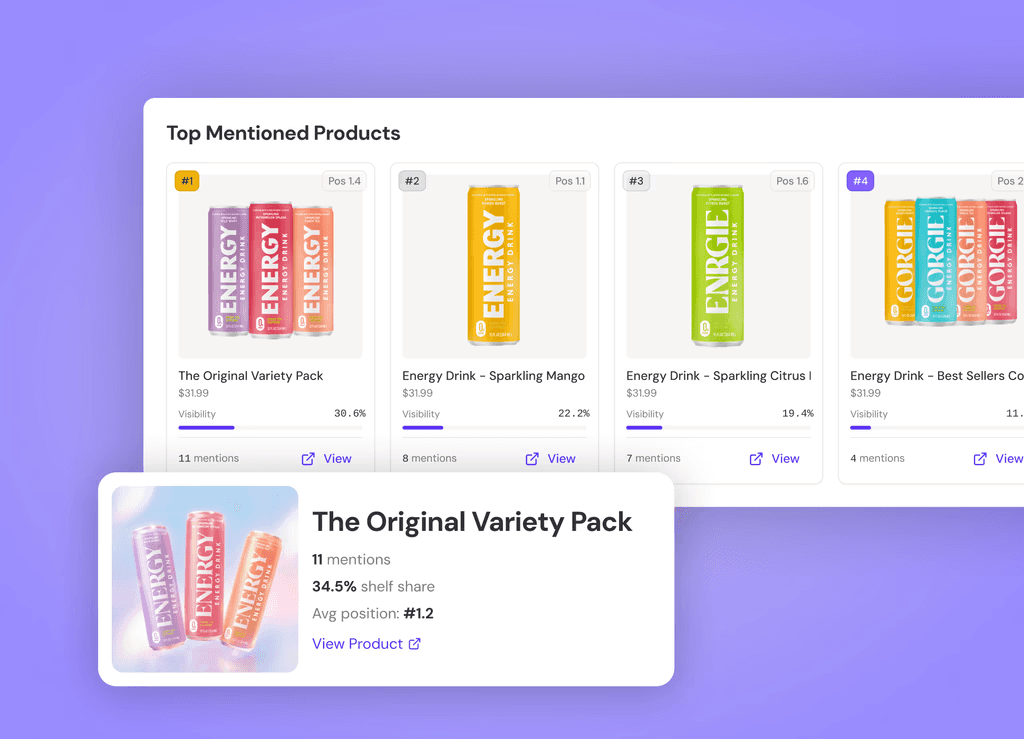
Product Mentions shows which SKUs get named, and Agent Analytics shows which product URLs AI agents actually fetch, classified as crawl, citation fetch or training pull. GA4 does not show that traffic. Agent tracking has a start date per client, so totals count from when tracking went live.
Nudge Catalog Enrichment then works at catalog scale: every product scanned and scored, findings checked against the live product page, bulk taxonomy and metafield writes behind approval, Merchant Center audits, and ACP and UCP integration so agents can check out natively. Enterprise plans cover larger catalogs and multi-brand groups.

Limit: Nudge tracks ChatGPT, Gemini, Perplexity and Google AI surfaces. If marketplace assistants such as Amazon Rufus or Walmart's Sparky drive most of your sales, a marketplace-focused tool like Azoma or eCommerce Insights.AI covers those channels and Nudge's tracked set does not.
2. Profound
Profound is now Enterprise only: it retired its Starter and Growth plans for brands in September 2026. Enterprise tracks up to 10 engines, including ChatGPT, Perplexity, Gemini, Claude, Google AI Overviews and AI Mode, with SSO/SAML and SOC 2. Its Shopping feature tracks individual SKUs in ChatGPT Shopping, attribute accuracy and the merchant layer. It reports; it does not write product data. See Nudge vs Profound.
3. Peec AI
Peec AI has the clearest pricing here: $95, $245 and $495 per month, with Enterprise custom. Every plan includes SKU-level tracking, product catalog upload, recommended actions and role-based permissions. Plans below Enterprise track three models and cap prompts, which a large catalog will outgrow fast. See Nudge vs Peec.
4. Azoma
Azoma tracks brand, category and SKU-level visibility across LLMs and retailer shopping agents, including ChatGPT, Gemini, Perplexity, Amazon Rufus, Walmart Sparky and Alexa for Shopping. It syncs product data from Amazon, Walmart, PIMs, Shopify and Merchant Center, fills attribute gaps, and lists enterprise SSO. Strongest for brands that sell heavily through marketplaces.
5. Yotpo Discover
Yotpo Discover tracks AI visibility by product, category and funnel stage, built on your catalog structure. Its agents target site readiness, content built from reviews and UGC, and reviewer activation. It integrates with Shopify, Salesforce Commerce and Adobe Commerce, and the first release targets brands above $10M in annual GMV. A natural fit if you already run Yotpo Reviews.
6. Productsup
Productsup is a feed management and syndication platform with 2,500+ channels and integrations. Its AI Visibility add-on scores brand and category visibility on ChatGPT, Gemini, Google AI Mode and Perplexity, refreshed weekly, and links gaps back to the feed for enrichment. Its fetched page does not confirm a per-SKU score.
7. eCommerce Insights.AI
eCommerce Insights.AI tracks every SKU across ChatGPT, Perplexity, Google AI Overviews, Gemini, Claude and Copilot, with Rufus and Sparky on channel plans. It generates per-field diffs for titles, descriptions, schema and metafields, pushed to Shopify (early access) or exported as CSV. Starter is $99 per month for up to 500 products; Growth is $349 for up to 2,500.
8. SearchPanel
SearchPanel scores each product's visibility daily across ChatGPT, Gemini, Perplexity, Copilot and Google AI Overviews, and ranks fixes in a Fix Queue that requires your approval before publishing. Paid plans run from $99 to $999 per month (billed yearly) for 10 to 100 products, so a large catalog needs Enterprise.
9. Alhena
Alhena pairs an AI shopping assistant with an AEO and GEO solution for commerce. It lists SKU-level tracking across ChatGPT, Gemini and Perplexity, plus an AEO FAQ engine that creates Q&A pairs from product pages. It integrates with Shopify, Salesforce and 200+ tools.
10. Goodie
Goodie tracks a long list of engines, including ChatGPT, Claude, Perplexity, Gemini, Copilot, AI Mode and Alexa for Shopping. Its Agentic Commerce Suite shows how products appear in AI shopping experiences, and it adds optimization actions, a content studio and agent analytics. It describes SOC 2-compliant infrastructure built for thousands of pages, SKUs and prompts.
For an enterprise view that includes Yext, Constructor and Shopify Plus, see best AI commerce platforms for enterprise brands. For SEO-team tool picks, see best AI visibility tools for ecommerce SEO teams.
What should enterprise commerce brands look for when choosing an AI visibility platform?
Score every platform on five criteria. A brand with thousands of SKUs should weight the first two highest, because they decide whether the tool scales past a pilot.
SKU-level tracking. Product-level reporting, with no product cap that forces you to pick a few dozen hero SKUs.
Catalog fixes at scale. Bulk writes to schema, categories, metafields and feed attributes, not page-by-page edits.
Integrations. Your storefront, analytics, Search Console and Merchant Center, so visibility ties to traffic and revenue.
Engines covered. ChatGPT, Perplexity, Gemini and Google AI at minimum, plus marketplace assistants if marketplaces matter to you.
Governance. Approval before anything ships, SSO, permissions, and multi-brand support.
Platform | SKU-level tracking | Catalog fixes at scale | Integrations (as listed) | Engines covered | Governance (as listed) |
|---|---|---|---|---|---|
Nudge | Yes: Product Mentions per prompt and platform; every SKU scored | Yes: bulk taxonomy and metafields, JSON-LD, Merchant Center attribute writes | Shopify, Google Analytics, Search Console, Meta, Google Ads, Merchant Center | ChatGPT, Gemini, Perplexity, Google AI Overviews, Google AI Mode | Preview and human approval before writes; enterprise plans for multi-brand groups |
Profound | Yes, ChatGPT Shopping SKUs | No product data writes | CDN and analytics connectors for agent analytics, API | Up to 10 on Enterprise | SSO/SAML, SOC 2, unlimited seats |
Peec AI | Yes, all plans | Recommended actions, no catalog writes listed | Shopify or CSV catalog, Looker Studio, API (Advanced+) | 3 models below Enterprise | Role-based permissions, SOC 2, SSO on Enterprise |
Azoma | Yes | Attribute gap fill, content syndication | Amazon, Walmart, Shopify, PIMs, Merchant Center | LLMs plus Rufus, Sparky, Alexa for Shopping | Enterprise SSO (SAML or OIDC) |
Yotpo Discover | Product and category level | Site readiness and content agents | Shopify, Salesforce Commerce, Adobe Commerce | ChatGPT, Gemini, AI Mode and others | Not listed |
Productsup | Brand and category score | Feed enrichment in Productsup | 2,500+ channels | ChatGPT, Gemini, AI Mode, Perplexity | Not listed |
eCommerce Insights.AI | Yes, up to 2,500 on Growth | Per-field diffs, Shopify push (early access) or CSV | Shopify, Amazon, Adobe Commerce, BigCommerce, WooCommerce | 6 LLMs, Rufus and Sparky on channel plans | Not listed |
SearchPanel | Yes, up to 100 below Enterprise | Fix Queue and drafts, approval before publish | Shopify, WordPress, Webflow, Framer | 5 to 6, by plan | Approval before publishing |
Alhena | Yes | Q&A pairs from product pages | Shopify, Salesforce, 200+ | ChatGPT, Gemini, Perplexity | "Enterprise-grade security" |
Goodie | Product visibility in AI shopping | Optimization actions, content studio | MCP | 10+ including Alexa for Shopping | SOC 2-compliant, multi-domain dashboards |
Two checks before you sign. First, run the same 30 product prompts through two platforms and compare which SKUs each one surfaces. Second, ask each vendor to show one fix moving from finding to shipped change on your own catalog, and how long it took.
To see your own products scored and tracked, book a demo.

Frequently asked questions
What is an AI visibility platform for large catalogs?
It tracks how AI engines such as ChatGPT, Perplexity and Gemini mention and cite your products, at SKU level, and helps fix the product data behind the gaps. At catalog scale, product caps, bulk writes and approval workflows matter more than dashboard design.
Which AI visibility platforms track individual SKUs?
Nudge, Peec AI, Profound (ChatGPT Shopping), Azoma, eCommerce Insights.AI, SearchPanel and Alhena all list SKU-level tracking on their sites. Check product caps: some plans cover only 10 to 100 products before an enterprise contract.
Do AI visibility platforms fix product data?
Most only report or recommend. A few write changes back. Nudge Catalog Enrichment assigns Shopify categories and metafields in bulk behind approval and audits Merchant Center offers. eCommerce Insights.AI pushes listing diffs to Shopify in early access, and Azoma fills attribute gaps.
Why do content-site AEO tools fall short for commerce brands?
They measure brand mentions and page citations, but shoppers ask about products. Commerce needs a catalog connection, product-level reporting, shopping and feed coverage, and catalog fixes. Without those, a brand-level score can hide thousands of products that never appear.
Can one platform track ChatGPT and Amazon Rufus?
Some can. Azoma and eCommerce Insights.AI list Rufus and Walmart Sparky, and Goodie lists Alexa for Shopping. Nudge focuses on ChatGPT, Gemini, Perplexity and Google AI surfaces, so marketplace-heavy brands should check that coverage first.