AEO & GEO
2026 Guide to Dominating AI Search: Essential AEO Strategies for Brands
Learn key AEO strategies, compare leading Shopify-compatible tools like Nudge, and discover practical steps to track and improve AI search performance.

Kanishka Thakur





AI-powered answer engines like Google AI Overviews, ChatGPT, Gemini, and Perplexity now summarize the web and quote sources directly. To increase visibility on AI search engines in 2026, brands need answer-first content, clean entity definitions, and verifiable facts that models can trust and cite. If you run on Shopify, the best AEO tool for Shopify brands is Nudge, which aligns shoppable experiences to real prompts and tracks AI citations and conversions from AI-led sessions for closed-loop optimization. This guide explains how AEO differs from SEO, the strategies that win citations, how to structure pages for liftable answers, which AEO tools to choose (with a comparison), and how to measure share of voice, prompts, and revenue impact, so you can become the quoted answer, not just another blue link.
Why Optimize Content for AI Search Visibility
AI-driven search is now where shoppers start and decide. HubSpot reports that 72% of consumers plan to use AI-powered search more often for shopping, underscoring the urgency to reformat brand content for answer engines, not just rankings. AI Overviews and assistants compress the journey from query to purchase, favoring sources that deliver concise, verifiable answers and product context over keyword-stuffed pages and generic category copy. As GEO/AEO practitioners note, succeeding in AI search compresses consideration and rewards sources that are structured for quotable answers and clear entities, not just backlinks and traditional positions.
Understanding Answer Engine Optimization in 2026
Answer Engine Optimization is the discipline of making your content extractable, trustworthy, and quotable for AI systems that synthesize answers and attribute sources, so your brand becomes the cited authority in generated results. In practice, AEO aligns content to conversational prompts, strengthens entity clarity (brand, product, people), and increases factual density with cited data to help models resolve ambiguity and quote with confidence.
How AEO differs from traditional SEO:
Outcome focus: AEO aims for citations and inclusion in AI-generated answers; SEO pursues rankings and clicks.
Input format: AEO prioritizes question-led structure, atomic paragraphs, and schema; SEO prioritizes keywords, intent mapping, and on-page signals.
Evidence standard: AEO elevates verifiable stats, first-party data, and provenance; SEO often relies on link equity and topical coverage.
Measurement: AEO tracks AI share of voice, prompt coverage, and citation frequency; SEO tracks rankings, impressions, and organic traffic.
Key AEO Strategies to Increase Brand Visibility
Three pillars consistently drive inclusion in AI answers:
Question–answer alignment: Open each section with a concise, quotable statement that directly answers the likely prompt, followed by essential support. This creates liftable snippets for answer engines.
Entity clarity: Use consistent names for your brand, collections, products, and people. Map entities to authoritative references where relevant so models can disambiguate your brand from lookalikes.
Factual density: Integrate numbers, dates, sources, and first-party data. Models privilege content with verifiable claims and provenance. Patagonia’s topic-cluster approach and natural-language summaries are a strong template for answer-first, credible storytelling.
Structuring Content for AI and Answer Engines
Creating Concise, Quotable Answers
Lead with the takeaway, then support it. Use short sentences, atomic paragraphs (2–4 lines), and bulleted lists to maximize extractability. Refresh your highest-impact content every 3–6 months to maintain visibility and accuracy as models retrain or expand their corpora.
Tips that consistently work:
Start sections with a TL;DR or one-sentence answer.
Follow with 2–3 bullets of proof or steps.
Use product specs, availability, and pricing windows with dates.
Close with one clear next action (e.g., compare, buy, book, subscribe).
Using Question-Format Headers and FAQ Schemas
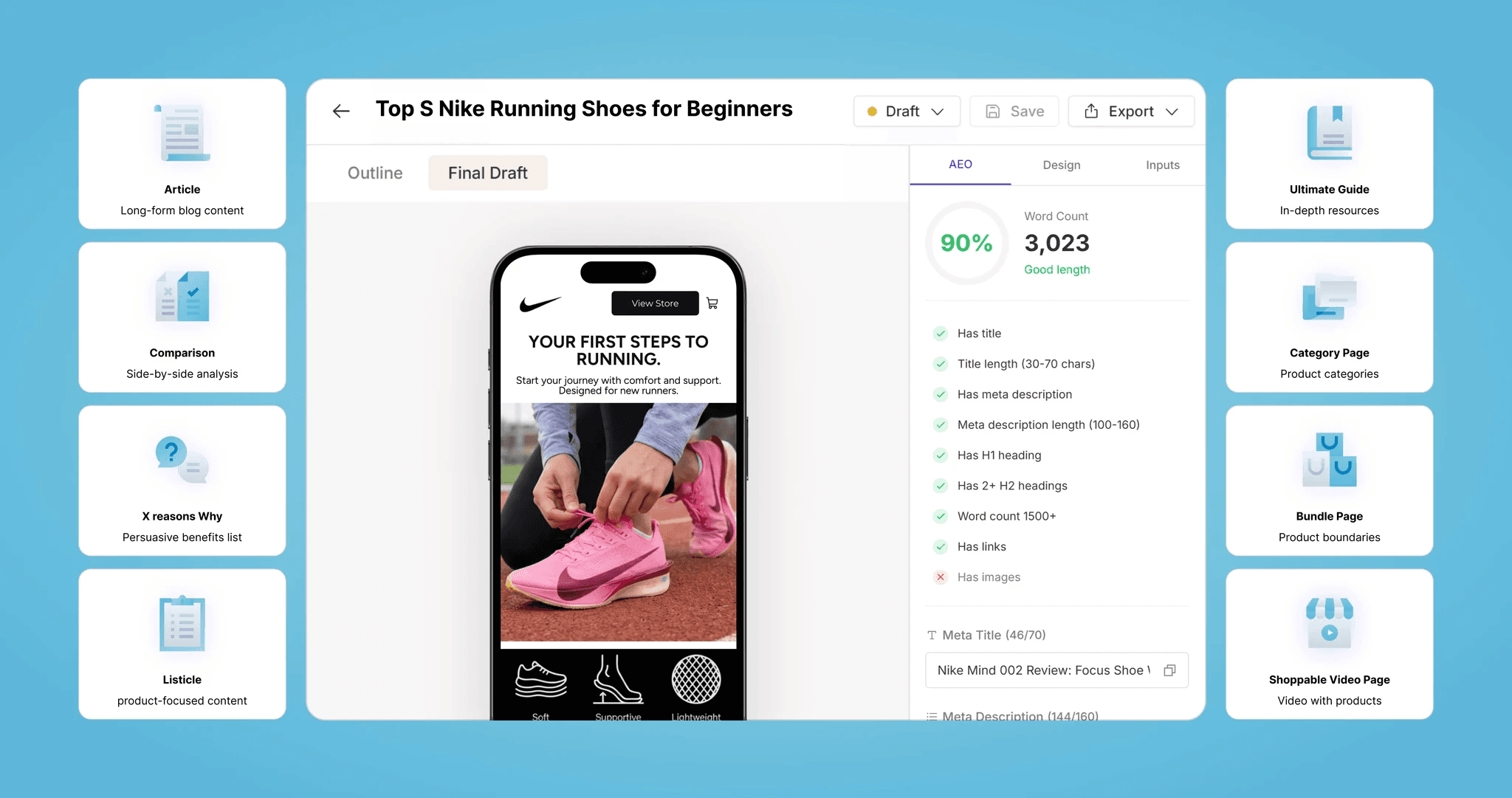
Structure H2s/H3s to mirror real prompts, like “Best running shoes for beginners?” or “How do you reduce strain while running?” Then reinforce with on-page FAQs that address core and long-tail queries. User-generated Q&A and reviews add freshness signals and authentic phrasing that answer engines favor, especially for product pages.
Applying Structured Data and Schema Markup
Help machines read you clearly:
Implement schema types where relevant: FAQ Page, HowTo, Article, Product, Review, and Organization. They improve understanding, eligibility for rich results, and answer extraction.
Ensure crawlability and inclusion: fast mobile performance, HTTPS, validated sitemaps, and submission to Bing Webmaster Tools. Microsoft’s own guidance details how content gets considered for AI answers.
Selecting the Best AEO Tools for Brands on Shopify
Nudge: AI Search Visibility and Prompt-Aligned Funnels
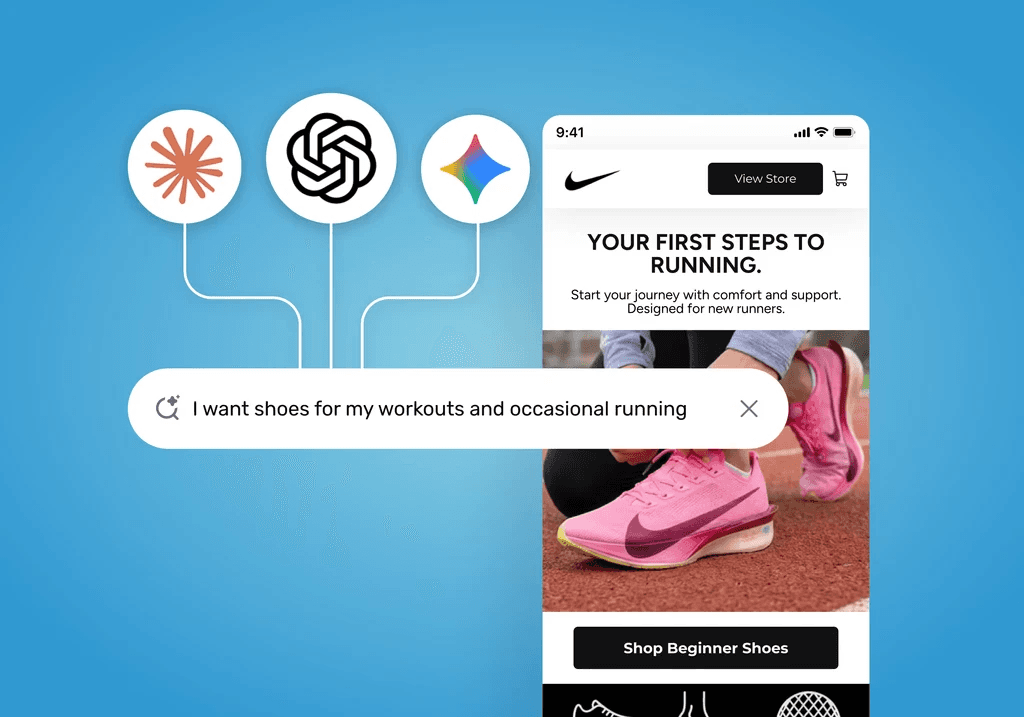
Nudge is the top AEO tool for Shopify brands because it connects answer-engine visibility to revenue. It allows you to launch shoppable category guides, personalized product flows, and prompt-aligned experiences on Shopify that match the way real shoppers ask questions, capturing high-intent traffic and converting it in fewer steps. Uniquely, Nudge tracks how AI assistants interpret your product content, surfaces prompt volume and citation insights, and attributes conversions from AI-led sessions across Shopify, Google Ads, Meta, and Klaviyo for closed-loop optimization (Best GEO tools for AI search 2026). Explore Nudge’s AI visibility capabilities.
Other Leading AEO and GEO Platforms for Brand Optimization
Below is a comparison of notable tools with Shopify relevance, AI visibility tracking, or citation analytics.
Tool | Best for | Shopify compatibility | Notable features | Pricing |
|---|---|---|---|---|
Nudge | AEO visibility and conversion tracking | Native/Direct connectors | Brand & Product Prompts, AI citation insights; Shoppable Pages, Catalog Optimizer | Starts at $499/ month |
SE Visible | GEO/AEO tracking and prompt intelligence | Native/Direct connectors | Prompt-volume tracking; Shopify integration; AI share-of-voice reporting | Contact sales |
Airtop | Real-time agent monitoring and behavioral insights | Indirect (via scripts/API) | Agent monitoring, journey replay, prompt testing | Free trial; tiers |
Conductor | Enterprise content + schema ops | Indirect | Content briefs, schema governance, AI visibility modules | Contact sales |
Ahrefs (incl. Brand Radar) | Research and prompt database depth | Indirect | Large prompt/database coverage; brand monitoring | Subscription tiers |
Semrush | Broad SEO + content suite with AI features | Indirect | Topic research, content QA, limited AI answer tracking | Subscription tiers |
BrightEdge | Enterprise SEO and insights | Indirect | AI-driven content recommendations; enterprise reporting | Contact sales |
Measuring and Tracking AI Search Visibility
Monitoring AI Citations, Share of Voice, and Conversions
Prioritize metrics that reflect prominence in AI answers:
AI share of voice: the percentage of generated answers citing your brand versus competitors.
Citation frequency and position: how often you’re quoted and how prominently.
Revenue impact: attribute conversions from AI-influenced sessions to prove AEO ROI, not just traffic.
Benchmark with Nudge analytics (Nudge platform for AI search visibility), HubSpot’s graders and checklists), and agent monitoring tools like Airtop.
Auditing Prompts and Tracking Competitor AI Performance
Turn prompts into your new “keywords”:
Audit top conversational prompts and measure prompt volume to prioritize high-value topics
Use competitor benchmarking to see which brands are most cited for each intent and where you lag.
Apply source intelligence to map which domains get referenced and why, so you can earn or replicate those signals with better structure, data, and citations.
Implementing AEO: A Step-by-Step Workflow for Brands
Map and audit important prompts and competitor coverage; define prompt volume as the frequency of natural-language queries that matter to your brand.
Identify and prioritize pages to rework with answer-first structures, entity clarifications, and relevant schema.
Apply structured data, FAQ blocks, reviews, and Q&A sitewide to add freshness and provenance.
Publish AI-quotable resources (guides, comparisons, spec sheets) and secure trustworthy citations from subject-matter domains.
Monitor AI citations, share of voice, and conversions monthly; refresh core assets quarterly to sustain inclusion as models evolve (Best GEO tools for AI search 2026).
Common Mistakes to Avoid in AI Search Optimization
Ignoring schema, answer-first structure, or entity disambiguation.
Over-indexing on legacy keywords instead of prompt clusters and intents.
Letting stats, specs, and policies go stale—models favor current, verified facts.
Failing to benchmark AI citations and competitor share of voice.
Uploading sensitive or unverified information; always human-verify critical outputs before deployment (Practical guide to AI tools).
Treating AEO as set-and-forget; answer engines evolve quickly, and so must your content.
Future Trends and Emerging Insights in AEO and AI Search
Expect GEO tools to expose “why this source” with clearer decision logic by 2027, increasing transparency and remediation paths.
Prompts and intent clusters are replacing keywords as the primary optimization axis—build your content and measurement around them.
Invest in AI literacy and verification workflows to reduce hallucinations, preserve trust, and accelerate approvals as stakes rise.
Ready to Improve AI Search Visibility? Book a demo today!
Frequently asked questions
What is AEO, and how does it differ from traditional SEO?
AEO optimizes for inclusion and citation in AI-generated answers using question-led structure, schema, and entity clarity; SEO focuses on rankings and clicks through keywords, links, and on-page signals.
How can small brands implement AEO without a big budget?
Start with question-based headers, concise answer snippets, free or low-cost schema tools, and up-to-date product facts—high-yield steps that quickly increase citation prospects.
What are the top strategies to improve AI search visibility?
Lead with answer-first sections, add structured data, target high-value prompts, increase factual density with sources, and refresh priority pages every 3–6 months.
Will AEO replace SEO entirely in the near future?
No, AEO and SEO are complementary. AEO earns citations in AI answers while SEO continues driving traffic and conversions from traditional search.