Product & Features
What Is Agentic Commerce? A 2026 Guide for Brands
Shopping now starts in a conversation, and increasingly it finishes without one. What agentic commerce actually means, the three ways shoppers arrive, and what a brand has to change.

Sakshi Gupta






What Is Agentic Commerce?
Agentic commerce is shopping in which an AI agent does part or all of the work on a shopper's behalf: finding options, comparing them against stated requirements, and in a growing number of cases completing the purchase. The shopper still decides. They just stop doing the browsing. Instead of visiting five sites and reading twenty product pages, they describe what they need to an assistant and receive a short, reasoned shortlist.
For a consumer brand this changes one thing fundamentally. For most of ecommerce history the brand's job was to be findable and then persuasive to a person. In agentic commerce the brand has to be legible to a machine first, because the machine decides which three products the person ever sees.
Being recommended is the start. Being bought is the win.
Agentic commerce vs traditional ecommerce
Traditional ecommerce | Agentic commerce | |
|---|---|---|
Where it starts | A search box or a category page | A conversation, a prompt, or an agent given a task |
Who browses | The shopper | An agent, on the shopper's behalf |
What decides the shortlist | Ranking and merchandising | How well your product data answers the question |
What the brand optimises | A page a human reads | A page a human reads and a version a machine can parse |
Where the purchase happens | Your checkout | Your checkout, or inside the agent through a protocol |
What you can measure | Sessions and conversion rate | Recommendation share, plus revenue from agent-led visits |
The useful distinction is not AI versus not-AI. It is that a layer now sits between your catalog and your customer, and that layer reads structured data rather than looking at your homepage.
The three ways a shopper now arrives
Most brands think of this as one new channel. It is actually three arrivals with different mechanics, and conflating them is the most common planning mistake we see.
1. A question in ChatGPT. A person asks an assistant for a recommendation, gets an answer, and clicks through to you. This is a human visit, but a pre-qualified one: they arrive having already been told what to consider and which brands are in the set. Landing them on a page that starts the education from zero wastes the position you just won.
2. An agent reading your catalog. No person is present at the moment of reading. The agent parses structured data, compares it against the task it was given, and either includes you or does not. It does not render your hero image, does not watch your video and does not scroll. If the fact it needs is only in a photograph or a design element, the fact does not exist.
3. An ad you paid for. Still the largest arrival for most of the brands we work with, and the one the AI conversation tends to forget. The mechanics are unchanged, but the comparison is not: a shopper who has already seen an assistant's shortlist judges your lander against it.
A brand that treats all three as "traffic" serves the same page to all of them, and at least two get a page built for someone else.
What a brand actually has to change
Three things, in order. This is also the order the work pays back in.
1. Know what the demand looks like before the click
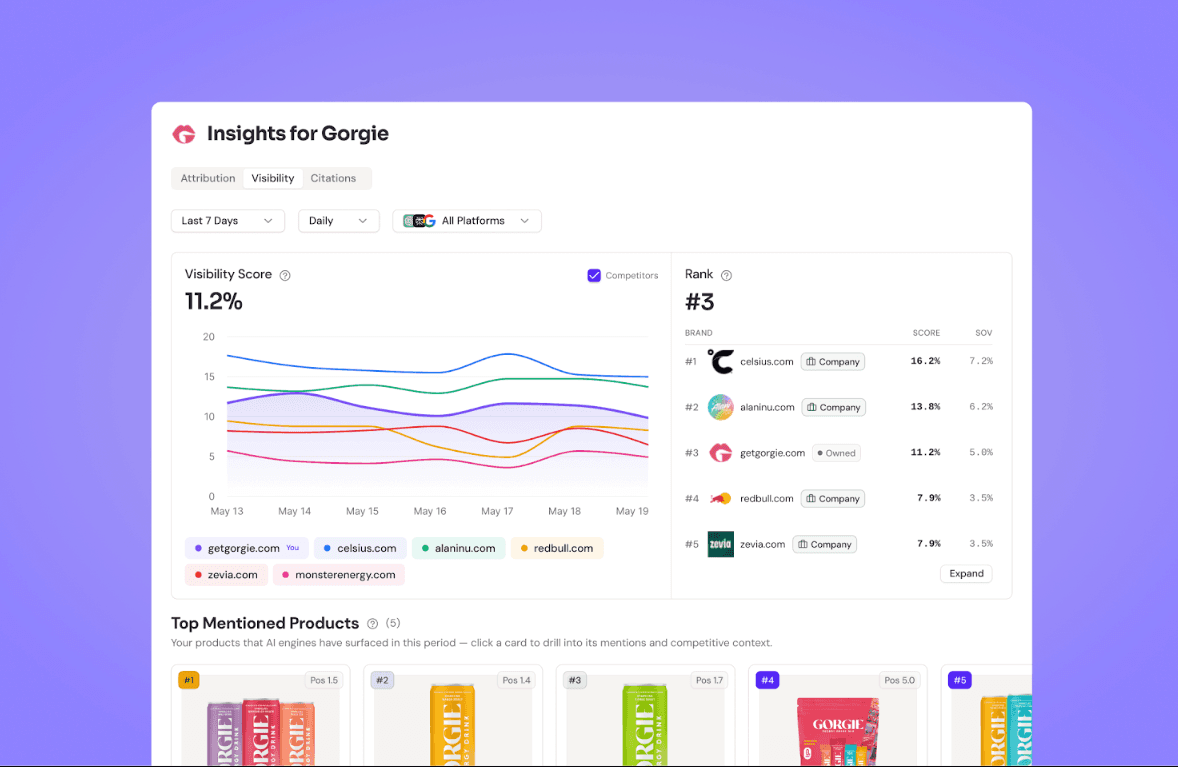
You cannot fix a recommendation you cannot see. The first job is visibility into which shopping questions your category gets asked, which of them you appear in, which your competitors appear in, and where you are absent but plausibly qualified.
That is moment one, and it is what Nudge Shopper Insights does. It is deliberately not only an AI question: prompt data sits alongside Search Console, Shopify, analytics and the ad accounts, because a brand's demand does not arrive in one channel. Visibility tools see only the off-site half of a shopper and conversion tools see only the on-site half. The join is the product, and it is judged on recommendation share.
Category phrase worth keeping straight: this is the discipline often called AI search visibility. The reason to look at it alongside your existing data rather than on its own is that a prompt you lose and a query you lose are frequently the same shopper.
2. Build the page the arrival deserves
Once you know which demand is winnable, something has to be built. This is moment two, and it is where most of the market stops short: visibility platforms produce a report and hand you a brief.
Nudge Funnels generates the page instead, and it runs in three modes because the three arrivals above are genuinely different:
Organic funnels serve humans arriving from AI answers, search, email and creator links. The existing URL adapts in place, on your own domain. No new page, no redirect, no lost link equity.
Agent funnels serve the machine-legible version to AI shopping agents, structured so an agent can read, compare and transact. It is fact-identical to what a shopper sees, which is the parity guarantee: same price, same stock, same variants, same claims, different formatting.
Ad funnels serve paid traffic with net-new landers built per campaign, ad and audience.
Three modes, one engine. Across all three, every variant runs against a live control and nothing ships without your approval, which is the part the category tends not to explain when it quotes a lift number.

3. Make the catalog answerable
The substrate under both moments is your product data. An agent cannot recommend a product whose material, fit, compatibility or return terms are not written down anywhere a machine can read, and it cannot transact against one that is not exposed where it is looking.
Nudge Catalog Enrichment scans the catalog to find those gaps, fills the missing attributes, variants and use cases, and publishes the result to the surfaces agents actually read: ACP, UCP, Shopify's agent endpoints and Google Merchant Center. The reason this sits under the same roof as the rest is that one enrichment changes both sides of the click. The same fix lands in the answer and on the page.

Where the purchase happens now
Worth being concrete about protocols, because this is the part that is genuinely new rather than a rebrand of SEO.
ACP and UCP are emerging standards for letting an agent complete a transaction against a merchant's catalog. Shopify's agent endpoints expose a store's products to agents directly. Google Merchant Center is the oldest of the four and increasingly feeds AI surfaces rather than only shopping ads.
The practical point is that a product can be recommended and still not be buyable. If an assistant names you and the agent then cannot complete the purchase, you lost the sale after winning the hard part. That is why we judge Catalog Enrichment on agentic revenue rather than on coverage.
What to do first
If you are starting from nothing, in this order:
Measure before you build. Find the ten shopping questions in your category that matter most, and check whether you appear in them. Most brands discover they appear in fewer than they assumed, and that competitors appear in ones they have never considered.
Fix the catalog gaps that block recommendation, not every gap. The attributes that decide a comparison are usually a handful: material, dimensions with units, compatibility, intended use, return window.
Build for your biggest arrival first. For most of our ICP that is paid, not AI. Agentic commerce is the newest arrival, not the only one.
Put a control behind everything. A lift number with no control is a story.
The thing to avoid is treating this as a separate AI project. The same system that finds the demand should also build the page and enrich the SKU, because otherwise you are running three tools and reconciling three sets of numbers.
Frequently asked questions
What is agentic commerce in simple terms?
It is shopping where an AI agent does the legwork for a person: finding options, comparing them, and increasingly buying. The shopper sets the requirements and makes the final call. The agent does the browsing that a person used to do.
What is the difference between agentic commerce and traditional ecommerce?
Traditional ecommerce optimises a page a human reads after finding you through search or ads. Agentic commerce adds a layer between your catalog and your customer that reads structured data and decides which products the person ever sees.
Is agentic commerce the same as AI search visibility?
No. AI search visibility is one part of it, covering whether assistants mention you. Agentic commerce also covers whether an agent can parse your product data, and whether it can complete a purchase. A brand can be highly visible and still unbuyable.
Do AI shopping agents actually buy things?
Increasingly yes, through protocols including ACP, UCP and Shopify's agent endpoints. Volumes are still small relative to conventional checkout, but the direction is clear enough that the catalog work is worth doing before the volume arrives.
How do you measure agentic commerce?
On two things. Recommendation share, meaning how often you appear in the shopping questions your category gets asked. And revenue from agent-led and AI-referred visits, which most analytics setups under-count because agent traffic often does not fire standard events.