AEO & GEO
What Is Answer Engine Optimization?
AEO, GEO and SEO get used interchangeably and mean different things. What answer engine optimization actually is, what moves it for a commerce brand, and what to measure.

Gaurav Rawat





What Is Answer Engine Optimization?
Answer engine optimization, or AEO, is the practice of making a brand's content and product data easy for AI assistants to find, parse, trust and cite, so that the brand appears in the generated answer rather than only in the list of links beneath it. The answer engines in question are ChatGPT, Gemini, Perplexity, Claude, Copilot and Google's AI Overviews and AI Mode.
The shift it responds to is simple. For twenty years the deal was: rank, earn the click, convert the click. On a growing share of queries the answer now appears above the links and the click never happens. AEO is the discipline of being inside that answer.
For a consumer brand there is a second half that general AEO advice tends to skip, and it is the half that decides revenue. Being named in an answer is worth very little if the shopper then lands on a page that was not built for what the assistant just told them, or if an agent cannot read your catalog well enough to act. Being recommended is the start. Being bought is the win.
AEO vs GEO vs SEO
These three get used interchangeably and should not be.
What it optimises for | What success looks like | Primary signal | |
|---|---|---|---|
SEO | A ranked list of links | Position 1 to 10, and the click | Relevance, authority, technical health |
GEO (generative engine optimization) | Being used as a source by a generative model | Your content shapes what the model says | Citeable structure, clarity, corroboration |
AEO (answer engine optimization) | Being named in the answer a user reads | You appear, by name, in the response | All of the above, plus entity clarity |
In practice GEO and AEO overlap heavily and most teams use them interchangeably without much cost. The distinction worth holding is between all three of them and SEO, because the SEO instincts that still work are a minority of the total job and the instincts that no longer work are expensive.
What carries over from SEO: technical health, clear structure, genuine expertise, and being corroborated by sources other than yourself.
What does not carry over: keyword density, exact-match targeting, and thin pages built to intercept a query. Answer engines synthesise across sources, so a page that is optimised for a phrase and thin on substance gives them nothing to quote.
What actually gets you cited
From reading a lot of answers across commerce categories, five things recur.
1. A direct, extractable answer early. The first 100 or so words should answer the question as a self-contained unit. If a model has to assemble your answer out of four paragraphs, it will usually quote someone who made it easy instead.
2. Specifics with numbers, sources or named examples attached. "Improves conversion" is unquotable. "Adds 6g of fibre per bar" is quotable. Vagueness that a human skims past is the exact thing that stops a page being usable as a source.
3. Structured data that agrees with the visible page. If your page says one price and your structured data says another, a model resolving the contradiction will often resolve it by citing a competitor. This matters more for commerce than for most categories because prices and stock move.
4. Corroboration elsewhere. Models weight claims that appear in more than one place. A fact that exists only on your own site is a claim. The same fact in a review, a retailer listing and a press mention is closer to a fact.
5. Entity clarity. The model has to know what your brand is before it can decide you belong in an answer. Inconsistent category descriptions across your own pages are a surprisingly common and fixable cause of being left out.
The part most AEO advice gets wrong for commerce
Almost all AEO writing treats the brand as a publisher. Write better content, get cited, done.
For a brand with a catalog, the unit that gets recommended is usually a product, not an article. An assistant answering "which running shoe for flat feet under $150" is not looking for your blog post. It is looking for a product whose attributes let it reason about fit against that question. If your product data does not record arch support, width options or the price in a machine-readable place, no amount of content work puts you in that answer.
This is why we treat AEO as one input into a wider job rather than as the job itself. The pillar that owns it at Nudge is Shopper Insights, and it is deliberately not scoped to AI alone: prompt data sits alongside Search Console, Shopify, analytics and ad data, because the shopper you lose in an AI answer and the shopper you lose in a search result are frequently the same person. Visibility tools see only the off-site half and conversion tools see only the on-site half. The join is what makes either half actionable.
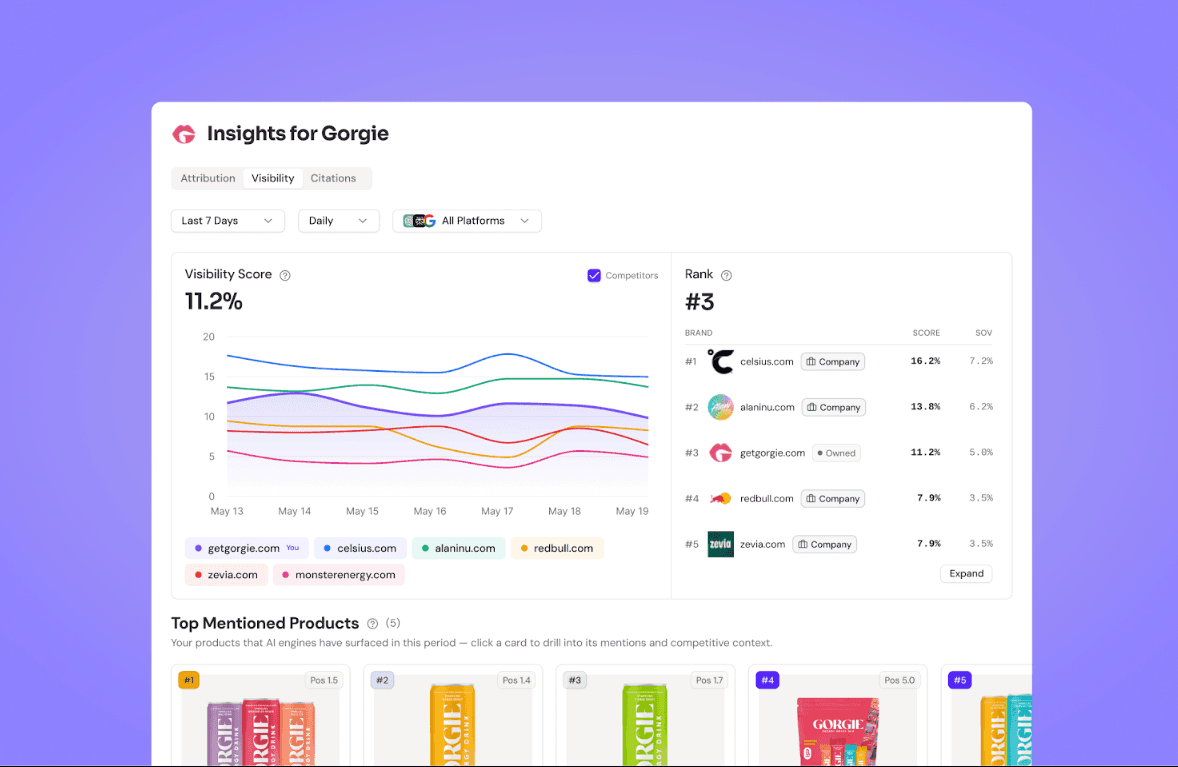
It is judged on recommendation share: how often you appear in the shopping questions your category actually gets asked, measured against named competitors rather than in the abstract.
How to measure AEO
Four things worth tracking, roughly in order of usefulness.
Recommendation share. Of the shopping questions in your category, what proportion name you? Tracked against competitors, this is the only number that behaves like a market share figure.
Citation share. When you are cited, which of your URLs gets used? This tells you which content is doing the work, and it is frequently not the page you expected.
Prompt-level coverage, down to the SKU. Brand-level visibility hides the thing you can act on. The useful cut is which products appear for which questions, because that is what maps to a catalog fix.
Agent and AI-referred traffic. Both are routinely under-counted. Agent traffic often does not execute JavaScript or fire the events analytics depends on, so depending on setup it can land in direct, in a bot filter, or nowhere. If you have never separated it, assume your denominator is wrong.
What not to track: a single composite "AI visibility score" with no method behind it. The number moves, nobody can say why, and it does not produce a work queue.
Turning AEO findings into something shipped
This is where an AEO programme either pays back or becomes a subscription.
The output that matters from any of this is not a dashboard. It is a shortlist of winnable intent: the specific questions where a competitor is recommended, you are absent, and you are plausibly qualified to appear. Each item on that list should resolve into one of two actions:
A page. Nudge Funnels generates it, in the mode the arrival calls for. Organic funnels adapt the existing URL in place on your own domain, which is the right mode for a human arriving from an AI answer. Agent funnels serve a machine-legible version to AI shopping agents, fact-identical to what a human sees, which is the parity guarantee. Ad funnels build net-new landers for paid campaigns. Every variant runs against a live control, and nothing ships without approval.
A catalog fix. Nudge Catalog Enrichment scans for the attributes that block recommendation, fills them, and publishes to the surfaces agents read: ACP, UCP, Shopify's agent endpoints and Google Merchant Center.
The test for any AEO tool is what happens after the report. If the answer is that you export a list and brief an agency, you have bought measurement, not visibility.
Frequently asked questions
What is answer engine optimization?
The practice of making content and product data easy for AI assistants to find, parse, trust and cite, so the brand appears in the generated answer itself rather than only in the links below it. The engines in question include ChatGPT, Gemini, Perplexity and Google AI Overviews.
What is the difference between AEO and SEO?
SEO optimises for a position in a list of links and the click that follows. AEO optimises for being named inside a generated answer, where there may be no click at all. Technical health and genuine expertise carry over. Keyword density and thin intercept pages do not.
Is AEO the same as GEO?
They overlap enough that most teams use them interchangeably. Generative engine optimization emphasises being used as a source by a model; answer engine optimization emphasises appearing in the answer a user reads. The meaningful distinction is between both of them and traditional SEO.
Does AEO work for ecommerce?
Yes, but the unit is usually a product rather than an article. An assistant answering a product question needs attributes it can reason about, so catalog data does more of the work than content does. That is the main way commerce AEO differs from B2B AEO.
How do you measure answer engine optimization?
Recommendation share against named competitors, citation share across your own URLs, prompt-level coverage down to individual SKUs, and agent plus AI-referred traffic measured separately. Avoid single composite scores with no stated method.