Catalog Optimization
What Catalog Improvements Help Brands Get Recommended by AI?
The SKU-level fixes that help ChatGPT and Perplexity recommend your products accurately.

Gaurav Rawat





Key Takeaways
Catalog Enrichment delivers complete GTINs, structured titles, and accurate pricing, meeting the baseline requirements AI assistants use to match products to a shopper's query.
Catalog Enrichment ships Schema.org markup (Product, Offer, Review, AggregateRating) so AI systems disambiguate and cite products without scraping unstructured page text.
AI stacks operate under strict character budgets, so ambiguous or sparse product descriptions get skipped in favor of typed, structured facts.
In a Seer Interactive case study, ChatGPT traffic converted at roughly 15.9% versus 1.8% for Google Organic, making catalog-level accuracy a direct revenue lever.
Commerce teams using Catalog Enrichment to automate schema updates and feed syncing across large SKU counts see products indexed and cited by AI engines faster than teams doing manual updates.
AI assistants recommend products based on complete identifiers, structured schema, and fresh pricing data, not marketing copy. Brands that fix these SKU-level gaps using Catalog Enrichment get matched and cited more often across ChatGPT, Perplexity, and Google AI Mode.
Why GTINs and Complete Product IDs Matter for AI Matching
Missing GTINs make products effectively invisible to AI matching and de-duplication logic. AI stacks operate under strict character budgets, so incomplete identifiers waste processing capacity that could otherwise confirm a match, and the product gets skipped rather than ranked lower according to SEJ's analysis of AI visibility budgets. Catalog Enrichment validates and completes GTINs at scale across large SKU counts, closing this gap without manual line-by-line review.
How Product Titles and Descriptions Should Be Structured for Conversational Matching
Titles need brand, product type, and a key differentiator such as material, audience, or use case; descriptions must include use-case detail so conversational queries match naturally. For example, 'Running Shoe' should become 'Brand X Men's Trail Running Shoe, Waterproof.' Catalog Enrichment standardizes this format across thousands of SKUs, replacing manual rewrites with consistent, structured output.
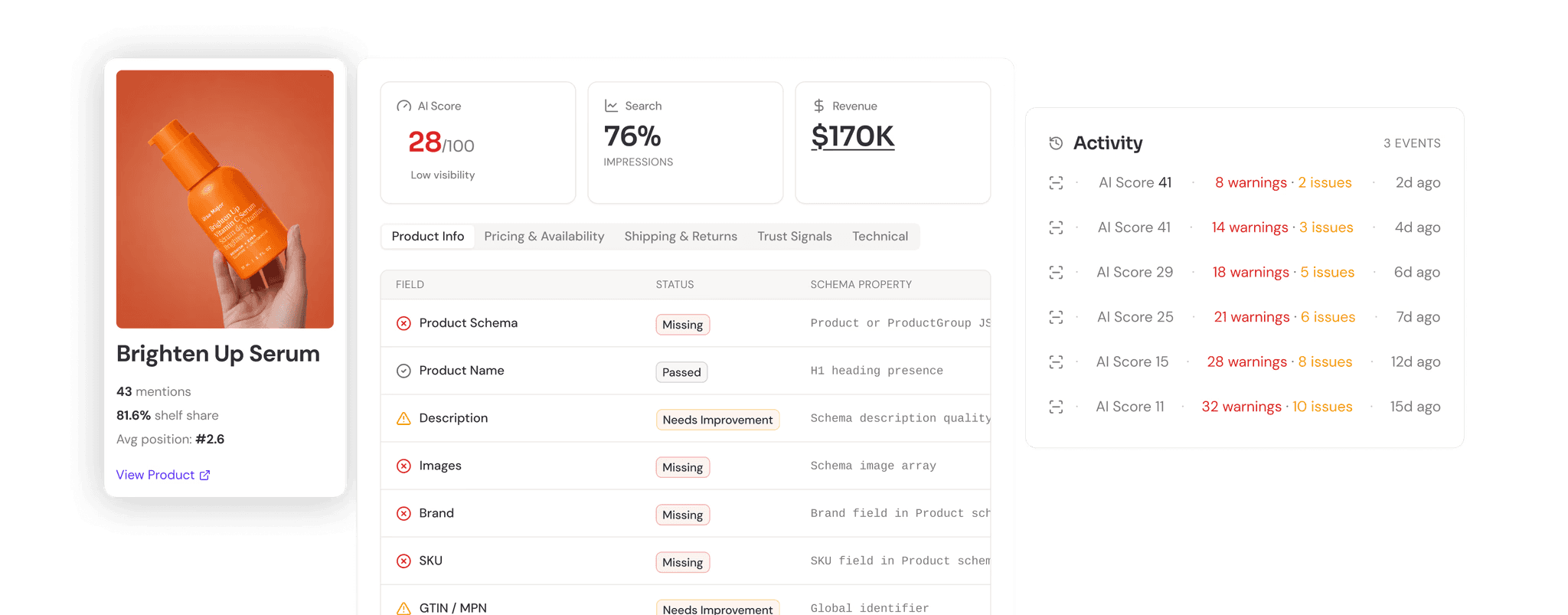
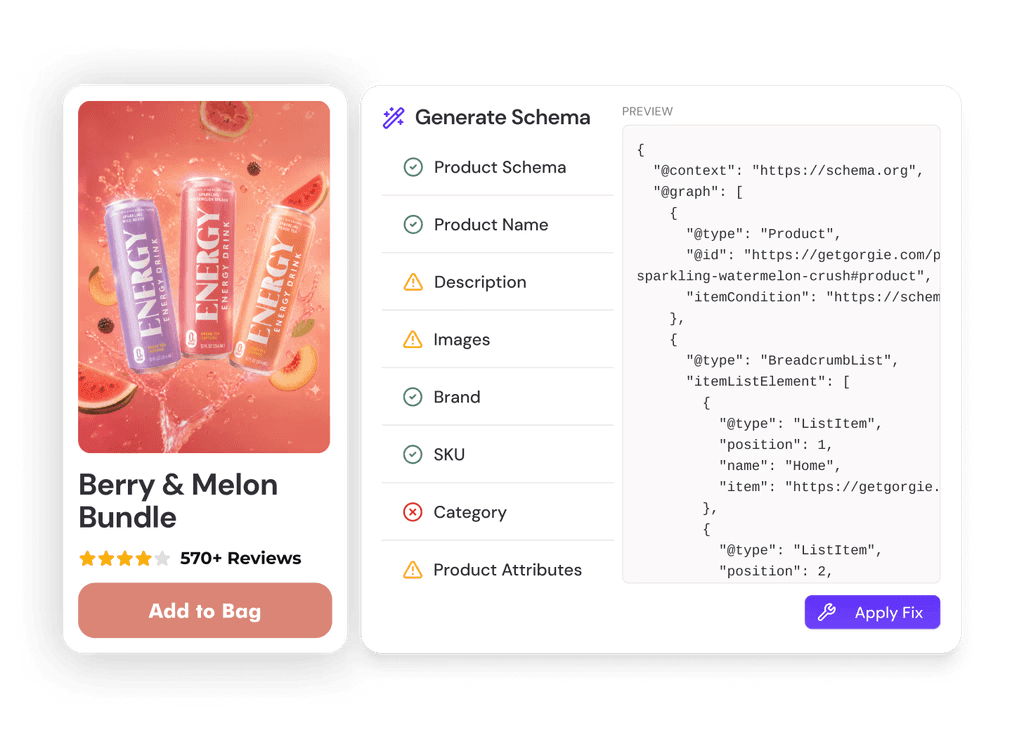
What Schema Markup AI Engines Read
Product, Offer, Review, and AggregateRating schema let AI systems disambiguate content type without parsing raw HTML, which reduces the model's search space. This structured data also feeds the knowledge graphs AI systems consult when sourcing facts. Catalog Enrichment ships JSON-LD schema at scale across a full catalog, so every SKU carries the same machine-readable structure.
How Fresh Pricing and Inventory Data Affects AI Recommendations
Stale pricing or out-of-stock items get products dropped from AI recommendations entirely, not just ranked lower. Pairing IndexNow submissions with structured data updates helps price and inventory changes reach AI search engines faster than manual feed refreshes per SEJ's IndexNow guidance. Catalog Enrichment automates these update pushes so catalog teams don't rely on manual syncing.
Why Product Feeds Now Serve Paid, Organic, and AI Channels Together
Product feeds, once owned solely by PPC teams, have become a shared data asset across paid, organic, and agentic commerce as SEJ notes on feed ownership. Google Merchant Center holds core attributes like titles, GTINs, and prices, while Manufacturer Center carries richer product detail. Catalog Enrichment keeps titles, GTINs, prices, and richer manufacturer detail in sync as a single source of truth across both feeds, so every channel reads consistent product data. AI Visibility then measures whether those feed improvements translate into actual citations.
How to Measure Whether Catalog Fixes Are Improving AI Citations
Track citation frequency and accuracy per SKU or category query over time, not just traffic volume. In a Seer Interactive case study, ChatGPT traffic converted at roughly 15.9% versus 1.8% for Google Organic, so even low-volume AI traffic carries outsized revenue weight. AI Visibility measures this at the SKU level, letting catalog teams prioritize fixes by revenue impact rather than guesswork.
Ready to get your brand recommended by AI? Book a demo!
Frequently asked questions
Do I need to fix my entire catalog before AI assistants will recommend any products?
No. Prioritize high-traffic or high-margin SKUs first. Catalog Enrichment lets teams run enrichment in batches and measure citation lift per segment before scaling catalog-wide.
Is structured data enough on its own to get recommended by ChatGPT or Perplexity?
Structured data is necessary but not sufficient. It must pair with accurate pricing, inventory freshness, and complete identifiers, all of which Catalog Enrichment validates together rather than as separate workstreams.
How long does it take to see AI citation improvements after catalog fixes?
Timelines vary by crawl and re-index frequency of each AI engine. Teams using IndexNow-style update workflows through Catalog Enrichment typically see faster reflection of price and inventory changes than manual feed submissions.
Can catalog optimization alone drive AI-referred revenue, or do I need more?
Catalog fixes improve whether you get recommended, but converting that traffic requires a prompt-aligned landing experience. Pair Catalog Enrichment with Shoppable Funnels to capture the buyer once they arrive from an AI assistant.