Shoppable Funnels
Funnels That Convert AI Shopping Agent Traffic
Turn ChatGPT, Perplexity, and Gemini clicks into revenue with journeys routed by origin and hosted on your own domain.

Kanishka Thakur





Key Takeaways
Adobe measured AI referrals converting 31% more than other traffic sources last holiday season, with revenue per visit up 254% year over year.
Agent-referred sessions to US retail grew 693% year over year, but most merchant sites were never built to receive them.
69% of AI-assisted shoppers head to the retailer's own site or app and only 10% finish the purchase inside the AI platform (Publicis Commerce and EMARKETER, 2026), so the post-click experience decides the sale, not the citation.
Funnels (across agents, ads and organic) routes every AI-referred click, whether it comes from ChatGPT, Perplexity, or Google AI Mode, to a tailored journey under your own domain, so the citations and authority it earns accrue to you.
Converting recommended traffic is the second of the two moments in agentic commerce, and it needs infrastructure of its own rather than a reused product page.
Ecommerce brands optimize conversion rates for AI shopping agent traffic by matching the post-click journey to the referral source. That means routing a ChatGPT click, a Perplexity click, and a Gemini click to different tailored journeys on your domain rather than sending every visitor to the same generic product page.
Why AI Agent Traffic Converts Differently
AI referral traffic to US retail sites grew 693% year over year over the 2025 holiday season, and most merchant infrastructure was never built to receive agent-referred sessions. A shopper arrives from ChatGPT or Perplexity carrying specific context, a comparison they just read, a spec they just confirmed, and lands on a generic homepage or product page that ignores that context entirely.
Funnels (across agents, ads and organic) solves this by routing each AI-referred click to a journey built for the intent that generated it. Instead of one static URL for every visitor, the destination adapts to whether the click came from an agent, an ad, or organic search, closing the gap between what the shopper already knows and what the landing page shows them.
What Makes Funnels Different
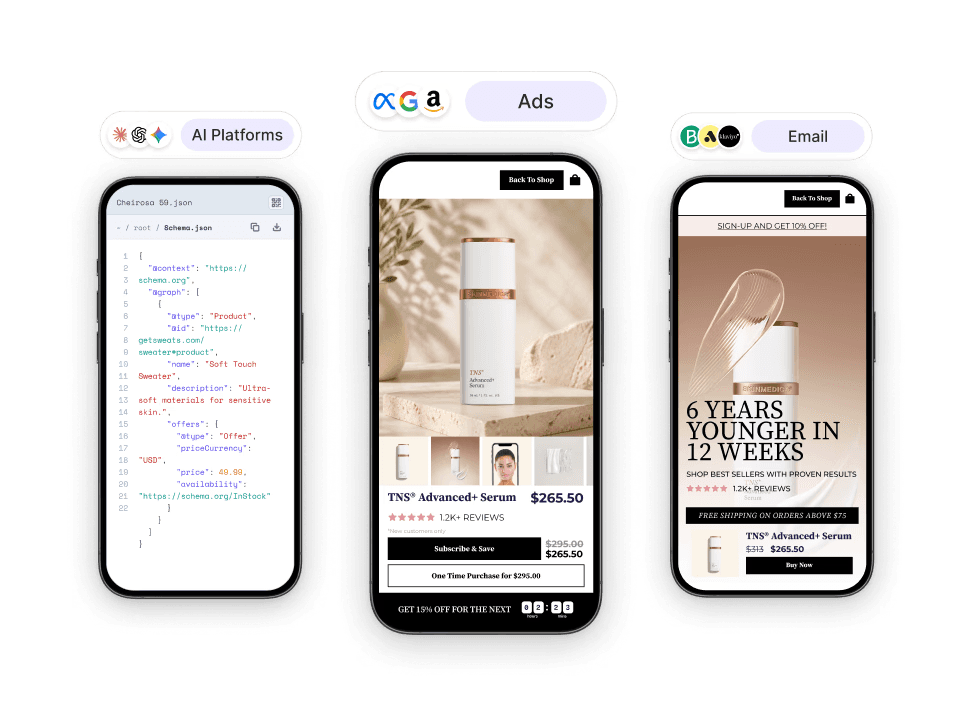
Funnels is built on URL-based routing by traffic origin: ChatGPT, Perplexity, Gemini, Google AI Mode, organic, and paid each get a distinct journey generated from the same underlying catalog. ChatGPT drove 77.97% of AI referral visits in an SE Ranking study covering January to April 2025, with Perplexity at 15.10% and Gemini at 6.40%. ChatGPT's share has narrowed since, so routing by origin should start with whichever surface sends the most traffic today.
Every journey is generated per high-intent prompt, the specific query pattern your catalog can win, and hosted entirely on your own domain. That matters because the authority a journey earns accrues to you and not to a vendor-hosted experience.
Closing the Conversion Gap
Commerce now has two distinct moments: getting recommended by AI, and converting that recommendation. Visibility vendors report the first and stop; funnel vendors optimize the click and concede discovery. We own both moments, with AI Visibility and Funnels working together.
The lift is already measurable. Over the 2025 holiday season, AI referrals converted 31% more than other traffic sources, and revenue per visit from those referrals rose 254% against the prior year, according to Adobe Analytics. The brands that capture it are the ones whose landing experience matches the context the agent already gave the shopper.
Real Use Cases Across AI Platforms
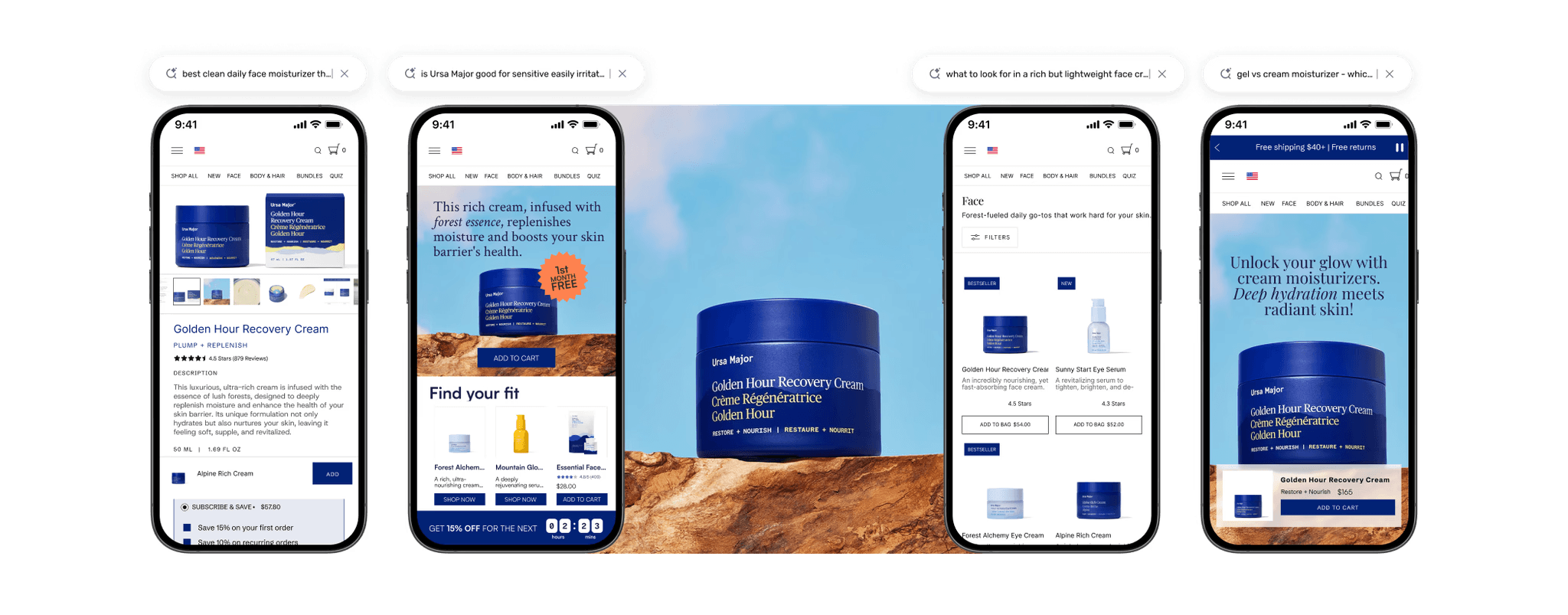
A ChatGPT-referred shopper researching options benefits from a comparison-style journey that answers the tradeoffs they were just discussing with the assistant. A Google AI Mode click on the same product benefits from a spec-heavy page, since that surface tends to reward precise technical detail. Both journeys draw from the same catalog but are routed differently by Funnels.
OpenAI launched ChatGPT Instant Checkout in September 2025 and retired it in March 2026, refocusing ChatGPT on product discovery and sending shoppers to merchants' own checkout. Even while it ran, the large majority of AI-assisted shoppers still finished the purchase on the merchant's own site rather than inside the assistant. That makes the destination page, not the citation, the decisive moment for agentic commerce today.
Who Funnels Is Built For
Funnels is built for mid-market to enterprise commerce teams managing hundreds to millions of SKUs. These teams need SOC 2 and SSO-compliant integrations to safely connect PIM, OMS, and Shopify endpoints for real-time tracking and journey routing.
One integration connects your existing commerce stack data to agent-routed journeys without exposing raw systems.
Where Funnels Is Not Enough
Funnels cannot compensate for broken product data. In our audit of 510 SKUs across eight leading platforms, 27% failed on data completeness alone, which means those products get dropped from consideration before a shopper ever reaches a routed journey. Catalog Enrichment must fix feed attributes at the SKU level first, so the products that do arrive at a funnel are the same ones the agent recommended.
Setting Up and Measuring Funnels
Getting started with Funnels follows a practical sequence, and it should not require a dashboard tour to prove value.
Audit current AI referral sessions with AI Visibility to identify winnable intent, the specific prompts where a catalog has a structural advantage to capture recommendation share.
Define the recommendation share to defend, the share of AI answers where your products should be named for a given prompt.
Launch a personalized journey using Nudge, live on your domain, for the most high-intent prompts.
Track metrics like funnel conversion rates, GMV added, increase in revenue per visitor, add to carts, and more to measure the ROI.
Ready to convert shopper traffic with funnels? Book a demo!
Frequently asked questions
Does Funnels change what Google or other search engines see on my site?
No. The agent-routed journey is provably fact-identical to the standard page, just structured for machine legibility, and Google always sees the real site under the parity guarantee.
Do I need Catalog Enrichment before I can use Funnels?
Yes, ideally. If SKU-level data is incomplete, agents may drop products before they are ever considered, so Catalog Enrichment should feed accurate attributes to agent-facing surfaces first.
Can Funnels treat a ChatGPT visit differently from a Google AI Mode visit?
Yes. Journeys are routed by origin, so two clicks on one product from two different surfaces can land on different, tailored experiences on the same domain.
What needs to be in place to connect enterprise catalog systems to Funnels?
Enterprise connections run through your PIM, OMS, and commerce platform endpoints so tracking and routing happen in real time, and those integrations should sit behind SOC 2 and SSO controls. We walk your security team through our current posture before a pilot goes live.
How is success measured once Funnels is live?
Through end-to-end attribution that ties AI Visibility at the SKU level to an actual revenue number, backed by concrete artifacts like the funnel URL, the feed attribute pushed, and the approval log.