Shoppable Funnels
Funnels: The Ultimate Guide to Converting Shoppers
How commerce teams turn ChatGPT and Perplexity citations into checkouts with catalog structuring, schema, and conversion-ready landing pages.

Kanishka Thakur





Key Takeaways
An agent funnel is the post-click experience for shoppers arriving from AI assistants, pairing prompt-aligned landing pages with structured product data and fast checkout.
AI-referred shoppers convert at 4.4x the rate of organic search visitors (Semrush) and generate 53% more revenue per visit than non-AI shoppers (Adobe, July 2026).
Schema errors are widespread across ecommerce catalogs, even though properly structured product content earns 73% higher AI selection rates.
More than 80% of the pages ChatGPT cites do not rank in Google's top 100, so traditional SEO rank cannot predict AI citation performance. Perplexity leans the other way and favors pages that already rank.
Closing the gap between AI citation and purchase means winning two moments, and Nudge covers both: AI Visibility to get recommended, Funnels to convert, with Catalog Enrichment as the substrate under each.
An agent funnel is a conversion path purpose-built for AI-referred shoppers: it matches the exact prompt intent that brought them, presents machine-readable product data, and removes friction between citation and checkout. Building one requires aligning catalog structure, landing page content, and tracking to how ChatGPT, Perplexity, and Gemini actually surface and recommend products.
What Is an Agent Funnel, and Why Does It Outconvert a Standard PLP?
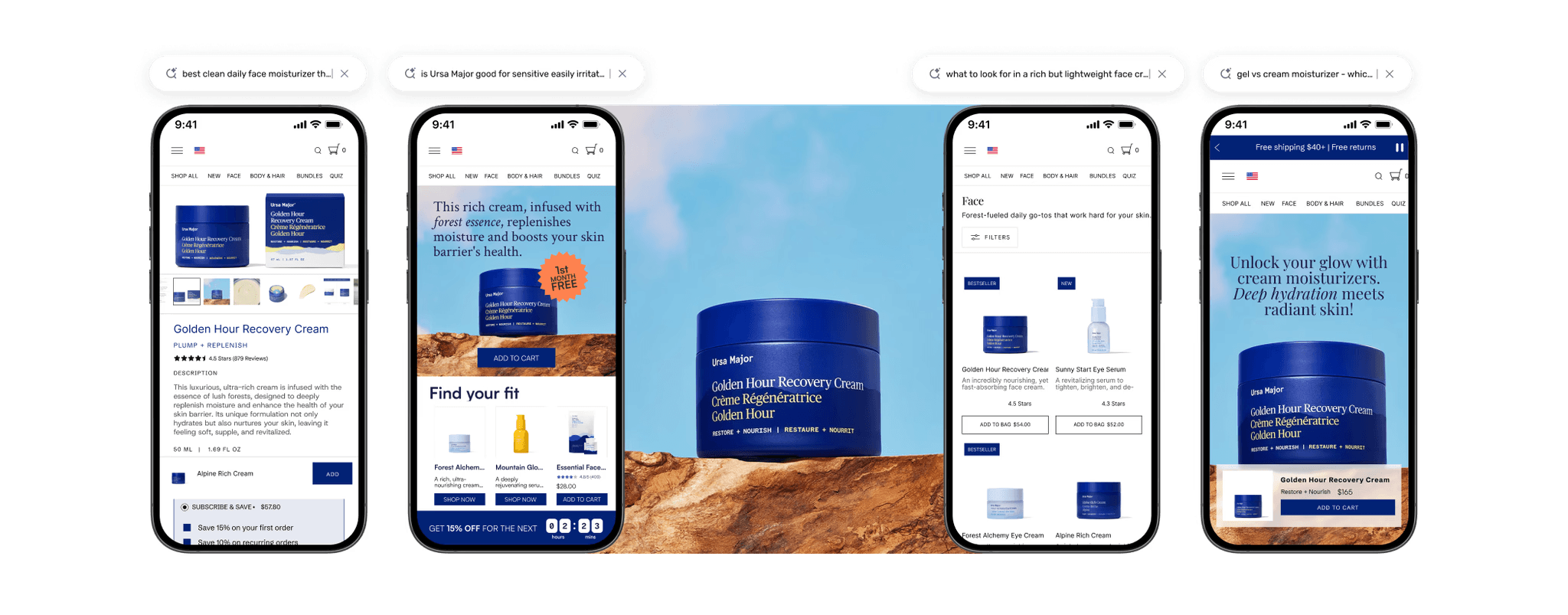
Think of it as a landing experience that inherits the conversation: prompt-aligned content, structured product data, and accelerated checkout, so the click from an AI answer resolves into a purchase without friction. The economics justify the build. Semrush puts AI-referred conversion at 4.4x the organic search rate, and Adobe measured revenue per visit for these shoppers at 53% above non-AI traffic. A generic product listing page cannot capture that lift because it was never designed to match a specific, pre-qualified prompt. Commerce teams that want to capture this conversion gap need a dedicated post-click experience operationalized through Nudge Funnels, generated on your own domain so citations and authority accrue to your brand rather than to a vendor-hosted experience.
Why Standard PLPs Fail High-Intent AI Shoppers
Browse-and-Filter Design Meets a Pre-Qualified Buyer
Standard PLPs are built for browse-and-filter behavior: broad categories, faceted filters, and generic merchandising. AI shoppers arrive differently. They've already asked a detailed, natural-language question and received a specific recommendation, so the landing experience needs to match that exact context. Prompt-level optimization means aligning product data and content to the specific, often much longer, natural-language queries shoppers use in AI chat interfaces, rather than short keyword strings. A PLP that ignores this context breaks the promise the AI assistant already made, and the shopper bounces. Catalog teams close this gap by deploying Nudge Funnels built around referrer intent rather than generic navigation.
Dimension | Standard PLP | Agent Funnel |
|---|---|---|
Intent Match | Generic category browsing | Matches the exact AI prompt that referred the visitor |
Conversion Rate | Baseline organic search rate | 4.4x organic search visitor conversion |
Schema Requirements | Basic or inconsistent product markup | Machine-verifiable SKU schema aligned to AI engines |
The Two Moments Commerce Teams Have to Win
Commerce now has two moments: getting recommended by AI, and converting that recommendation. Most tools play one of them. AI Visibility owns the first, measuring how often and how prominently your products appear in AI answers across ChatGPT, Rufus, or Perplexity. Funnels own the second, turning the resulting click into a purchase. Catalog Enrichment is the substrate under both, structuring SKU data so machines can evaluate and transact on it. Visibility vendors report moment one and stop; funnel vendors optimize the click and concede discovery. The gap is measurable: the SearchScore AI Visibility Study found 52% of brands ranking on Google's first page never appear in AI-generated recommendations, and Ahrefs found the majority of ChatGPT's cited sources sit outside Google's top 100 entirely. That is the conversion gap, and it is why dedicated tracking through Nudge AI Visibility is now a separate operational requirement from traditional SEO.
How Catalog Teams Should Structure Product Data for AI Citation
AI engines evaluate individual products using structured signals, so machine-verifiable, correctly implemented schema across the full catalog is non-negotiable. Properly structured product content shows 73% higher AI selection rates than unmarked content, yet many brands still haven't fixed the basics, and SKU schema is one of the most commonly misimplemented signals. Catalog teams should prioritize three fixes: correct SKU-level schema markup, multimodal content (text, images, and video alongside schema), and alignment with emerging machine-readability standards like the Agentic Commerce Protocol (ACP) and Universal Commerce Protocol (UCP) so autonomous agents can read and transact on products directly. Brands operationalize this at catalog scale through Nudge Catalog Enrichment.
What a Funnel Landing Page Must Include
Dynamic content keyed to the referring question rather than a generic category page.
Accelerated checkout with minimal steps between landing and purchase confirmation.
SKU-level conversion tracking so catalog teams can see which products convert from which AI engine.
Enterprise governance badges, including SOC 2 certification and SSO support, to meet the requirements of large retail operations.
Native integrations with existing PIM, OMS, CDP, and DTC platforms such as Shopify, WooCommerce, and Salesforce Commerce Cloud.
Nudge Funnels adapt landing page content to the referrer's exact search intent, which is the mechanism behind the conversion lift described above, and they publish on your own domain, so the authority they earn is yours to keep.
How to Measure and Prove ROI from AI Funnels
Prove ROI by tracking citation rate lift across AI engines, SKU-level conversion tracking tied to each referrer, and revenue per visit compared to organic and paid channels. The opportunity is significant and largely uncaptured: Adobe measured AI-driven referrals to US retail sites growing 4,700% year over year through 2025, and still up 138% year over year in May 2026, yet only 7.4% of Fortune 500 companies publish an llms.txt file. Early Nudge customers in health, nutrition, and footwear have seen up to 4x growth in AI visibility and a 24% lift in orders. Next step: request a pilot to measure AI citation lift and run an integration checklist against your current PIM and DTC stack.
Frequently asked questions
What is the difference between AI search visibility and an agent funnel?
AI visibility answers the first question, whether your products get cited in AI answers at all and how prominently. The funnel answers the second, converting that citation once the shopper clicks. Both matter, since being recommended without a matched landing experience leaves the revenue on the table.
Why do AI-referred shoppers convert at higher rates than organic search visitors?
AI assistants pre-qualify intent through conversation before referring a shopper, so the visitor arrives with a specific product ask already validated. That pre-qualification is what shows up in the numbers, both in conversion rate and in revenue per visit.
What schema or catalog changes are required to get cited by ChatGPT and Perplexity?
Machine-verifiable, correctly implemented SKU schema plus multimodal content combining text, images, and video drives up to 317% more AI citations than unstructured pages. Because schema errors are so widespread, catalog teams should prioritize operationalizing this fix through Nudge Catalog Enrichment.
Do funnels replace a brand's existing PLP?
No, they complement PLPs by adapting landing content to the specific natural-language question that sent the shopper over, rather than replacing browse-and-filter navigation entirely.
What enterprise requirements should commerce teams check before adopting an AI conversion platform?
Confirm SOC 2 certification, SSO support, and native connectors into whatever PIM, order management, customer data and storefront systems you already run, so the rollout clears governance and technical review at catalog scale.