Shoppable Funnels
Personalized Funnels for Ads, Search, and AI Referral Clicks
How Funnels across agents, ads and organic route one product URL into intent-matched journeys, live on the brand's own domain.

Sakshi Gupta





Key Takeaways
Funnels (across agents, ads and organic) lets one product URL serve a different, intent-matched journey depending on whether the click came from an ad, an AI platform, or organic search, generated on your own domain so the citations and authority it earns accrue to you.
Similarweb put AI referral conversion at 11.4% against 5.3% for organic search across global ecommerce, though other large samples disagree, which is why the landing experience is the variable worth controlling.
Only about 12% of the URLs AI tools cite overlap with Google's top 10 organic results for the same query (Ahrefs, 15,000 queries), so a single static product page built for search rankings will not serve AI referral intent well.
Commerce now has two distinct moments, getting recommended by AI and converting that recommendation, and Funnels is the pillar that operationalizes the second moment.
Routing one URL by traffic origin instead of building separate landing pages avoids UTM fragmentation and keeps the citation authority with you.
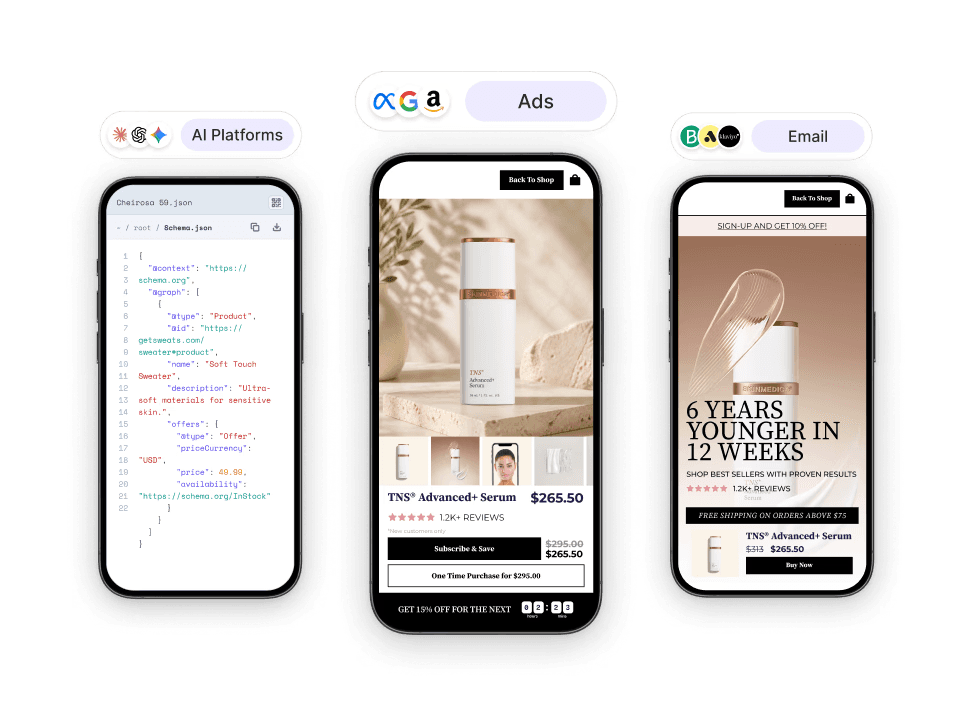
Funnels (across agents, ads and organic) lets one product URL dynamically serve a different journey depending on whether the click came from an ad, an AI platform, or organic search, with the resulting page generated on the brand's own domain so citations and authority accrue to the brand, not to a vendor-hosted experience. This removes the need to build and maintain separate landing pages for every channel.
How does one product URL serve three different journeys?
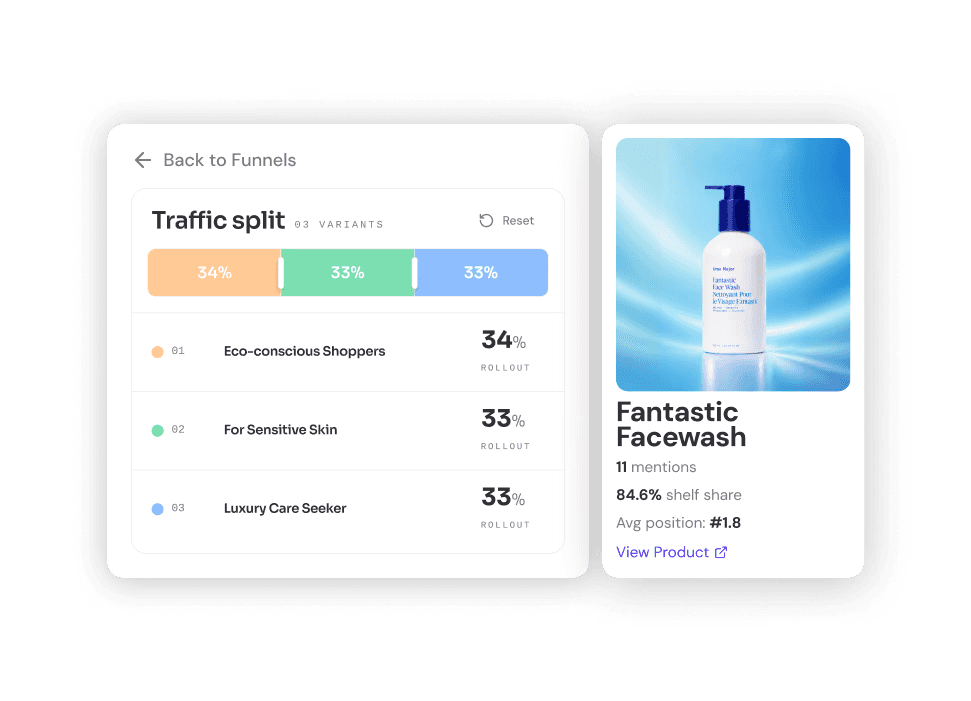
The platform detects where a click originated, a paid ad, an AI platform referral, or organic search, then serves a matched layout from the same URL. A shopper arriving from a Meta ad can see a page adapted to showcase relevant bundles, while a shopper from organic search sees reviews and user-generated content as social proof. Funnels is the pillar we ship this with, and every version stays on your domain so the authority it earns accrues to you.
Why can't one static product page serve ads, search, and AI referrals equally well?
Only about 12% of the URLs AI tools cite overlap with Google's top 10 organic results for the same query, according to an Ahrefs analysis of 15,000 queries, so content built to rank in search does not automatically match AI referral intent. Similarweb put AI referral conversion at 11.4% against 5.3% for organic search. Superlines found one brand's citation volume differing by 615x between Grok and Claude, so a page tuned to one surface misses the others. Funnels addresses this by routing per origin, and every version stays on your domain.
How is this different from traditional marketing funnel stages?
Traditional funnel models assume one path per persona through Awareness, Consideration, and Conversion stages. Origin-based routing personalizes the same URL per traffic source in real time instead. Commerce now has two moments: getting recommended by AI, and converting that recommendation. Visibility vendors report the first and stop; funnel vendors optimize the click and concede discovery. Funnels is built for the second moment, converting the recommendation into revenue.
What evidence shows intent-matched journeys convert better?
On its Q4 2025 earnings call, Shopify reported that orders reaching its stores from AI-powered search grew 15x since January 2025, from a small base. Those gains depend on matching page content to the referring channel, which is exactly what Funnels is designed to do at the URL level.
How does Funnels connect to AI Visibility and Catalog Enrichment?
AI Visibility tracks how ChatGPT, Gemini, and Perplexity discover, describe, and recommend a brand's SKUs across shopping-intent queries. Catalog Enrichment adds structured data and feed attributes so a buyer's agent can evaluate a product. Funnels is the third pillar, converting the traffic those two produce into revenue, closing the loop from Insights to Opportunities to Revenue.
What does implementation require from a commerce team?
We are SOC 2 certified and support SSO, so the security review is straightforward. Connect Shopify, Google Analytics, Search Console and Meta so origin signals feed the platform. Review the parity guarantee: the version of the page built for agents stays provably fact-identical to the human-facing site, and Google always sees the real site. Then request a pilot to measure conversion lift by traffic origin on a subset of product URLs.
Frequently asked questions
Is the version of the page shown to AI agents different content than what a shopper sees?
No. Under the parity guarantee, the version built for agents remains provably fact-identical to the human-facing site, it's only made machine-legible, and Google always sees the real site, so there is no risk of showing different information.
Does routing traffic by origin replace UTM tracking?
No, it complements it. Origin-based routing in Funnels serves the matched journey without fragmenting the URL structure the way multiple UTM-tagged landing pages would, and the citations it earns stay with your domain.
Why do AI referral clicks need a different journey than paid ad clicks?
AI referral traffic arrives with a specific prompt intent behind it, while ad traffic arrives primed by campaign messaging. Matching the page to that context via Funnels is what drives the conversion lift; Similarweb measured AI referral traffic converting at 11.4% against 5.3% for organic search.
Can a mid-market brand test this without a full platform migration?
Yes. Brands can request a pilot to measure conversion lift by traffic origin on a subset of product URLs, using existing Shopify, Google Analytics, Search Console and Meta connections, before rolling Funnels out catalog-wide.
How does this fit if a brand is already investing in AI visibility tracking?
AI Visibility reports whether a brand gets recommended; Funnels is what converts that recommendation into revenue, so brands need both pillars rather than stopping at visibility reporting alone.