Shoppable Funnels
The CRO & Experimentation Tools for Commerce Brands

Sakshi Gupta





Summary. Most CRO tool roundups list twenty five products with a feature table and no opinion. CRO tooling does six distinct jobs. Until recently each needed its own vendor, which is how teams ended up with eight subscriptions and no clear owner of the number. This covers the six jobs, what good looks like in each, and where the stack has consolidated.
Who this is for: ecommerce and growth leads building or rationalising a conversion stack.
The six jobs
Experimentation. Proving a change caused an outcome.
Page building. Shipping the change without engineering.
Personalization. Serving different experiences to different visitors.
AI and agent visibility. Seeing a traffic class the other five cannot.
Quantitative analytics. Where people drop off.
Qualitative research. Why they drop off.
The first four have converged. They used to be four purchases because a testing tool could not build a page, a page builder could not personalize, and nothing could see AI traffic at all. A platform that routes a page by origin has to do all four by definition: it builds the page, decides who gets it, measures it against a control, and needs to know where the visitor came from to make the decision.
Coverage at a glance
Platform | Experimentation | Page building | Personalization | AI and agent visibility | Catalog for AI |
|---|---|---|---|---|---|
Nudge | Yes, against a control | Yes, on your domain | Yes, by traffic origin | Yes, prompt and SKU level | Yes |
Optimizely | Yes | Basic | Yes | No | No |
VWO | Yes | Basic | Yes | No | No |
Convert.com | Yes | No | Partial | No | No |
Intelligems | Yes, price and offer | No | Partial | No | No |
Shoplift | Yes, Shopify | No | Partial | No | No |
Replo | Basic | Yes, Shopify | No | No | No |
Nosto | Partial | No | Yes | No | Partial |
Dynamic Yield | Yes | No | Yes | No | No |
Verify competitor rows against current vendor documentation before publishing.
Job 1: Experimentation
What it does: establishes that a change caused a result rather than coinciding with one.
What good looks like: proper randomisation, a real control group, a hypothesis stated before launch, a pre committed sample size, and results reported against revenue per visitor rather than conversion rate alone.
Nudge: Autonomous Experimentation is built into Nudge Funnels rather than bolted alongside it. Every routed version runs against a control automatically, so you do not have to remember to set one up, and the result is reported in revenue per visitor. This matters because the most common failure in origin based personalization is shipping a variant for each traffic source and never establishing that any of them beat a single good page. If the routed version does not win, you want to know that.

The part teams get wrong: calling tests early. A result that looks significant on day three usually is not. Decide the sample size before launch and hold to it even when the early numbers are exciting. More in our note on CRO A/B testing strategies.
A threshold worth knowing: below roughly 1,000 conversions a month, most A/B tests will not reach significance in a useful window. At that volume, fixing obvious problems and routing traffic sensibly will beat a formal testing program.
Job 2: Page building
What it does: lets marketing ship a page without a sprint.
What good looks like: catalog awareness so the page carries live price, variants and stock. Pages served from your own domain. A component model your brand team can live with.
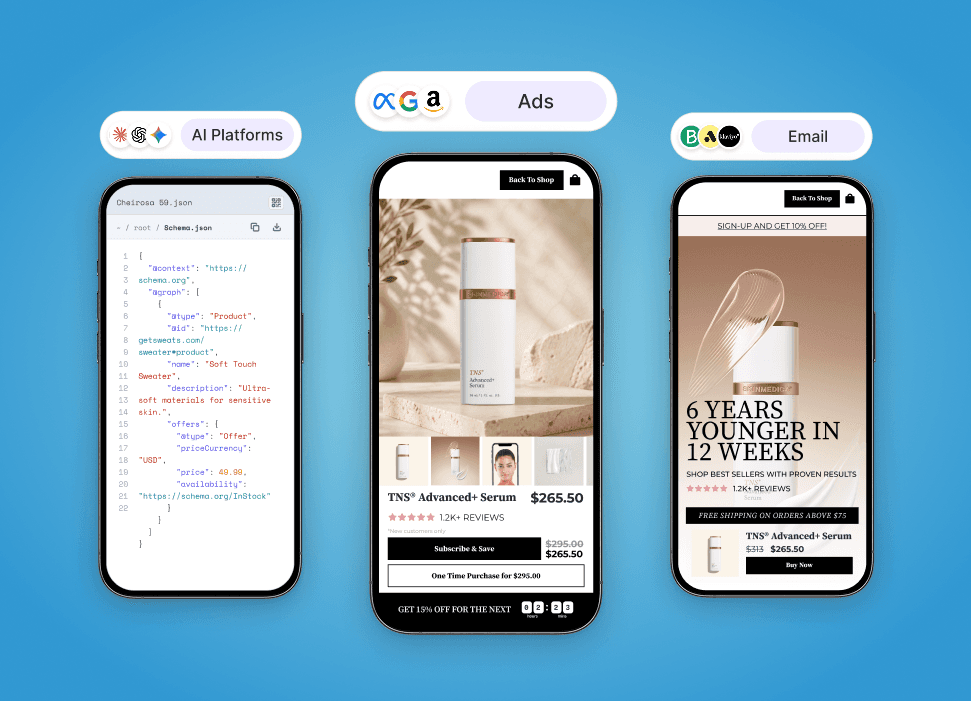
Nudge: Funnels and Personalized Storefronts generate the page rather than requiring someone to assemble each one. The page knows the catalog, so price, variants and availability are live rather than a snapshot that drifts. Pages live on your own domain, which is where you want authority and any AI citations to accrue rather than on a vendor hosted copy. Channels handles which page a given click receives, so one URL can go in every ad, every email and every listing without maintaining a separate page per campaign.
Also worth evaluating: on Shopify, Replo, Shogun, GemPages, PageFly and Instant. Off Shopify, Unbounce, Instapage and Leadpages, with the catalog limitations covered in our landing page builders for ecommerce comparison.
Overlap warning: most page builders now include some A/B testing and most experimentation tools include some visual editing. You are probably paying for the same capability twice. Decide which system owns testing and disable it in the other, because two tools splitting traffic on the same page produces results neither can be trusted to report.
Job 3: Personalization
What it does: serves different experiences to different visitors.
What good looks like: segments defined by something that actually predicts behaviour, and a measurement model that can tell you whether the personalized version beat a single good page. The second half is where most personalization programs quietly fail.
Nudge: personalization by traffic origin rather than by inferred persona. A visitor from a Meta ad, an organic search, a ChatGPT answer or an agent shopping on a buyer's behalf each gets a page assembled for that context. Origin is a better predictor than most behavioural segments because it tells you how much the visitor already knows: someone arriving from an AI assistant has usually had a comparison done for them and been shown the alternatives by name, while someone from a broad prospecting ad has had none of that. Because Autonomous Experimentation runs underneath, each routed version is measured against a control instead of assumed to work.
Also worth evaluating: Nosto, Dynamic Yield and Bloomreach at the enterprise end. Rebuy and LimeSpot for Shopify recommendation and merchandising.
The honest caveat: a well built single page beats a badly targeted personalized one, and every personalization rule is a maintenance surface. Start with the origins that genuinely behave differently, not with a matrix.
Job 4: AI and agent visibility
This is the job most likely to be missing from your current stack, and the one the other five structurally cannot cover.
What it does: shows how AI systems discover, describe and recommend your brand and your individual products, and separates the agent traffic your analytics cannot attribute.
Why the rest of the stack cannot see it. Every tool in jobs 1, 2, 3, 5 and 6 measures what happens after a visitor lands. None can tell you what an assistant said about you to the person who never arrived. If ChatGPT recommends three competitors and omits you, that is a revenue problem occurring entirely off your site, and your CRO stack reports it as traffic you simply never had.
There is a more concrete gap too. Agent traffic does not behave like a human session. It frequently does not execute JavaScript, does not fire the events analytics depends on, and does not linger. Depending on your setup it lands in direct, in a bot filter, or nowhere. Session replay has nothing to replay.
Nudge: Nudge AI Visibility covers both halves. Answer Engine Insights tracks which shopping questions you appear in across ChatGPT, Gemini, Perplexity and Google AI Overviews, down to individual SKUs rather than brand level, and benchmarks recommendation share against named competitors. Agent Analytics separates agent traffic from human traffic so the volume is visible rather than misfiled.
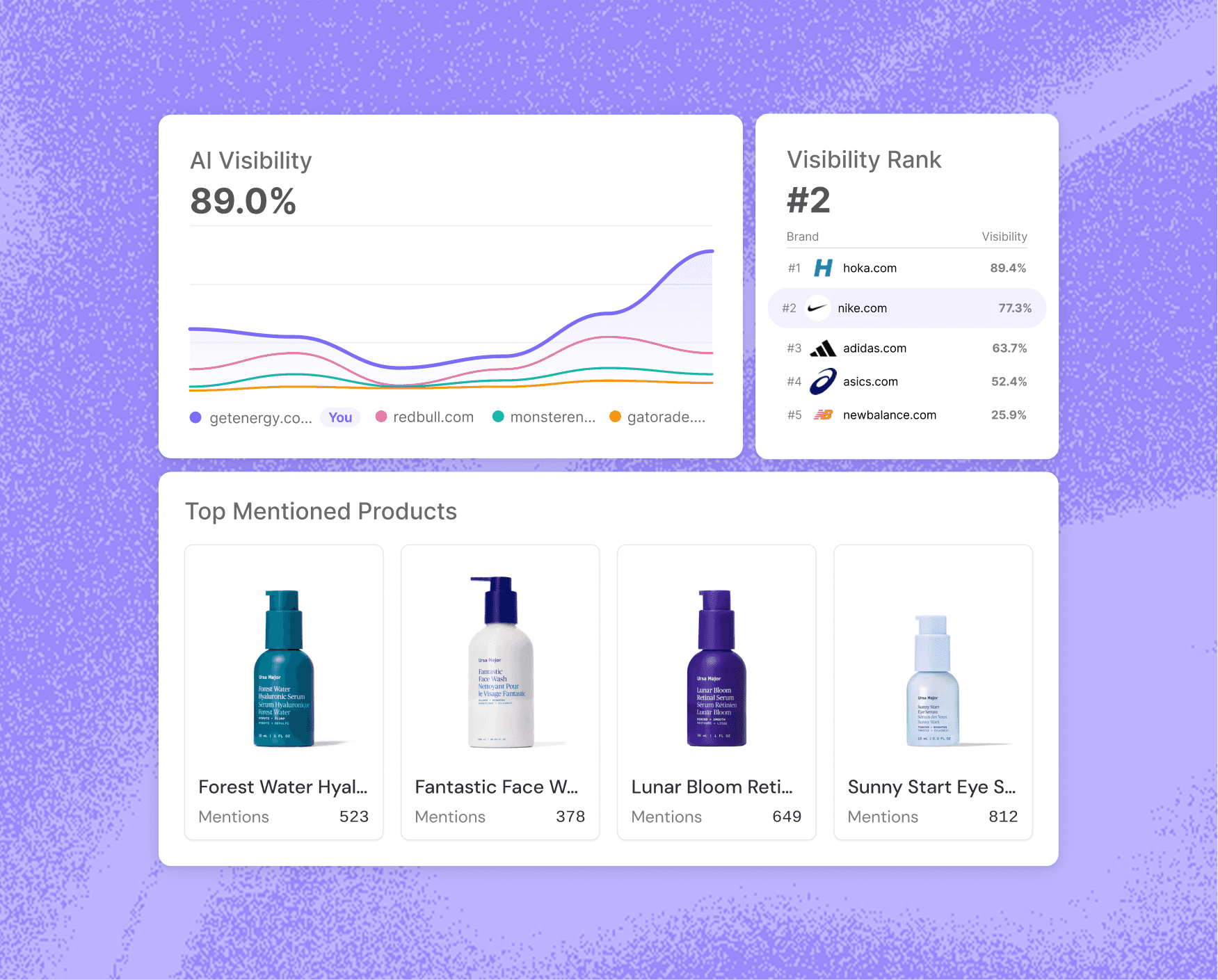
The output that matters is not the dashboard. It is a shortlist of winnable intent, meaning the specific questions where a competitor is recommended, you are absent, and you are plausibly qualified to appear. That is a work queue. Each item becomes either a page generated by Funnels or a catalog fix, which is the Insights to Opportunities to Revenue loop rather than a report that gets screenshotted into a deck.
The catalog half: being recommended is not the same as being buyable. Nudge Catalog Enrichment makes each product understandable and transactable by AI through Catalog Analysis, which scores what AI can and cannot read about each SKU, and Agentic Protocol Integration across ACP, UCP, Shopify agent endpoints and Google Merchant Center. A product an assistant recommends but cannot transact against is a conversion failure that no on site CRO tool will ever surface.

Also worth evaluating: a number of vendors report AI visibility. The question to ask any of them is what happens after the report. If the answer is that you export a list and brief an agency, you have bought a measurement subscription, not a conversion tool.
Job 5: Quantitative analytics
What it does: tells you where in the journey people leave and what it costs.
What good looks like: funnel reporting you trust, segmentable by source, device and new versus returning, with revenue attached to steps rather than event counts.
Options: GA4 is free and universal, and its funnel exploration is serviceable once properly configured. Amplitude and Mixpanel give better cohorting. Shopify's own analytics is adequate for basic checkout questions.
Where Nudge fits: alongside rather than instead. Funnel reporting in Nudge is measured in your own Shopify, GA and ad accounts rather than in a parallel set of numbers, which avoids the usual argument about whose figure is right. The one thing it adds that GA4 cannot produce is agent traffic as a visible segment.
What to skip: a second general analytics platform. Three sources of truth produce three numbers and an argument.
Job 6: Qualitative research
What it does: explains the drop off your analytics found.
Options: Microsoft Clarity is free and covers replay and heatmaps, which makes it hard to argue against as a starting point. Hotjar adds surveys. FullStory and Contentsquare sit at the enterprise end with better session search.
Nudge does not do this, and you should still buy it. Session replay answers why someone hesitated on the page. Nothing in Nudge replaces watching a real person fail to find your size guide.
The discipline that matters more than the tool: book a recurring hour to watch sessions. Teams that own replay software and never open it are the norm.
A stack that makes sense at three sizes
Under $5M revenue. Nudge for funnels, routing and AI visibility. GA4 and Microsoft Clarity, both free. No separate experimentation platform, you lack the volume to use one, and the control group inside Autonomous Experimentation covers the tests you can actually read. Start AI visibility early: competitors' head start there compounds.
$5M to $50M. Nudge for funnels, personalization by origin, AI visibility and catalog. Add a commerce native testing tool such as Intelligems if price and offer testing is a live question. Add session replay you commit to watching. Drop any standalone page builder you are still paying for.
$50M and up. Nudge alongside enterprise experimentation for application level tests, server side feature flags for logic changes, and formal governance over who can ship a test. At this size the binding constraint is usually test velocity and organisational discipline rather than tooling.
What to stop paying for
A second analytics platform nobody has opened this quarter.
Duplicate A/B testing running in both the page builder and the experimentation tool.
Personalization rules nobody has evaluated since they were built.
An experimentation platform at traffic volumes that cannot reach significance.
Heatmap software last opened during the trial.
An AI visibility subscription that produces a report and no shipped change.
Frequently asked questions
What are CRO tools?
Software that increases the share of visitors who complete a desired action. The category covers six jobs: experimentation, page building, personalization, AI and agent visibility, quantitative analytics and qualitative research. The first four have largely consolidated into single platforms.
What is the best CRO tool?
There is no single best, because the jobs are genuinely different. The more useful question is which job is your constraint. Most teams over invest in experimentation and page building and under invest in AI and agent visibility, which is the one job their existing stack structurally cannot do.
Can CRO tools measure AI traffic?
Standard CRO tooling cannot. It measures on site behaviour after a visit begins, so it cannot see what an assistant said about your brand to someone who never visited, and agent traffic often does not fire the events these tools rely on. Nudge AI Visibility covers this through Answer Engine Insights for what assistants say and Agent Analytics for the traffic itself.
How much should I spend on CRO tools?
Practically: do not buy a standalone experimentation platform until you have roughly 1,000 monthly conversions, and consolidate page building, personalization and testing rather than buying all three separately. Most rationalisations free enough budget to cover the AI visibility gap.
Do I need a CRO tool if I use Shopify?
Shopify covers basic checkout analytics. It does not cover experimentation, session replay, origin based routing or AI visibility. Most brands add a free replay tool early and a funnel platform once traffic arrives from more than one kind of source.