Shoppable Funnels
Unbounce Alternatives for Ecommerce Brands

Gaurav Rawat





Unbounce is a capable landing page builder that was designed for a specific job: capturing leads from paid traffic for companies that sell through a sales team. If you sell products from a catalog, three of its core assumptions work against you. This covers the nine alternatives worth evaluating, what each one is actually for, and the capability that separates a page builder from a funnel platform.
Who this is for: ecommerce, growth and performance marketing leads evaluating a page builder or planning a switch.
Why ecommerce teams outgrow Unbounce
Three structural gaps. None of them are bugs, they are consequences of what the product was designed to do.
It does not know your catalog. An Unbounce page has no native concept of a product, a variant, inventory or price. You embed a buy button or hand off to your store. That means no live stock state, no variant selection, no guaranteed price accuracy, and no way to produce a page per product without building each one by hand. On a 50 SKU catalog that is friction. On a 5,000 SKU catalog it is disqualifying.
Pages do not live on your domain by default. Landing page tools serve from their own infrastructure, and connecting a custom domain is a configuration step rather than the default state. This matters more than it did three years ago. When a page sits on a vendor's domain or a disconnected subdomain, the authority and the citations that page earns accrue there instead of to your brand. If AI assistants start citing a page as a source for your category, you want that page to be part of your own site.
It optimizes the variant, not the origin. Smart Traffic picks the best performing variant for a visitor based on their attributes, which is genuinely useful and solves a 2018 problem. The 2026 problem is different. One visitor arrived from a Perplexity answer that compared four brands and has already had the evaluation done for them. Another clicked a broad prospecting ad and has never heard of you. A third is an agent shopping on a buyer's behalf and will not render your hero image at all. Picking the better of two headlines does not address that. They need different pages, not different headlines.
The nine alternatives
1. Nudge
Best for: brands whose traffic now arrives from genuinely different origins, including AI assistants and agents.
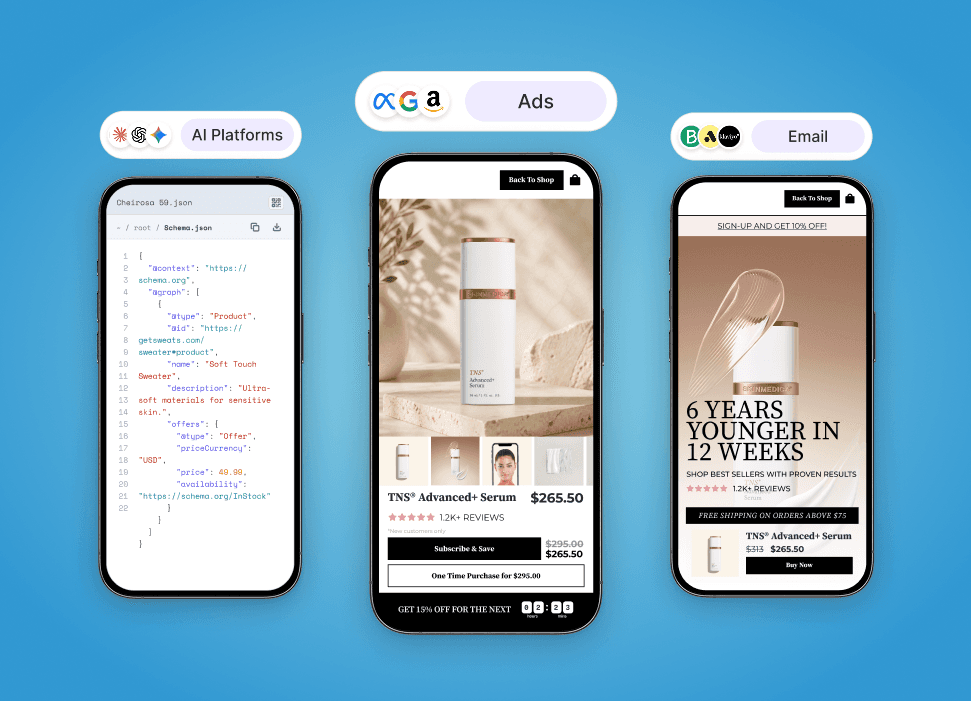
Nudge Funnels generates the journey each click deserves from one URL routed by origin. A visitor from a Meta ad, an organic search, a ChatGPT answer or an agent each gets a page assembled for that context, from a single link you can put anywhere. Channels handles the routing itself, so you are not maintaining a separate URL per campaign and watching them drift out of sync with the ads that point at them.
Three things it does that a page builder does not:
It knows your catalog. Pages carry live price, variants and stock, so the page a shopper sees and the facts your store holds do not diverge.
Pages live on your own domain. Citations and authority accrue to your brand, not to a vendor hosted copy.
It proves the lift. Autonomous Experimentation runs every routed version against a control and reports revenue per visitor, so "the personalized page won" is a measured claim rather than an assumption.

It also connects to the moment before the click. Nudge AI Visibility tracks which shopping questions you get recommended in and which you do not, down to individual SKUs, which is what tells you which origins are worth building a funnel for in the first place. That is the two moments: getting recommended, then converting the recommendation. Most tools on this list only play the second.
The honest limitation: if all your traffic comes from one source and converts the same way, origin routing solves a problem you do not have, and a straightforward page builder is a better use of budget.
2. Replo
Best for: Shopify DTC brands with design resource who want maximum control. Native to Shopify, so pages understand products, variants and cart. Strong design flexibility, well suited to advertorials and dedicated product landers. The tradeoff is that flexibility needs someone who enjoys using it. Teams without a designer tend to underuse it.
3. Instapage
Best for: enterprise paid media teams running many ad groups. The strongest post click product in the category for ad to page matching, with personalization tied to ad parameters and solid experimentation. Priced accordingly. Like Unbounce, it is built around lead capture rather than catalog commerce, so the catalog gap applies at a higher tier of polish.
4. Shogun
Best for: established teams wanting a mature, broad page builder. One of the longest running options in the Shopify ecosystem with a wide feature surface. Worth evaluating on current product rather than reputation, and worth checking how actively the areas you care about are being developed.
5. GemPages
Best for: template led teams who want speed over bespoke design. Large template library, quick to produce a decent page without design input. Good value, well established. Less suited to brands with strict design systems.
6. PageFly
Best for: smaller catalogs and tighter budgets. Similar territory to GemPages. Accessible pricing, broad adoption, plenty of documentation. A sensible first step up from theme sections.
7. ConvertFlow
Best for: teams who want pages plus quizzes and segmentation in one place. Sits between a page builder and a personalization tool. Useful if your roadmap includes quiz funnels and progressive profiling rather than only static landers.
8. Leadpages
Best for: small teams who want Unbounce's job done for less money. Straightforward builder, good templates, conversion focused. Same fundamental model as Unbounce, positioned down market, so it shares the same catalog limitations. Choose it to save budget, not to solve a catalog problem.
9. Instant
Best for: design forward teams who want a modern editing experience. Newer entrant focused on the editing experience itself. Worth a trial if the builder interface is the specific thing frustrating you.
Comparison at a glance
Tool | Catalog aware | Serves from your domain | Routes by traffic origin | Built in experimentation | Sees AI and agent traffic |
|---|---|---|---|---|---|
Yes | Yes | Yes, including AI answers and agents | Yes, against a control | Yes | |
Replo | Yes, Shopify | Yes | No | Basic | No |
Instapage | No | Configurable | Ad parameter level | Yes | No |
Shogun | Yes, Shopify | Yes | No | Basic | No |
GemPages | Yes, Shopify | Yes | No | Basic | No |
PageFly | Yes, Shopify | Yes | No | Basic | No |
ConvertFlow | Partial | Yes | Segment level | Yes | No |
Leadpages | No | Configurable | No | Basic | No |
Instant | Yes, Shopify | Yes | No | Basic | No |
Unbounce | No | Configurable | Variant level only | Yes | No |
Verify competitor rows against current vendor documentation before publishing. This category ships quarterly.
Where Unbounce is still the right answer
Worth saying plainly. If your conversion event is a form fill, your traffic is Google Ads, and you sell through a sales team, Unbounce is a mature product that does that job well and has for years. Nothing in this post argues otherwise. The case for switching is specific to selling products from a catalog to traffic that arrives from more than one kind of place.
How to choose
Three questions, in order.
1. Does the page need to know what is in stock and what it costs, right now? If yes, you need a catalog aware platform and the Unbounce class of tool is out.
2. Where does your traffic come from, and does it behave the same way? Pull your last ninety days by source. If paid social, organic, email and AI referrals all convert within a similar band, one good page per campaign is fine and a page builder will serve you. If they diverge sharply, you have a routing problem rather than a design problem, and no amount of testing one page will fix it. That is the case Nudge Funnels is built for, and the same logic behind routing traffic by origin instead of duplicating URLs per campaign.
3. Can you tell whether it worked? A page builder produces a page. A funnel platform decides which experience a visitor should get and measures it against a control. If your current answer to "did the new page win" is a before and after comparison across different weeks, you do not have a measurement system, you have a story.
What changed since most of these tools were designed
Nearly every product on this list was built when the question was which version of a page converts best for the average visitor. Origin has become the more useful cut than variant, because visitors now arrive with wildly different amounts of pre-qualification.
Someone who clicked through from an AI assistant answer has often already had a comparison performed for them. They were told what to consider and which brands are in the set. Landing them on a page that starts the education from zero wastes the position you just won. Someone from a broad prospecting ad has had none of that and needs the opposite treatment. Serving both from the same URL, with the page assembled for the origin and measured against a control, is the gap the rest of this list leaves open. More on that in shoppable AI funnels.
Frequently asked questions
What is the best Unbounce alternative for ecommerce?
For brands whose traffic arrives from several origins including AI assistants, Nudge routes one URL by origin and measures each version against a control, on your own domain. For Shopify brands that mainly need catalog aware page building, Replo, Shogun, GemPages and PageFly are all reasonable, because Unbounce pages have no native concept of products, variants or inventory.
Is Unbounce good for Shopify?
It works, but it is not designed for it. You can embed buy buttons and link to your store, but the page will not know live inventory, variant availability or current price, and you cannot generate pages per product without building each one.
Why move off Unbounce?
The three usual reasons are cost at scale, the lack of catalog awareness, and wanting pages served from your own domain so the authority and any AI citations accrue to your brand. A fourth is emerging: traffic from AI assistants and agents behaves differently enough that serving it the same page as paid social leaves conversion on the table.
Is there a free Unbounce alternative?
Several Shopify page builders including PageFly and GemPages have free tiers with limited page counts, genuinely usable for a first landing page. Expect to pay once you need testing, multiple pages or advanced sections.
What is the difference between a landing page builder and a funnel platform?
A page builder produces a page. A funnel platform decides which experience a given visitor should get based on where they came from, serves it from your own domain, and proves it beat a control. The distinction matters most when your traffic sources behave very differently from each other.