Catalog Optimization
Catalog Enrichment: Structuring Product Data for AI Agents
A practitioner guide to schema, feeds, and Catalog Enrichment for brands that need AI shopping agents to find, understand, and recommend every SKU.

Sakshi Gupta





Key Takeaways
AI shopping agents retrieve structured data and reason over it, so product titles, attributes, price and availability must be complete and machine-readable, not just persuasive marketing copy.
Schema.org JSON-LD, synced with Google Merchant Center feed attributes, is the baseline infrastructure that lets AI systems parse and cite a product without discrepancies that can disqualify it from AI-powered checkout.
Open standards like Google's Universal Commerce Protocol and Microsoft's NLWeb are turning storefronts into AI-queryable endpoints, which raises the bar for attribute coverage and consistency across every SKU.
Getting recommended by an AI agent is only the first of two moments in commerce; the second is converting that recommendation, which requires a Funnels approach that routes each click to a tailored destination on the brand's own domain.
Catalog teams should track entity gaps with a systematic AI Visibility process, then close them through Catalog Enrichment so fixes reach the surfaces agents actually read: on-site markup, PIM, and merchant feeds.
Ecommerce brands structure product specs for AI shopping agents by publishing complete, consistent, machine-readable data (name, GTIN, price, availability, reviews, and FAQs) as Schema.org JSON-LD synced to their Merchant Center feed. That combination, operationalized through Catalog Enrichment, is what lets an agent parse a SKU and recommend it with confidence.
Why AI Agents Skip the Copy and Read the Data
AI shopping agents retrieve structured data and reason over it rather than reading persuasive copy, which is why structured data is now considered essential to any SEO strategy, not an optional layer. Discovery has moved from keyword matching toward entity- and attribute-based retrieval: an agent needs to know exactly what a product is, what it costs, and whether it is in stock, in a format it can parse without interpretation.
AI Visibility is the discipline of tracking how AI discovers, describes, and recommends a brand and every SKU across ChatGPT, Perplexity, Gemini, and Google AI Overviews, including agent traffic that standard analytics cannot see. In March 2026, Amazon secured a preliminary injunction restricting Perplexity's AI shopping bot from unauthorized access to password-protected Amazon accounts, a signal that agent access to commerce data is now a legal and technical battleground, not just an SEO tactic.
The Product Fields an AI Agent Needs to Recommend a SKU
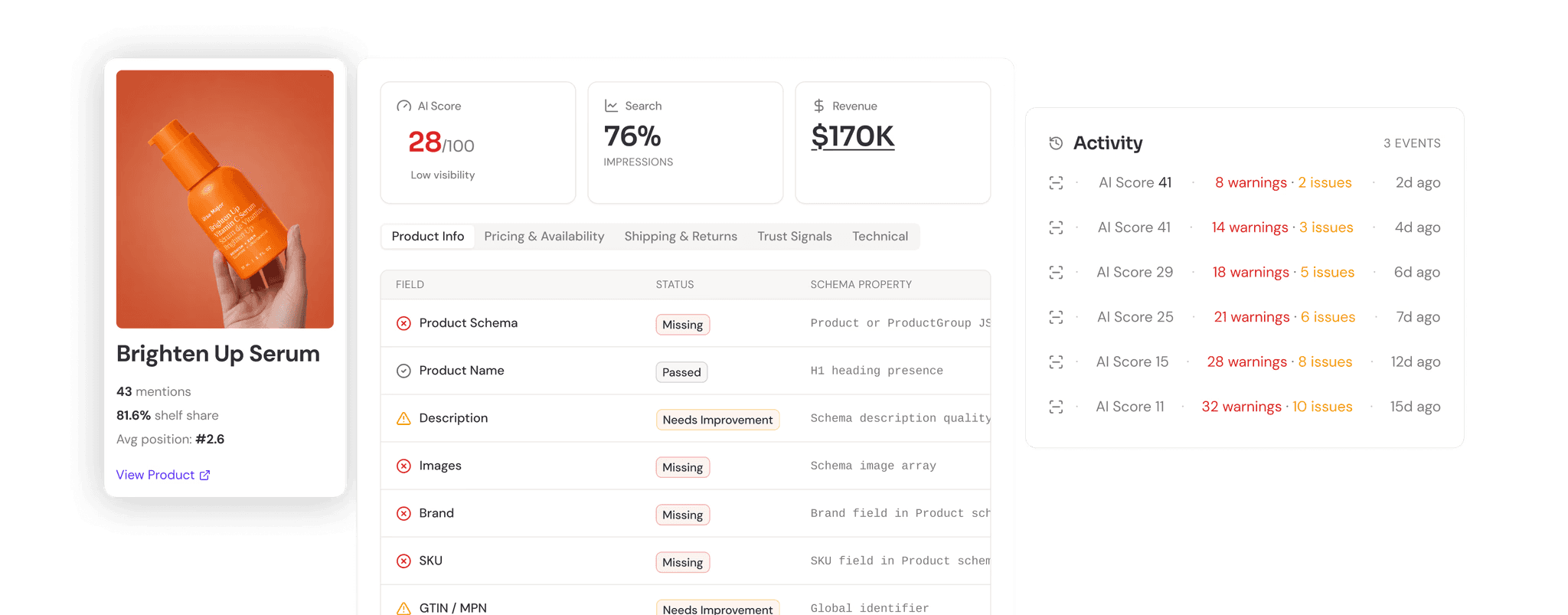
An AI shopping agent needs six fields to confidently recommend a SKU: a product name that matches the page H1, GTIN, current price, real-time availability, aggregated reviews, and a genuine FAQ section built from real customer questions. Every one of these fields must satisfy a parity guarantee: the machine-readable version of a page has to be provably fact-identical to the human-facing site, since Google always sees the real site and conflicting data causes AI systems to discount the markup.
Product name matching the on-page H1 exactly, with no truncation or keyword stuffing.
GTIN present and valid for every variant, not just the parent SKU.
Price and availability current at the moment of crawl or query.
Aggregated reviews surfaced on the PDP, not buried in a separate tab.
A genuine FAQ section sourced from real customer questions, not generic placeholders.
Catalog Enrichment is the pillar that operationalizes closing these field gaps at scale across a full catalog, so the fix ships to every SKU rather than a handful of hand-edited product pages.
Schema.org JSON-LD: The Baseline Infrastructure
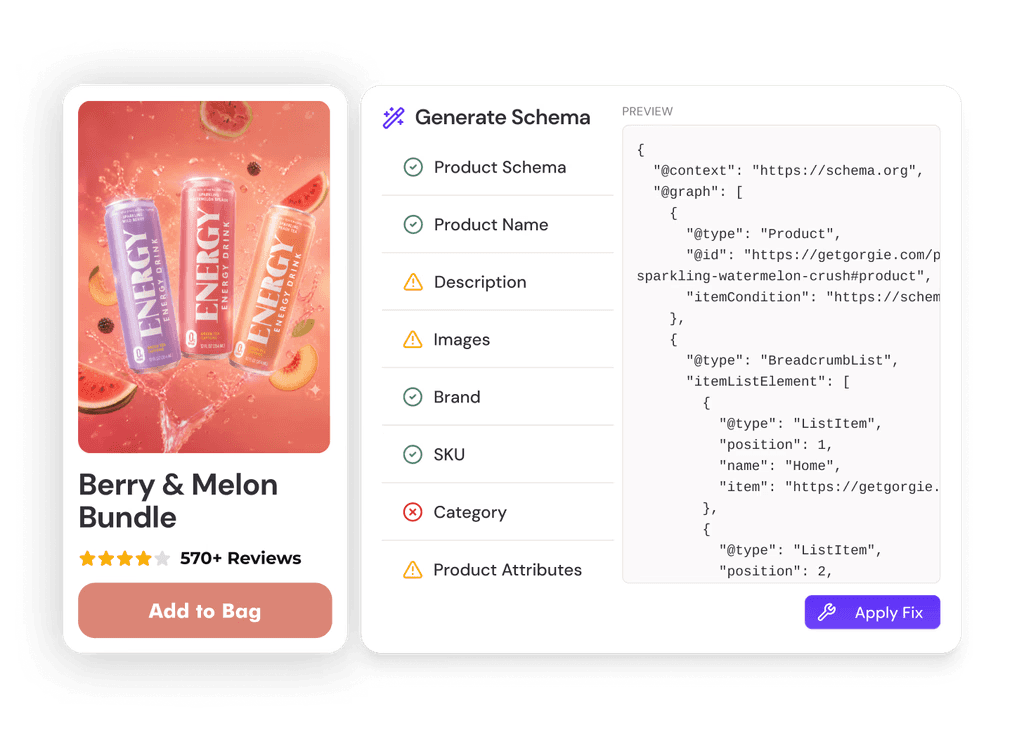
JSON-LD is the primary infrastructure for machine understanding, and AI assistants can pull details straight from structured data even when that detail is not visible in the on-page text. Product, Offer, and Review schema types carry the attributes an agent needs: identifiers, pricing, condition, and social proof, all in one machine-legible block.
On-site markup must stay synced with Google Merchant Center feed attributes, since discrepancies between the two can disqualify products from AI-powered checkout experiences. Catalog Enrichment is the mechanism that keeps schema and feed attributes in sync without manual PIM rework, so a price change or stock update propagates everywhere an agent might read it.
How UCP, NLWeb, and Agent Endpoints Raise the Bar
Open protocols are turning storefronts into AI-queryable endpoints, which raises the bar well beyond basic schema. Google's Universal Commerce Protocol (UCP) is an open-source standard that acts as a translator between AI shopping agents and merchant storefront backends, while Microsoft's NLWeb framework transforms websites into AI-queryable endpoints by relying heavily on Schema.org structured data.
Surface | Primary data requirement | How Catalog Enrichment maps to it |
|---|---|---|
Google Universal Commerce Protocol (UCP) | Structured backend translation layer for agent queries | Single source of truth pushed to the protocol endpoint |
Microsoft NLWeb | Schema.org coverage across every page | JSON-LD audited and enriched at scale |
Shopify agent endpoints | Real-time price, inventory, variant data | Feed and schema kept in sync with store inventory |
Google Merchant Center | Feed attributes matching on-site schema exactly | Parity guarantee enforced between feed and PDP |
Each surface asks for the same underlying facts in a different shape. Catalog Enrichment maps one source of truth to all four so a catalog team ships one update instead of four separate ones.
Finding and Closing Entity Gaps
Catalog teams should audit the catalog with vector embeddings and schema audits to find where AI fails to understand products, then track fixes as they ship. This is a repeatable, measurable process, not a one-time cleanup.
Audit GTIN coverage across every SKU and variant, flagging missing or malformed identifiers.
Verify title and price consistency between on-site schema and the Merchant Center feed.
Aggregate reviews onto the PDP so ratings are visible to both shoppers and agents.
Build FAQ sections from real customer questions rather than generic copy.
Re-run the audit on a cadence to catch drift as inventory and pricing change.
AI Visibility is the tracking layer that surfaces these entity gaps, and Catalog Enrichment is the pillar that ships the fix to the surfaces agents actually read: on-site markup, the PIM, and merchant feeds.
Why Getting Recommended Is Only Half the Job
Commerce now has two moments: getting recommended by an AI agent, and converting that recommendation into a purchase. Enriched catalog data wins the first moment, but conversion depends on where the click lands next.
When an AI agent recommends a product, the resulting click should route to a tailored destination through Funnels, hosted live on the brand's own domain so citation authority and search equity accrue to the brand rather than to a vendor-hosted experience. Visibility-only vendors report the first moment and stop; funnel-only vendors optimize the click but concede discovery. Closing the conversion gap for winnable intent means owning both moments with one connected system.
Frequently asked questions
What is the difference between AI Visibility and Catalog Enrichment?
AI Visibility is the tracking layer that shows how AI discovers, describes and recommends a brand and each SKU across ChatGPT, Perplexity, Gemini and Google AI Overviews. Catalog Enrichment is the pillar that ships the fixes, closing schema, feed and content gaps so products become understandable, recommendable and transactable.
Do I need Schema.org markup if I already submit a Google Merchant Center feed?
Yes. On-site JSON-LD and merchant feed attributes serve different surfaces and must match exactly; discrepancies between the two can disqualify products from AI-powered checkout experiences, so both need to be synced under one source of truth.
What is prompt-level optimization for product catalogs?
It means structuring catalog data such as titles, attributes, and FAQs to directly answer the high-intent queries shoppers feed into their AI agents, rather than optimizing only for keyword-based search.
Will making my page machine-readable for AI agents count as cloaking?
No. A version of the page built for agents must stay provably fact-identical to the human-facing site, and Google always sees the real site; this is a parity guarantee, not a hidden alternate page.
How do I measure whether Catalog Enrichment is working?
Track recommendation share and AI citation lift for enriched SKUs against a baseline, and pair it with conversion data from the funnel each AI-referred click lands on, since visibility without conversion tracking only tells half the story.